
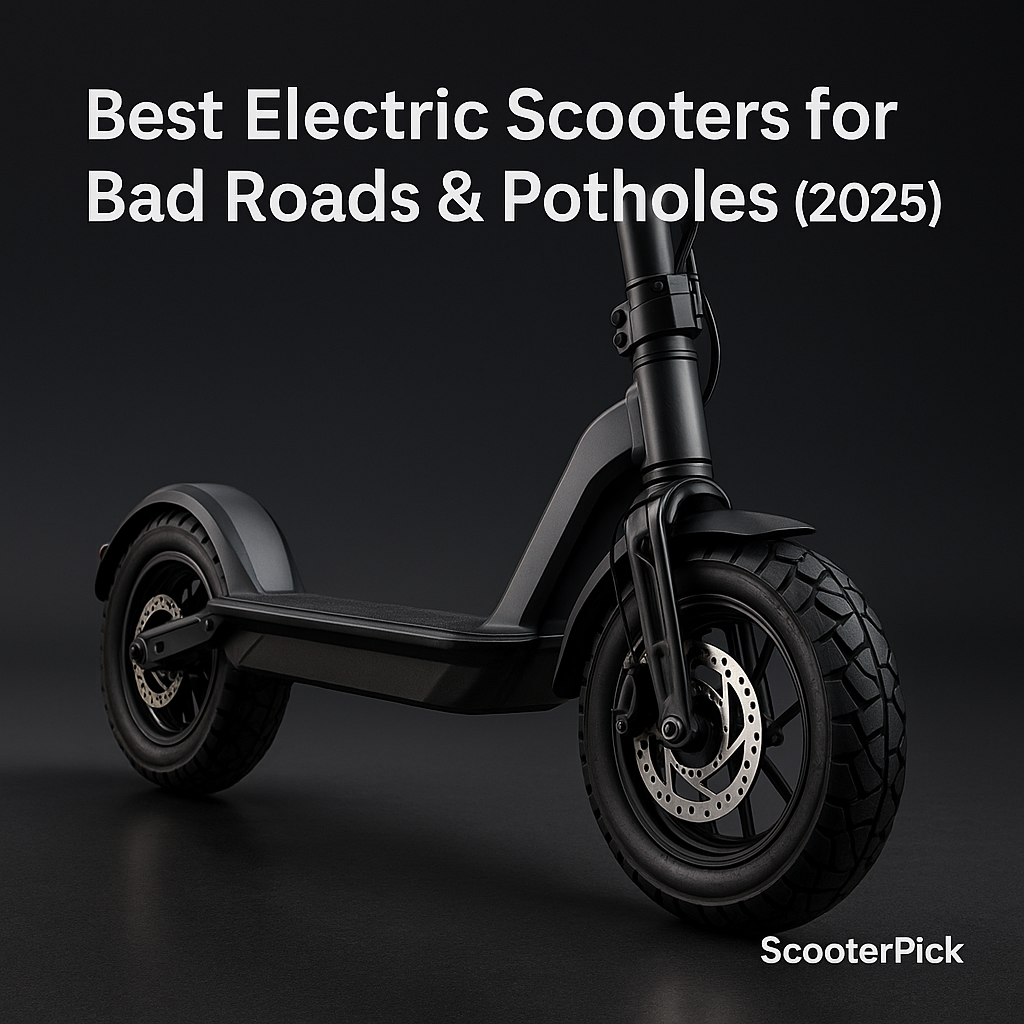
Bad roads are common. Cracked asphalt, brick seams, trench patches, and small potholes can shake you up and wear parts fast. Therefore, you need a scooter that stays stable, softens bumps, and stops with control. In this guide, you’ll find models already covered on ScooterPick that handle rough streets well. Moreover, you’ll learn what to look for, how we scored the picks, and which scooter fits your budget and route.
What Makes a Scooter Good on Bad Roads
Bigger tires help first. Ten- or eleven-inch tires roll over gaps more smoothly than small wheels. As a result, the tire does not “fall in” as easily, and you keep control. Furthermore, wider casings add grip and comfort.
Pneumatic, tubeless tires add comfort. Air inside the tire absorbs small hits. In addition, tubeless setups work with sealant, which can limit flats and pinch cuts. Consequently, you ride farther with fewer roadside fixes.
Real suspension matters. Front and rear suspension let the wheels move instead of your body. However, soft springs without control can bounce. Therefore, look for designs with rebound control so the scooter does not pogo after a bump. Additionally, balanced front and rear rates keep the deck level.
A tight stem keeps you steady. Rough streets expose weak latches. Thus, a solid clamp and a stiff column reduce wobble during braking and quick turns. Likewise, a firm folding joint helps the scooter track straight.
Brakes you can modulate are safer. Hydraulic discs give smooth power and light lever feel. Meanwhile, regen braking can settle the scooter near the end of a stop. Plus, larger rotors resist fade on long hills.
Deck, clearance, and fenders play a role. A longer deck helps your stance. In addition, fair ground clearance avoids deck strikes, and full fenders keep grit off parts. Consequently, parts last longer between services.
Smooth power helps on rough patches. A controller that ramps power in gently keeps the tire from slipping on ripples and seams. Moreover, steady throttle mapping reduces rider fatigue.
IP ratings help with splash, not floods. In short, treat rain with care. Nevertheless, a commuter-grade rating adds peace of mind. Finally, dry the scooter after wet rides.
Red flags. Tiny 8–8.5″ solid wheels, no suspension, narrow decks, weak stem locks, and small drum brakes make bad roads feel worse. Likewise, loose clamps and cheap bearings fail early.
How We Selected & Scored
We looked only at models already listed on ScooterPick. Then, we filtered for rough-road traits: big pneumatic tires, useful suspension, strong brakes, and solid frames. Next, we rated each scooter on a 10-point scale:
- Ride comfort on rough surfaces
- Pothole resilience (tires, rims, clearance)
- Stability & control (geometry, stem)
- Brake confidence
- Durability & build quality
- Weather practicality
- Maintenance & parts access
- Range on mixed terrain
- Value for money
- Owner satisfaction (broad market signals; no links)
Assumptions: city speeds, mixed rider weights, cracked pavement, brick, and shallow potholes. Above all, ride at safe speeds and slow down for unknown surfaces. Additionally, recheck tire pressure before long rides.
Top Picks for Broken Pavement & Potholes
Below are the standouts for rough streets. Importantly, each one balances control, comfort, and daily use.
Premium Picks
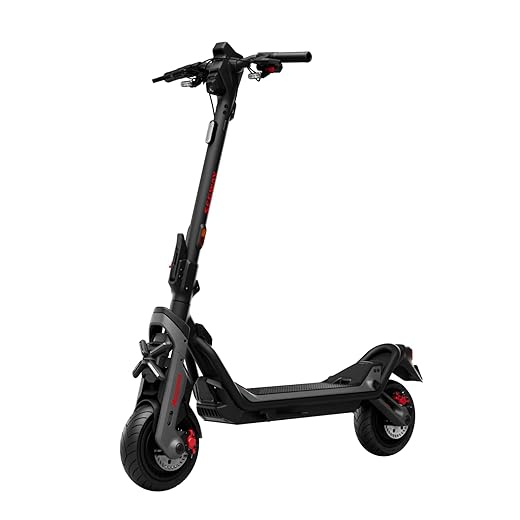
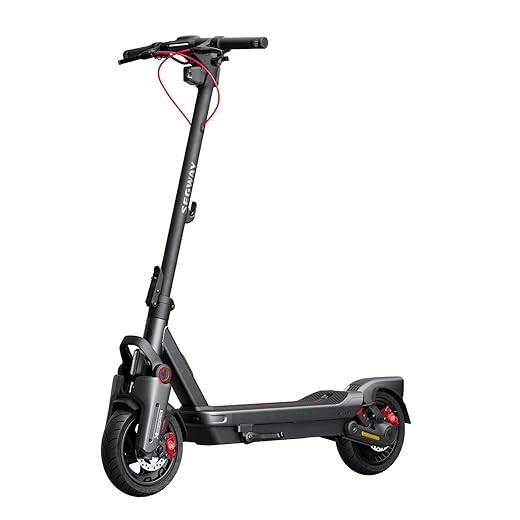
Segway Ninebot GT3
The GT3 is built to stay calm when the road gets ugly. It uses big pneumatic tubeless tires, real suspension at both ends, and strong hydraulic brakes. Consequently, the deck stays level, the stem feels solid, and the scooter tracks straight over sharp edges. Moreover, the chassis keeps its line when you are braking on bumps.
Why it works on bad roads
- 11″-class tubeless tires add grip and cushion
- Dual suspension keeps wheels in contact with the ground
- Hydraulic discs stop hard yet stay smooth
- Stiff stem and deck reduce flex and wobble
- Useful clearance for humps and patched trenches
Key rough-road specs
Tires: ~11″ pneumatic tubeless • Suspension: front + rear, long-travel feel • Brakes: hydraulic discs + regen • Weight: heavy yet stable • Rider cap: high • Motors: high torque • Water: commuter-grade splash resistance
Scorecard (1–10)
Comfort 9 | Potholes 9 | Stability 9 | Brakes 9 | Durability 9 | Weather 7 | Maintenance 7 | Range 8 | Value 7 | Satisfaction 9
Pros
- Very stable on broken pavement
- Strong, easy-to-control brakes
- Tires and suspension soften sharp hits
- Firm cockpit with little play
Cons
- Heavy to lift
- Pricey for short hops
- Big size needs more storage space
Joyor S10-S-Z
The S10-S-Z blends big 10″ tires with dual suspension and a steady deck. As a result, cobbles, cuts, and seams feel less harsh. It suits riders who want comfort and control without going full “super scooter.” Additionally, it offers strong value for daily use.
Why it works on bad roads
- Dual suspension smooths repeated chatter
- 10″ pneumatic tires bridge cracks and shallow holes
- Solid disc brakes give steady stops
- Long deck helps a wide, stable stance
Key rough-road specs
Tires: 10″ pneumatic • Suspension: front + rear • Brakes: discs (+ regen on some trims) • Weight: mid-heavy, planted feel • Rider cap: robust • Motors: torquey dual setup • Water: commuter-oriented
Scorecard (1–10)
Comfort 8 | Potholes 8 | Stability 8 | Brakes 8 | Durability 8 | Weather 6 | Maintenance 7 | Range 8 | Value 8 | Satisfaction 8
Pros
- Cushioned ride on rough city blocks
- Confident handling at urban speeds
- Strong comfort-to-price ratio
Cons
- Heavier than simple commuters
- Needs basic tuning over time
- Not as refined as high-end builds
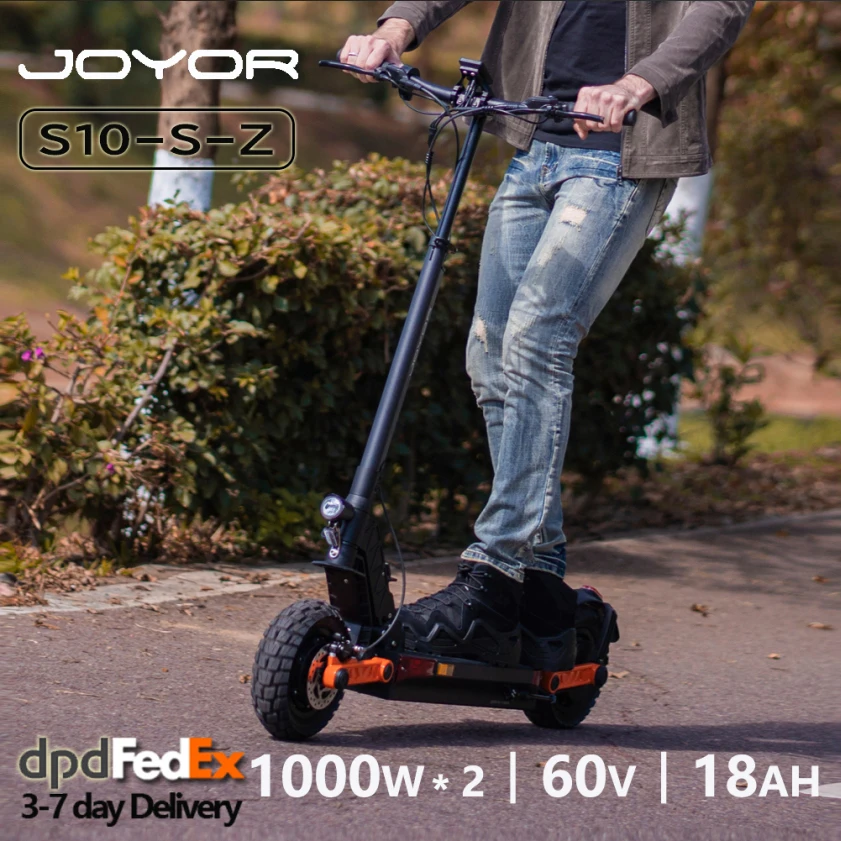
JOYOR S10-S-Z Folding Electric Scooter Dual 1000W Motor 10" Adults E-scooter with 60V 18Ah Battery
Mid-Range Picks
Segway Ninebot MAX G2
The MAX G2 is a calm, durable commuter. It pairs 10″ self-sealing tubeless tires with front and rear suspension plus a disc + electronic brake system. Therefore, it handles daily rough patches without drama. Moreover, the self-healing tires cut down on small flats.
Why it works on bad roads
- 10″ tubeless tires with sealant help prevent flats
- Front and rear suspension take the edge off cracks
- Brakes feel predictable and easy to modulate
- Strong folding parts keep steering precise
Key rough-road specs
Tires: 10″ tubeless pneumatic (self-healing) • Suspension: front + rear • Brakes: front disc + electronic rear • Weight: moderate-plus • Rider cap: commuter-class • Motor: torquey single • Water: commuter-grade splash resistance
Scorecard (1–10)
Comfort 8 | Potholes 7 | Stability 8 | Brakes 8 | Durability 8 | Weather 7 | Maintenance 8 | Range 8 | Value 9 | Satisfaction 9
Pros
- Great all-round pick for mixed streets
- Tires seal many small punctures
- Calm, low-stress ride
Cons
- Not a long-travel rig
- Heavier than ultra-light options
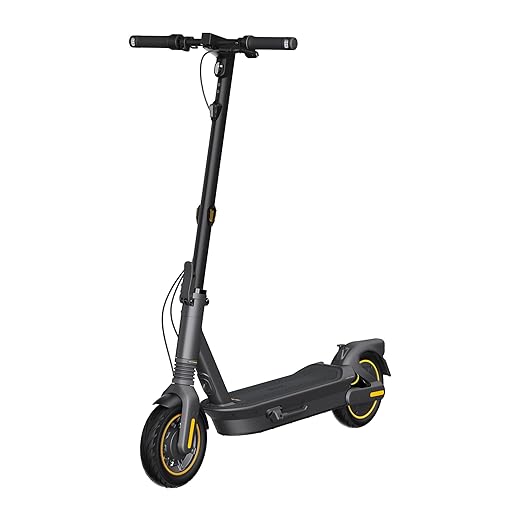
Segway Ninebot MAX G3
The MAX G3 keeps the same winning idea as the G2 and adds small ride tweaks. As a result, it feels smooth, steady, and friendly for daily use over cracked pavement. Additionally, the chassis remains quiet over time.
Why it works on bad roads
- ~10″ tubeless tires give a soft footprint
- Updated tuning helps over chatter and seams
- Disc + electronic braking inspires trust
- Solid frame feel for daily bumps
Key rough-road specs
Tires: ~10″ tubeless pneumatic • Suspension: tuned front + rear • Brakes: disc + electronic assist • Weight: moderate-plus • Rider cap: commuter-class • Motor: efficient single • Water: commuter-grade splash
Scorecard (1–10)
Comfort 8 | Potholes 7 | Stability 8 | Brakes 8 | Durability 8 | Weather 7 | Maintenance 8 | Range 8 | Value 8 | Satisfaction 8
Pros
- Smooth control on rougher blocks
- Easy to live with day to day
- Balanced fit and stance
Cons
- Still commuter-level travel
- Not ideal if you carry it up many stairs
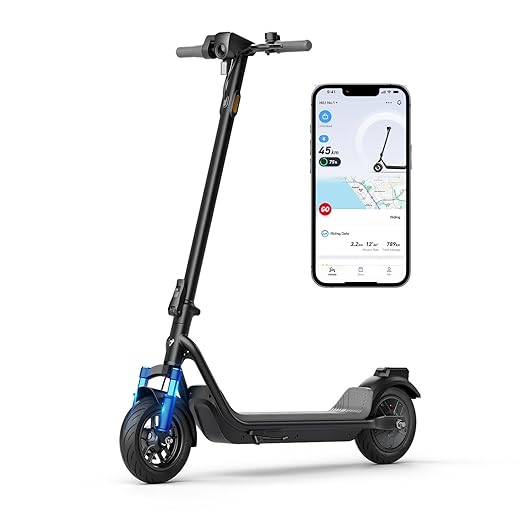
NIU KQi3 Max
The KQi3 Max has no suspension; yet, it still works for moderate rough roads thanks to big pneumatic tires, a strong frame, and a long deck. With the right PSI, the ride feels calmer than you might expect. Even so, you should slow down for sharp hits.
Why it works on bad roads
- Large air tires soak up small, sharp edges
- Rigid cockpit keeps steering clear and direct
- Long deck reduces fatigue over ripples
- Smooth throttle helps on uneven starts
Key rough-road specs
Tires: 9.5–10″ pneumatic • Suspension: none (relies on tire give) • Brakes: discs + regen • Weight: midweight • Rider cap: commuter-class • Motor: torquey single • Water: urban splash protection
Scorecard (1–10)
Comfort 7 | Potholes 6 | Stability 8 | Brakes 8 | Durability 8 | Weather 6 | Maintenance 8 | Range 7 | Value 9 | Satisfaction 8
Pros
- Simple and sturdy
- Good value with low upkeep
- Tires and stance work well on mixed streets
Cons
- No suspension: slow for sharp hits
- Not ideal for frequent deep potholes
Comparison Table — Rough-Road Essentials
| Model | Tire Size/Type | Suspension | Brakes | IP Rating | Approx. Weight | Rider Capacity | Rough-Road Comfort | Notes |
|---|---|---|---|---|---|---|---|---|
| Segway Ninebot GT3 | ~11″ pneumatic tubeless | Front & rear | Hydraulic discs + regen | Commuter-grade | Heavy | High | 9 | Premium control and stability |
| Joyor S10-S-Z | 10″ pneumatic | Front & rear | Disc (+ regen) | Commuter-oriented | Mid-heavy | Robust | 8 | Strong comfort/value mix |
| Segway Ninebot MAX G2 | 10″ tubeless pneumatic (self-healing) | Front & rear | Front disc + electronic | Commuter-grade | Moderate-plus | Commuter | 8 | Calm ride on rough routes |
| Segway Ninebot MAX G3 | ~10″ tubeless pneumatic | Front & rear (tuned) | Disc + electronic | Commuter-grade | Moderate-plus | Commuter | 8 | Smooth, predictable control |
| NIU KQi3 Max | 9.5–10″ pneumatic | None | Discs + regen | Urban splash | Midweight | Commuter | 7 | Works if PSI is set right |
Note: Scores blend tire give, suspension (if any), deck stance, and cockpit stiffness. Additionally, they assume city speeds and typical rider loads.
Buying Guide for Rough Roads & Potholes
Tires & Rims
Start with 10–11″ pneumatic tires. They roll over edges better and grip broken surfaces. In addition, tubeless setups with sealant can stop many small leaks. Set PSI by rider weight: too high feels harsh; too low risks rim hits. After hard bumps, check sidewalls and rims. Furthermore, replace tires when tread gets thin.
Suspension
Suspension should move, then settle. Therefore, aim for designs with decent travel and rebound control. If the front and rear feel balanced, the scooter stays level on brick or patchwork roads. If settings are adjustable, change one step at a time and test. Moreover, log your changes so you can revert.
Brakes
Hydraulic discs give smooth power and less hand strain. Moreover, bigger rotors handle heat better. Mechanical discs can work if kept clean and aligned. Regen braking can steady the chassis as you slow. Consequently, stops feel calmer on rough ground.
Fit & Stability
A longer deck and a firm stem make the scooter feel planted. In addition, a wider stance reduces twitch over seams. Keep the stem clamp at spec torque; even a small amount of play grows fast on rough roads. Likewise, check wheel nuts and rotor bolts often.
Durability & Service
Rough roads shake parts loose. So, build a quick routine: check fasteners, listen for rattles, spin wheels, and inspect tires. Choose models with common pads, tires, and bearings. Also, full fenders help parts last longer. Finally, keep a small tool kit at home.
Weather
IP ratings cover splash and spray. However, they do not cover deep water. After a wet ride, wipe down the scooter and let it dry before charging. Additionally, store it indoors to protect seals and bearings.
Budget
As price rises, you often get better suspension, stiffer frames, hydraulic brakes, and larger tires. Even so, mid-range models with good tires and fair suspension still ride well on rough city blocks. On a strict budget, big pneumatic tires and correct PSI are the key wins. Meanwhile, keep speeds modest to protect rims.
Safety on Damaged Roads
- Look ahead and pick lines. For example, cross cracks at an angle and avoid narrow gaps that can trap a wheel.
- Set smart speeds. Slow before the rough, then add power once you see grip.
- Unweight for sharp edges. A small knee bend right before a hit reduces shock. Moreover, keep your arms loose.
- Brake on the best surface. Start strong on smooth parts, then ease a bit over the worst spots.
- Prevent pinch flats. Check PSI each week and avoid square curb hits. Additionally, avoid metal edges and drains.
- Be seen. Use a bright light and reflective bits; rough roads need extra focus.
- Wear real gear. A certified helmet is a must; gloves and pads add protection. Finally, replace worn pads early.
Maintenance for Rough-Road Life
Weekly 5-minute checklist
- Set tire pressures to brand-recommended PSI for your weight
- Scan sidewalls and rims for cuts or dings
- Check stem clamp torque and latch play
- Spin wheels to confirm no rotor rub or big hops
- Squeeze levers to verify firm, smooth brake feel
Tire care
Top up PSI before long rides. Replace worn tread or cut sidewalls. If tubeless, refresh sealant as advised. Additionally, re-seat beads if you see slow leaks.
Suspension care
Wipe exposed parts after rain. If rebound feels bouncy or top-out knocks appear, inspect sooner and service as needed. Moreover, keep pivots clean.
After rain
Dry the scooter and let moisture clear. Then, charge. Finally, store it in a cool, dry place.
FAQs
Are solid tires okay on potholes?
They resist flats, yet they ride hard and pass big hits to the frame. Therefore, pneumatic—ideally tubeless—tires are safer and more comfy on rough streets. Nevertheless, solid tires can work for short, slow hops.
What PSI should I use?
Follow the brand chart for your weight and tire size. Then, adjust in 2–3 PSI steps. Too low risks rim hits; too high feels harsh and skittish. Additionally, recheck PSI when temps swing.
Do I need hydraulic brakes?
Not always, but they help a lot on broken pavement. In short, you get smooth control with less hand effort. Moreover, maintenance stays simple once set up.
Is IP55 enough for rain?
For splash, yes—if you avoid deep water and dry the scooter after. However, no consumer scooter is “waterproof.” Consequently, ride with care in storms.
How much travel is enough?
Balanced and well-controlled travel beats big numbers. If the scooter stays calm over square-edge hits, it works. Furthermore, proper rebound keeps the deck from bouncing.
What wears out first on bad roads?
Loose clamps, rattly fenders, and cheap bearings go early. So, keep bolts tight and parts clean. Additionally, replace brake pads before they glaze.
Do heavy scooters ride better?
Extra mass calms small chatter. However, geometry and damping still matter a lot. Meanwhile, remember that heavy scooters are harder to carry.
Final Verdict
If your route is truly rough, the Segway Ninebot GT3 sits at the top. Its big tubeless tires, strong suspension, and hydraulic brakes keep you in control when the road falls apart. For riders who want comfort and value, the Joyor S10-S-Z delivers a cushy, planted ride without the extreme price. Moreover, it remains stable at realistic city speeds.
For daily city use with regular rough patches, the Segway MAX G2 and MAX G3 remain smart picks. Their 10″ tubeless tires, commuter-tuned suspension, and steady frames make bad blocks feel manageable. Finally, if you prefer simple upkeep, the NIU KQi3 Max shows how big pneumatic tires and a solid frame can still work on moderate rough roads—as long as you keep PSI dialed and speeds in check.
Choose the build that fits your route and storage. Then, keep it maintained. As a result, both comfort and safety go up every week you ride. Additionally, your hands, knees, and nerves will thank you.