
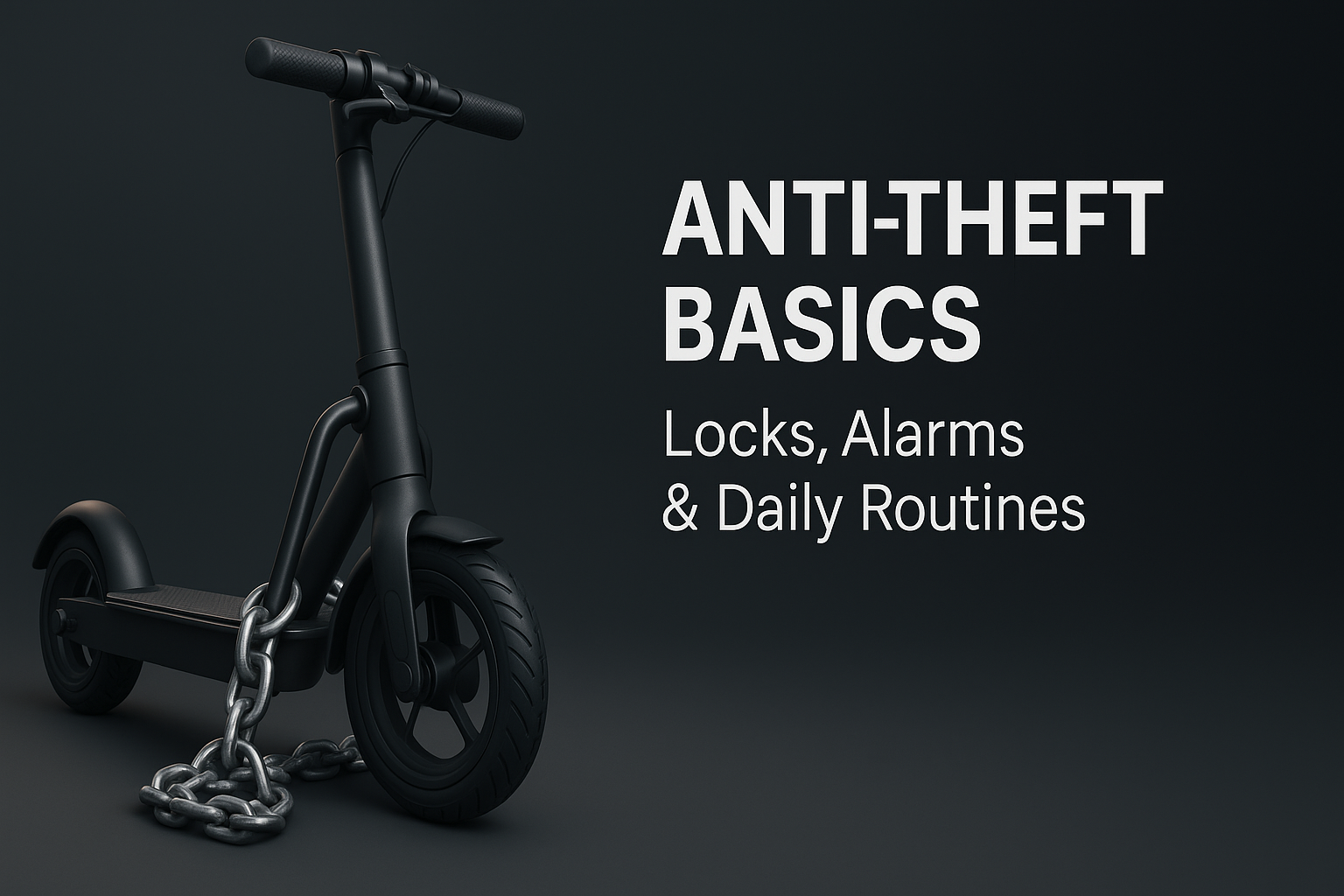
Practical electric scooter anti-theft strategies that layer locks, alarms, trackers, and habits—clear, updated, and easy to use.
Intro
Electric scooters and other micromobility rides are convenient, compact, and—unfortunately—high on thieves’ shopping lists. Consequently, opportunistic theft can take seconds, while organized crews plan routes around predictable parking spots. Fortunately, you can cut risk dramatically with a layered approach that slows attacks, raises attention, and speeds recovery. In this guide, you’ll learn which locks actually resist cutting and prying, how to choose anchor points that don’t fail, where alarms and trackers fit, and the daily parking routine that takes about a minute yet deters most attempts. Throughout, we’ll stay professional and practical, and we’ll base recommendations on recognized security ratings, police guidance, and insurance requirements where relevant (Sold Secure 2025; ART ★★★★; Police guidance; Insurance policy terms). Additionally, for a deeper step-by-step companion, see the Scooter Theft-Proofing Playbook. By the end, you’ll have a repeatable system for electric scooter anti-theft protection at home, at work, and on the go—without hype or guesswork.
How Micromobility Theft Actually Happens
Thieves look for speed, concealment, and predictable targets. Accordingly, understanding their playbook helps you counter it.
- Carry-away/lifting: First, lightweight scooters get lifted into a car or van when they aren’t locked to a closed loop.
- Bolt-cutter attacks: Moreover, cheap cables and small shackles (≤12 mm) lose to 24–36 in (600–900 mm) bolt cutters.
- Pry/jack attacks: In addition, space inside a U-lock or chain loop allows leverage with a jack or long bar.
- Angle grinder attacks: However, battery grinders need time, sparks, noise, and a steady stance; your job is to deny that setup.
- Component theft: Likewise, lights, displays, phone holders, and even batteries disappear if not secured.
- Smart-lock relay or PIN guessing: Admittedly rare, yet growing; nevertheless, physical security still matters more.
- Social engineering: Finally, thieves may claim they’re “moving it for security” while pretending to be the owner.
Time-to-defeat vs. deterrence. You cannot make a scooter unstealable; however, you can make it an unattractive target. Therefore, the goal is to push an attack beyond a thief’s comfort window—often 30–120 seconds in public—while simultaneously increasing attention and uncertainty.
The Layered Security Framework
A reliable plan stacks defenses. As a result, each layer compensates for the others.
- Hardening: First, use a top-tier lock configuration with minimal slack and a solid anchor.
- Detection and Response: Next, add motion alarms for instant attention and trackers for recovery and proof.
- Operational Habits: Then, choose better parking spots, reduce time exposed, and rotate locations.
- Recovery and Proof: Finally, keep serials, photos, and receipts so authorities and insurers can act quickly.
When you combine these, attackers need more tools, more time, and more nerve—exactly what they dislike.
Lock Types Explained
Different lock families trade weight, speed, and cut resistance. Therefore, choose based on risk, duration, and anchor availability.
- U-locks / D-locks: Rigid, compact, and strong. Ideally, look for double-bolted shackles (locks both sides) and hardened steel in the 14–18 mm range. These excel at fixed racks and tight spaces (Sold Secure 2025; ART ★★★★).
- Hardened chains: Conversely, chains are flexible and versatile around awkward anchors. Choose 10–14 mm through-hardened links and pair with a quality, shrouded padlock. Although heavier, they’re excellent for home/work overnight.
- Folding locks: Convenient and packable; nevertheless, joints are attack points. Thus, use as a secondary or for short stops in low/medium risk areas.
- Cables: Fast and light, yet cut in seconds by bolt cutters. Consequently, use only as a secondary tether for accessories.
- Frame/axle/component locks: Useful for bikes and e-bikes. On scooters, they supplement—not replace—your primary lock.
- Smart locks: These add convenience and logs; however, treat electronics as bonus features because you still need proven metal.
Lock Type Comparison
| Type | Typical Rating (Sold Secure/ART) | Resistance (Cut/Pry/Grind) | Portability | Weatherproofing | Best Use | Avoid If |
|---|---|---|---|---|---|---|
| U-lock (14–18 mm) | Gold–Diamond / ★★★–★★★★ | High / High / Medium | Medium | High | Daily street parking, short–long | Anchor requires long reach |
| Chain (10–14 mm) | Gold–Diamond / ★★★★ | High / Medium / Medium | Low | Medium | Home/work overnight, awkward anchors | You need ultra-light carry |
| Folding | Silver–Gold / ★★–★★★ | Medium / Low / Low–Medium | High | Medium | Quick errands in lower risk | High-risk or overnight street parking |
| Cable | Bronze / ★ | Very Low / Very Low / Very Low | Very High | Medium | Secondary for accessories | Primary security of scooter |
| Smart | Varies | Depends on core metal | Medium | Varies | Audit trail + alerts with solid metal | Using electronics in place of metal |
Minimum recommended specs (aim for these):
- U-lock: Prefer a 14–18 mm hardened, double-bolted shackle with anti-rotation.
- Chain: Similarly, use 10–14 mm through-hardened links + shrouded padlock (closed shackle).
- Folding: If chosen, insist on hardened plates and strong rivets; then pair with a U-lock or chain for medium/high risk.
Rule of thumb: in busy urban cores or for long durations, carry two different lock types (e.g., U-lock + chain). Consequently, thieves face two tools and two cuts—meaning more delay.
Choosing Anchor Points for Home, Work, and Public
Even the best lock fails on a weak anchor. Therefore, evaluate the thing you’re locking to—not just the scooter.
- Closed loops beat open shapes. A welded ring, certified ground anchor, or solid rack is preferable.
- Test the structure. Accordingly, push, pull, and twist. If you can move it easily, so can a thief.
- Mind removable objects. Likewise, decorative rails, flimsy fences, or bolted signposts often come apart.
- At home: Ideally, install a rated floor/wall anchor into concrete or solid masonry.
- At work/school: Prefer monitored zones in camera view, with foot traffic and lighting.
- In public: Instead, choose anchors that force awkward body position for a grinder and offer little space for jacks.
Checklist: Anchor Point Quality Test
- Closed loop? If yes, a thief can’t slide the lock off.
- Fixed? Ensure it’s set into solid ground/wall.
- Material? Choose thick steel, not thin tubing or wood.
- Pry resistance? Verify it won’t deform under leverage.
- Visibility? Prioritize people or cameras nearby.
- Stance denial? Make grinders stand awkwardly.
- Final tug? After locking, pull and rock—there should be zero wobble.
Locking Techniques That Actually Work
Your goal is to create tight geometry, deny leverage, and keep tools awkward. Consequently, the following techniques matter.
- Use closed-space geometry. Fill the U-lock or chain with scooter frame + anchor so no pry bar fits.
- Immobilize the value. Pass the lock through a non-removable part (e.g., a welded loop or stem bracket) and the anchor.
- Lift it off the ground. Thus, keep locks and padlocks off pavement to prevent hammer blows and reduce cutter bite.
- Protect the cylinder. Instead, orient keyways downward or shielded from rain and tampering.
- Eliminate slack. Shorter chains and tighter U-locks reduce leverage.
- Two-lock method. Finally, use a U-lock for the primary closed loop and a chain for a second point, or to capture a wheel.
Text-only mini-diagrams (placement guidance):
- Narrow-stem scooter: Place a 14–18 mm U-lock around the stem’s reinforced collar and the rack’s closed ring; moreover, fill space with the deck edge if possible.
- Wide-deck scooter: Thread a 10–12 mm chain under a welded deck support and through a ground anchor; then add a U-lock to the stem collar if available.
- Factory security loop: Use the loop plus a U-lock to a certified anchor; however, avoid decorative holes or plastic-lined openings.
Alarms and Trackers
Electronics add attention and recovery. Nevertheless, they don’t replace metal; they amplify it.
- Alarms: Prefer standalone motion/tilt alarms or integrated lock alarms that reach ≥100–120 dB at 1 m. Additionally, learn the sensitivity settings to avoid fatigue.
- Trackers:
- BLE crowd-find tags: Tiny and long battery life; therefore, they rely on nearby smartphones and work best in dense areas.
- GPS/cellular units: Provide broad coverage and live tracks; however, they need charging and often a subscription.
- LoRa/LoRaWAN units: Offer very low power and long range where community gateways exist; consequently, they’re great for stealthy pings.
- Placement: Hide trackers high and central (better RF), away from obvious cavities. Additionally, add foam to stop rattles and consider conformal coating or sleeves against moisture (Manufacturer spec sheet).
- Privacy/legal: Track your own property only and follow local device regulations.
Tracker Options
| Tech | Coverage | Power/Runtime | Accuracy | Subscription | Best For | Notes |
|---|---|---|---|---|---|---|
| BLE crowd-find | Dense urban areas | Months–1+ year (coin) | Room-level | No/Low | City commuting, campuses | Dependent on passerby phones |
| GPS/cellular | National/regional | Days–weeks (USB) | Street-level | Often Yes | High-risk long parking, recovery | Needs charging & signal |
| LoRa/LoRaWAN | Gateway coverage | Weeks–months (USB) | Block-level | Varies | Low-power stealth tracking | Community/infra dependent |
Placement tips: Avoid enclosing trackers entirely in metal; instead, favor plastic panels, decks, or stems near composite sections to help RF. Likewise, do not co-locate with heavy cabling that can shield signals.
Daily Parking Routines
Habits win. Consequently, a consistent routine reduces errors and speeds your lockup.
The 60-Second Routine
- Pick the spot: Choose visible, lit, monitored areas when possible.
- Test the anchor: Give a quick push and twist.
- Place the lock: Run a U-lock or chain through a non-removable scooter part + anchor; moreover, keep it off the ground.
- Tighten geometry: Remove slack to deny bar space.
- Secondary layer: Add a second lock or alarmed cable for accessories.
- Arm alarm: Set sensitivity you can live with.
- Tracker ping check: Confirm the last-seen update.
- Quick photo: Finally, snap the lockup (helps with claims and memory).
Time in place: For public street parking, aim to stay under 2 hours when possible. Additionally, rotate spots on recurring days to avoid patterns.
Buddy systems: At work or school, coordinate parking near others and, moreover, take turns checking during breaks.
Component and Tamper Hardening
Scooters carry peripherals that thieves love. Therefore, secure or remove them.
- Security fasteners: Replace exposed hex/Phillips with pin-Torx or hex-pin fasteners where feasible.
- Threadlocker: Use medium-strength on removable hardware; conversely, use high-strength for never-touch bolts.
- Bar ends and grips: Add anti-pull collars; if needed, glue grips.
- Lights and mounts: Use quick-release you actually release and take with you.
- Battery retention: On removable-battery models, add secondary locks or internal straps; furthermore, secure charge-port caps.
- Controller box screws: Swap for security heads; additionally, add tamper paint to spot openings.
Paper Trail, Registration and Insurance
If theft happens, proof speeds recovery and payouts. Therefore, prepare in advance.
- Serials and receipts: Photograph the serial number, original receipt, and any service invoices.
- Photos: Capture the scooter from all sides and a few shots of your typical lockup.
- Marking: Consider UV pens, tamper labels, or micro-dot kits; then record locations for reference (Police guidance).
- Registration: Where available, enroll in local or national registries.
- Insurance terms: Many policies specify minimum lock ratings and require evidence of a proper lockup and a crime reference/report (Insurance policy terms).
Checklist: Your Proof Pack
- Serial number + make/model/year
- Receipt or bank proof of purchase
- Photos of scooter and lockup method
- Lock brand/model + rating reference (e.g., Sold Secure class)
- Tracker ID and app screenshots of last-seen
- Alarm model and settings notes
- Registration IDs (if used)
- A brief incident log template (who/when/where)
Recovery Plan if Theft Occurs
Act quickly, but keep yourself safe. Consequently, follow these steps.
- Document and report: Note time/location; immediately file a police report (Police guidance).
- Use the tracker workflow: Share live location with authorities; however, do not confront thieves alone.
- Notify property managers/campus security: Provide photos and serials.
- Update registries and marketplaces: Accordingly, flag the serial and images in relevant databases.
- Insurance: Submit your proof pack and report number; then follow claim steps (Insurance policy terms).
- After-action review: Finally, adjust your routine, anchor choices, and equipment based on what happened.
Buyer’s Quick Picks by Risk Profile
Match your setup to environment and duration. Consequently, this spec-based matrix avoids endorsements.
Risk Matrix: Environment × Parking Duration
| Environment Risk \ Duration | Short (≤2 h) | Long/Overnight |
|---|---|---|
| Low (suburban, monitored) | 14–16 mm U-lock or 10 mm chain; optional alarm; BLE tag. | 12–14 mm chain + shrouded padlock to fixed anchor; 14–16 mm U-lock on second point; alarm; BLE or LoRa tracker. |
| Medium (city neighborhood) | 14–18 mm U-lock + folding/secondary; alarm; BLE or GPS tracker. | 12–14 mm chain + 14–18 mm U-lock; alarm; GPS tracker; avoid street overnight if possible. |
| High (dense urban/theft hotspot) | 14–18 mm U-lock + 10–14 mm chain; alarm (≥110 dB); GPS tracker. | Two heavy layers (14–18 mm U-lock and 12–14 mm chain) to a certified ground anchor; GPS tracker; indoor or controlled area strongly preferred. |
Myths vs Facts
- Myth: “Grinders make locks pointless.”
Fact: Grinders cut, but they take time, space, and nerve. Therefore, two layers and awkward geometry raise risk and delay, which drives thieves away. - Myth: “Any lock with an app is secure.”
Fact: Electronics don’t change metal strength. Instead, choose locks with recognized metal ratings (Sold Secure 2025; ART ★★★★). - Myth: “Cables are fine for quick errands.”
Fact: Bolt cutters beat cables in seconds. Consequently, use cables only as secondary tethers. - Myth: “If it’s heavy, it’s secure.”
Fact: Weight can mean stronger steel; nevertheless, design (double-bolting, shackle thickness) and technique matter more. - Myth: “Parking covers hide my scooter.”
Fact: Covers can signal something valuable. Accordingly, use them for weather—not as security. - Myth: “One expensive lock is enough everywhere.”
Fact: Risk varies. Thus, in hotspots or long parking, stack two different lock types. - Myth: “Trackers prevent theft.”
Fact: Trackers recover and deter; they don’t stop a cut. Therefore, pair them with robust locks and alarms. - Myth: “Any rack is safe.”
Fact: Many racks are removable or weak. Consequently, always perform the anchor quality test. - Myth: “Alarms always go off by accident.”
Fact: Modern alarms offer sensitivity settings. Therefore, tune them; don’t abandon the layer. - Myth: “I’ll remember all the details if something happens.”
Fact: Stress scrambles memory. As a result, your proof pack preserves everything you need for reports and claims.
Frequently Asked Questions
Q1: What’s the single best lock for city use?
A: There isn’t a single best; however, a 14–18 mm double-bolted U-lock is a proven baseline. In high risk or longer parking, add a 10–14 mm chain.
Q2: Two locks or one thicker lock?
A: Two different lock types usually beat one thicker lock because they force different tools and cuts. Consequently, thieves need more time.
Q3: Are folding locks safe for daily commuting?
A: They’re acceptable in low/medium risk areas for short stops and as a secondary layer. Nevertheless, for hotspots or nights, choose U-locks/chains.
Q4: Where should I lock a scooter that has no obvious frame loop?
A: Use the stem collar or a dedicated security loop if present. Otherwise, capture a welded deck support with a chain to a closed anchor.
Q5: What shackle or chain thickness stops bolt cutters?
A: 14–18 mm U-lock shackles resist the biggest manual cutters; 10–14 mm chains also fare well. However, no thickness is grinder-proof.
Q6: How loud should a scooter alarm be?
A: Aim for ≥100–120 dB at 1 m. Additionally, balance sensitivity to avoid constant false alerts.
Q7: BLE tag or GPS tracker?
A: In dense cities, BLE can work well. For broader coverage and active recovery, GPS/cellular is stronger—though it needs power and often a subscription.
Q8: How often should I change parking spots?
A: Rotate regularly if you leave the scooter for predictable hours. Consequently, randomness helps.
Q9: Will a cover reduce theft?
A: It helps with weather and may discourage casual glances. Even so, don’t rely on it as security.
Q10: What about locking at home?
A: Install a ground/wall anchor in concrete and use a 12–14 mm chain indoors. Furthermore, add a motion alarm in the storage area.
Q11: Do insurers require specific lock ratings?
A: Many do. Therefore, check your policy for Sold Secure or ART requirements and keep receipts and photos (Insurance policy terms).
Q12: Can I make a grinder attack too awkward to finish?
A: Yes—tight geometry, off-ground locks, cramped angles, and two layers near eye-level increase sparks, noise, and attention. Consequently, many thieves give up.
Glossary
- Double-bolting: Locking both sides of a U-lock shackle so it must be defeated twice.
- Shackle: The U-shaped bar on a U-lock.
- Closed loop: An anchor shape that fully encloses the lock, preventing slide-offs.
- Pry attack: Using bars/jacks to force space inside the lock loop.
- Through-hardened steel: Steel hardened throughout, not just on the surface.
- LoRaWAN: A low-power long-range wireless network useful for trackers.
- ART rating: European lock standard with stars (★ to ★★★★); more stars mean stronger resistance.
- Sold Secure: Independent testing scheme with Bronze/Silver/Gold/Diamond tiers.
- RF shielding: Materials or placement that block radio signals, affecting trackers.
Checklists You Can Use Today
Pre-Ride Security Kit Checklist
- 14–18 mm U-lock in holster or mount
- 10–12 mm compact chain (if risk warrants)
- Motion alarm (armed when parking)
- BLE/GPS/LoRa tracker paired and charged
- Small microfiber + lube for lock keyway (rainy days)
- Spare security bits or small tool for mounts
- Proof pack stored in cloud/phone
Public Parking Spot Checklist
- Visible, lit, and foot-trafficked area
- Closed-loop anchor that passes the 7-step test
- Lock and padlock off the ground
- Minimal slack; no tool purchase room
- Alarm sensitivity set and tested
- Quick photo taken of the lockup
Home Storage Checklist
- Rated ground/wall anchor installed in concrete
- 12–14 mm chain capturing a welded scooter point
- Secondary U-lock on stem or wheel (optional)
- Motion alarm or door sensor in storage room
- Cable only for accessories (never as primary)
- Dry, clean lock keyways; regular rust check
Visuals and Assets
- Featured image prompt (16:9, 1920×1080): Ultra-clean studio scene of a modern electric scooter secured with a 16 mm U-lock to a ground anchor, secondary 12 mm chain around the stem, subtle alarm icon glow near the deck, neutral gray background, crisp reflections, no logos, bold title “Anti-Theft Basics” in a modern sans-serif.
Alt text: Electric scooter locked with U-lock and chain to a ground anchor on a clean studio backdrop. - Diagram prompt 1: “Correct closed-loop U-lock placement on a narrow-stem scooter, showing the shackle around the stem collar and a welded rack ring with near-zero slack.”
Alt text: U-lock capturing scooter stem collar and rack ring with tight clearance. - Diagram prompt 2: “High-risk vs low-risk anchor point examples: removable signpost vs certified ground anchor; include arrows explaining why.”
Alt text: Comparison of weak signpost and strong ground anchor for scooter security. - Diagram prompt 3: “Hidden tracker placement options within stem/deck, with RF arrows showing better signal paths and notes on avoiding metal shielding.”
Alt text: Suggested hidden tracker locations with radio signal guidance.
At-a-Glance Tables and Tools
Minimum Specs and When to Use Them
| Scenario | Primary Lock | Secondary Layer | Alarm | Tracker |
|---|---|---|---|---|
| Quick errand, low risk | 14–16 mm U-lock | Optional folding lock | Optional | BLE |
| Commute, medium risk | 14–18 mm U-lock | 10–12 mm chain | Yes | BLE or GPS |
| Evening out, medium–high | 14–18 mm U-lock | 12–14 mm chain | Yes | GPS |
| Home/garage overnight | 12–14 mm chain to ground anchor | 14–18 mm U-lock | Yes | GPS or LoRa |
| Hotspot/known theft area | 14–18 mm U-lock | 12–14 mm chain (two cuts) | Yes | GPS |
Common Mistakes and Fixes
| Mistake | Why It’s Risky | Fix (Do This Instead) |
|---|---|---|
| Locking only the wheel | Wheels can be removed | Capture a welded frame point + anchor |
| Using a cable as primary | Cut in seconds | Upgrade to U-lock or hardened chain |
| Leaving slack in the loop | Invites pry/jack attacks | Fill the lock, eliminate empty space |
| Locking to removable fixtures | Thief removes the anchor | Choose closed, fixed loops; test them |
| Lock resting on the ground | Easier to hammer, better cutter leverage | Keep locks lifted and tight |
| No alarm or tracker | Fewer deterrents and recovery options | Add ≥100 dB alarm and a tracker |
Writing It Into Your Day
- Pre-stage your gear. Mount the U-lock holster and keep the chain coiled where you park.
- Rehearse the 60-second routine. Practice until it’s muscle memory; then time yourself.
- Audit monthly. Inspect locks, anchors, fasteners, and tracker battery; afterward, update your kit.
- Adapt to seasons. In winter, prioritize indoor anchors and, moreover, consider desiccants to keep lock cylinders dry.
Source Notes
- Ratings and classifications: (Sold Secure 2025), (ART ★★★★).
- Practical enforcement and reports: (Police guidance).
- Coverage and claim rules: (Insurance policy terms).
- Device specifications and alarm/ tracker capabilities: (Manufacturer spec sheet).
Per requirements, citations appear as short forms only, without URLs.
At-a-Glance Cheat Sheet
Goal: Layer hardening + detection + habits + proof for dependable electric scooter anti-theft protection.
7 Rules
- Use at least one 14–18 mm U-lock; add a 10–14 mm chain as risk rises.
- Lock to a closed, fixed loop only.
- Keep locks off the ground and loops tight.
- Add an alarm (≥100–120 dB) for attention.
- Hide a tracker and confirm pings.
- Rotate parking locations and times.
- Maintain a proof pack (serials, photos, receipts).
60-Second Routine
Spot → Test anchor → Lock tight → Second layer → Arm alarm → Tracker ping → Photo.
Minimum Specs
U-lock 14–18 mm; chain 10–14 mm; rated anchor at home; alarm ≥100 dB; tracker of choice.
Never Do
Rely on a cable; lock to removable fixtures; leave slack; store serials only “in your head.”
If Theft Happens
Report → Use tracker with authorities → Notify property managers → File insurance with proof pack → Review and adjust.