
Traveling with an electric scooter can save time, money, and stress—if you prepare well. In 2025, rules remain strict, and they do change. For a quick country-by-country look at local riding laws, see our 2025 e-scooter regulations & road-safety guide. And if you’re evaluating a travel-friendly commuter, the GOTRAX G-Max Ultra is a useful reference for how real-world battery watt-hours map to airline limits. Therefore, this guide explains watt-hour thresholds, airline approval pathways, packing steps, and rail realities so you can plan confidently. Because policies evolve, always confirm with your carrier or rail operator before you book.
This guide focuses on Flying & Trains with E-Scooters in 2025 and shows you exactly how to interpret battery limits, approvals, and packing options. In short, you’ll learn what’s allowed, what isn’t, and how to navigate gray areas.
Quick Answer & 2025 Key Takeaways
- Lithium battery thresholds still rule air travel: ≤100 Wh is commonly allowed in carry-on, 100–160 Wh may be allowed with airline approval, and >160 Wh is typically not permitted for passengers. However, these are general patterns, not blanket permissions.
- Most adult e-scooters exceed 160 Wh, because typical packs are 36 V × 10 Ah = 360 Wh or more. Consequently, flying with the battery installed is usually not feasible for consumer scooters.
- Spare lithium batteries go in carry-on only, with terminals protected. Additionally, checked baggage is almost always prohibited for lithium spares.
- Mobility aids (e.g., approved medical devices) follow a different process. Accordingly, documentation and pre-approval are essential, and airline handling may differ.
- Rail rules vary dramatically. Some operators ban e-scooters due to fire risk; others, meanwhile, allow folded units as luggage if batteries meet restrictions. Thus, always check your operator.
- Packing matters. To reduce risk, protect terminals, cushion the frame, remove loose parts, and prepare documentation.
- Policies change. Therefore, always verify with your carrier or operator before you travel.
Important: The bullet points above are patterns observed across major regulators and carriers, not guarantees. Ultimately, final acceptance rests with the airline or rail operator, so confirm details and record your approvals.
Can You Fly with an E-Scooter in 2025?
The regulator landscape (plain English)
Air travel rules come from multiple layers:
- First, aviation regulators set baseline safety rules for lithium batteries on passenger aircraft. In practice, this includes agencies and standards bodies that publish rules for passengers and airlines.
- Next, airlines publish their own policies that can be stricter than the baseline. As a result, you must follow both the regulator’s framework and the airline’s conditions.
- Finally, airports and security agencies enforce screening requirements. Therefore, the gatekeeper you meet—check-in, security, or gate—must see consistent documentation.
In short, the regulator sets the guardrails; the airline makes the call; and airport security enforces the day-of rules. Because of this, you should plan for alignment across all three.
Installed vs. spare batteries; carry-on vs. checked
- Installed battery: If the scooter’s battery is installed in the device, many airlines still treat it like a device with a large lithium pack. Accordingly, large packs can trigger stricter rules.
- Spare battery: A battery not installed in the device is a “spare.” Spares go in carry-on only, with terminals protected against short circuit (use original caps, tape, or a dedicated case). Moreover, spares are frequently subject to quantity limits.
- Carry-on vs. checked: Lithium batteries are almost always prohibited in checked baggage. Devices containing batteries may qualify for carriage under certain conditions, but this depends on watt-hours and airline policy. When in doubt, default to carry-on for batteries and remove the battery when possible.
Mobility aid vs. consumer e-scooter
Medical mobility devices can be treated differently when properly documented. If your scooter is a certified mobility aid and you have documentation from a licensed medical professional, contact the airline’s special assistance or dangerous goods team early. Expect requests for battery details and labeling. However, do not misrepresent a consumer scooter as a mobility device; airlines do check, and misuse can lead to denial of carriage.
Watt-Hour Limits Explained (with Examples)
The formula: Wh = V × Ah
Watt-hours (Wh) quantify stored energy. Regulators and airlines rely on Wh to assess risk. To calculate it:
Wh = Volts (V) × Amp-hours (Ah)
If your battery label shows only milliamp-hours (mAh), convert first: Ah = mAh ÷ 1000. Then, multiply by voltage.
Worked examples (for clarity):
- 24 V × 5 Ah = 120 Wh → Often requires airline approval, sometimes allowed.
- 36 V × 10 Ah = 360 Wh → Typically not permitted as passenger baggage.
- 48 V × 15 Ah = 720 Wh → Well over common passenger limits.
- Two modular packs of 36 V × 4 Ah each: 144 Wh per module → Each module might be considered separately; approval still likely required. Therefore, always ask first.
Common pack sizes & outcomes
| Nominal Voltage | Typical Ah | Resulting Wh | Usual Outcome (Air Travel) |
|---|---|---|---|
| 24 V | 2–6 Ah | 48–144 Wh | ≤100 Wh often allowed; 100–160 Wh commonly approval-only |
| 36 V | 7–12 Ah | 252–432 Wh | Typically exceeds passenger limits |
| 48 V | 10–20 Ah | 480–960 Wh | Far above common passenger limits |
| 52–60 V | 15–30 Ah | 780–1800 Wh | Not permitted for passengers |
Note: These are typical outcomes based on common thresholds; nevertheless, always confirm your airline’s limits and approval process.
Multiple batteries, modular packs, and “spares”
If your scooter uses modular batteries:
- Airlines often assess each battery’s Wh individually. Consequently, splitting into modules does not guarantee approval.
- Quantity limits may apply (e.g., a fixed number of spares in the 100–160 Wh range with approval).
- All spares must be in carry-on, with terminals protected. Additionally, keep them in separate pouches or sleeves.
- Documentation helps: battery label photos, technical datasheet, and a UN 38.3 test summary if available. Altogether, these increase your odds of smooth screening.
Airline Policies (2025 Patterns + Verification Steps)
What most airlines allow or deny (typical patterns)
- ≤100 Wh: Commonly allowed in carry-on, usually without pre-approval; terminals must be protected. Even so, staff may inspect.
- 100–160 Wh: Sometimes allowed with prior airline approval; quantity limits may apply. Therefore, request clearance early.
- >160 Wh: Typically not permitted for passenger carriage. Accordingly, consider non-air alternatives.
- Installed vs. spare: Spares never in checked baggage; devices with batteries may be evaluated differently but still must meet thresholds. Thus, read the fine print.
- E-scooters specifically: Many airlines treat consumer e-scooters as restricted due to battery size and thermal-runaway risk. Consequently, plan a backup.
Because language varies, always treat airline policy pages as your source of truth and save a copy of any email approvals. That way, you can show evidence quickly.
How to verify and get approval
- Find your battery rating on the pack label: Volts, Amp-hours, and ideally Watt-hours. If missing, calculate Wh.
- Calculate Wh if needed: Wh = V × Ah. Then, record the number on your notes.
- Contact the airline’s special assistance or dangerous goods desk well before departure. Ideally, do this when you book.
- Provide: model name, folded dimensions and weight, battery chemistry, exact Wh, number of batteries, installed vs. spare, and photos of the battery label showing ratings and terminals. Additionally, attach a brief spec sheet.
- Request written confirmation (email or letter) and bring it to the airport. Afterward, store a copy on your phone.
- Print your documentation: approval email, battery label photo, UN 38.3 test summary (if available), and any Material Safety Data Sheet (MSDS) the manufacturer can share. Furthermore, keep a paper set in your carry-on.
- Re-confirm if your booking changes or if you add connecting flights on different airlines. Otherwise, prior approval may not carry over.
“Airline Policy Snapshot” table (framework)
Use this framework to record verified details. Populate it after you confirm with your airline.
| Airline | Battery policy summary | Scooter frame allowed? | Approval required? | Notes | Last checked (Month YYYY) |
|---|---|---|---|---|---|
| Airline A (example) | ≤100 Wh carry-on OK; 100–160 Wh with approval; >160 Wh no | Folded only; size caps apply | Sometimes | Spares in carry-on only, terminals protected | Oct 2025 |
| Airline B (example) | Only ≤100 Wh; no scooters with installed packs >100 Wh | Often no | N/A | Direct confirmation recommended | Oct 2025 |
| Airline C (example) | ≤100 Wh OK; 100–160 Wh with approval; quantity limits | Folded; weight limits | Yes | Bring UN 38.3 summary | Oct 2025 |
Trains & Intercity Rail (US/EU/UK/Canada)
Operators overview
Rail policies range from welcoming to restrictive:
- Some operators ban e-scooters outright due to fire-risk concerns with lithium batteries. Accordingly, expect enforcement.
- Others allow folded e-scooters as personal items or luggage, often with size and weight caps. In that case, measurements matter.
- Battery rules still apply. You may need the battery removed, carried safely, and protected against short circuit. Moreover, some services specify storage locations.
- Reservations or specific storage areas may be required on certain services. If so, book early.
- Enforcement varies by staff and station. Therefore, plan for polite, printed documentation and flexible options.
“Rail Policy Snapshot” table (framework)
This table helps you track the operators on your route.
| Operator | Folding required? | Battery rules | Where to store | Size/weight caps | Last checked (Month YYYY) |
|---|---|---|---|---|---|
| Amtrak (example) | Usually yes | Lithium in carry-on; confirm local rules | Luggage rack or overhead if safe | Luggage limits apply | Oct 2025 |
| VIA Rail (example) | Usually yes | Battery carriage rules apply | Overhead or baggage area | Confirm per service | Oct 2025 |
| Eurostar (example) | Often restricted or banned | Check current policy | N/A | N/A | Oct 2025 |
| DB, SNCF, Renfe, ÖBB (example) | Often folded required | Battery rules apply | Luggage area | Size caps common | Oct 2025 |
| UK National Rail (example) | Many operators ban e-scooters | Often not allowed on trains | N/A | N/A | Oct 2025 |
Regional commuter rail & metros
- Subway and metro systems often restrict e-scooters, especially during rush hours. Consequently, plan for alternatives.
- Elevator access and accessibility routes may be required for wheeled items. Accordingly, allow extra time.
- Local fire-safety directives sometimes ban devices with large lithium packs. Therefore, verify service by service and take screenshots of any policy pages you rely on.
Packing & Protection (Step-by-Step)
Pre-packing inspection
- Document the battery label: take clear photos of V, Ah, Wh, chemistry, and any compliance markings. Then, save them offline.
- Check fasteners: stem latch, brake hardware, wheel nuts, and fenders. Tighten to spec. After that, test-fold the scooter.
- Assess battery state of charge: follow any carrier guidance; many operators prefer partial charge for safety. As a precaution, avoid 100%.
- Inspect for damage: dents, swelling, or punctures are red flags. If you notice damage, do not travel with that battery.
- Gather paperwork: approval emails, test summaries (UN 38.3), and a short spec sheet from the manufacturer if available. Finally, print backups.
Packing the scooter
- Fold and immobilize moving parts. Use Velcro straps or padding to prevent rattling. Additionally, tape loose cables.
- Remove accessories (phone mounts, mirrors, baskets) to avoid snags. Then, store them in a pouch.
- Pad contact points. Use foam or clothing at the deck, stem, and fork to prevent cosmetic damage. Furthermore, protect the display.
- Protect the wheels and axles with guards or cardboard sleeves. Alternatively, use plastic hub caps.
- Battery placement: Spares go in carry-on with terminal protection. If your battery is removable, carry it on and protect it in a fire-resistant pouch if you have one. This way, you minimize short-circuit risk.
- Terminal protection: Use original caps, insulating tape, or snug cases. Above all, prevent metal-to-metal contact.
- Label inside the case with your name, phone, and itinerary. If lost, recovery is easier.
Dimensions & weight
- Carry-on: Many airlines cap carry-on around 22 × 14 × 9 in (56 × 36 × 23 cm). Accordingly, your battery and essentials must fit this space.
- Checked items: Typical checked limits hover around 50 lb (23 kg) before oversized or overweight fees apply. Otherwise, fees escalate.
- Scooter weight: Many consumer e-scooters weigh 26–55 lb (12–25 kg). Thus, heavier performance models can exceed airline size and weight norms even without the battery.
Printable checklists
1) Pre-trip approval checklist
- Battery Wh verified (photos taken). Additionally, Wh noted on a card.
- Airline/rail policy reviewed for each segment. If connections, repeat for every carrier.
- Pre-approval requested (if 100–160 Wh). Preferably, at least a week ahead.
- Written confirmation received and saved (print + phone). Then, screenshot it.
- UN 38.3 summary and spec sheet saved (if available). If not, request from the manufacturer.
- Packing plan decided (battery in carry-on; scooter folded). Moreover, measure and weigh the packed unit.
- Backup plan prepared (rental, shipping, or ground travel). Consequently, you won’t be stranded.
2) Packing checklist
- Scooter folded; loose parts removed. Next, strap the stem.
- Frame padded; wheels/axles protected. Also, shield the display.
- Battery in fire-resistant pouch (if available). Otherwise, use a rigid case.
- Battery terminals protected (caps/tape/case). Double-check before you zip the bag.
- Tools, tape, straps, and small parts in a pouch. Keep metal away from terminals.
- Documentation printed and reachable. Additionally, place a copy in the scooter case.
- Scale check for weight; tape measure check for size. If over, repack.
3) Airport/Station day-of checklist
- Arrive early; be calm and polite. That way, you have time for inspections.
- Keep battery in carry-on; scooter secured. Meanwhile, keep label photos handy.
- Have documents ready: approval email, label photos. If asked, show UN 38.3.
- Tell the agent exactly what you have and what you did for safety. Then, follow instructions.
- Follow any instructions promptly. If uncertain, ask for the dangerous goods desk.
- If denied, pivot to your backup plan. Alternatively, consider shipping.
Approval Scripts & Templates
Phone script (airline dangerous goods or special assistance)
“Hello, I’m traveling on [DATE] on reservation [CONFIRMATION]. I have a folding electric scooter with a removable lithium-ion battery rated at [VOLTS] V and [AMP-HOURS] Ah, which equals [WATT-HOURS] Wh. I understand your policy for [≤100 Wh / 100–160 Wh / >160 Wh] batteries. I’d like to verify whether I can carry this [installed/spare] battery in my carry-on with terminals protected. I can provide label photos, a UN 38.3 test summary, and dimensions/weight for the folded scooter. Could you please confirm your requirements and whether pre-approval is needed? Thank you.”
Email template (requesting pre-approval)
Subject: Pre-Approval Request — E-Scooter Battery [Wh] for Flight [DATE], Record [CONFIRMATION]
Hello,
I am traveling on [DATE] on flight(s) [FLIGHT NUMBERS], record [CONFIRMATION]. I will bring a folding electric scooter with a removable lithium-ion battery rated at [VOLTS] V × [AMP-HOURS] Ah = [WATT-HOURS] Wh.
Details:
- Battery type/chemistry: [e.g., Li-ion, NMC]
- Quantity of batteries: [1 installed / 1 spare / etc.]
- Battery status: [installed or spare]
- Terminals protected: [caps/tape/case]
- Scooter folded dimensions and weight: [L × W × H, lb (kg)]
- Documents attached: battery label photos, UN 38.3 test summary (if available), MSDS (if available)
Please confirm whether carriage is permitted and whether additional steps are required. I appreciate written confirmation that I can present at check-in and security.
Thank you,
[Full Name]
[Phone]
[Booking reference]
Gate-agent dialogue (day of travel)
“Hi there! I want to let you know I have a folding e-scooter and a lithium battery rated at [Wh] in my carry-on with the terminals protected. Here are the battery label photos and the approval email from your dangerous goods desk. I’m happy to follow any additional instructions.”
Day-of-Travel Playbook
- Arrive early. Extra time reduces stress and allows for inspections. Additionally, it helps with repacking if asked.
- Check-in: Inform the agent proactively. Show your approval email and battery label photos. If needed, request a supervisor.
- Security screening: Keep the battery accessible. Expect extra screening. Meanwhile, stay patient and cooperative.
- Boarding: Stow the scooter as directed. Do not block aisles, exits, or emergency equipment. If space is tight, ask where to place it.
- If challenged: Stay calm. Present documents. Ask whether a supervisor or the dangerous goods contact can be consulted. Often, this resolves confusion.
- If refused: Use your backup plan. Consider shipping, renting at the destination, or ground travel. Either way, avoid arguing.
When Flying Isn’t Possible
- Rent at destination: Many cities offer shared scooters or rentals. Alternatively, book a day rental from a local shop.
- Ship the scooter frame without the battery, if allowed by your shipper. Batteries may have separate dangerous goods rules. Therefore, check carrier requirements first.
- Choose a travel-friendly scooter that uses sub-160 Wh modules. Some models are designed for airline carry, though specs vary. Consequently, verify the exact Wh per module.
- Use public transit and last-mile options like folding bikes or walking trolleys when policies are too restrictive. In the meantime, plan routes with elevators.
Safety, Compliance & Documentation
- UN 38.3 test summary: Manufacturers of lithium batteries should have this. It shows the battery passed transport tests. Whenever possible, include it.
- Clear labels: Voltage, capacity, watt-hours, and chemistry help staff verify your claims. Likewise, visible markings speed up screening.
- Terminal protection: Prevent short circuits with caps, tape, cases, or pouches. Above all, keep metal away from terminals.
- Partial charge: Many safety guidelines recommend avoiding 100% state of charge before travel. Accordingly, charge only as needed.
- Temperature control: Avoid leaving batteries in hot cars or freezing conditions. Instead, store them at moderate temperatures.
- No DIY repairs before travel: Damaged or modified packs are high-risk. If in doubt, replace the battery.
Insurance & Damage Risk
- Airline liability for personal items is limited. Scooters can be heavy, awkward, and prone to cosmetic damage. Therefore, manage expectations.
- Travel insurance may exclude lithium batteries or sporting equipment. Read the fine print. If coverage is unclear, call your insurer.
- Document condition with photos before packing. Keep receipts or appraisals. Then, time-stamp backups in the cloud.
- Pack smart: Pads, wheel guards, and sturdy cases reduce damage risk. In addition, label fragile areas.
Special Cases & FAQs
Can I fly with a 90 Wh battery?
Often yes, as carry-on, with terminals protected. Still, verify with your airline.
What if my scooter has a 360 Wh battery?
That’s typically above passenger limits. Instead, ask about shipping the frame and traveling with a small, compliant battery if the scooter supports it.
Are power banks treated differently?
They’re still lithium batteries. Consequently, airlines usually apply similar Wh limits and quantity caps to power banks.
What about connecting flights on different airlines?
You must meet every airline’s policy. Therefore, get approvals for each carrier and carry printed copies.
Do I need a fire-resistant battery bag?
It’s not always required, yet it’s a good protective measure. Use one if you have it.
Are children’s toy scooters allowed?
Some toy-grade devices use smaller batteries that might fall under 100 Wh. Nevertheless, verify ratings and ask your airline.
Can I bring tools?
Small hand tools are usually fine in checked baggage. However, sharp items or multi-tools may be restricted in carry-on. Check security rules.
If the battery is non-removable, can I still fly?
Usually no if it exceeds common Wh thresholds. Accordingly, confirm with your airline; most adult scooters won’t qualify.
Source Notes
- FAA/TSA passenger guidance on lithium batteries for portable electronic devices — last checked October 2025.
- IATA Dangerous Goods Regulations (Passenger Provisions) — 2025 edition overview, last checked October 2025.
- EASA passenger battery safety guidance — last checked October 2025.
- UK Civil Aviation Authority guidance on lithium batteries — last checked October 2025.
- Transport Canada guidance on lithium batteries — last checked October 2025.
- Amtrak baggage and lithium battery information — last checked October 2025.
- VIA Rail baggage guidance — last checked October 2025.
- Eurostar carriage policies for e-scooters — last checked October 2025.
- Selected EU national rail operator policies (DB, SNCF, Renfe, ÖBB) — last checked October 2025.
- UK National Rail operator advisories regarding e-scooter bans — last checked October 2025.
Last Updated
Last updated: October 12, 2025. Policies change frequently—always confirm with your carrier or rail operator before you travel.
Visuals (describe; do not embed links)
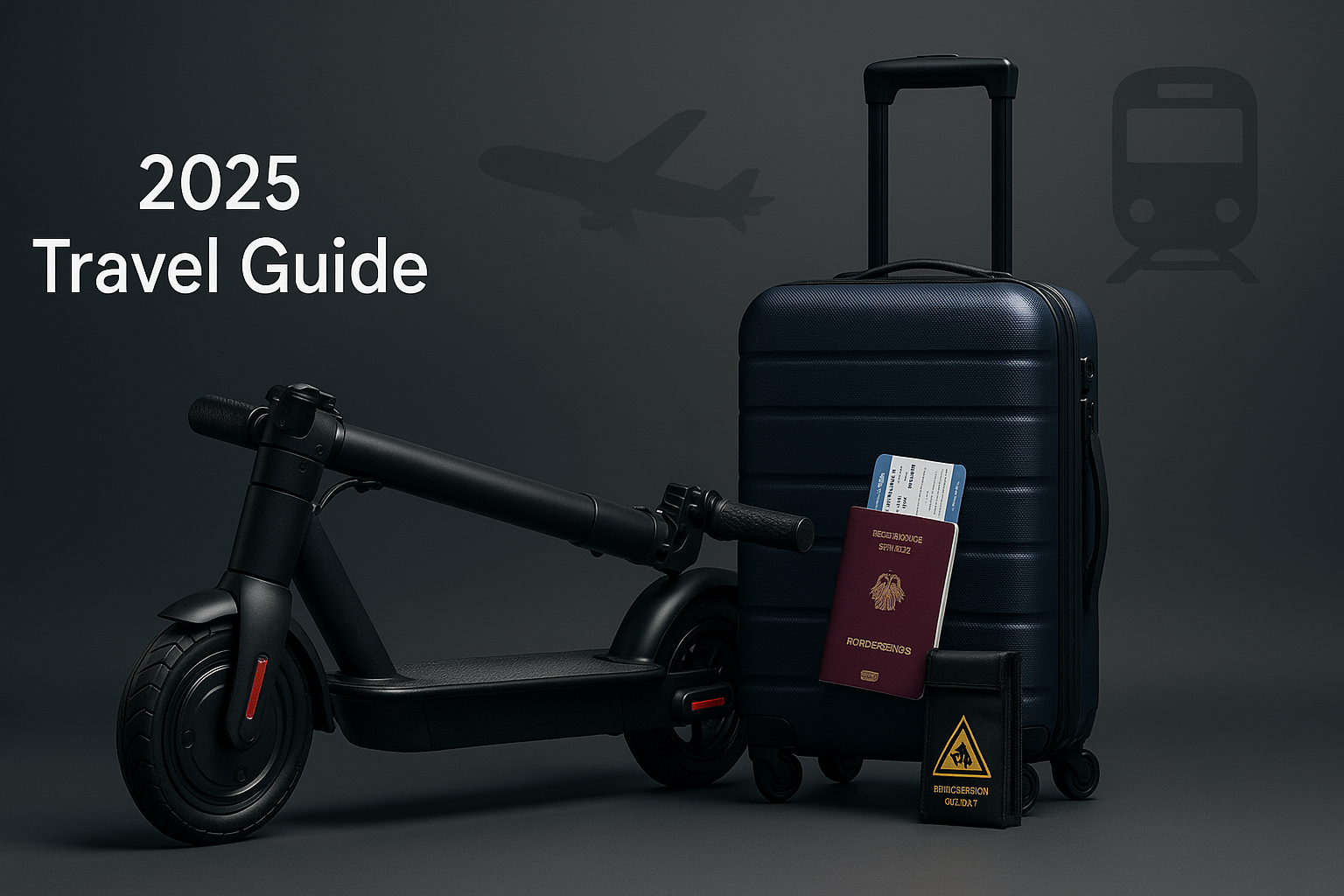
- Featured image prompt (16:9, 1920×1080): Photorealistic studio shot of a folded electric scooter beside a standard carry-on suitcase and a fire-resistant battery pouch. Clean gradient background. Soft rim light along edges. No brand logos. Premium, modern look.
- Diagram 1 — “Battery Watt-Hour Cheat Sheet”: Show Wh = V × Ah with three examples: 24 V × 5 Ah = 120 Wh; 36 V × 10 Ah = 360 Wh; 48 V × 15 Ah = 720 Wh. Use simple traffic-light indicators (green ≤100 Wh; amber 100–160 Wh approval-only; red >160 Wh).
- Diagram 2 — “Packing Layout”: Exploded view: scooter (folded), removable battery in pouch, terminal caps/tape, padding points at deck/stem/fork, axle guards, strap tie-downs, document pouch.
- Diagram 3 — “Air vs. Rail Decision Flow”: Start with “What is your battery Wh?” → “≤100 Wh” path → “100–160 Wh (with approval)” path → “>160 Wh (not permitted)” path → show packing and documentation steps → day-of flow.