
A quick promise
First, this guide is simple. Moreover, it shows what each controller does. In addition, it explains how each one feels. Consequently, you can choose with confidence. Finally, you get quick tests and easy tuning tips.
The short answer
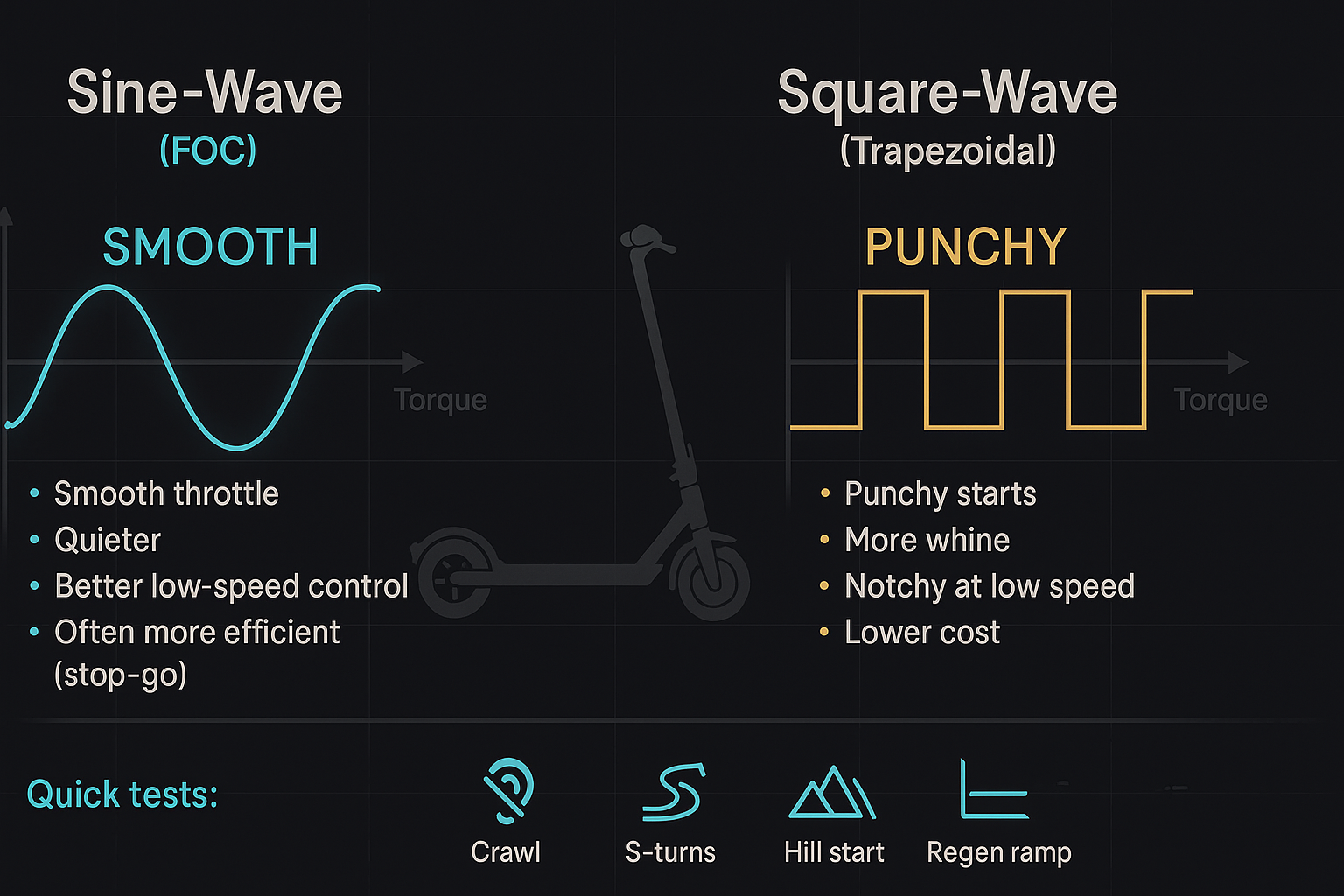
- Square-wave controllers are cheap and punchy. However, they can feel rough at slow speed.
- Sine-wave controllers are smooth and quiet. Furthermore, they often save a bit of energy in stop-and-go.
- Therefore, choose sine-wave for calm control and low noise. Conversely, choose square-wave for low cost and a sharp start.
- Above all, good tuning helps both types.
What a controller does
To begin, your scooter or e-bike uses a BLDC motor. Therefore, the coils need current at the right time. The controller sends that current. In addition, it limits heat and current. As a result, the battery and motor stay safe.
Generally, power is sent in two ways:
- Square-wave (trapezoidal). Here, power turns on and off in steps.
- Sine-wave (often FOC). Instead, power flows in smooth waves.
Consequently, the ride feel changes a lot.
Square-wave in plain words
How it works:
First, the controller switches motor phases in six steps per cycle. Next, timing comes from Hall sensors or back-EMF. Consequently, the waveform is blocky.
How it feels:
- To start, launches feel sharp.
- However, low-speed control can feel jumpy.
- Moreover, noise is higher.
- In addition, vibration can rise on hills.
Why many people use it:
- Firstly, it is low cost.
- Secondly, it is simple to wire.
- Thirdly, it is easy to replace.
Limits you may notice:
- For one thing, it can buzz.
- Also, it can run warmer at slow speed.
- Furthermore, regen can feel on/off.
- Finally, fine traction aids are rare.
Sine-wave in plain words
How it works:
In contrast, the controller makes currents that look like smooth waves. Typically, FOC keeps torque lined up with the magnets. Therefore, the current loop is fast and steady.
How it feels:
- First, throttle is smooth at all speeds.
- Moreover, starts are calm and controlled.
- Additionally, noise is low.
- Consequently, regen is easy to modulate.
Why riders like it:
- Above all, it is quiet and refined.
- Likewise, it helps in tight spaces.
- In city use, it often adds a little range.
- Finally, it can unlock extras like slip control.
What to watch:
- However, it costs more.
- Besides, setup matters.
- Also, firmware quality varies by brand.
Why the feel is so different
First, consider torque ripple. With square-wave, torque comes in pulses. Consequently, you can feel each pulse at walking speed. By contrast, sine-wave smooths the pulses. Therefore, torque feels continuous.
Second, think about harmonics. Blocky power adds extra tones. As a result, parts shake and noise rises. Meanwhile, smooth waves cut those tones. Consequently, the frame is calmer and the sound is soft.
Third, look at control speed. Many sine-wave units track current very fast. Hence, the motor follows your hand with less delay. In turn, low-speed moves feel precise.
Starts, stops, and slow moves
In real life, you start, stop, and creep. Therefore, control at low speed matters.
- With square-wave, the first push can feel like a jab. Consequently, in a tight space the bike may jump.
- With sine-wave, the first push is gentle. As a result, you can place the wheel where you want. In addition, hill starts are easier to aim.
Sound and how it changes your mind
Noise shapes emotion. For example, a loud whine can feel harsh. As a result, you may think the parts are near the limit. Conversely, a quiet glide feels safe. Consequently, the same speed feels calmer. Ultimately, quiet riding cuts stress on long days.
Range and real roads
Now, let’s talk range. In city riding, there are many stops. Therefore, there is a lot of part-throttle time. In this case, a sine-wave controller can save some energy. Specifically, smooth current lowers loss at low speed. In addition, the start ramp wastes less.
At high cruise, the story changes. Instead, air drag rules. Consequently, the benefit shrinks. Thus, on a long, flat, fast path, both types can be close.
Finally, your hand matters most. If smooth feel calms your pace, you gain range. If smooth feel tempts you to ride faster, you lose it. In short, habits decide.
Heat and life span
Heat hurts parts. However, type is not the only cause.
- Square-wave is simple, which helps reliability. Nevertheless, at low speed it can warm the motor more.
- Sine-wave shapes current well. Therefore, the motor can run cooler in stop-and-go. Still, bad setup can remove that benefit.
Consequently, quality rules. A good square-wave can outlast a poor sine-wave. Likewise, a good sine-wave can outlast a poor square-wave.
Regen braking feel
Regen sends power back to the pack. It also slows the wheel.
- With square-wave, regen can feel stepped. Therefore, the first bite may be strong.
- With sine-wave, regen is linear. Consequently, you can set light feel for paths and stronger feel for hills.
As a result, hands relax. Moreover, pads last longer. Finally, control improves.
Weather and extra noise
Because square-wave adds more electrical noise, lights or cheap horns may hum. By comparison, sine-wave often leaks less noise. Nevertheless, water safety depends on seals and grommets. Therefore, keep those parts tight and clean.
Safety tools you may see
Basic square-wave units keep it simple. Consequently, they may not add traction aids. Meanwhile, many sine-wave units add small helpers:
- Firstly, launch slip control
- Secondly, soft “rain” mode with low torque
- Thirdly, hill-hold or crawl
Because these tools use fast current loops, they limit spin without harsh cutouts. Therefore, new riders feel safer.
Clear side-by-side view
| Feature | Square-Wave | Sine-Wave |
|---|---|---|
| Low-speed feel | Jumpy at times | Very smooth |
| Noise | Higher whine | Low and calm |
| First hit | Sharp | Strong but soft |
| Regen | Stepped | Linear |
| City range | Often lower | Often higher |
| Setup | Simple | Needs care |
| Cost | Low | Higher |
| Extras | Few | Many |
In short, sine-wave favors comfort. Conversely, square-wave favors price.
Easy tuning wins (both types)
You can get a better ride in minutes. Therefore, try these steps.
- Throttle curve
First, use a straight line. Next, add a tiny dead zone at 0–2%. In the rain, cap torque in the first 30% of twist. - Current limits
Generally, keep phase current about 2–3× battery current. If starts skid, reduce phase current by 5–10%. Consequently, launches calm down. - Start ramp
Add a short ramp of 100–300 ms. As a result, the tire stays composed. On a hill, increase start current a bit, yet keep the ramp. - Regen map
Set mild regen under 15 km/h. Then, set stronger regen above 20–25 km/h. If the rear hops on paint, lower the low-speed value. - Sensor learn (FOC)
Run auto learn. Afterwards, test at walking pace. If you feel cogging, re-learn. Do not just raise current. - Field weakening (FOC)
Use it only in a “Sport” mode. Meanwhile, watch temps. Otherwise, heat climbs fast. - Thermal guard
Prefer soft derate, not hard cut. Consequently, the bike stays controllable.
Because each change is small, you can test one at a time. Therefore, it is easy to roll back if needed.
Which one should you choose?
City commuter
Choose sine-wave. Consequently, the bike is quiet, starts are easy, and stress drops.
Delivery rider
Pick sine-wave again. In particular, long days are gentler on hands and ears. Moreover, range can rise a bit.
Budget or fleet
Select square-wave. After all, it is cheap and easy to swap. With brief training, riders adapt to the sharper feel.
Tinker and tune
Either type works. However, sine-wave gives more knobs. Therefore, testing is easier and more fun.
Kids or first-time riders
Choose sine-wave. Because starts are smooth and regen is predictable, fear stays low.
Upgrade checklist
Before a swap, always check these points:
- Voltage and current. Match the pack and the motor. Otherwise, you risk cutouts.
- Connectors. Check throttle, halls, brakes, lights, and the display. Consequently, wiring is clean.
- Display or app. Make sure you can set modes and read data.
- Space and cooling. The case must fit and air must flow.
- Local rules. Set a legal speed mode where required.
- Warranty. Opening the deck may void it; therefore, decide with care.
Common myths
“Square-wave is always wasteful.”
Not always. At high cruise, both can be close; therefore, the gap shrinks.
“Sine-wave is slow off the line.”
No. With the right current and ramp, it hits hard. Nevertheless, it feels calm.
“Loud means strong.”
Not really. Usually, loud means extra tones. In fact, power comes from current, heat room, and motor design.
“All FOC units ride the same.”
No. Because code and setup vary, two units can feel very different.
Ten-minute feel test
Use the same rider and route. Then do two laps per test. Finally, note how each bike acts.
- Crawl test
Ride at walking speed. Consequently, you can see if it surges or stays smooth. - Tight S turns
Roll on and off mid-turn. Therefore, you feel torque tracking. - Hill start
Start smooth, then start quick. As a result, you learn about traction. - Regen ramp
From 25 km/h, slow with regen only. Consequently, you can judge modulation. - Noise check
Climb a short rise. Afterwards, note whine and buzz. - Heat note
After the laps, check temps in the app. If temps spike, tune limits.
Quick fixes for common issues
Jerky at low speed
Add a ramp. In addition, lower phase current a bit. If you have FOC, re-learn sensors.
Spin on launch
Soften the first 10% of the throttle map. Moreover, lower the phase-to-battery ratio. Finally, add a wet mode.
Grabby regen
Lower low-speed regen. Alternatively, use a two-stage curve. Also, check brake cutoffs for chatter.
Too much whine
If the menu allows, raise PWM frequency a little. Additionally, tighten bolts. Finally, add thin rubber pads under the controller mount.
Sensorless notes
A sensorless square-wave can struggle at zero speed because it waits for back-EMF. Conversely, a sensorless sine-wave can guess position with a model. Even so, Hall sensors still help a lot. Therefore, keep them if you can.
Pack stress and drive parts
Big current steps can spike the pack. Consequently, plugs and bearings see more stress. Sine-wave loops and ramps can tame those spikes. Nevertheless, if you ask for too much from a small pack, any unit gets hot. Hence, size with care.
Comfort and the human side
Fatigue comes from more than weight. Instead, it often comes from tiny jolts and noise. Because smooth torque cuts those jolts, you relax. Consequently, you look farther ahead and ride with flow. Over months, that calm feel keeps the fun alive.
Cost and value
Square-wave wins on price. However, sine-wave wins on feel. Therefore, the smooth ride can be worth more than the price gap. Moreover, buyers notice it at resale. Still, if cost rules, square-wave is fine and proven.
FAQs
Does sine-wave always add range?
No. Specifically, it helps most in the city. At high cruise, the gap is small.
Is square-wave bad for the motor?
Not by itself. Although it can run warmer at low speed, good limits keep it safe.
Can a throttle map fix rough feel?
It helps. Nevertheless, waveform still matters. Ultimately, true silk needs smooth waves.
Will sine-wave make my scooter slow?
No. With the right limits, it launches hard. It simply feels calm.
Is field weakening safe?
Yes, in short bursts. However, watch heat. Therefore, use it only in a sport mode.
Copy-ready tuning list
- Throttle: linear, tiny dead zone, rain cap
- Currents: phase ≈ 2–3× battery
- Start ramp: 100–300 ms
- Regen: light <15 km/h; stronger >20–25 km/h
- FOC learn: run it, test it, re-run if needed
- Field weakening: sport mode only
- Thermal: soft derate, no hard cliff
The final word
If you want quiet control, choose sine-wave. If you want the lowest price and a sharp start, choose square-wave. In both cases, use the steps above. Consequently, with a few small tweaks, your ride will feel better every day.