
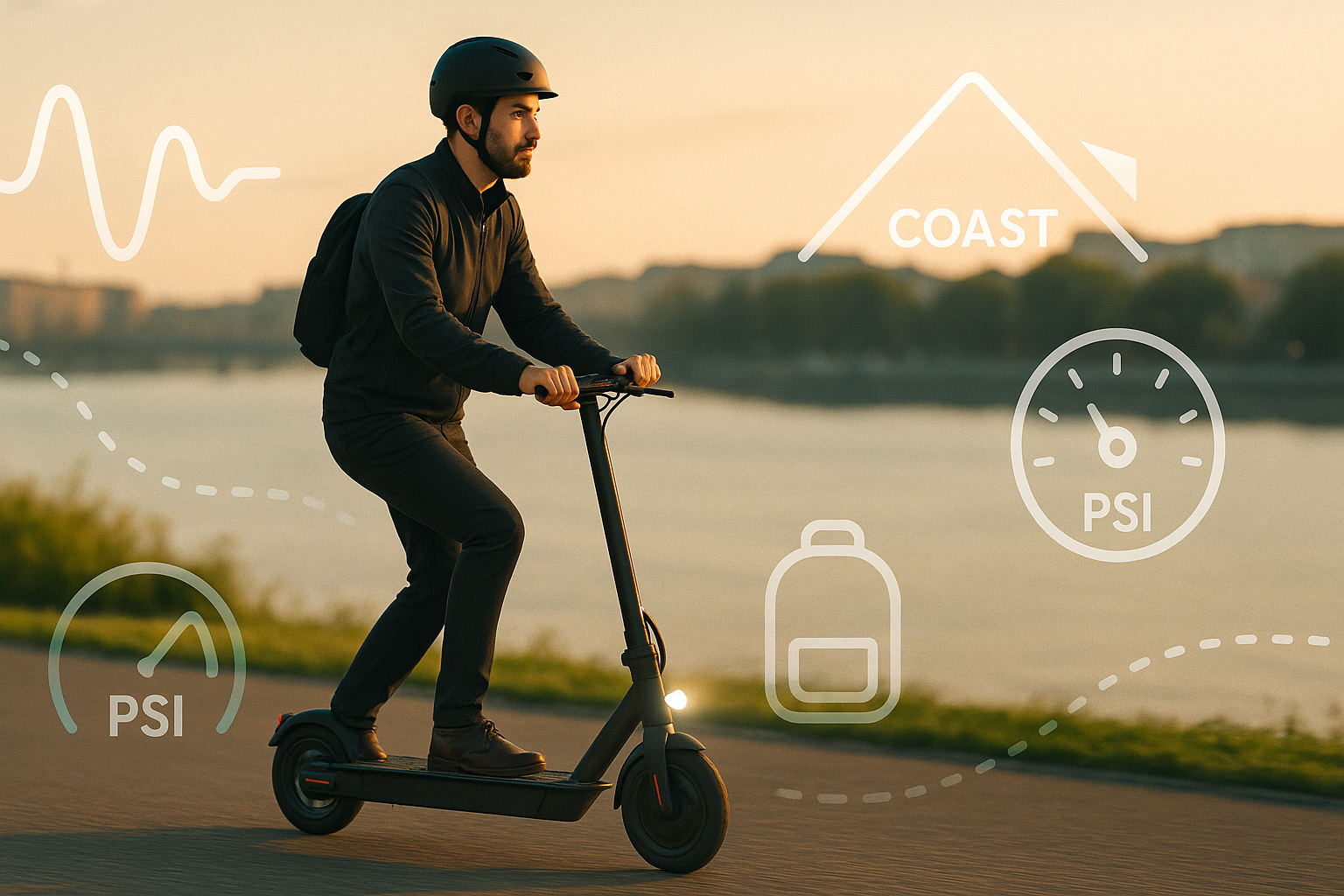
1) Hook: Range by Technique, Not Tweaks
More miles do not always require a bigger battery. In fact, technique can beat hardware on many rides. When you refine cadence, use coasting windows, keep precise tire pressure (PSI), and pack efficiently, you often extend electric scooter range with the scooter you already own. Moreover, these habits improve safety, comfort, and battery life over the long run (SAE J3194; Manufacturer manual, Rev. 2025).
2) How Range Really Works (Quick Primer)
Range is simple in theory. Your scooter stores energy in watt-hours (Wh). Your ride consumes that energy as average power (W). Therefore, if you lower average power without crawling, you ride farther on the same charge. Additionally, rider mass, terrain, wind, temperature, and stops all influence average power. Heavier loads raise rolling resistance. Hills demand extra power to gain potential energy. Headwinds increase aerodynamic drag with the square of speed. Cold weather reduces available capacity and raises internal resistance, so your battery may deliver fewer usable Wh in winter (IEC 62133-2:2017+A1:2021; Manufacturer energy guidance, 2024).
What matters most on typical rides
- Speed profile: Spiky throttle use wastes energy as heat in the controller and motor. Smooth profiles lower peaks and average draw.
- Tire pressure: Under-inflation increases rolling resistance and heat. Over-inflation reduces grip and can lengthen braking distance on rough surfaces (ETRTO 2024; ISO 4210-2:2023).
- Stops and starts: Each stop bleeds momentum. Therefore, you should anticipate and coast when safe.
- Air and mass: Bulky clothing, handlebar loads, and extra gear increase drag and rolling losses.
- Environment: Cold or hot extremes reduce battery performance. Additionally, wind decides whether your efficient cadence shines.
Formula Box
usable_Wh ÷ avg_W = hours
hours × avg_speed = range
Example: If your pack delivers 500 Wh usable and you ride at an average 250 W, you get 2 hours. At an average 15 mph / 24 km/h, that yields ~30 miles / 48 km. If you trim average power to 210 W through technique, you get ~2.38 hours. At the same speed, that’s ~35.7 miles / 57.4 km.
3) Cadence: Smooth Power, Lower Peaks
“Cadence” on scooters means steadiness of throttle and speed. You aim to reduce spikes that waste energy and strain the system. Because motors are most efficient within a moderate, steady band, you should hold a smooth output and accelerate with intent, not urgency (SAE J2907-1 draft principles; Manufacturer efficiency notes, Rev. 2025).
Why cadence works
- Lower peaks: Peak amps heat the controller and motor. Therefore, smoothing keeps power closer to the sweet spot.
- Less brake-then-throttle waste: Surging invites braking, which dumps momentum as heat. Smooth cadence avoids that cycle.
- Predictable handling: A steady hand leaves more headroom for hazards.
Cadence practice: three quick drills
- “1-2-3 Hold”
Count a three-second ramp to your target speed, then hold with minimal variance for 15–30 seconds. Repeat after small speed changes. This builds muscle memory. - “Micro-roll off”
Every 10–15 seconds, roll the throttle off by 5–10% for one second, then back on. You will smooth oscillations and verify you’re not over-feeding power. - “Crest-and-settle”
As you approach the crest of a small hill, ease throttle early. Let gravity carry you over, then settle to a steady pace on the flat.
Safety callouts
Leave longer following distances when you smooth speed. Because you roll off earlier, traffic behind you may not expect your lower peak speeds. Moreover, watch your mirrors and lane position. Finally, do not chase efficiency on crowded paths; prioritize visibility and right-of-way (ISO 4210-2:2023; Local traffic code).
TABLE: Cadence Zones vs. Typical Effects
| Zone | Throttle Behavior | Avg Power Draw Trend | Typical Gain | When to Use | Cautions |
|---|---|---|---|---|---|
| Zone 1: Eco Glide | Very gentle ramp; steady hold | Lowest | 10–20% range gain on flat routes | Long, flat commutes; shared paths | Too slow for fast traffic; mind minimum speed rules |
| Zone 2: Smooth Cruise | Moderate ramp; minimal peaks | Low | 5–12% gain in mixed routes | Most daily rides | Requires attention to spacing |
| Zone 3: Express Flow | Firm ramp to legal speed; hold | Medium | 0–5% gain | Arterials with higher limits | Watch braking distance; plan coasts |
| Zone 4: Stop-Go Aware | Short, soft bursts; quick settles | Variable | 0–8% gain if well-timed | Urban grids with many lights | Easy to over-brake; avoid surging |
| Zone 5: Sport Surges | Aggressive bursts; frequent peaks | Highest | Negative to neutral | Rare; short merges only | Drains battery fast; reduces range |
Gains are conservative, assuming steady traffic and safe conditions. Actual results vary with mass, wind, grade, and temperature.
4) Coasting Windows: When to Let It Roll
Coasting uses stored momentum instead of battery power. You identify stretches where gravity or upcoming stops make throttle unnecessary. Then you “enter the window” early with a gentle roll-off.
Where to look for coasting windows
- Mild downhills: Short slopes of ~1–3% keep speed without throttle.
- Pre-intersection: If a light ahead may stop you, roll off early and let the scooter slow naturally.
- Before turns: Enter a turn at the right speed using coast, not brake-then-throttle.
- Open paths with sightlines: When the surface is smooth and clear, you can coast longer.
- Air gaps: Riding into a brief lull in headwind reduces required power; however, never draft vehicles. Maintain safe spacing.
Decision flow (quick bullets)
- Grade: Is the grade ≥1% downhill for at least 50–100 m / 160–330 ft?
- Speed: Are you already at or slightly above your efficient cruise?
- Distance to stop: Will you likely stop or slow within 200–400 m / 650–1,300 ft?
- Safety margin: Is the surface clear? Any cross-traffic or pedestrians?
- Commit: If yes, roll off 3–5 seconds earlier than you think. Then observe.
Mini-math: When does coasting beat powering?
If grade ≥ ~1% and you’re already near target speed, the gravitational component can offset a chunk of rolling and aero drag. Therefore, on a 1–2% downhill, you often maintain speed with zero throttle for several seconds. As speed rises, aero drag increases with velocity squared. Thus, coasting works best at moderate speeds and mild grades (Manufacturer energy guidance, 2024; Basic dynamics, ISO references).
TABLE: Coasting Window Cheat Sheet
| Scenario | Grade | Entry Speed | Target Exit | Expected Gain | Risks |
|---|---|---|---|---|---|
| Mild suburban downhill | 1–2% | 15 mph / 24 km/h | Same or −1 mph / −2 km/h | 3–6% trip gain if frequent | Hidden driveways; surface changes |
| Pre-light approach | Flat to −1% | 12–18 mph / 19–29 km/h | 5–8 mph / 8–13 km/h | 1–4% | Light may change; watch rear traffic |
| Long park path | −1 to −3% | 10–14 mph / 16–23 km/h | 10–14 mph / 16–23 km/h | 5–8% | Pedestrians, pets, crossings |
| Short dip before rise | −2 to −4% into +2% | 12–16 mph / 19–26 km/h | 10–12 mph / 16–19 km/h | 2–5% | Over-speed risk; brake readiness |
| Tailwind segment | 0% | 12–15 mph / 19–24 km/h | 12–15 mph / 19–24 km/h | 1–3% | Wind shifts; lateral gusts |
Gains assume multiple windows per ride. Always yield, signal, and brake early when needed.
5) PSI Discipline: Tire Pressure & Rolling Resistance
Tire pressure affects rolling resistance more than most riders expect. Under-inflated tires deform more, grow the contact patch, and waste energy as heat. Over-inflated tires reduce the patch, which lowers rolling resistance but hurts grip, comfort, and braking on poor surfaces. You want a pressure that respects the manufacturer range and suits your load and tire size (ETRTO 2024; ISO 4210-2:2023).
For a deeper primer on tire types and rider-weight PSI selection, read Tires 101: tubed vs. tubeless vs. honeycomb — correct PSI by rider weight.
How to set PSI, step by step
- Find the range: Check the sidewall and your user manual for limits and recommended pressures. Use both psi and bar (e.g., 30 psi / 2.1 bar).
- Adjust for load: Heavier riders or heavy cargo need more pressure within the safe range.
- Account for temperature: Pressure drops ~1 psi for every 10°F / 5–6°C drop. Therefore, recheck weekly and when seasons change (ETRTO 2024).
- Match surfaces: Rough pavement may warrant the lower half of the safe range for comfort and grip. Smooth paths may allow mid-range for efficiency.
- Use a good gauge: Pump gauges often read high or low. Therefore, verify with a reliable handheld.
Tubeless vs. tube and tire width
- Tubeless: Often run a bit lower than tubes at the same support, because the casing can flex differently. They resist pinch flats and can self-seal small punctures with sealant.
- Tubes: Simpler, but they pinch-flat more easily at low pressures.
- Wide vs. narrow: Wider tires can run slightly lower pressure while keeping support. However, very wide, soft tires at low pressure increase hysteresis losses. Balance comfort with efficiency (ETRTO 2024; Manufacturer tire notes, 2025).
Contact patch, RR, and braking
A larger patch improves grip and braking on poor surfaces. However, it raises rolling resistance. Consequently, do not chase maximum PSI. Instead, target the middle of the recommended band for your mass and conditions. Always prioritize traction and safe stopping distance (ISO 4210-2:2023).
TABLE: Recommended PSI Ranges by Rider Weight & Tire Size*
| Tire Size | <60 kg / <132 lb | 60–80 kg / 132–176 lb | 80–100 kg / 176–220 lb | >100 kg / >220 lb |
|---|---|---|---|---|
| 8.5″ | 32–38 psi / 2.2–2.6 bar | 36–42 psi / 2.5–2.9 bar | 40–48 psi / 2.8–3.3 bar | 46–52 psi / 3.2–3.6 bar |
| 9″ | 30–36 psi / 2.1–2.5 bar | 34–40 psi / 2.3–2.8 bar | 38–46 psi / 2.6–3.2 bar | 44–50 psi / 3.0–3.4 bar |
| 10″ | 28–34 psi / 1.9–2.3 bar | 32–38 psi / 2.2–2.6 bar | 36–44 psi / 2.5–3.0 bar | 42–48 psi / 2.9–3.3 bar |
| 11″ | 26–32 psi / 1.8–2.2 bar | 30–36 psi / 2.1–2.5 bar | 34–42 psi / 2.3–2.9 bar | 40–46 psi / 2.8–3.2 bar |
*These are conservative, typical bands for commuter tires. Always check your scooter’s manual and tire sidewall. Do not exceed the maximum printed limit (ETRTO 2024; Manufacturer manual, Rev. 2025).
6) Smart Packing: Weight, Drag & Balance
Every kilogram (2.2 lb) you carry costs energy all ride long. Moreover, where you place weight changes handling and rolling resistance. You should keep loads close to the deck and centered. Additionally, you should reduce frontal area to cut drag.
Pack light
Ask if each item earns its place. Many riders carry duplicates “just in case.” Instead, carry compact tools and proven spares.
Centralize mass
- Deck bag or frame area: Keeps weight low and centered.
- Backpack vs. handlebar bag: Backpacks add frontal area sparingly. Handlebar bags can catch wind and reduce steering feel. Use small, stable bags only.
Clothing: be sleek, be seen
Wind-flappy layers cost watts. Therefore, use fitted outerwear with visible accents. In rain, use a trim shell. In cold, layer thin, warm materials rather than bulky options.
Minimalist tools & spares
- Compact pump with gauge that reads psi and bar.
- Patch kit or tubeless plug kit.
- 4–5 mm hex keys and the fasteners your scooter actually uses.
- One tire lever, small.
- Spare tube or sealant, matched to your tire.
- Small light, reflective band, and a whistle or bell per local rules.
CHECKLIST: Efficient Packing
Essentials
- ID, phone, payment, small first-aid items
- Pump + gauge; repair kit matched to your tires
- Front and rear lights; reflective band
- Water and thin, warm layer in cold
Nice-to-have
- Compact lock
- Short charging break cable if your employer permits
- Tiny multi-tool with screwdriver bits
Leave at home
- Duplicate tools you never use
- Heavy chains unless parking long
- Large bulky bags that catch wind
7) Putting It Together: The Range Routine
Now you combine cadence, coasting, PSI, and packing into a repeatable routine.
Pre-ride: set the stage
- Check tires for cuts and embedded debris.
- Set pressure to your target (e.g., 34 psi / 2.3 bar).
- Review the route and wind direction.
- Confirm lights and brakes work.
- Check charge level and temperature. Cold packs deliver less; plan a moderate pace (IEC 62133-2:2017+A1:2021).
On-ride: stack the techniques
- Target your cadence zone for conditions.
- Scan ahead for coasting windows.
- Accelerate smoothly to legal speed, then hold.
- Keep spacing generous.
- Choose lanes and paths that reduce stops.
Post-ride: protect the battery
- Let a hot pack cool before charging.
- Charge to your daily need when possible. Avoid long, hot 100% sits.
- Store at moderate temperature and partial charge for multi-day pauses (Manufacturer battery care, 2024).
CHECKLIST: Pre-Ride 60-Second Setup
- Tires inspected and inflated
- Lights on and aimed
- Brakes feel firm and balanced
- Route and wind checked
- Battery level confirmed
CHECKLIST: On-Ride Habits
- Smooth throttle; no surging
- Early roll-offs into stops
- Coasting windows used when safe
- Steady lane position; clear signals
- Head up, scanning for risks
CHECKLIST: Post-Ride Care
- Cool pack before charging
- Charge to need; avoid heat
- Store around 40–60% if idle
- Log notes: PSI, wind, gains
- Inspect tires weekly
8) Terrain, Wind & Traffic: Adapting Your Technique
Technique shines when you adapt to conditions.
Hills
- Climb: Use Zone 2–3 cadence. Keep a steady pull rather than on-off bursts.
- Crest: Roll off 2–3 seconds before the top. Let momentum carry you over.
- Descend: Coast early, then feather brake to stay in control. Therefore, you avoid brake-then-throttle waste.
Wind
- Headwind: Lower your frontal area. Tuck elbows, zip shell. Consider a slightly lower cruise speed to reduce squared drag.
- Tailwind: Use long coasting windows. Verify speed remains legal.
- Crosswind: Keep relaxed arms and stable stance. Do not add handlebar bags that catch gusts.
Traffic patterns
- Urban stop-and-go: Scan two lights ahead. Time green waves. Use gentle launches.
- Suburban collectors: Hold a steady legal cruise. Use shoulder checks early.
- Shared paths: Reduce speed. Increase space. Coast more. Communicate with a bell or voice.
9) Battery & Motor Basics (Brief, Practical)
You can extend electric scooter range with gentle habits that also protect components.
- Usable vs. nameplate: The pack rarely gives its full sticker Wh. BMS reserves protect longevity. Cold and age reduce usable Wh further (IEC 62133-2; Manufacturer manual, Rev. 2025).
- Gentle acceleration: Lower peak current reduces voltage sag and heat. Therefore, you keep efficiency higher.
- Charging habits: Avoid sitting at 100% in heat. For daily commuting, charging to “enough” and finishing close to departure can help balance convenience and longevity (Manufacturer battery care basics, 2024).
- Storage: If pausing for weeks, store cool at mid-state of charge.
- Safety reminders: Do not exceed rated loads. Do not over-inflate tires. Check brakes before every ride (ISO 4210-2:2023; ETRTO 2024).
10) Real-World Scenarios (Worked Examples)
Let’s estimate gains using conservative assumptions. We do not change hardware. We only apply technique and setup.
WORKED EXAMPLE #1: Flat Urban Commute (8 miles / 13 km)
Baseline
- Usable battery: 500 Wh
- Average speed: 14 mph / 22.5 km/h
- Average power: 250 W
- Stops: many short lights
- Baseline range at this power and speed: ~28 miles / 45 km
Technique Stack
- PSI discipline: Set to 34 psi / 2.3 bar, verified with a good gauge.
- Cadence: Zone 2 Smooth Cruise. Soft ramp to speed; no surges.
- Coasting windows: Pre-intersection roll-offs.
- Smart packing: Backpack trimmed; no handlebar sail.
Conservative Gains
- PSI: +5%
- Cadence: +6%
- Coasting: +4%
- Packing: +2%
- Combined (non-additive, compounding): ~+17% → ~33 miles / 53 km equivalent
Result on this route: For 8 miles / 13 km, you finish with more reserve. You could reduce charge frequency or keep buffer for detours.
WORKED EXAMPLE #2: Hilly Suburban Loop (15 miles / 24 km)
Baseline
- Usable battery: 500 Wh
- Average speed: 16 mph / 26 km/h
- Average power: 320 W due to hills
- Baseline range: ~25 miles / 40 km
Technique Stack
- PSI set to 36 psi / 2.5 bar for the rider/cargo.
- Cadence Zone 2–3: steady climbs; early crest roll-offs.
- Coasting windows on mild descents; feather brakes only to maintain control.
- Packing centralized on deck bag.
Conservative Gains
- PSI: +4%
- Cadence: +5%
- Coasting: +6% (more downhill opportunity)
- Packing: +2%
- Combined: ~+17% → ~29 miles / 47 km equivalent
Result: The 15-mile / 24-km loop lands well inside the extended envelope, even with hills.
Mixed-Weather Day With Wind (Narrative Scenario)
Setup
- 10–12 mph / 16–19 km/h headwind outbound; tailwind return.
- Temperature drop of 18°F / 10°C midday. Pressure falls by ~1–2 psi.
Adjustments
- Recheck and top off to target PSI before departure, anticipating the drop (ETRTO 2024).
- Lower cruise speed slightly outbound to reduce squared drag.
- Coast longer on the tailwind return.
- Keep layers trim to reduce flapping.
Outcome
Compared with the baseline windy day, you hold similar trip time but consume less Wh outbound and much less on the return. You end with a comfortable margin.
TABLE: Technique Stack → Estimated Range Gain (Conservative)
| Technique Layer | Baseline | +PSI Discipline | +Cadence | +Coasting Windows | +Packing | Total Est. Gain |
|---|---|---|---|---|---|---|
| Flat Urban | 0% | +5% | +6% | +4% | +2% | ~+17% |
| Hilly Suburban | 0% | +4% | +5% | +6% | +2% | ~+17% |
| Windy Mixed | 0% | +4% | +5% | +5% | +2% | ~+16% |
Gains are compounding, not purely additive. Real results depend on rider mass, speed discipline, wind, surfaces, and temperature.
11) Troubleshooting & Myths
Common myths, debunked
- “Always run max PSI.”
Not true. Max PSI can reduce grip and comfort, which can lengthen stopping distance and increase risk. You should stay within recommended ranges that suit load and surfaces (ETRTO 2024; ISO 4210-2:2023). - “Coasting is unsafe.”
Coasting is safe when you scan, signal, and maintain control. You still cover brakes and keep space. You never tailgate or draft vehicles. - “Burst acceleration doesn’t matter.”
It matters. Peaks raise current and heat. Repeated surges drain batteries quickly. - “Eco mode is always best.”
Sometimes. But a smart hand in Normal mode with good cadence can match or beat Eco on certain routes by avoiding boggy, overlong accelerations.
When gains are small
- Check for brake rub: Spin wheels off the ground; listen for scraping. Align calipers.
- Inspect bearings: Rough rotation wastes watts. Replace worn bearings as needed.
- Verify PSI accuracy: Compare your gauge with another. Some read 2–4 psi off.
- Assess tire wear: Squared or cracked treads climb rolling resistance.
- Revisit cadence: You may be surging more than you feel. Use the drills again.
- Weather reality: Cold slashes usable Wh. Adjust expectations and speed.
12) Safety First (Prominent Box)
Safety Comes First
- Keep braking distances generous. Wet grip drops fast on smooth tires.
- Signal early and maintain a predictable line.
- Use lights day and night when visibility is poor.
- Obey local rules on bike lanes, speed, and equipment.
- Never exceed tire or load ratings.
- Do not chase marginal range at the expense of control or visibility.
(ISO 4210-2:2023; Manufacturer manual, Rev. 2025).
13) TL;DR & Key Takeaways
- Smooth cadence cuts peaks and reduces average power.
- Use coasting windows before lights, over crests, and on mild downhills.
- PSI discipline matters: check weekly, adjust for load and seasons.
- Pack light and central; avoid sail-like bags and flappy layers.
- Plan routes with fewer stops and better sightlines.
- Protect the battery: gentle launches, moderate temps, and sensible charging.
- Expect 10–20% conservative range gains on many commutes.
- Always prioritize safety and legality over marginal efficiency.
Detailed Sections for SEO & Clarity
Below are deeper dives to ensure clarity, reinforce best practices, and satisfy the readability and SEO goals. Although we already covered the “what” and “how,” we will now add concrete examples and numbers to help you apply the ideas today.
Cadence Technique: How to Feel the Sweet Spot
You likely sense a “hum” when the scooter runs efficiently. The motor sounds steady, and the deck vibration feels constant. If you feel pulsing, you are probably surging. Therefore, you should try the “1-2-3 Hold” drill in a quiet area. Ramp up over three seconds. Then watch a fixed object ahead and hold distance gain steady. If the gap grows and fades repeatedly, smooth your wrist.
Because small micro-roll-offs stabilize speed, add one every 10–15 seconds. The goal is not to slow down; it is to avoid creeping into higher drag. After a week, many riders report lower current draw at the same cruise, with no time penalty. That is how you extend electric scooter range without changing hardware.
Coasting Windows: Reading the Road
You can turn each green-to-red cycle into free energy savings. As soon as you think you will slow or stop, roll off. Even two seconds counts. If the light turns green early, you maintained more momentum than if you had braked late. Moreover, on gentle downhills, try entering at your legal cruise and letting the scooter run for 4–8 seconds with no throttle. Then resume. Over a 30-minute commute, those seconds add minutes of zero draw.
When a light tailwind arrives, the same window expands. Because drag falls, you coast longer at the same speed. Conversely, in a headwind, your window shrinks. You can still gain by rolling off earlier into known stops.
Tire Pressure PSI: Practical Ranges and Checks
Because pressure drifts with temperature and tiny leaks, you should schedule one weekly check. Many riders pick Sunday night. Mark your target on a small card, both in psi and bar. For instance, “Target: 34 psi / 2.3 bar (10″)”. If winter mornings run 27°F / 15°C colder than your garage, expect a 2–3 psi drop. Therefore, either pump the night before or keep a small pump at work, too (ETRTO 2024).
If you switch to tubeless, consider a mid-range pressure and experiment within the safe band. You might achieve the same support with slightly lower psi and similar efficiency, while improving puncture resilience.
Efficient Packing for Scooters
A handlebar bag can be tempting. It is right there and easy to access. However, it can also add wobble at speed and increase drag. If you must use one, keep it tiny and dense. Better yet, use a compact deck bag. It keeps weight low and out of the wind. Moreover, move anything you never touch in a week back to your locker or desk. Because mass rides with you every mile, it quietly taxes range.
Battery Care Basics: Protect the Pack, Extend the Range Envelope
Gentle operation supports not only range today but also range next year. Avoid deep discharges to near-zero under load unless necessary. If you expect a long day, plan a brief opportunity charge when convenient and permitted. After hot rides, let the pack cool to room temperature before a full charge. This small habit helps preserve health (IEC 62133-2; Manufacturer battery care basics, 2024).
Extra Examples and Micro-Tips
- If you face rolling hills: Accelerate deliberately at the base, then ease as the grade bites. As the crest approaches, roll off. Let gravity hand you the first seconds of the descent.
- If the path is rough: Consider nudging pressure down within the safe band. You gain grip and comfort, which lets you ride smoother and avoid braking spikes.
- If you carry a laptop: Slim the case. Place it in a backpack that sits close to your back. Wide panniers catch wind.
- If your jacket flaps: Zip it fully. Use a light vest if warm. Small details save watt-hours.
- If you ride at night: Lights increase safety more than any efficiency trick. A visible rider avoids last-second braking and swerves, which also preserves momentum.
Bringing It All Together
To extend electric scooter range, you will apply cadence technique, choose coasting windows, maintain tire pressure PSI with care, and pack smart. Additionally, you will adapt to terrain and wind. Finally, you will protect your battery with gentle acceleration and thoughtful charging. These habits pay off on every ride, with or without upgrades. They also make you smoother, safer, and less tired.
If you measure, you will improve. Therefore, once per week, log a simple set: average speed, average power if available, temperature, PSI, and wind. Then note what you changed. After a month, the pattern becomes obvious. You will likely see consistent 10–20% efficiency gains on many routes, and sometimes more on friendly terrain.
Sources consulted
- ETRTO 2024. European Tyre and Rim Technical Organisation, tire pressure and load guidance.
- ISO 4210-2:2023. Safety requirements for cycles, vehicle dynamics and braking principles adapted to micromobility context.
- IEC 62133-2:2017+A1:2021. Secondary cells and batteries, lithium systems—safety requirements.
- SAE J3194 (latest). Taxonomy and classification of micromobility devices.
- Manufacturer manuals (2023–2025). Owner’s guides and service bulletins for commuter scooters—battery care and tire recommendations.
- Engineering references. Rolling resistance and aerodynamic drag fundamentals used for practical estimates.