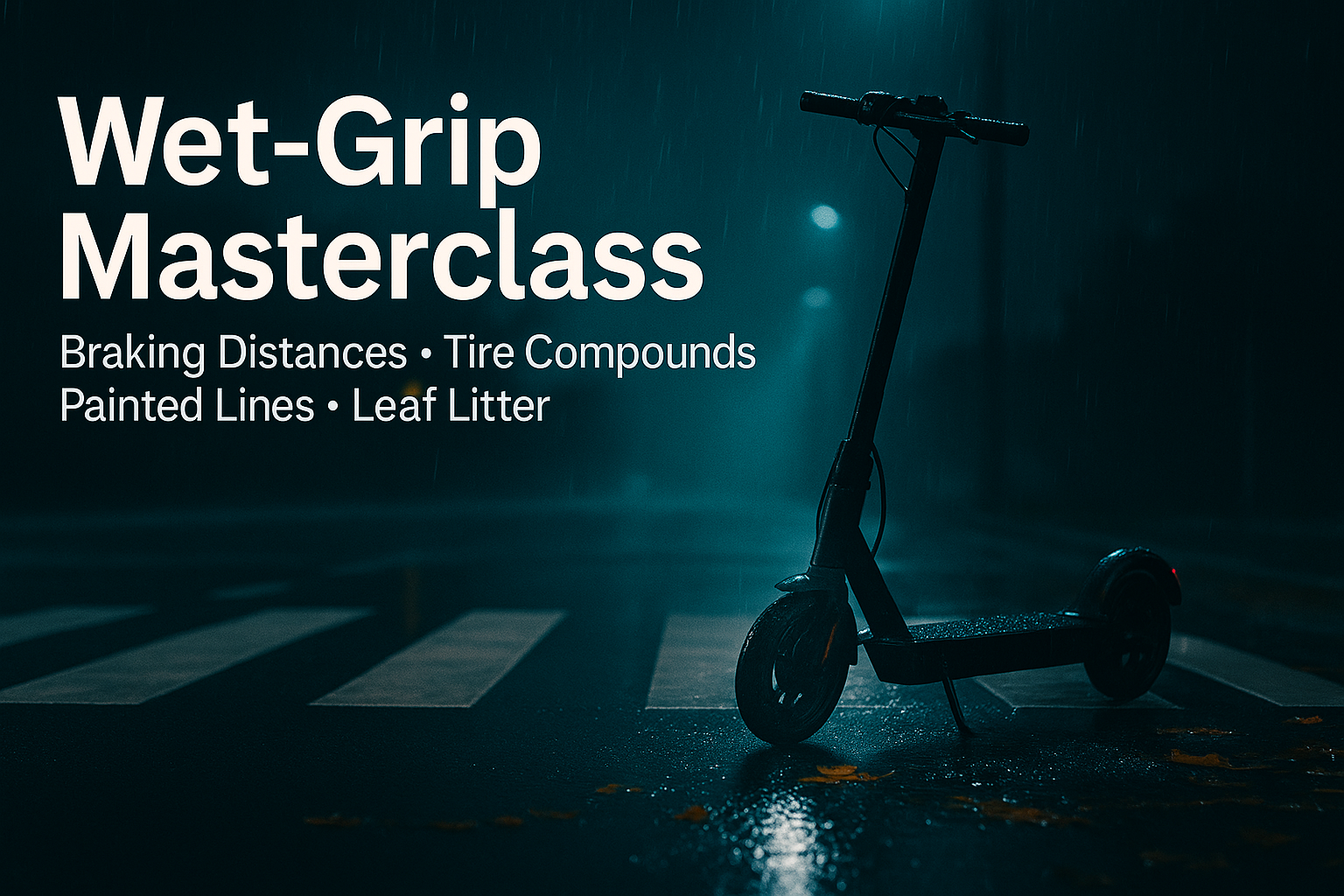
Rain changes everything. Consequently, water lowers friction, hides hazards, and stretches stopping distance far beyond what dry-road instincts expect. For deeper braking strategy, worked examples, and setup checklists, see the Brake Performance Guide. Therefore, this guide shows you how to master wet grip electric scooters with practical, tested techniques. In addition, you’ll learn how braking systems behave, which tire compounds help, why painted lines and leaf litter get treacherous, and how to set pressures for control without wrecking range.
Key Takeaway
In the wet, slow sooner, brake straighter, and plan further ahead. Ultimately, technique plus setup beats raw power every time.
Why Wet Grip Drops So Fast
When water sits between your tire and the road, it reduces the effective friction coefficient (μ). Even a thin film, however, cuts micro-asphalt contact, while deeper films can lift the tire over surface texture. As speed rises, the chance of partial hydroplaning increases. Although true hydroplaning is rare at typical scooter speeds, you still lose bite because water and contaminants (oil, dust, pollen) act like lubricants. Additionally, colder temperatures stiffen rubber and further trim available grip.
Reaction vs braking distance
Your total stopping distance equals reaction distance (how far you roll before you begin braking) plus braking distance (how far you need once brakes engage). In rain, both grow: you hesitate slightly more, and your tire-road μ drops. Consequently, planning becomes essential.
Formula you’ll use throughout: dtotal=v⋅treaction+v22μgd_\text{total} = v \cdot t_\text{reaction} + \frac{v^2}{2 \mu g}dtotal=v⋅treaction+2μgv2
- vvv: speed (m/s).
- treactiont_\text{reaction}treaction: your reaction time (typical 1.0–1.5 s).
- μ\muμ: friction coefficient (dry asphalt often ~0.7; wet asphalt commonly ~0.35).
- ggg: 9.81 m/s².
Pro Tip
On wet days, assume your effective μ is half of dry. As a result, double your following distance. This quick mental model keeps you honest.
Braking Systems on E-Scooters (and What Changes in the Wet)
Scooters mix different brake types. Each, importantly, behaves differently when it’s wet.
- Mechanical disc: Simple and strong. However, water on rotors and pads delays bite. The first squeeze wipes the rotor; the second usually grabs harder. Therefore, modulate gently.
- Hydraulic disc: Best modulation and force. Yet, contaminated pads glaze faster in the wet. Consequently, keep rotors/pads clean and bedded.
- Drum: Enclosed hardware resists spray and grit. Initial bite is predictable; nevertheless, ultimate power is lower than good discs.
- Electronic/regen: Great for stability in straight lines, especially at high battery charge. In the wet, start with light regen to settle the chassis, then blend in mechanical braking.
- Foot brake: Emergency-only. It becomes inconsistent on wet fenders and can destabilize the rear; therefore, rely on it sparingly.
ABS/traction control (where available) helps prevent lockup and smooths slip events, particularly on the front. However, it can’t create grip. Consequently, you still need conservative entries, straight-line braking, and clean tires.
Caution
After riding through a deep puddle, expect a one-to-two squeeze delay before discs bite normally. Accordingly, prime the brakes with a gentle wipe squeeze in a safe straight line.
Wet Grip Electric Scooters: Why They Feel Different
Yes, the headline phrase matters—wet grip electric scooters respond to rain with softer carcasses, varied compounds, and electronic braking strategies that differ from bicycles or motorcycles. Because scooters carry small-diameter tires and short wheelbases, surface texture and micro-slips show up faster. Moreover, you stand upright, so weight shifts happen quickly; that’s great for agility yet punishing for errors. Consequently, minor surfaces—painted chevrons, leaf mats, tactile paving—become major factors in how wet grip electric scooters behave.
Tire Compounds & Tread That Actually Help
Compounds and hardness
- Silica-rich compounds typically retain grip at lower temperatures and in the wet by improving hysteresis (the tire’s ability to conform to micro-texture). Consequently, they feel more planted on cold, damp mornings.
- Harder blends last longer but slide sooner on cold, wet asphalt. Therefore, avoid ultra-hard compounds for rain-heavy routes.
- Shore A hardness gives a rough sense of stiffness: lower Shore A can ride grippier but may wear faster. As always, balance longevity with safety.
Tread and carcass
- Siping and fine tread help water escape laterally, improving edge grip at sensible lean angles. Deep, blocky treads, by contrast, are not always better on slick urban surfaces.
- Pneumatic tubed & tubeless form a compliant contact patch that keys into asphalt texture; this, in turn, boosts wet grip when pressures are right.
- Solid/honeycomb tires prevent flats but transmit impact and reduce micro-conformity. Consequently, they can be harsher and less forgiving on smooth, wet surfaces.
Key Takeaway
In rain, compliance is king. Thus, a tire that deforms to the surface grips better than one that skates over it.
Pressure & contact patch
- Over-inflation shrinks the contact patch and raises the risk of skids.
- Under-inflation rolls the sidewalls, heats the carcass, and can pinch-flat tubed tires.
- Wet days often reward a small pressure reduction (e.g., −2 to −3 psi / −0.1 to −0.2 bar) within safe ranges. Heavier riders, however, still need higher baselines.
Pressure guidance ranges (general, not brand-specific)
These are conservative, rider-weight-based ranges for typical urban tires. Always respect the sidewall max and your scooter’s manual. Additionally, consider temperature: colder air drops pressure.
| Tire size | Rider 50–70 kg | Rider 70–90 kg | Rider 90–110 kg | Rider 110–130 kg | Notes |
|---|---|---|---|---|---|
| 8.5″ | 35–40 psi (2.4–2.8 bar) | 40–45 psi (2.8–3.1 bar) | 45–50 psi (3.1–3.4 bar) | 50–55 psi (3.4–3.8 bar) | For wet grip, drop 2–3 psi from normal, but stay above pinch-flat risk. |
| 9″ | 32–38 psi (2.2–2.6 bar) | 38–44 psi (2.6–3.0 bar) | 44–50 psi (3.0–3.4 bar) | 48–54 psi (3.3–3.7 bar) | Tubeless tolerates slightly lower pressures than tubed at same load. |
| 10″ | 30–36 psi (2.1–2.5 bar) | 34–40 psi (2.3–2.8 bar) | 38–44 psi (2.6–3.0 bar) | 42–48 psi (2.9–3.3 bar) | Larger diameters ride calmer over wet texture and joints. |
Warm-up & temperature effects
Rubber grips best in a certain temperature window. In cold rain (≤50 °F / 10 °C), compounds stiffen, siping does less, and dust turns to slurry. Accordingly, use gentler inputs, a longer warm-up, and slightly lower speeds. Conversely, warm rain can lift oils and diesel residues to the surface; that’s slick for different reasons, so adjust again.
Surfaces That Bite (and Slip): Painted Lines, Leaf Litter & More
- Thermoplastic road markings (painted lines/arrows/zebra crossings): very smooth; water pools and lowers μ sharply. Therefore, cross them as perpendicularly as possible, upright and steady.
- Metal plates/manhole covers/rail tracks: zero texture when wet. Consequently, avoid them mid-corner.
- Polished concrete or sealed pavers: looks clean; nevertheless, behaves like glass when rained on.
- Cobblestones: rounded tops deflect the tire. Thus, glide over them upright; avoid lean.
- Wet leaves/leaf litter: compress into a slick mat, especially in autumn. Accordingly, treat like ice.
- Fresh asphalt: can be oily early after laying but often improves as it cures. Even so, remain cautious.
- Tactile paving: raised dots/strips can unsettle steering; therefore, cross them straight and stable.
Caution
Rainbow-colored sheens mean oil. Do not brake hard on them. Instead, coast across gently, then brake after the patch.
Measured Reality — Stopping Distance Tables
Assumptions: level surface (~0%), clean asphalt, rider + gear ~80 kg, well-maintained brakes and tires, consistent posture. Reaction time shown as 1.0–1.5 s range. Metric and imperial units included. As noted earlier, friction assumption for calculations: dry μ ≈ 0.7, wet μ ≈ 0.35.
| Speed | km/h | Reaction distance (1.0–1.5 s) | Braking distance (dry) | Braking distance (wet) | Total dry (min–max) | Total wet (min–max) |
|---|---|---|---|---|---|---|
| 10 mph | 16.1 | 4.5–6.7 m | 1.5 m | 2.9 m | 5.9–8.2 m | 7.4–9.6 m |
| 15 mph | 24.1 | 6.7–10.1 m | 3.3 m | 6.5 m | 10.0–13.3 m | 13.3–16.6 m |
| 20 mph | 32.2 | 8.9–13.4 m | 5.8 m | 11.6 m | 14.8–19.2 m | 20.6–25.1 m |
| 25 mph | 40.2 | 11.2–16.8 m | 9.1 m | 18.2 m | 20.3–25.9 m | 29.4–35.0 m |
Key Takeaway
At 25 mph (40.2 km/h) in the wet, your total stop can stretch to ~35 m (~115 ft). Consequently, that’s a full city bus length.
Worked example (20 mph / 32.2 km/h)
- v=20 mph=8.94 m/sv = 20 \text{ mph} = 8.94 \text{ m/s}v=20 mph=8.94 m/s
- treaction=1.2 st_\text{reaction} = 1.2 \text{ s}treaction=1.2 s
- Wet asphalt μ=0.35\mu = 0.35μ=0.35
dreaction=v⋅t=8.94×1.2≈10.7 md_\text{reaction} = v \cdot t = 8.94 \times 1.2 \approx 10.7 \text{ m}dreaction=v⋅t=8.94×1.2≈10.7 m dbraking=v22μg=8.9422×0.35×9.81≈11.6 md_\text{braking} = \frac{v^2}{2 \mu g} = \frac{8.94^2}{2 \times 0.35 \times 9.81} \approx 11.6 \text{ m}dbraking=2μgv2=2×0.35×9.818.942≈11.6 m dtotal≈10.7+11.6=22.3 md_\text{total} \approx 10.7 + 11.6 = 22.3 \text{ m}dtotal≈10.7+11.6=22.3 m
If you ride the same speed on dry asphalt (μ≈0.7\mu \approx 0.7μ≈0.7), the braking portion drops to ~5.8 m and total becomes ~16.5 m. Therefore, earlier, smoother braking is the winning play for wet grip electric scooters.
Wet-Grip Riding Techniques That Save You
- Look far ahead, and lower your base speed. Consequently, you’ll spot slick patches early.
- Brake in a straight line before the corner. Then, roll off the brakes as you lean.
- Squeeze, don’t grab. Build pressure over ~0.3–0.5 s; thus, you load the tire gradually.
- Bias rear slightly when it’s very slick (e.g., painted lines). However, keep some front brake for stability and stopping power.
- Feather regen first to settle the chassis; afterward, blend mechanical braking.
- Keep lean angles modest. Aim for smooth arcs; avoid mid-corner stabs at brakes or throttle.
- Cross hazards perpendicular. Painted lines, rails, and tactile paving reward upright posture.
- Weight the outside foot in corners and keep arms relaxed to avoid twitch inputs.
- Test grip safely. In a straight, apply a light brake to feel μ before you need it.
Pro Tip
Make “slow before, flow through” your mantra. Ultimately, on wet grip electric scooters, you win by setting speed early, then holding a calm, neutral line.
Setup, Maintenance & Pre-Ride Checks for Rain
- Tires: check for cuts, squared profiles, hardened rubber, or worn siping. Replace early if the wet scares you—fresh tread and softer compounds help.
- Rotors & pads: clean contamination (finger oils, chain lube overspray). If pads glaze, replace and re-bed.
- Cables & hydraulics: remove slack, fix sticky levers, and bleed spongy brakes.
- Fenders & drainage: ensure they’re solid and not rubbing. Otherwise, leaf litter can jam them.
- Electrical/IP ratings: “water-resistant” ≠ “water-proof.” Therefore, avoid pressure washers and axle-directed hose jets.
- Fasteners: after pothole hits, torque-check stem, axle, and brake mounts.
Pre-ride checklist (rainy days)
- Tire pressure set (see table), tread OK, valve caps on.
- Rotors wiped; brakes bite by the second squeeze.
- Lights, reflectors, and horn/bell working.
- Deck griptape clean and sharp.
- App speed cap reduced.
Post-ride checklist
- Rinse grit with a gentle flow; avoid bearings and electronics.
- Spin wheels to feel for debris and bent rotors.
- Dry rotors and chain/belt areas; relube where appropriate.
- Air-dry indoors; do not store wet in freezing conditions.
Weekly (wet season)
- Inspect brake pad thickness.
- Check spoke tension (if applicable) and axle nuts.
- Verify firmware and ABS/traction settings.
Do’s, Don’ts & Decision Tree
Do
- Do widen your following gap to at least 4–6 seconds; therefore, you preserve options.
- Do set a rainy-day speed cap. Consequently, mistakes cost less.
- Do use brighter lights and add reflective elements. Additionally, clean lenses improve output.
- Do practice progressive braking in an empty, straight lot; afterward, your hands will remember.
Don’t
- Don’t brake hard while leaned; instead, straighten first.
- Don’t pressure-wash bearings, seals, or display housings; otherwise, you’ll drive water inside.
- Don’t trust early light rain after a dry spell; oils float to the top.
- Don’t straddle metal seams or rails under power; rather, cross them square.
Decision tree
- Rain intensity & visibility good? If no, postpone.
- Tire state (tread, age, pressure) solid? If no, fix first.
- Route risk (painted lines, metal plates, leaf zones) high? If yes, reroute or slow further.
- You feel skittish today? If yes, cut speed again or stop. Ultimately, confidence is a safety feature.
Myths vs Facts (Quick Hits)
- Myth: Knobbier tread always grips better in rain.
Fact: On smooth urban asphalt, compliant slicks with fine siping often outperform chunky blocks. Therefore, choose accordingly. - Myth: Higher pressure “cuts” through water.
Fact: Over-pressure shrinks the contact patch and reduces wet traction. Consequently, stay within the tabled ranges. - Myth: Regen alone is enough to stop safely.
Fact: Regen stabilizes, but mechanical brakes provide the decisive stop—especially at low battery or low speed. Thus, blend both. - Myth: ABS means you can brake late in the wet.
Fact: ABS manages slip; it does not create grip. Therefore, start braking earlier. - Myth: Painted lines are harmless at scooter speeds.
Fact: Wet thermoplastic can halve μ. Accordingly, treat them like mini ice rinks.
Troubleshooting: Slides, Wobbles & What to Fix
- Front wash (front tire slides wide): You braked or turned too hard for the μ available. Next time, slow before the turn, stay upright over slick patches, and relax your arms. Additionally, consider a slightly softer compound tire and a small pressure reduction.
- Rear slide (rear steps out): You applied too much rear brake or throttle mid-corner. Therefore, use smoother inputs, reduce rear bias, and check for contamination on the rear tire.
- Wobble/shimmy: Often from over-inflation, wind gusts, loose headset, or a death grip on the bars. Accordingly, drop 1–2 psi within range, relax the upper body, and service the steering.
Seasonal & Local Factors
- First rain after a dry spell: oils rise; grip is worst in the first 15–30 minutes. Consequently, ride conservatively.
- Autumn: leaf litter hides potholes and turns into slick mulch. Therefore, treat shaded corners with extra care.
- Winter: de-icing salts and brine attack metals and add a slimy residue when re-wetted. Thus, rinse and dry thoroughly.
- Spring: pollen plus dust forms a fine paste in showers. Accordingly, expect vague steering until it washes away.
- Urban bus/truck routes: diesel droplets and rubber grindings polish the wheel tracks. When safe, ride just outside the shiny band.
Safety & Legal Notes
- Boost visibility: high-output front light with a clean lens, properly aimed; rear light at seatpost/deck height; side reflectors on wheels and frame. Moreover, reflective clothing helps at dusk.
- Clothing: bright waterproof shell, gloves with light palm padding for wet levers, and clear or yellow lenses at night.
- Local rules: many jurisdictions expect “reasonable speed” in poor weather. Consequently, you remain responsible for safe stopping distance.
- Storage: dry the scooter; avoid leaving it wet in cold garages. Otherwise, condensation can creep into housings as temperatures swing.
Surface Risk Matrix (Slipperiness Scale)
Rate slipperiness 1 (low) to 5 (extreme) in wet conditions.
| Surface | Slipperiness (1–5) | What to do |
|---|---|---|
| Painted lines, crossings (thermoplastic) | 5 | Cross upright and perpendicular; avoid braking on top. |
| Wet leaves / leaf litter | 5 | Treat like ice; coast, then brake after. |
| Metal plates, manhole covers, rails | 5 | Avoid mid-turn; no lean or braking on top. |
| Polished concrete / sealed pavers | 4 | Reduce speed; minimal lean; smooth throttle. |
| Cobblestones | 4 | Stay upright; let the scooter float; no sharp inputs. |
| Tactile paving | 3 | Cross straight; keep hands light. |
| Fresh asphalt (curing) | 2 | Watch for oil patches; traction improves over time. |
Summary: The Five Big Wins in the Wet
- Plan earlier: set speed before corners; brake in straight lines. As a result, surprises shrink.
- Modulate: squeeze progressively; feather regen, then add mechanical. Consequently, grip lasts longer.
- Optimize tires: healthy tread, compliant compound, wet-day pressures. Therefore, your contact patch works for you.
- Read the surface: avoid braking on painted lines, leaves, and metal. Thus, you keep stability.
- Keep it maintained: clean rotors, fresh pads, intact fenders, correct torque. Ultimately, reliability is grip.
Glossary
- μ (mu): coefficient of friction; higher means more grip.
- Contact patch: the tire area touching the ground.
- Hydroplaning: tire rides on a film of water, losing road contact.
- Siping: small slits that help evacuate water.
- Trail braking: continuing to brake lightly while entering a corner.
- Shore A: a rubber hardness scale.
- ABS: anti-lock braking system that limits wheel lock.
- Regen: regenerative braking using the motor to slow the wheel.
References
- FHWA, Pavement Friction Management, 2022.
- TRL, Micromobility Safety in Urban Environments, 2023.
- UNECE R78, Braking for L-Category Vehicles (context), 2023.
- PIARC, Road Surface Characteristics and Skid Resistance, 2020.
- ETRTO, Tyre and Rim Standards (inflation guidance context), 2023.
- ISO, Road Surface Friction Measurement Concepts, 2021.
- DfT (UK), Traffic Signs Manual – Road Markings, 2020.
- NHTSA, Brake Systems – Performance and Evaluation (general principles), 2021.