
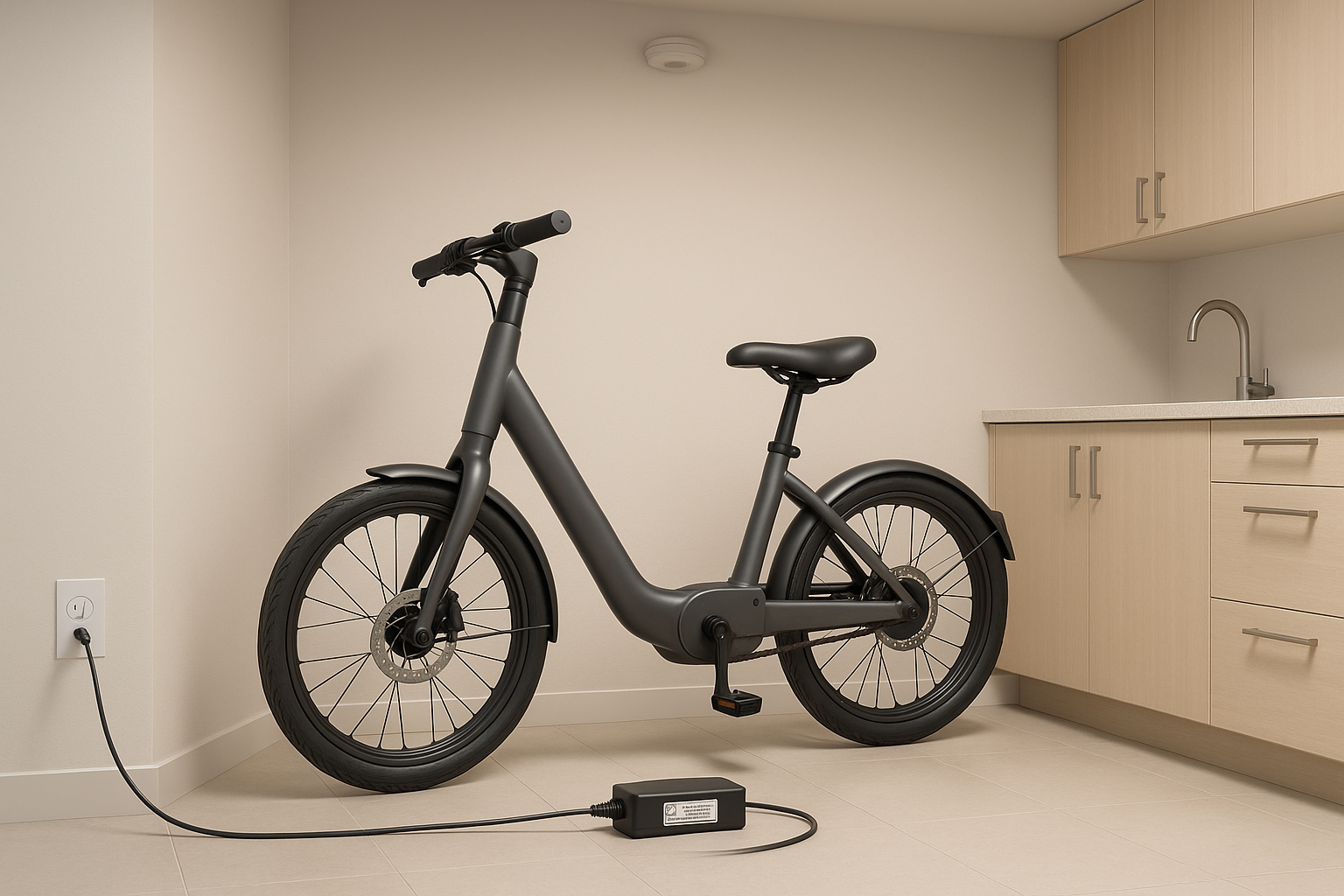
Short Hook — why this matters in multi-unit buildings:
Apartment living changes how you charge and store lithium-ion devices. Because you share walls, exits, and detection systems, a small mistake can affect many neighbors. Therefore, this guide translates standards and best practices into simple steps so you can charge safely, store batteries wisely, and communicate clearly with building management. Ultimately, apartment charging fire safety is about reducing risk without fear-mongering while keeping daily routines smooth.
Safety disclaimer: This guide provides general information only. Always follow your device manual, the guidance of your local fire authority, and your building’s rules. When in doubt, ask your manufacturer or a qualified professional.
What Makes Apartment Charging Different?
Multi-unit fire risk dynamics (shared egress, detection, suppression basics)
Apartments concentrate people, power, and combustibles; consequently, a small ignition can impact an entire floor. Hallways are shared egress routes; thus, blocking them with devices or cords raises risk during an emergency. Although centralized detection and suppression systems help, smoke can still spread quickly. As a result, good charging habits matter more in multi-unit than in single-family homes.
Key dynamics:
- Shared egress: Corridors and stairwells must stay clear; otherwise, obstructions delay evacuation.
- Compartmentation: Units are designed to contain fire for a period; however, open doors or early smoke migration can reduce that benefit.
- System dependencies: Detectors and sprinklers help; even so, early human response (noticing heat, smell, or noise) often prevents escalation.
Codes, rules, and who sets them (building mgmt, fire dept, insurers)
Several entities set the framework you operate within:
- Fire and electrical codes (e.g., NFPA 1, NFPA 70/NEC).
- Energy storage guidance for residential settings (e.g., NFPA 855).
- Certification standards for systems and batteries (e.g., UL 2849, UL 2271, UL 2272, UL 2054, UL 1642).
- Building management and insurers, who may add stricter rules than the minimum code to reduce liability.
- Local fire authority advisories, which often convert technical language into practical do’s and don’ts.
Accordingly, your building’s policy may be more restrictive than general code language, which is normal.
Battery Basics You Actually Need
Li-ion chemistries you’ll see (NMC/NCA vs LFP) in plain language
Most e-bikes and e-scooters use NMC (Nickel Manganese Cobalt) or NCA (Nickel Cobalt Aluminum) cells. These chemistries are energy-dense and common. By contrast, LFP (Lithium Iron Phosphate) is heavier for the same capacity yet more thermally stable, which some manufacturers prefer for longevity and safety margins. Nevertheless, all chemistries benefit from correct charging, storage at moderate State of Charge (SOC), and avoiding extreme heat or deep discharge. (UL 2271, UL 2054, IEC 62133)
State of Charge (SOC) explained; why extremes stress cells
SOC is the percent “fullness” of a battery. Storing at 100% for long periods stresses many chemistries; similarly, leaving a pack near 0% invites over-discharge and imbalance. In practice, most packs age slowest when stored around the middle of the SOC range. Consequently, daily riders may still charge higher for range, yet for storage, aim for mid-range unless your manufacturer says otherwise.
Additionally, for a practical look at how regenerative braking affects battery state-of-charge, range, and heat, see our guide on regenerative braking: types, limits & battery impact.
Thermal runaway 101; typical early warning signs
Thermal runaway is a rapid, self-heating failure that can lead to fire and smoke. Although it is rare relative to the number of cycles worldwide, consequences can be severe in tight spaces. Early indicators include:
- Unusual heat during light use or while idle.
- Sweet/solvent odors or hissing/popping sounds.
- Swelling, discoloration, or leaking.
If you notice these, isolate the device on a non-combustible surface, increase distance to combustibles, and contact a professional or emergency services if the condition escalates. (NFPA 1, local fire advisories)
Recommended SOC Storage Ranges (By Use Case & Temperature)
Important: Always check your device manual first; manufacturer guidance takes precedence. Even so, the tables below reflect common best practices for consumer LEV packs and align with principles found across battery standards and safety literature (UL 2271, UL 2054, IEC 62133).
Table 1 — Storage SOC by Use Case and Chemistry
Alt text: A table showing recommended SOC bands for short-term and long-term storage for NMC/NCA and LFP batteries.
Caption: Keep SOC near the middle for storage; rebalance monthly.
| Use Case | NMC/NCA Recommended SOC | LFP Recommended SOC | Notes |
|---|---|---|---|
| Short-term (days–weeks) | 40–60% | 40–70% | If you’ll ride soon, slightly higher SOC is fine; still, avoid 100% unless necessary. |
| Long-term (≥1–3 months) | 30–50% | 40–60% | Check SOC monthly; top up to mid-range; avoid deep storage near 0%. |
| Post-ride before storage | Cool to room temp first | Cool to room temp | Do not store hot; instead, let the pack rest before plugging in or storing. |
| After full charge | Ride soon or discharge to ~60% | Same | If you charged to 100%, ride a few minutes or use a timer to stop early. |
Table 2 — Storage SOC vs Temperature & Inspection Cadence
Alt text: A table mapping ambient temperature bands to SOC guidance and how often to check.
Caption: Temperature affects aging; therefore, warm conditions call for lower SOC and more frequent checks.
| Ambient Temperature | General SOC Guidance | Inspection Cadence | Notes |
|---|---|---|---|
| ≤ 0 °C / 32 °F | 40–60% | Check monthly | Avoid charging below freezing; instead, warm to room temp before charging. |
| 0–25 °C / 32–77 °F | 40–60% (NMC/NCA) / 40–60% (LFP) | Check monthly | This is the ideal range for storage; it is stable and predictable. |
| 25–35 °C / 77–95 °F | 30–50% | Check every 2–3 weeks | Because heat accelerates aging, store slightly lower SOC. |
| > 35 °C / 95 °F | 30–40% | Check every 1–2 weeks | If possible, relocate to a cooler area; avoid closed hot spaces. |
Safe Charging Setups in Apartments
Outlets, circuits, and loads (15A/20A circuits, shared loads, avoid “daisy-chains”)
Use a proper wall outlet with a grounded receptacle. On 15 A or 20 A circuits, mind other appliances on the same circuit; otherwise, nuisance trips may indicate overload. Do not “daisy-chain” power strips or stack adapters. If a breaker trips, locate the actual cause rather than bypassing protection. Where available, GFCI/AFCI protection adds a helpful layer. (NFPA 70)
Extension cords, power strips, and why most are a bad idea; what ratings to look for if unavoidable
Prefer no extension cord. However, if you must use one:
- Choose a heavy-duty, grounded, short cord rated above your charger’s draw.
- Avoid coiling cords tightly; otherwise, heat builds in coils.
- Skip thin, bargain cords and most multi-taps; they overheat under continuous loads.
Charger placement, ventilation, and surfaces
Place the charger and device on a hard, non-combustible surface (tile, stone, concrete). Additionally, keep the setup clear of curtains, bedding, paper, and clothes. Ensure ventilation around both charger and pack. Never cover a charging pack with anything that traps heat.
Day vs. overnight charging; supervision; timers; when to stop at ~80–90% for routine use
Prefer supervised, daytime charging. If you must charge in the evening, stay nearby and awake. For daily riders, stopping around 80–90% reduces time at high voltage and slows aging. Consequently, a plug-in timer or OEM app (when provided) can end the session automatically. Unplug when finished.
Understanding UL, ETL, CE, and Other Safety Marks
What UL actually certifies (and what it doesn’t)
UL develops safety standards and also performs testing/certification as a Nationally Recognized Testing Laboratory (NRTL). A UL mark means the specific product was evaluated to the specified UL standard, not that every device in a brand line is “UL-certified.” Therefore, verify the exact model and standard number on the label. (UL, NRTL framework)
Scope and correct usage of key standards
- UL 2849 — Complete electrical systems for e-bikes (system-level safety).
- UL 2271 — Battery packs for light electric vehicles (design and testing).
- UL 2272 — Electrical systems for certain self-balancing vehicles; sometimes referenced for other micromobility categories by policy, yet scope matters.
- UL 2054/UL 1642 — Rechargeable battery packs/cells (general).
- CSA, ETL (Intertek), TÜV/GS — Other reputable third-party labs and marks.
- CE (EU) and UKCA (UK) — Manufacturer conformity marks under regional directives; they are not the same as NRTL certification.
- EN 15194 — EPACs (EU e-bike systems).
- IEC 62133 — Portable secondary cells and batteries.
- UN 38.3 — Transport tests for lithium cells/packs.
How to verify marks on chargers, packs, and complete systems
Check the label for:
- Standard number (e.g., “UL 2849”).
- Model number, manufacturer, and file/listing number where applicable.
- Matching model in your documentation.
- No blurry, misspelled, or generic marks. Counterfeits often look “off.”
Warning — misleading labels: Some products imitate marks or misuse “CE” graphics. If a mark lacks a standard number, a model ID, or a legitimate certifier’s name, treat it as unverified.
Table — UL/Marking Quick-Reference
Alt text: A quick-reference table mapping each mark to scope and what to check on the label.
Caption: Match standards to device type; verify the exact model.
| Mark/Standard | Applies To | What It Means | What to Check |
|---|---|---|---|
| UL 2849 | E-bike systems | System-level eval of drive, battery, charger | Standard number + system model |
| UL 2271 | Battery packs | Pack design/testing for LEVs | Pack model, voltage, Wh |
| UL 2272 | Self-balancing systems | Electrical system safety | Only relevant categories |
| UL 2054 / UL 1642 | Packs / cells | General battery safety | Label clarity; manufacturer |
| ETL (Intertek) / CSA / TÜV/GS | Various | Third-party evaluation | Lab name, standard ref |
| CE (EU) / UKCA (UK) | Region compliance | Manufacturer declaration | Model ID; supporting docs |
| EN 15194 | EPACs (EU e-bikes) | System requirements | Marking + instruction alignment |
| UN 38.3 | Transport | Passes shipping tests | Shipping docs; pack ID |
Charging Etiquette for Neighbors and Building Rules
Shared spaces, corridors, and egress rules; don’t block exits
Never charge or store devices in hallways or stairwells; rather, use your unit or designated rooms. Keep cords out of walking paths. If your building provides a dedicated charging room, follow posted capacity and spacing rules.
Noise/odors, charging windows, and courtesy notifications
Fans and chargers can hum; therefore, pick reasonable charging windows. If a pack emits odors or heat, stop, isolate, and inform management if required by building policy.
Storing multiple devices (family/roommates): spacing, rotation, and labeling
Label each device and charger. Additionally, keep 15–30 cm (6–12 in) between packs during storage. Rotate which device charges first so no pack sits at 100% all week.
Where NOT to Charge or Store (and Safer Alternatives)
Avoid:
- Bedrooms and beds.
- On couches, rugs, or piles of clothes.
- Inside closets with poor airflow.
- Hallways and stairwells (egress).
- Enclosed cars in hot garages.
Prefer:
- A tiled kitchen corner or utility area with hard, non-combustible surfaces.
- A small fire-resistant pad/box designed for battery storage (if allowed by your building).
- A location with a smoke alarm nearby (not directly above a steam-heavy zone).
- A cool, dry space away from direct sun.
Pre-Charge, During-Charge, and Post-Charge Checklists
Pre-Charge Checklist
- Inspect charger, cord, and connector for damage; additionally, check for bent pins.
- Confirm the correct charger model for your device.
- Place device and charger on a hard, clear surface.
- Ensure ventilation and keep combustibles away.
- Confirm supervision plan and timer (if you stop at ~80–90%).
- Verify outlet condition; avoid daisy-chained strips.
During-Charge Checklist
- Stay within earshot and eyesight.
- After the first 10–20 minutes, feel the pack case briefly: warm can be normal; hot is not.
- Watch for smell, smoke, popping/hissing, or swelling.
- Keep children and pets away from cords and chargers.
- If anything seems off, stop charging and isolate the device.
Post-Charge Checklist
- Unplug the charger from the outlet and device (unless your manufacturer instructs otherwise).
- Allow the pack to cool before handling or storing.
- Store at mid-SOC if not riding soon.
- Coil cords loosely to avoid damage; don’t pinch cables in doors.
“If Something Seems Off” Mini Decision Tree
- Unusual heat/smell/noise? → Stop charging immediately.
- Isolate on a non-combustible surface; clear surrounding area.
- Observe from a safe distance; if escalation occurs (smoke, flames), evacuate and call emergency services.
- If stabilized but suspicious, do not reuse until inspected by the manufacturer or a qualified technician.
Recognizing Problems Early
Heat, swelling, popping/hissing, sweet/solvent odors, discoloration
These are early flags of failure. Notably, a sweet, solvent-like odor can precede visible smoke. Likewise, hissing or popping may indicate venting. Swelling or discoloration demands immediate isolation. Do not puncture or compress a swollen pack.
Immediate actions and safe evacuation steps; what NOT to attempt
- If the pack vents or ignites, evacuate, close doors behind you to compartmentalize, and call emergency services. (NFPA 1)
- Do not throw water on energized electrical components; firefighters will manage tactics.
- Do not carry a venting pack down a hallway; instead, distance yourself and wait for responders.
Storage for Weeks/Months
SOC maintenance schedule; top-up cadence; temperature/ventilation
For NMC/NCA and LFP, storage around 40–60% in a cool room slows aging. Additionally, check SOC monthly; top up to the middle. Keep airflow around the pack and avoid closed, hot closets.
Partial discharge before storage; transport considerations; seasonal changes
If you charged to 100% but cannot ride soon, run the device for a short trip to bring it toward ~60%. For transport, ensure the device meets UN 38.3 requirements (especially for shipping). During summer, consider slightly lower SOC; during winter, warm packs to room temperature before charging.
Myths vs. Facts
- Myth: “LFP can sit at 100% forever.”
Fact: LFP is more tolerant; nevertheless, mid-SOC storage still reduces aging. - Myth: “A UL logo anywhere means the whole product is safe.”
Fact: The mark must match the specific model and standard. (UL 2849, UL 2271) - Myth: “Trickle charging overnight is harmless.”
Fact: Unnecessary time at high voltage raises stress; instead, prefer supervised and timed sessions. - Myth: “If it doesn’t feel hot, it’s fine.”
Fact: Odors, hissing, or swelling are also red flags. - Myth: “Any phone charger will do.”
Fact: Use the manufacturer-approved charger only; otherwise, wrong chargers risk failure. - Myth: “Storing at 0% preserves cycles.”
Fact: Deep storage invites over-discharge and imbalance. - Myth: “CE equals UL.”
Fact: CE/UKCA are manufacturer declarations; conversely, NRTL marks are third-party certifications.
Insurance, Warranties, and Building Policies
What insurers/buildings may require; documenting devices; photos/receipts
Insurers and managers may require UL-listed systems, no hallway charging, and supervised charging only. Accordingly, keep receipts, serial numbers, and photos of labels. Document maintenance and firmware updates. If you modify a battery, you may void warranties and violate policies.
Sample “Apartment LEV Policy” One-Pager (Template)
Title: Light Electric Vehicle (LEV) Charging & Storage Policy
Scope: E-bikes, e-scooters, and similar devices used by residents.
Rules:
- Charge only with manufacturer-approved chargers on hard, non-combustible surfaces.
- No charging or storage in hallways, stairwells, or common egress areas.
- Overnight charging discouraged; instead, use timers to stop at ~80–90% when possible.
- Keep devices and chargers free of combustible materials; maintain clear ventilation.
- Inspect cords, chargers, and packs before each charge; report damage.
- Store at mid-SOC (40–60%) when unused for more than a week; check monthly.
- Only certified products (e.g., UL 2849 systems or UL 2271 packs) permitted; labels must be intact and legible.
- In case of odor, heat, smoke, or swelling: stop, isolate, evacuate if needed, and notify management.
Acknowledgment: Resident signature/date.
International Notes (EU/UK vs. US)
CE and UKCA vs. UL/ETL; EN 15194 (EPACs), UN 38.3, IEC 62133 insight; local fire authority advisories
In the US, NRTL marks like UL or ETL are central. In the EU/UK, CE/UKCA are declarations of conformity, while EN 15194 governs EPAC/e-bike system requirements. Meanwhile, IEC 62133 covers portable secondary cells and battery packs worldwide. UN 38.3 controls transport safety, not daily charging rules. Regardless of region, local fire authority advisories translate standards into practical resident guidance for apartment life.
Risk Matrix: Typical Apartment Scenarios
Alt text: A matrix rating common apartment charging/storage scenarios by likelihood and severity.
Caption: The goal is to move scenarios into lower-right (low likelihood and low severity) through simple habits.
| Scenario | Likelihood (L) | Severity (S) | Risk (L×S) | Mitigation |
|---|---|---|---|---|
| Supervised daytime charge on tile with OEM charger | Low | Low | Low | Keep clear space; stop at 80–90%; unplug when done. |
| Overnight charge in bedroom on carpet | Medium | High | Higher | Avoid bedroom; use timer; move to kitchen tile; supervise. |
| Using thin extension cord under rug | Medium | Medium | Medium | Use no cord or heavy-duty, short, grounded cord; don’t cover. |
| Charging in hallway/stairwell | Low–Medium | High | Higher | Prohibited; move inside unit; keep egress clear. |
| Storing at 100% next to radiator | Medium | Medium–High | Higher | Store at 40–60% away from heat; check monthly. |
| After crash: pack looks fine, charged immediately | Low–Medium | High | Higher | Inspect first; if in doubt, isolate and have it evaluated. |
| Multiple devices packed together at 100% | Medium | Medium–High | Higher | Space 15–30 cm; mid-SOC; stagger charges. |
FAQs
- Is partial charging better for daily use?
Yes. Stopping around 80–90% reduces time at high voltage and can slow aging; moreover, it usually preserves enough range. - Is overnight charging ever okay?
If you must, set a timer, charge on a hard, non-combustible surface, and avoid bedrooms. Nevertheless, supervised daytime charging is safer. - Can I leave the charger plugged in after it’s “full”?
Unplugging is cleaner and keeps heat down. While some systems manage it well, less time energized is generally better. - How do I spot counterfeit chargers?
Look for missing standard numbers, blurry logos, mismatched model names, and suspiciously light bricks. When possible, buy from the device manufacturer or an authorized seller. - Are battery storage bags worth it?
A quality fire-resistant container/pad can add a layer of protection; however, it is not magic. You still need mid-SOC, spacing, and supervision. - What SOC should I use for vacation storage?
About 40–60%, cool room, and check on return. If you’ll be gone for months, ask a trusted person to check monthly. - Is LFP maintenance-free?
No chemistry is maintenance-free. LFP is more stable; nonetheless, it still benefits from mid-SOC storage and avoiding high heat. - Do I need a GFCI outlet?
It’s beneficial in many settings. Furthermore, follow electrical code and manufacturer instructions. (NFPA 70) - Can I charge on the balcony?
Only if your building allows it and weather will not wet the equipment. Additionally, keep away from sun and combustibles. - What if my pack got wet?
Dry the exterior, keep it off charge, and contact the manufacturer. Water ingress can be dangerous; therefore, do not attempt to charge until cleared. - Can I repair a damaged pack?
Do not attempt DIY pack repairs. Instead, contact the manufacturer or a certified service partner. Unauthorized repairs may void warranties and violate building policy. - Should I update firmware?
Yes, if the manufacturer provides updates that improve charging, BMS behavior, or safety. As always, follow official instructions.
Glossary of Terms (A–Z)
- AFCI: Arc-Fault Circuit Interrupter; detects arcing faults.
- BMS: Battery Management System; monitors cells, balancing, temperature.
- CE/UKCA: EU/UK conformity marks; manufacturer declarations.
- GFCI: Ground-Fault Circuit Interrupter; protects against shock hazards.
- IEC 62133: International safety standard for portable secondary cells/packs.
- LFP: Lithium Iron Phosphate cell chemistry; stable, lower energy density.
- NCA/NMC: High energy-density lithium chemistries common in LEVs.
- NRTL: Nationally Recognized Testing Laboratory; third-party certifier.
- NFPA 1 / NFPA 70 / NFPA 855: Fire code, electrical code, and energy storage guidance.
- SOC: State of Charge; percentage of battery capacity filled.
- Thermal runaway: Rapid self-heating failure that can lead to venting or fire.
- UL 2849 / 2271 / 2272 / 2054 / 1642: Key UL standards for systems, packs, and cells.
- UN 38.3: Transport testing requirements for lithium cells/packs.
Final Safety Recap (Screenshot-Friendly)
Do:
- Charge supervised, on hard, non-combustible surfaces.
- Use the manufacturer’s charger and keep cords uncoiled and undamaged.
- Store at ~40–60% SOC if not riding for a while; check monthly.
- Keep space between devices and away from heat sources.
- Unplug when finished; use timers to avoid 100% when possible.
- Verify labels and standards match your exact model.
Don’t:
- Charge in bedrooms, on beds/carpets, or in hallways.
- Daisy-chain power strips or hide cords under rugs.
- Ignore smells, heat, swelling, or noises.
- Store packs hot or at 100% for long periods.
- Attempt DIY pack repairs.
Visuals & Data Elements Recap
- ✅ 2 tables for SOC & temperature guidance.
- ✅ 1 quick-reference table for UL/markings.
- ✅ 3 step-based checklists + a mini decision tree.
- ✅ 1 simple risk matrix.