
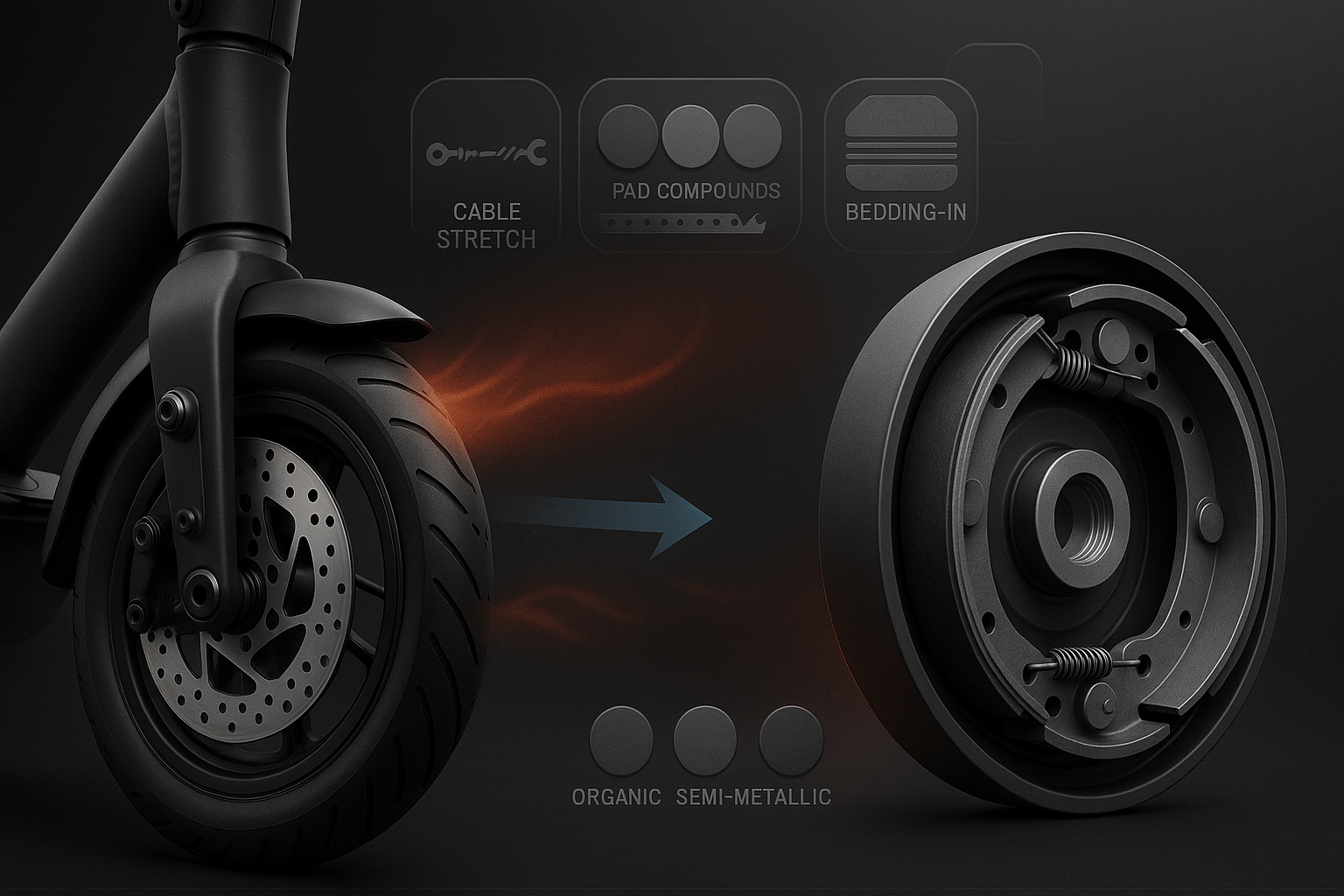
Good brakes are not optional on an electric scooter; they are your last line of defense. When electric scooter brake performance is dialed in, the scooter stops smoothly, predictably, and straight. Consequently, this expert guide translates standards-aligned principles into practical steps you can perform at home or at the shop—so you can stop shorter, control heat, manage noise, and keep performance consistent over time. Additionally, for broader upkeep on a popular commuter family, see our companion piece on the Segway Ninebot MAX G30/G2/G3 care and upgrades: common fixes & best add-ons.
How Scooter Brakes Work (Plain English)
Braking converts your motion into heat and then sheds that heat to the air and wheel. In a scooter, the sequence is simple; nevertheless, each link matters:
Lever → cable or hose → caliper or drum cam → friction pair (pad–rotor or lining–drum) → tire contact patch → ground.
Because every interface can waste effort, understanding the parts is essential:
- Lever ratio: The distance between the lever pivot and the cable or piston attachment creates mechanical advantage. As a result, a longer effective lever ratio reduces hand force but may increase lever travel.
- Cable stretch vs housing compression: Steel inner wires elongate microscopically under load, while plastic or spiral-wound housings compress. Together, they consume lever travel and dull initial bite. Hydraulics are not immune either; hoses can expand if old or damaged.
- μ (mu), the friction coefficient: Pad or lining material converts motion to heat against a rotor or drum. Consequently, a stable μ gives consistent lever feel and stopping force. (ISO 611, 2019)
- Heat and fade: If friction surfaces or fluid overheat, μ drops and lever feel changes. You may squeeze harder yet stop slower; therefore, heat management is critical.
- Contamination: Oils, cleaners, or road film reduce μ. Likewise, dust and moisture alter bite and can cause squeal.
Key takeaway: Stopping power is the sum of small efficiencies. Therefore, fixing cable losses, pad choice, and alignment often transforms the result. (ISO 611, 2019)
Disc vs Drum — The Fundamentals
Disc brakes use a caliper to clamp pads against a metal rotor attached to the wheel. Accordingly, heat flows into the rotor and then into air. Water and mud get flung outward, and the rotor cools quickly because it is exposed.
Drum brakes press shoes (with friction linings) outward against an internal drum surface. In contrast, the system is sealed against splash and grit, but it sheds heat more slowly. Additionally, drum designs can “self-energize,” meaning rotation helps pull the shoe into the drum for higher effective μ.
Pros & Cons at a glance
| Factor | Disc Brake | Drum Brake |
|---|---|---|
| Weight | Often lighter at the wheel for similar power | Often heavier, integrated hub |
| Modulation | Very good, wide lever feel range | Good once set, narrower feel window |
| Wet performance | Strong; water is shed quickly | Predictable; sealed, but can hold moisture briefly |
| Contamination tolerance | Pads/rotor are exposed; sensitive to oils | Better sealed against grime; linings can glaze |
| Serviceability | Pads/rotor are simple to inspect/replace | Shoes live inside hub; inspection requires removal |
| Heat management | Excellent convective cooling | Slower heat rejection; fade more likely on long descents |
| Cost/complexity | Broad parts availability | Fewer aftermarket options |
Bottom line: Disc systems excel in heat management and modulation. Drum systems, however, excel in low maintenance and weather sealing. Therefore, choose based on terrain, mass, and service preferences.
Mechanical Disc: Where Performance Comes From
Mechanical disc brakes turn lever motion into cable pull and pad clamp force. Consequently, several elements drive performance:
- Caliper type:
- Single-piston designs move the inboard pad while flexing the rotor into the outer pad. They work; however, alignment is sensitive.
- Dual-piston designs move both pads symmetrically, thereby improving pad contact and modulation.
- Rotor diameter/thickness: A larger rotor increases effective radius, which increases torque for the same clamp force. Thicker rotors resist warping and heat up more slowly. Even so, always follow your owner’s manual for rotor size compatibility.
- Pad area and compound: Area influences heat capacity; nonetheless, compound choice shapes μ stability, noise, and wet bite more than raw area.
- Alignment and toe-in: Centering the caliper over the rotor is essential. Moreover, a whisper of toe-in (leading edge slightly closer) can tame squeal on some systems. Always follow your manufacturer’s procedure.
- Housing compression and cable friction: Linear-pull (compressionless) housing maintains lever feel. Additionally, gentle routing, minimal tight bends, and clean end caps reduce friction.
Rotor torque intuition: Conceptually, brake torque ≈ normal clamp force × effective radius. Therefore, increasing clamp force (within system limits) or radius (larger rotor, if approved) raises torque. Do not exceed the parts and fork/frame ratings. (ISO 4210-4, 2023)
Hydraulic Disc in E-Scooters (If Equipped)
Some scooters use compact hydraulic calipers and levers. Because hydraulic systems multiply force through fluid pressure, they provide:
- Consistent leverage: Pressure distributes evenly to pistons, improving pad contact and reducing rotor rub if aligned correctly. Furthermore, lever feel remains stable as pads wear.
- Heat and fade resistance: Pads and rotors still heat; however, lever feel stays consistent if fluid is fresh, bled, and seals are healthy.
- Pad knock-back: Rotor flex or wheel impacts can push pistons back, creating a longer first lever pull. Consequently, proper wheel true and strong hub bearings help.
- Maintenance: Regular bleeds, clean reservoirs, and correct fluid type are key. In addition, replace hoses or seals if sponginess persists.
Hydraulics often benefit heavier riders, cargo loads, or steep terrain where repeated stops generate more heat and require lower hand force. Nevertheless, respect fluid specifications and service intervals from your manual. (EN 17128, 2023)
Drum Brakes on Scooters
Drum brakes hide the friction surfaces inside the hub. As a result, they are:
- Self-energizing: Rotation can help pull the leading shoe into the drum, increasing effective μ. This reduces required hand force, particularly at low speeds.
- Stable in poor weather: The enclosure reduces splash contamination; however, trapped moisture can briefly reduce bite until warmed.
- Wear patterns: Shoes wear unevenly if the cam or pivot is misaligned. Consequently, glazing—smooth, shiny linings—lowers μ and increases noise.
- Adjustment window: Cable slack and the shoe–drum gap both affect lever travel. Therefore, proper free play keeps drag away and maintains bite.
- Heat considerations: Drums shed heat more slowly, so long downhills demand speed management and, if available, balanced use with regenerative braking.
Follow your manufacturer’s guidance on inspection intervals, shoe replacement criteria, and drum condition limits. (Manufacturer Manual, 2025)
Cable Stretch, Housing Compression & Leverage — The Hidden Losses
Many scooters leave stopping power on the table because of cable system losses. Accordingly, address the entire path:
- New cable “bed-in”: Inner wires settle; ferrules seat; housing end caps compress slightly under the first rides. Therefore, expect to re-tension once.
- Ferrule seating: Poorly seated ferrules act like springs. Thus, square-cut, clean housing ends and matched ferrules reduce mushy feel.
- Routing: Avoid sharp bends and long loops. Every bend increases friction; instead, choose the smoothest path.
- Lubrication: Use only lubricants approved for your cable and housing. Otherwise, some liners designed to run dry can swell or degrade.
Step-by-step cable setup
- Cut & square: Measure twice, cut once. Use sharp cutters. Then deburr housing ends flat and clean.
- Ferrules on: Install matched ferrules; next, test-fit into levers and calipers for full seating.
- Prep inner wire: If applicable, apply a thin film of compatible cable lube.
- Thread & route: Follow the smoothest path with gentle curves.
- Pre-tension: Pull cable snug at the caliper so pads sit close without rubbing.
- Anchor: Tighten the pinch bolt to the specified torque (lb-ft, N·m).
- Stretch cycle: Squeeze the lever firmly 10–15 times, then re-check tension.
- Re-anchor: Re-tighten if slack appears; finally, verify lever free-stroke and pad clearance.
Checklist: 60-second pre-ride brake feel test
- Squeeze each lever hard. Does it firm up early and stop before the grip?
- Spin the wheel. Any rub or drag?
- Pull again. Is the feel consistent from pull to pull?
- Roll the scooter and stop from a walking pace. Straight and predictable?
- Inspect cable ends for fray; moreover, verify ferrules are fully seated.
Pad Compounds & Rotor Pairing
Pad compound sets μ stability, noise, rotor wear, and heat tolerance. Choosing the right compound for your terrain and mass is a major lever for electric scooter brake performance. Additionally, pairing compounds to conditions improves both bite and longevity.
Common compound families
- Organic/Resin: Fast warm-up, quiet, excellent modulation. Lower heat ceiling and faster wear in grit. Gentle on rotors.
- Semi-metallic: Mixed fibers with metal content. Broader temperature window, stronger bite when warm, sometimes noisier. Moderate rotor wear.
- Sintered/Full Metallic: High heat resistance, strong bite when hot, best for long descents. Louder and harder on rotors. Needs heat to perform best.
Table 1: Compound → Initial Bite → Modulation → Wet Grip → Noise → Rotor Wear → Best Use
| Compound | Initial Bite | Modulation | Wet Grip | Noise | Rotor Wear | Best Use |
|---|---|---|---|---|---|---|
| Organic / Resin | High cold bite | Excellent | Good | Low | Very Low | Daily commuting, flat to rolling terrain |
| Semi-metallic | Medium–High | Very good | Good–Very good | Medium | Medium | Mixed terrain, heavier riders, moderate hills |
| Sintered / Metallic | Medium cold, high hot | Good | Good when warm | Higher | Higher | Long descents, heavy loads, wet grit, high heat |
Tip: Heavier riders or hilly routes often benefit from semi-metallic or sintered front pads for heat stability, while keeping organic pads at the rear for quiet balance. Nevertheless, always confirm pad compatibility with your rotor and caliper.
Bedding-In Pads/Rotor (Standards-Aligned, Safe)
Bedding-in deposits a thin, uniform transfer layer of pad material onto the rotor. This layer stabilizes μ, improves initial bite, and reduces noise. The goal is even contact and controlled heat—not hero stops.
A conservative, standards-aligned protocol
- Warm-up: In a safe area, perform 5–8 gentle slows from ~15 mph (25 km/h) to walking pace. Do not stop completely. Meanwhile, allow rolling cool-down between slows.
- Build: Do 6–10 stronger slows from ~20 mph (32 km/h) to ~5 mph (8 km/h), still avoiding a full stop. Separate each with easy coasting to shed heat.
- Set: Perform 2–3 firmer near-stops while keeping the wheel rolling slightly at the end to avoid imprinting pad material in one spot.
- Cool-down: Ride at moderate speed without braking for a minute to carry heat away.
- Inspect: Check for even pad contact and no glazing. Pads should look evenly matted, not glassy.
Signs of success: Stronger initial bite, less lever travel for the same stop, quieter operation.
Signs of glazing: Squeal, shiny pad surface, reduced bite. Lightly scuff pads per your manual or replace if glazing persists. (ISO 4210-4, 2023; SAE, 2022)
Important: Some manufacturers specify different cycles or cautions. Accordingly, follow your owner’s manual first. Avoid specific temperature targets unless the manual provides them.
Heat, Fade & Recovery
Kinetic energy rises with speed squared. Consequently, doubling speed quadruples energy to shed. Heat stacks when stops are close together, on long downhills, or with heavy riders and cargo.
Types of fade
- Pad fade: μ drops when pad resins overheat or surfaces gas out. You feel less bite and must pull harder; therefore, spacing stops helps.
- Fluid/lever fade (hydraulic): Boiling or micro-bubbles compress, lengthening lever travel. As a result, a proper bleed is essential.
- Mechanical fade: Cable expansion and housing compression increase under heat, softening feel. Consequently, premium housing can reduce this.
Recovery tactics
- Space out hard stops to add cool-down time.
- Lower speed before the steep section starts; then, maintain moderate pace.
- Use regenerative braking early if available, while remembering it fades at low speed or high state of charge.
- If fade appears, back off and allow a full cool-down; afterward, re-check lever feel. (EN 17128, 2023)
Regen & Blended Braking (If Your Scooter Has It)
Regenerative braking uses the motor as a generator to slow the wheel and recharge the battery slightly. Typically, it:
- Works best at moderate speed and lower state of charge.
- Drops off at walking pace, because motor back-EMF declines.
- Should never replace mechanical brakes as your primary stop.
Coordination tips
- Set regen to a moderate level so it trims speed early; then finish with the mechanical lever.
- Do not rely on regen for emergency stops. Instead, treat it as a helper.
- If regen changes after firmware updates or battery service, re-test your stopping loop. (Manufacturer Manual, 2025)
Wet Weather, Dust, and Contamination
Water reduces initial bite until pads squeegee the film away. Dust and oils lower μ and trigger noise. Consequently, your cleaning routine matters.
Best practices
- After washing or rain, perform a few gentle stops to dry rotors or drums.
- Keep chain lubes, aerosol protectants, and cleaners off friction surfaces. Therefore, mask rotors before spraying nearby parts.
- If pads become contaminated, follow your manual: some specify replacement; others allow careful decontamination with approved cleaners.
- For drums, brief reduced bite after immersion can occur. With multiple light applications, performance returns as heat drives moisture out.
Setup & Adjustment — Disc and Drum (Step-by-Step)
Disc (mechanical or hydraulic)
- Inspect rotor: Check for true and damage; if in doubt, compare lever feel across rotations.
- Center caliper: Loosen mount bolts, apply the lever, then tighten to spec so pads straddle the rotor evenly.
- Set pad clearance: Adjust inner and outer pads (if applicable) to minimize lever travel without rub.
- Verify lever free-stroke: You should feel a light gap before solid bite; otherwise, reduce cable tension or reset pistons.
- Anchor cable (mechanical): Pull slack, secure to torque spec, and test for slip.
- Re-check at axle torque: Tightening the axle can shift rotor alignment slightly; therefore, re-center if required.
- Test roll: Spin wheel, check for rub, then perform a gentle stop.
Drum
- Free play: Set lever free play per manual; too little causes drag, too much causes long pull.
- Equalize contact: If adjustable, ensure both shoes contact evenly. Otherwise, inspect cam orientation.
- Cable angle: Confirm the arm angle matches the manufacturer’s range to optimize cam leverage.
- Return spring: Verify snappy return without binding.
- Drag test: Spin wheel. Light, even drag during first pulls is acceptable; persistent drag needs re-adjustment.
- Road test: Perform short, straight stops and check for tracking or noises.
Table 2: System → Key Adjustment → Target Feel → Typical Mistake → Quick Fix
| System | Key Adjustment | Target Feel | Typical Mistake | Quick Fix |
|---|---|---|---|---|
| Disc (mech) | Caliper centering | Pads engage evenly, no rub | Tighten one mount first | Squeeze lever while tightening both |
| Disc (hyd) | Pad spacing | Short free-stroke, firm bite | Over-spacing pads | Reset pistons per manual; re-center |
| Disc (mech) | Cable tension | Early bite without drag | Over-tension causing rub | Back off barrel adjuster; re-seat ferrules |
| Drum | Lever free play | Manual-specified free play | Zero free play | Lengthen cable; verify arm returns |
| Drum | Shoe equalization | Even, quiet stops | One shoe leading hard | Re-seat cam, inspect pivots, re-adjust |
| Any | Rotor/drum cleanliness | Quiet, strong bite | Cleaner overspray | Decontaminate per manual; re-bed |
Maintenance Intervals & Wear Limits
Create a seasonal routine (or mileage-based plan) and stick to it. Replace parts when they hit wear limits specified by your manufacturer. In practice, proactive service reduces noise, prevents fade, and preserves consistency.
What to check
- Pad/shoe thickness: Replace when at or above the manual’s minimum thickness. Otherwise, stopping distances can grow suddenly.
- Rotor condition: Look for scoring, grooves, or color changes from overheating. Follow the manual for runout and thickness limits.
- Cables: Inspect for fray, corrosion, or kinks. Replace at first sign of damage; moreover, keep spares on hand.
- Housing and ferrules: Check end caps for collapse and housing for cracks.
- Bolts and torque spots: Verify caliper mounts, rotor bolts, lever clamps, axle nuts at specified lb-ft (N·m).
- Hydraulic health: Look for fluid leaks, cloudy fluid, or spongy feel. Bleed or service per interval.
When in doubt, replace friction parts early. Safety outweighs squeezing the last miles from pads or shoes. (Manufacturer Manual, 2025)
Troubleshooting (Decision Tree)
Use this quick flow before deep dives; it narrows causes efficiently:
- Soft lever / long pull?
- Check free play → cable stretch → pad clearance → air in hydraulics → contamination. Then fix in that order.
- Squeal?
- Clean rotor/drum → re-bed → adjust toe-in/centering → change compound if persistent.
- Pulsing under brake?
- Check rotor true/runout → drum ovalization → hub bearings → pad deposition spots.
- Weak wet braking?
- Perform drying stops → check pad compound suitability → decontaminate and re-bed.
- Drag after release?
- Reduce cable tension → verify return spring → re-center caliper → inspect piston rollback.
Table 3: Symptom → Likely Cause → Quick Test → Fix Now → Prevent Next Time
| Symptom | Likely Cause | Quick Test | Fix Now | Prevent Next Time |
|---|---|---|---|---|
| Soft/long lever | Cable stretch, air in fluid, pad setback | Pump lever twice | Re-tension cable or bleed | Re-check after first 25–50 miles (40–80 km) |
| Squeal | Contamination, glazing, misalignment | Alcohol wipe; light scuff | Decontam; re-bed; re-center | Mask rotors during sprays |
| Pulsing | Rotor warp, pad imprint, drum ovalization | Spin + light rub test | True or replace rotor; resurface drum | Avoid hot hold at full stop |
| Drag | Over-tension, sticky piston, shoe misfit | Wheel spin test | Back off adjuster; service caliper | Verify free play each service |
| Weak wet bite | Water film, wrong compound | Drying stops | Switch to semi-metallic/sintered front | Keep friction surfaces clean |
| Fade on descents | Heat stacking | Staged stops | Cool-down; lower speed early | Plan speed before the hill |
| Sudden bite loss | Oil contamination | Smell/film check | Replace pads; deep clean | Store away from aerosols |
Testing Protocol: Prove Your Brakes in 15 Minutes
Find a safe, flat loop free of traffic. Wear protective gear. Then proceed methodically:
- Warm-up & confirm: Two gentle rolling stops to verify basic function.
- Bedding-in touch-up: 4–6 moderate slows from ~15 mph (25 km/h) to ~5 mph (8 km/h).
- Consistency test: 3 firm stops from ~15 mph (25 km/h) to near standstill, spaced by coasting.
- Emergency simulation: One maximum-effort stop from ~15 mph (25 km/h). Keep weight back, stay straight, and release slightly if the wheel skids.
- Heat build test: Two back-to-back firm slows from ~20 mph (32 km/h). Evaluate for fade.
- Wet-patch pass (if safe): Ride through a shallow, clean wet section, then perform two gentle drying stops.
- Post-test inspection: Check for rub, pad glazing, loose hardware, or lever travel changes.
A pass feels like: Predictable initial bite, smooth growth with more lever squeeze, straight tracking, and unchanged lever feel. Rework is needed if the lever pulls to the grip, the scooter pulls to one side, or noise appears with reduced bite.
Heavier Riders & Braking
Mass increases energy dramatically; therefore, heavier riders should plan for robust friction and cooling.
- Rotor size and pad choice: If your manual permits, larger rotors and semi-metallic or sintered front pads help stabilize heat. Conversely, if upgrades are not allowed, reduce descent speed.
- Cable vs hydraulic: Hydraulics reduce hand force for repeated stops. If you stay mechanical, use compressionless housing and premium cables.
- Inspection frequency: Shorten intervals for pad checks, rotor/drum inspections, and cable condition.
- Downhill strategy: Enter descents slower; moreover, pulse braking to keep parts cooler. (EN 17128, 2023)
Parts & Materials Quality Signals
Choosing quality parts prevents headaches later. Therefore, review these cues:
- Rotor markings: Stamped thickness and rotation arrows; crisp edges, uniform finish, and correct bolt patterns.
- Pad backing plates: Flat, rigid, with secure bonding; no flaking.
- Hardware grade: Caliper and rotor bolts should match grade specs in your manual.
- Anti-rattle features: Spring clips and pad retainers reduce noise and chatter.
- Cables/housings: Stainless inner wires resist corrosion; compressionless housings maintain feel.
- Counterfeit cues: Misspellings, poor finish, inconsistent dimensions, or packaging without specs.
Buy parts that match your scooter’s approvals. When in doubt, choose components documented for your system; then test carefully.
Safety Do’s & Don’ts (Printable)
Do
- Verify critical torques in lb-ft (N·m) per your manual.
- Perform drying stops after rain or washing.
- Re-bed pads after contamination or rotor replacement.
- Inspect after the first 25–50 miles (40–80 km) and after impacts.
- Keep cleaners and oils away from friction surfaces.
Don’t
- Ride if the lever pulls to the grip or if brakes drag badly.
- Exceed rotor size limits or misuse adapters.
- Clamp a brake lever during transport on a loose wheel—pad imprint risk.
- Mix incompatible pads and rotors.
- Ignore unusual noises paired with weaker bite.
Electric Scooter Brake Performance — Putting It All Together
Improving electric scooter brake performance means stacking small wins. Accordingly, follow this sequence:
- Start with clean, correctly installed parts that the manufacturer approves.
- Remove cable and housing losses; then set precise pad clearances.
- Choose pad compounds for your mass, terrain, and weather.
- Bed-in carefully to build an even transfer layer.
- Manage heat on descents and use regen as a helper, not a crutch.
- Re-test after service and keep a simple maintenance log.
Follow these steps and your scooter will stop shorter, straighter, and more quietly, ride after ride.
FAQs
How long does bedding-in take?
Usually one short session. After 10–20 progressive slows with cool-downs, you should feel stronger bite. Sometimes a second ride helps; in that case, repeat the build phase.
Can I mix pad compounds front and rear?
Yes, if compatible. Many riders use a higher-heat compound up front and a quieter organic pad at the rear. Nevertheless, confirm compatibility with your rotor and caliper.
My brakes squeal but still stop well—should I worry?
Noise alone is not failure. However, squeal can signal contamination, glazing, or alignment issues. Clean, re-bed, and re-center; if needed, change compounds.
Do drum brakes need less maintenance than discs?
Often yes, thanks to sealing. Still, shoes wear, cams need inspection, and drums can glaze. Therefore, follow service intervals.
Will hydraulic brakes always stop better than mechanical?
Hydraulics reduce hand force and keep feel consistent. Mechanical systems can be excellent if set up perfectly with compressionless housing; consequently, either can perform when tuned.
Can I rely on regen braking alone?
No. Regen fades at low speed and high state of charge. Mechanical brakes remain primary; moreover, they are essential for emergency stops.
What’s the fastest way to improve stopping today?
Clean and re-bed your system, re-center the caliper or reset drum free play, and remove cable slack. Typically, small adjustments deliver big gains.
Why does my lever feel different after wheel removal?
Pad knock-back or rotor positioning changed. Re-center the caliper, confirm axle torque, and pump the lever; afterward, re-test on a safe loop.
Is rotor size upgrade always better?
Only if approved by your manufacturer. Larger rotors change leverage and can exceed fork/frame limits. When allowed, they improve heat handling and torque; otherwise, optimize pads and setup.
Where can I find a “brake performance guide” for my exact model?
Your owner’s or service manual is the authoritative source. Use this guide for principles; then apply the model-specific instructions precisely.
Glossary (Plain English)
- μ (Friction Coefficient): A number describing how grippy the pad/lining is against the rotor/drum.
- Bedding-in / Transfer Layer: The process and thin film of pad material on the rotor that stabilizes bite.
- Glazing: Overheated, glassy pad or shoe surface that reduces μ and makes noise.
- Fade: Loss of braking power due to heat in pads, fluid, cable, or drum/rotor.
- Runout: Wobble in the rotor; felt as pulsing under the lever.
- Toe-in: Slight leading-edge bias in pad alignment to reduce squeal.
- Free-stroke / Free Play: Lever movement before pads or shoes engage.
- Lever Ratio: Mechanical advantage from lever geometry that reduces hand force.
- Housing Compression: Squish of the brake housing that absorbs lever travel.
- Knock-back: Pistons pushed back by rotor flex or impacts, causing extra first pull.
- Sintered Pad: High-metal pad baked for heat stability.
- Organic/Resin Pad: Non-metallic pad with fast warm-up and quiet operation.
- Semi-metallic Pad: Mixed pad balancing heat stability and modulation.
- Contamination: Oils, cleaners, or grime on friction surfaces that lower μ.
- Self-energizing (Drum): Rotation that pulls the leading shoe into the drum to increase effective μ.
- Modulation: The fine control of braking force with lever input.
- Imprint: Pad material transferred unevenly to a hot rotor during a stop-and-hold.
- Barrel Adjuster: A threaded adjuster that fine-tunes cable tension at the lever or caliper.
References (no URLs)
- EN 17128 (2023)
- ISO 4210-4 (2023)
- ISO 611 (2019)
- UL 2272 (2024)
- SAE braking papers (2022–2024)
- Manufacturer Service Manuals (2025)
Optional Table 4: Disc vs Drum → Heat Handling → Wet Behavior → Maintenance → Typical Use
| System | Heat Handling | Wet Behavior | Maintenance | Typical Use |
|---|---|---|---|---|
| Disc | Excellent convective cooling | Strong after first rotation | Frequent visual checks; easy pad swaps | Performance commuting, hilly routes |
| Drum | Slower heat rejection | Predictable; briefly retains moisture | Longer intervals; shoes inside hub | All-weather utility, low upkeep |