

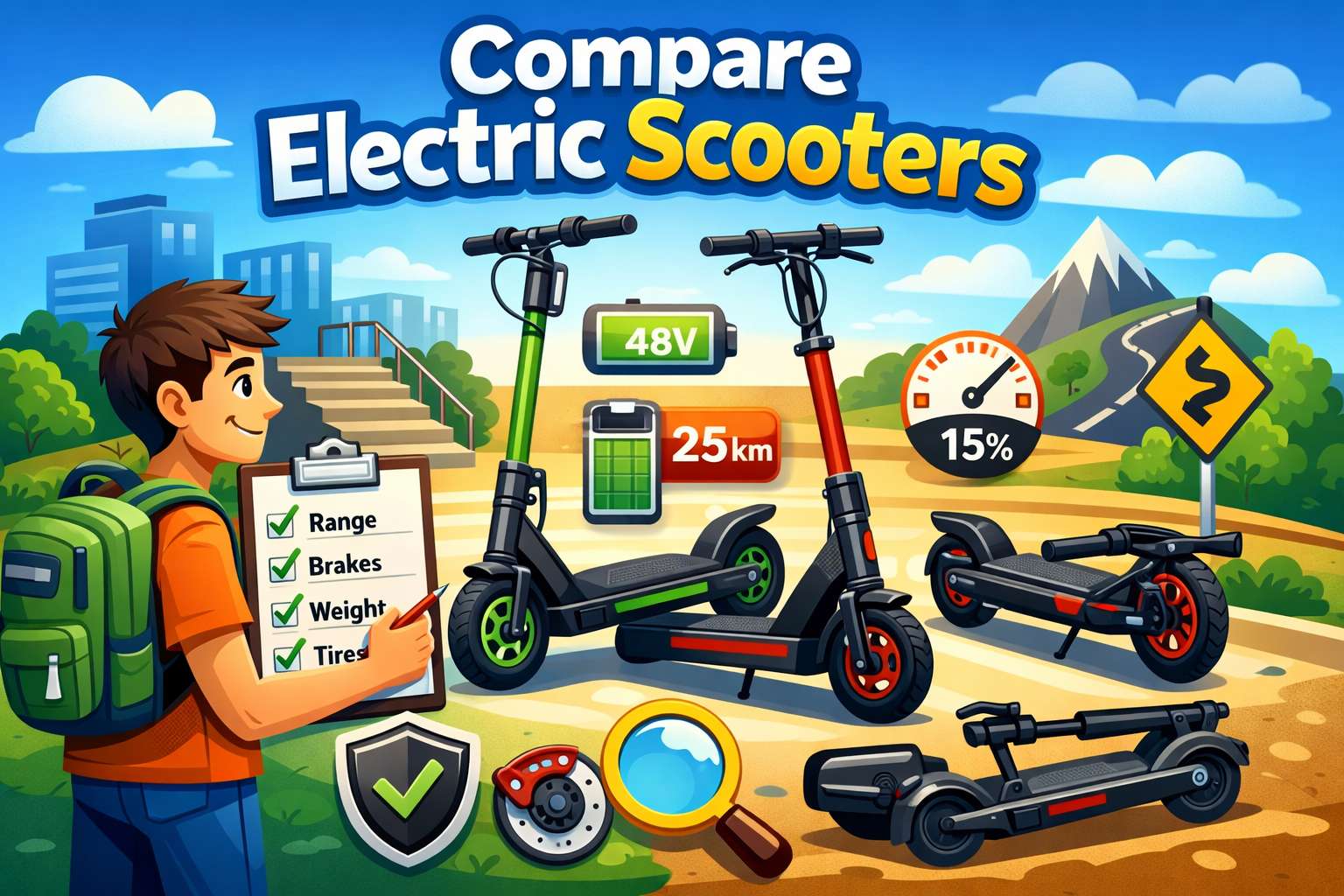
Comparing electric scooters can feel messy at first. So many models look the same on paper, and the big numbers grab your attention fast. So this guide keeps it simple. You will compare the parts that change the ride, and you will skip the noise.
Start with your route. Then write three quick facts on a note.
- One way distance in km
- Steepest hill you ride often
- Storage and carry needs, stairs, elevator, trunk
Next, set three nonnegotiables.
- Minimum real range target
- Maximum weight you can lift
- Brake setup you trust
Now you have a filter that works in real life.
Speed and power. Focus on pull, not top speed
Top speed looks exciting, but it rarely matches daily riding. So put acceleration and hill pull ahead of the headline speed.
Compare these values first.
- Rated motor power in W
- Battery voltage in V
- Max rider weight
- Hill grade claim, only when the maker lists it clearly
Then use a quick rule that stays honest.
- Same voltage and more rated watts often feels stronger.
- Higher voltage with similar watts often holds speed better on climbs.
After that, look at the drive setup.
- Single motor scooters feel simpler and lighter.
- Dual motor scooters climb better and punch harder off the line.
So if your route has steep hills, dual motor can matter more than an extra 3 km/h on the spec sheet.
Range. Compare battery energy, not the claimed km
Claimed range is a best case number. So treat it as a starting point, not a promise. Real range drops fast with speed, hills, wind, cold, and rider weight.
Next, use watt hours, Wh, as your common unit. Wh tells you how much energy the battery stores.
Here is the simple math.
- Wh = Voltage × Ah
For example:
- 36 V × 10 Ah = 360 Wh
- 48 V × 15 Ah = 720 Wh
Then make a quick real world estimate. Many commuter scooters land around 12 to 25 Wh per km in mixed riding. So a 360 Wh pack often fits shorter commutes, and a 720 Wh pack tends to cover longer ones.
At the same time, scooter weight and tires change the result. Wider tires can feel great, but they can use more energy. So compare Wh first, and then compare the build that spends that energy.
Battery and charging. Look for clear specs and safe hardware
Battery quality shapes reliability and cost later. So do not accept vague battery details.
Compare these items.
- Battery capacity in Wh
- Pack voltage and Ah
- Charger output in A
- Charge port placement and cover
- Battery replacement availability and price
Then look at charge time. A small charger takes longer, and that can be fine. A big charger charges faster, and that can add heat. So a normal charge rate plus a sturdy port cover is a safe, practical combo.
Next, check if the scooter has two charge ports. Two ports can cut charge time, but only if the brand supports safe dual charging and sells the correct chargers.
Brakes. Pick stopping power that matches your speed
Brakes decide confidence. So put them high on your list, even if a faster model looks tempting.
Compare the full system.
- Front brake type
- Rear brake type
- Disc rotor size, when listed
- Lever feel and adjusters
- Regen braking settings, when present
Then keep these simple notes in mind.
- Drum brakes often need less tuning and handle wet roads well.
- Disc brakes can stop harder, but they need more care and alignment.
- A rear fender brake works best as backup on faster scooters.
So if you plan to ride near top speed often, pick strong brakes first and chase speed second.
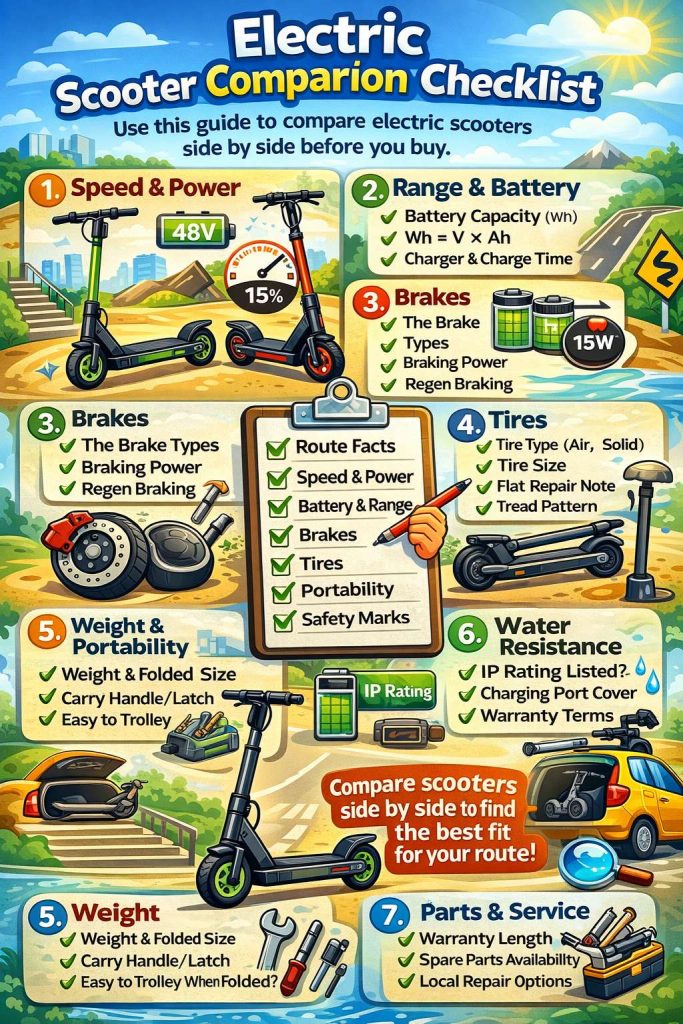
Tires. Comfort, grip, and flat risk live here
Tires change the ride more than most upgrades. So compare them early, not at the end.
Check these points.
- Tire size
- Tire type, pneumatic, tubed, tubeless, solid
- Tire width
- Tread pattern
Then use simple expectations.
- Pneumatic tires ride smoother and grip better on rough streets.
- Solid tires resist flats, but they feel harsher on cracks and cobbles.
- Tubeless tires can reduce pinch flats, but repairs can take more effort.
So for daily commuting, tire comfort often beats a small boost in top speed.
Suspension and frame feel. Stability matters more than a label
Suspension helps on rough roads. So it is easy to assume “more suspension” means “better scooter.” That is not always true.
Compare these details.
- Front suspension, rear suspension, both, or none
- Deck length and width
- Handlebar height range
- Stem play reports in long term reviews
- Folding latch design and tightness
Then trust what you can check.
A stable stem and a solid latch feel safer at speed than soft suspension on a flexy front end. So treat the folding joint like a core safety part, not a nice extra.
Weight and portability. Measure what you lift
Portability looks simple until you carry the scooter up stairs. So do not guess. Check the numbers.
Compare:
- Scooter weight
- Folded dimensions
- Carry handle or latch lock
- How it rolls when folded
Then think about your routine.
A few kilos can feel huge on day three. So if you carry it daily, pick the lightest model that still meets your range and braking needs.
Water resistance. Read the rating and the warranty terms
Many scooters claim water resistance. So treat that as “handles splashes” unless the brand clearly states more and backs it in the warranty.
Check:
- An IP rating that covers the whole scooter, not one part
- Warranty exclusions for water damage
- Port covers and cable routing
Then plan like a commuter.
If you ride in rain, good seals matter. So pick a model with clear sealing details and honest warranty language.
Safety marks and standards. Use them as a filter
Some listings mention standards or certifications. So treat them as one quality check, not the only one.
Look for:
- Clear certification language, not vague badges
- Model specific claims, not brand wide claims
- Battery related standards, when listed
- Market specific standards for your region
Then match the model number.
A single letter can change the build. So confirm the exact model you buy matches the exact model that got tested.
Parts, service, and ownership cost. Plan for normal wear
Many scooters feel great on day one. Then real life starts. Tires wear, brakes need pads, and a loose latch can ruin the ride.
Compare:
- Warranty length for frame, electronics, battery
- Local service options
- Spare tires or tubes availability
- Brake pad availability
- Replacement charger cost
- Battery replacement policy
Then think one year ahead.
Folding joints and tires often wear first. So parts access matters as much as the spec sheet.
A simple comparison scorecard you can use today
A scorecard keeps the decision clean. So score each line from 0 to 5, then total it. After that, pick the top score that still meets your nonnegotiables.
- Real range estimate from Wh
- Hill pull for your route
- Brake confidence
- Tire comfort and grip
- Stability of stem and folding latch
- Weight and folded size
- Water protection and warranty terms
- Parts supply and service access
- Total cost after add ons, lock, helmet, spare tube, pump
Then stop shopping. A clear winner will show up fast.
Red flags that save you time
Some listings waste your time. So watch for these signs.
- No battery Wh, no voltage, no Ah
- “Waterproof” claims with no rating details
- High speed claims with weak braking
- No spare parts path, no tires, no pads, no charger
- Very small deck on long commutes
- Vague warranty language on electronics and battery
So if you spot two or more red flags, move on.