

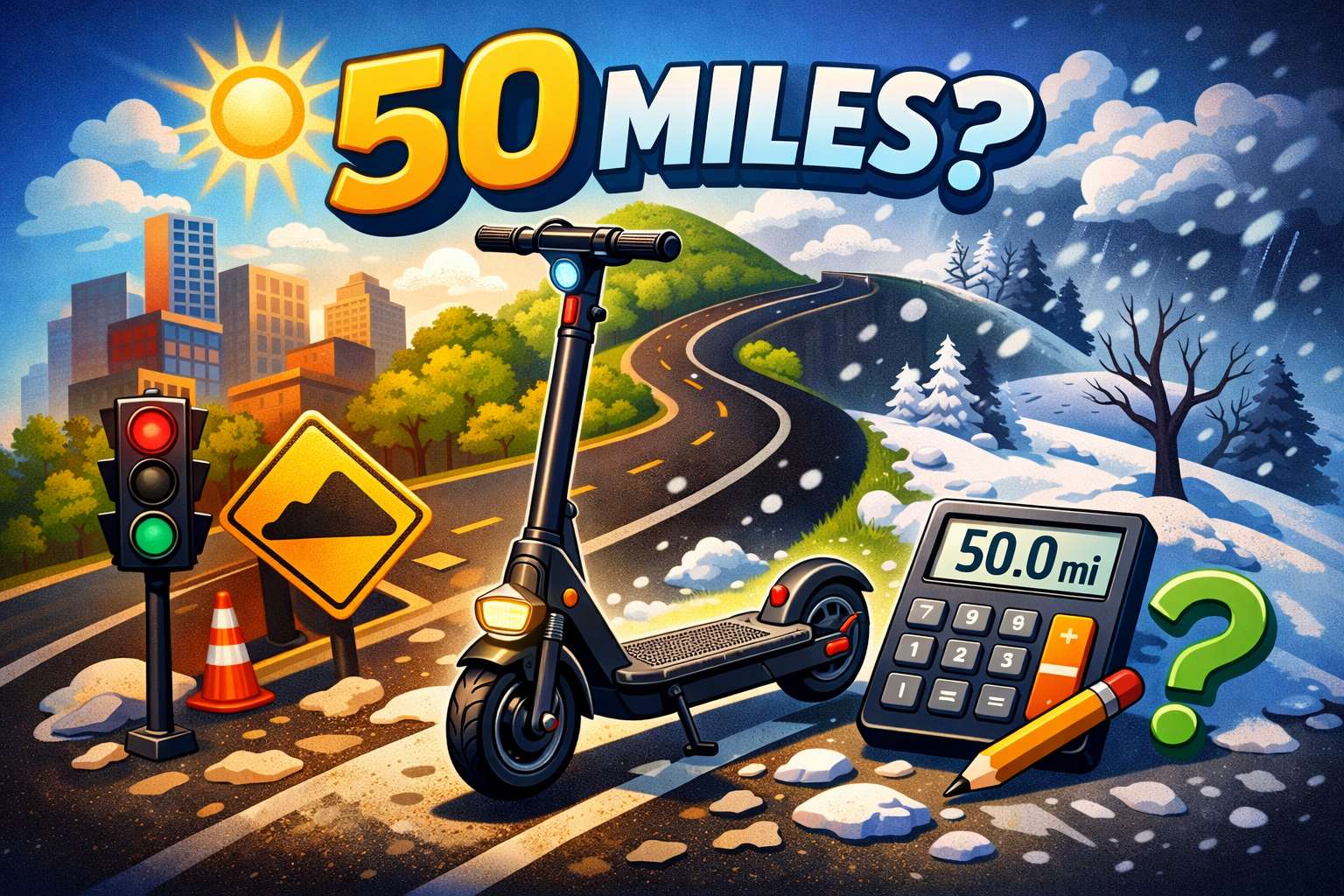
You see “50 miles” on a product page, and it sounds simple. Then real riding starts, and the number drops fast. That gap is normal. Lab-style tests use calm settings. Daily routes do not.
So this guide gives you a practical way to read range claims before you buy. You will get clear math, simple checks, and a weekly test plan you can run yourself. You will leave with a range estimate that fits your road, your speed, and your weather.
Why “50 miles” and your daily ride are not the same
First, brands test range in stable conditions. Next, riders use mixed conditions. Those two worlds are different.
In test mode, roads are flat, speed is steady, and stops are limited. In real life, traffic lights break momentum, hills pull extra power, and wind pushes back. Then cold mornings raise battery strain. So your real-world range drops.
That does not mean a brand is lying. It means the headline is a top-case figure. It is useful for comparing scooters, but it is not your personal daily result.
The short rule that saves money
Here is the fast rule.
Treat the listed range as a ceiling.
Then plan your commute with a lower band.
Use this planning band:
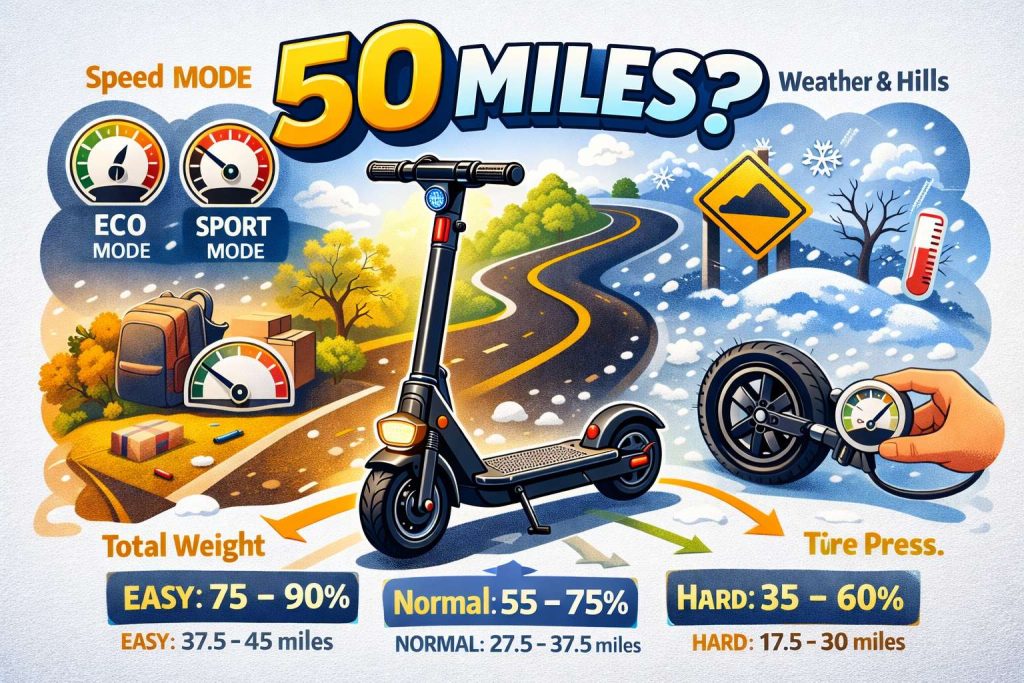
- Easy riding days: 75% to 90% of claim
- Normal city days: 55% to 75% of claim
- Fast, hilly, or cold days: 35% to 60% of claim
Now apply that to a 50-mile claim:
- Easy band:
50 × 0.75 = 37.5
50 × 0.90 = 45
Result: 37.5 to 45 miles - Normal band:
50 × 0.55 = 27.5
50 × 0.75 = 37.5
Result: 27.5 to 37.5 miles - Hard-use band:
50 × 0.35 = 17.5
50 × 0.60 = 30
Result: 17.5 to 30 miles
This single step already gives a better buying filter than the headline number.
The battery math buyers should use every time
Now let’s make this even cleaner. Use battery size in watt-hours, then divide by your expected energy use.
Range (miles) = Battery capacity (Wh) ÷ Wh per mile
Start with Wh per mile bands:
- Light pace, smooth route: 13 to 16 Wh/mile
- Normal mixed riding: 18 to 24 Wh/mile
- Fast mode, hills, cold air: 26 to 35 Wh/mile
Example with a 720 Wh battery:
- Normal mixed riding high estimate
720 ÷ 18 = 40 - Normal mixed riding low estimate
720 ÷ 24 = 30
So your normal band is 30 to 40 miles.
Same scooter, hard-use day:
- 720 ÷ 26 = 27.6923
- 720 ÷ 35 = 20.5714
So the hard-use band is about 20.6 to 27.7 miles.
That is why a “50-mile” label can feel very different in practice.
Speed mode changes range more than people expect
Eco mode and sport mode can feel like two different machines. First, higher speed needs more power against air drag. Next, fast starts pull larger current bursts. Then frequent braking wastes momentum.
So if your riding style is quick and punchy, estimate from the lower range band, not from the best-case band.
Quick check:
- If you ride near top speed for most of the trip, use 26 to 35 Wh/mile for planning.
- If you cruise calmly, use 18 to 24 Wh/mile first, then revise after your own test rides.
Weight, hills, and tire pressure. The hidden range killers
Rider load matters right away. Add body weight, backpack, lock, and maybe groceries, and total mass climbs quickly. Then every launch from a stop needs extra energy.
Hills matter too. Climbing burns power fast. Descents help a bit, yet they do not fully repay climb cost.
Tire pressure is easy to ignore, but it changes rolling resistance a lot. Low pressure makes the motor work harder, and range drops.
So do this weekly:
- Check tire pressure cold, before riding
- Keep both tires near the brand’s recommended PSI
- Recheck after temperature swings
Small habit. Big payoff.
Weather reality. Why winter rides feel short
Cold weather can cut range sharply. Battery chemistry slows down in low temperature. Then cabin heating is not your issue on a scooter, yet wind chill and dense air still push energy use up.
What should you do in winter?
Use your hard-use band as the default plan, then add reserve distance. That reserve protects you from traffic detours and late battery sag near the end of charge.
Good winter rule:
- Plan with 20% extra margin over your expected route distance
- Charge more often
- Park indoors when possible
Battery aging over time
All lithium batteries lose capacity over months and years. That is normal. So a scooter that did 34 miles in spring may do less after long heat exposure, repeated deep drains, or long periods at 100%.
Use these habits:
- Keep daily charge limit lower if your app supports it
- Avoid storing empty for long periods
- Avoid storing full for days with no ride
- Let a hot battery cool before charging
These habits support stable range and healthier battery life.
A practical pre-buy checklist for long-distance riders
Use this in store pages and comparison tabs.
- Read battery size in Wh, not just “up to X miles.”
- Note your real trip distance including detours.
- Pick Wh/mile band from your riding style.
- Calculate your expected range band.
- Keep a reserve of 20% to 30% for daily use.
- Compare charge time with your routine.
- Check rider weight limit and payload comfort.
- Review tire type and suspension for your road quality.
If you commute daily, this step pairs well with your legal prep. See this practical guide on electric scooter insurance in 2026. It helps you cover the non-range side of ownership.
Real-world range test you can run in week one
After purchase, run three controlled rides. Then your estimates become personal and accurate.
Ride A. Easy condition test
- Mild weather
- Flatter route
- Calm pace
- Start at 100%, stop at 20%
- Log distance
Ride B. Normal commute test
- Your usual route and speed
- Usual traffic
- Start at 100%, stop at 20%
- Log distance
Ride C. Hard-use test
- Faster pace or hill route
- Start at 100%, stop at 20%
- Log distance
Now convert each result to full-pack estimate.
Estimated full range = Logged distance ÷ 0.80
If Ride B logged 19 miles:
19 ÷ 0.80 = 23.75 miles
That is your normal full-pack estimate for daily planning.
Then keep a simple note in your phone:
- Easy day range
- Normal day range
- Hard day range
This is better than any generic claim online.
Common buyer mistakes and quick fixes
Mistake 1. Buying by top speed first
Fix: Buy by battery Wh and realistic range band first. Speed matters, yet a dead battery at mile 18 matters more.
Mistake 2. Ignoring reserve
Fix: Keep at least 20% reserve in planning. Battery output drops near low state of charge.
Mistake 3. Skipping tire checks
Fix: Weekly pressure check. This takes minutes and can recover noticeable range.
Mistake 4. No post-buy testing
Fix: Run the three-ride method in week one. Then plan from your own data.
Mistake 5. Thinking scooters are all equal for impact
Fix: Compare transport choices with full context. If you want that bigger picture, read this straight guide on electric scooter environmental impact vs e-bikes and cars.
Search terms riders use, and what they really mean
People search many versions of the same problem. Here is the plain meaning behind common queries:
- “Advertised vs actual scooter range”
Real-world distance compared with lab-style claim. - “How to calculate scooter range from battery Wh”
Simple battery math using Wh per mile bands. - “Eco mode vs sport mode range”
Energy draw difference by riding mode and speed style. - “Electric scooter range in winter”
Cold-weather drop and reserve planning. - “Scooter range estimator”
Personal band built from your own ride logs.
Use these terms in your own notes and comparisons. They keep you grounded in practical buying logic.
Final take
A 50-mile claim is not fake, but it is not your daily promise. It is a ceiling from controlled conditions. Real range comes from battery size, riding speed, terrain, weather, and payload.
So run the math first. Then buy from your expected band, not from the top-case headline. After purchase, test your own three ride scenarios, and plan from your numbers.
That is the long-distance reality check that protects your wallet and your commute.