

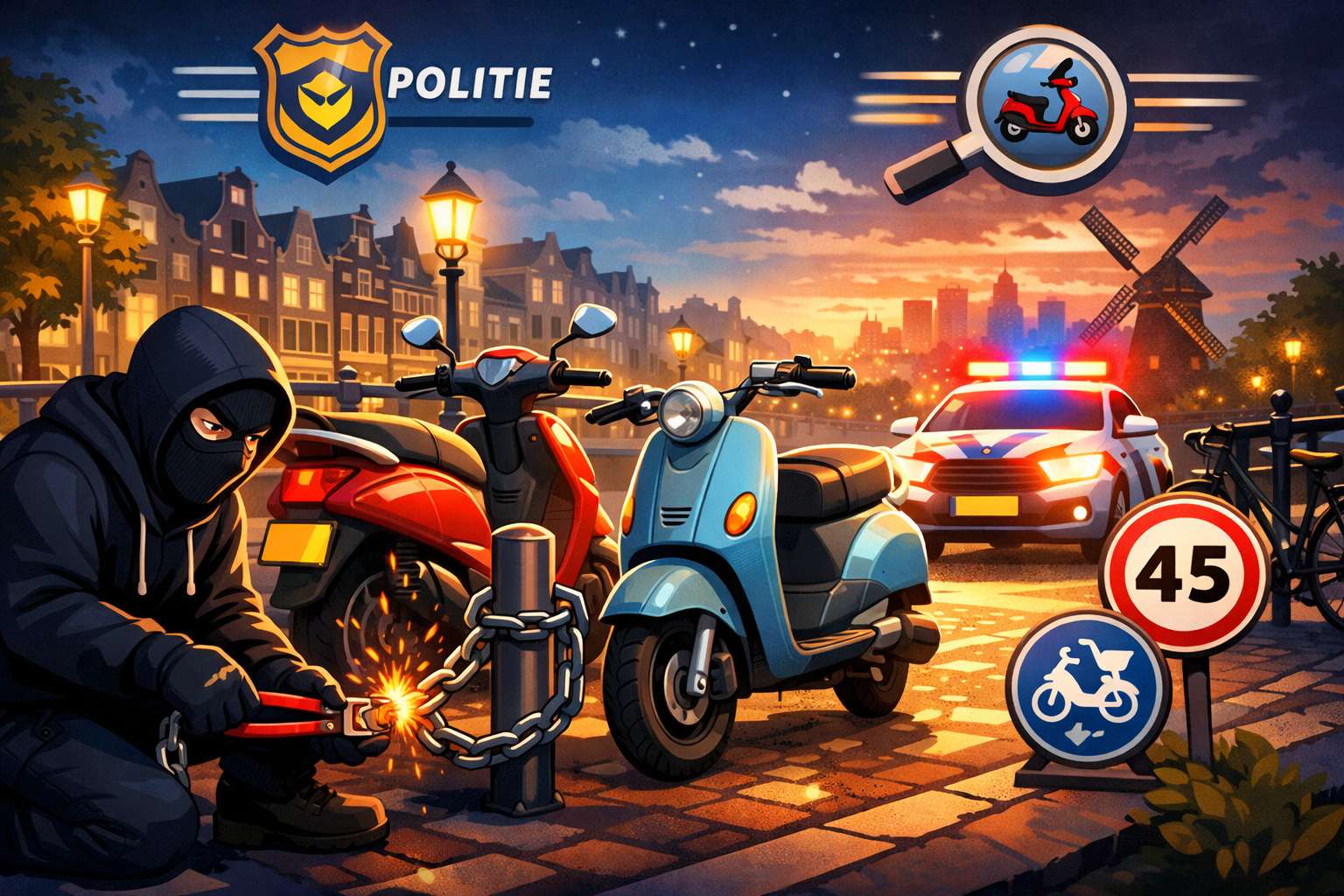
The Dutch theft trend is moving in the right direction, and that is real progress. Still, riders in big cities still face a high chance of losing a scooter or moped, especially at night.
First, the long trend shows a clear drop. CBS police data lists 19,561 registered thefts of bromfiets and snorfiets in 2012. Then, for 2024, the same dataset lists 11,735 as a provisional total. So the change is:
19,561 minus 11,735 equals 7,826 fewer thefts.
7,826 divided by 19,561 equals 0.4001.
So the drop is about 40.0%.
Then we look at 2025 monitoring figures. Industry tracking based on VbV registrations points to about 10,000 theft cases in 2025, with two close totals reported in public summaries, 10,018 and 10,051. I cannot confirm one single unified official total for 2025 yet, and that small gap comes from different reporting labels. Yet both totals point to the same thing: national theft kept falling.
How common is moped theft right now
Let’s turn those totals into a practical risk view.
Using 2024 data:
- 11,735 thefts
- Dutch population around 18,044,027
- 11,735 divided by 18,044,027 times 100,000 equals about 65 thefts per 100,000 residents
Using 2025 monitoring near 10,051:
- 10,051 divided by 18,044,027 times 100,000 equals about 56 thefts per 100,000 residents
So the national trend looks better year by year. Yet theft is still common enough to matter for daily life. A stolen scooter means missed shifts, missed school runs, and surprise costs in one day.
City risk is still the real story
National averages look calmer, but city risk stays hot. Claim frequency data for 2025 puts Eindhoven near 3.00%, Amsterdam near 2.04%, Rotterdam near 1.77%, Breda near 1.64%, Groningen near 1.54%, and The Hague near 1.31%. So a rider in one of these areas faces much higher risk than the country average suggests.
At the same time, local conditions push risk up:
- dense parking rows
- busy stations and nightlife zones
- fast resale channels for parts
- repeat targeting of popular models
So if you live in a lower-risk town, national decline feels real. But if you park in a dense city center, your daily risk still stays elevated.
Bike lane rules in the Netherlands: bromfiets versus snorfiets
This part causes confusion for locals and tourists every year. The key is vehicle class.
A bromfiets or bromscooter follows bromfiets lane rules. You use a fiets/bromfietspad if present, or the roadway if that shared path is missing. You do not use a regular fietspad that is marked for standard bicycles only.
A snorfiets runs under a different rule set. Snorfiets max speed is 25 km/h, and it can use many fietspaden. Yet some cities move snorfiets traffic to the roadway on crowded cycle routes. Amsterdam and Utrecht use this rule on selected routes. So road signs on site decide the final lane position.
Then there is the helmet rule. Since January 1, 2023, snorfiets riders must wear a helmet too. That rule still applies in 2026.
Can you ride a scooter with a car license in the Netherlands
Yes. A valid Dutch category B car license includes AM entitlement on the license. AM covers brommer, scooter, snorfiets, speedpedelec, and brommobiel categories in normal use.
So if you already hold B, you do not take a separate AM route again. Still, other legal duties stay active:
- minimum age rules
- valid registration
- liability insurance
- approved helmet use
So the license part is simple, and compliance still depends on the vehicle setup and road use.
Speed limits for mopeds in the Netherlands
Speed limits depend on vehicle class and road type.
For bromfiets, bromscooter, and speedpedelec:
- 45 km/h on the roadway
- 40 km/h on fiets/bromfietspad outside built-up areas
- 30 km/h on fiets/bromfietspad inside built-up areas
For snorfiets:
- 25 km/h maximum
Then there is one more point riders forget. The legal construction speed for bromfiets class is still capped at 45 km/h. So illegal tuning can trigger fines, seizure risk, and insurance trouble after a crash.
Why theft dropped, yet city riders still need a plan
The long trend fell, and that is good news. Still, police and insurers keep warning riders about theft pressure in urban zones. So practical prevention still matters every day.
Use a routine that takes less than two minutes:
- lock the frame to a fixed object
- add a second lock type
- park in bright, high-traffic spots
- avoid leaving the same model in the same blind corner each night
- store keys out of view at home
- keep frame number and registration details saved on your phone
Then add insurance planning, not panic. If you want a clean breakdown of cover types and claim tips, this guide helps: electric scooter insurance guide 2026.
If theft happens, report fast through the police channel and share full vehicle details at once. Speed matters for recovery workflows.
What people search on this topic in 2026
Search intent is practical and direct. Riders want legal clarity and theft prevention steps they can use today.
Common searches include:
- scooter theft Netherlands 2026
- moped theft Amsterdam
- bromfiets bike lane rules Netherlands
- snorfiets helmet rule Netherlands
- can I drive a scooter with car license Netherlands
- AM license Netherlands scooter
- moped speed limit Netherlands
- stolen scooter report Netherlands
So the core pattern is clear. Riders want to stay legal, lower theft risk, and get back on the road fast if theft happens.
The big takeaway is simple. National theft is down to the lowest level in over a decade, and that is real progress. Yet city riders still face strong local risk, so habits, locks, and route-aware parking still make the difference day to day.