
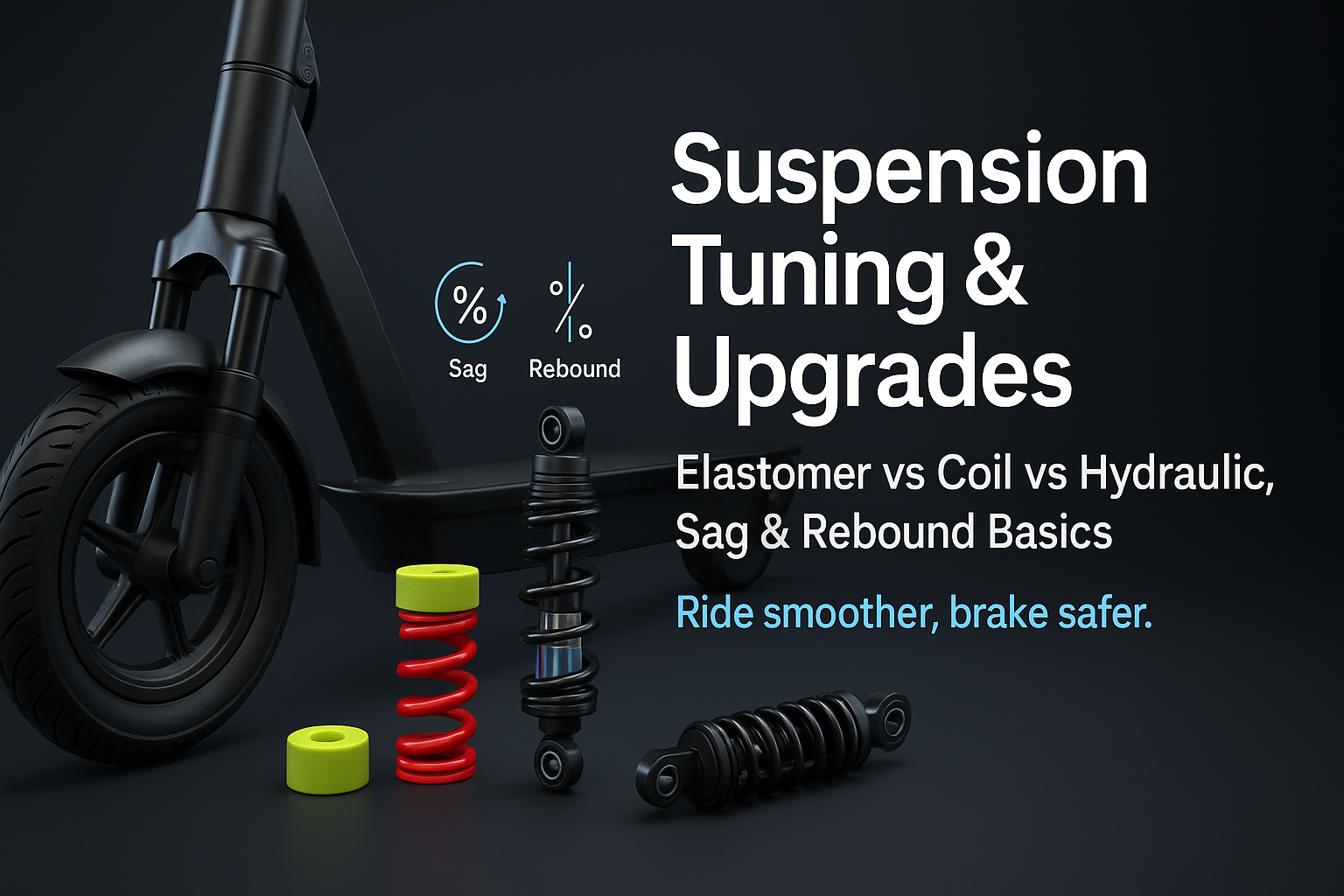
A well-tuned suspension transforms the way a scooter rides. With the right setup, you’ll keep tires planted, reduce fatigue, and stop faster when it counts. For front-end stability, pair your tuning with a quick stem wobble & headset service to eliminate play before you start measuring sag.
What “Suspension Tuning” Really Means
Suspension tuning is the deliberate adjustment of spring and damping forces to match a rider, a load, and a surface. When tuned well, the wheels follow the ground instead of skipping across it, which improves traction, braking stability, and comfort. Conversely, a mismatched setup wastes energy, chatters over bumps, and bottom-outs on big hits.
Think of the spring as the “support” and the damper as the “traffic cop.” The spring carries the weight and sets ride height (sag). Meanwhile, the damper meters motion so the chassis doesn’t pogo or pack down. Ultimately, your job is to balance both for your weight, your terrain, and your speed.
Why this matters on scooters
Scooters concentrate mass over a short wheelbase. Therefore, poor tuning shows up fast: brake dive, headshake, rear chatter, or skittering over painted lines. By contrast, a good baseline reduces those issues and makes small tires feel bigger than they are.
Suspension Types Explained (Elastomer vs Coil vs Hydraulic)
Different designs solve the same problem with trade-offs in adjustability, cost, and service requirements. Accordingly, choose based on how you ride, how often you service parts, and how much control you need.
Elastomer Suspension
How it works. Solid polymer pucks, bushings, or blocks compress under load. Many stems and swingarms use stacked elastomers.
Typical travel. About 0.4–2.4 in (10–60 mm), depending on geometry and stack height.
Adjustability. Limited but useful: change durometer (hardness), add/remove spacers, or adjust preload if the hardware allows. Even so, range is narrower than coil or hydraulic.
Durability. Simple and robust; however, elastomers age and can harden or crack over time. Consequently, periodic inspection is wise.
Temperature sensitivity. Noticeable. Cold weather stiffens the material; hot weather softens it. As a result, feel changes seasonally.
Maintenance. Minimal. Inspect for cracks or permanent set; replace as needed. Additionally, keep hardware torqued.
Cost & use cases. Low cost; ideal for commuting, low-maintenance riders, and light off-road where simplicity is king.
Coil Spring Suspension
How it works. A steel or titanium spring provides the spring rate. A damper (oil cartridge or simple piston) may control motion.
Typical travel. Roughly 2–6 in (50–150 mm) for scooter shocks and forks, model-dependent.
Adjustability. Good. You can change preload, swap to a different spring rate, and often adjust rebound. Some units add low-speed compression. Therefore, it suits riders who want predictable changes.
Durability. Excellent mechanical life. Spring rate is stable across temperatures. Still, damping parts age and need service.
Maintenance. Low for the spring itself; moderate for the damper if oil-based (seals and fluid age).
Cost & use cases. Moderate. Great for mixed terrain, heavier riders, or anyone who wants predictable support with straightforward service.
Hydraulic (Air/Oil) Suspension
How it works. An air spring (pressurized chamber) or coil provides support; oil is forced through valves and shims for damping. Many scooters use sealed hydraulic shocks or forks.
Typical travel. About 3–8 in (75–200 mm) on performance models; compact commuters sit lower.
Adjustability. Often excellent. Air pressure sets spring rate and sag. External knobs set rebound and sometimes compression (low-speed and, on premium units, high-speed). Consequently, you can tailor feel precisely.
Durability. Very good when serviced on schedule. Oil and seals need periodic attention. Otherwise, performance drifts.
Temperature sensitivity. Air pressure changes with temperature; oil viscosity shifts as well. Therefore, you must compensate seasonally.
Maintenance. Moderate to high. Expect seal and oil service intervals.
Cost & use cases. Higher initial cost; best for riders who want precise control, frequent tuning, or high-speed stability.
Quick Comparison
| System | Pros | Cons | Tunability | Maintenance | Typical Issues | Best For |
|---|---|---|---|---|---|---|
| Elastomer | Simple, quiet, cheap, light | Temp-sensitive, limited travel, aging set | Low (durometer/preload) | Low | Hardens in cold, packs under repeated hits | Low-maintenance commuters, smoother pavement |
| Coil | Consistent rate, linear feel, affordable upgrades | Heavier than air, needs correct spring rate | Medium–High (preload, spring swaps, rebound; sometimes compression) | Low–Medium | Bottoming if rate too soft; harsh if too stiff | Mixed terrain, heavier riders, cargo |
| Hydraulic (Air/Oil) | Wide adjust range, lighter spring (air), precise damping | Cost, service complexity, temp effects | High (air pressure, rebound, compression) | Medium–High | Pressure drift, seal wear, viscosity changes | Performance riding, rough streets, high speed |
Core Concepts — Sag, Preload, Spring Rate, Rebound, Compression
Sag
Sag is how much the suspension compresses under rider weight in normal stance. It sets ride height and mid-stroke support. In practice, target a band rather than a single number.
- Static sag (%) = (Rider-loaded compression ÷ Total travel) × 100
- Typical targets:
- Front: 15–25% for smooth pavement; 25–30% for rough or mixed surfaces
- Rear: 20–30% for pavement; 25–35% for rough or mixed surfaces
Preload vs Spring Rate
- Preload changes the starting position of the spring. It does not change the spring rate. Use it to fine-tune sag once your spring rate is close. Otherwise, you’ll mask a rate problem.
- Spring rate is force per unit distance. If you can’t hit targets without over- or under-preloading, change the spring rate (or elastomer hardness / air pressure). That way, sag lands in range with sensible preload.
Progression (Volume Spacers/Tokens)
Air springs and some hydraulic units allow volume spacers. Reducing air volume makes the spring more progressive: softer off the top, firmer near bottom-out. Accordingly, add tokens to curb bottoming without raising sag drastically.
Rebound
Rebound damping controls return speed after compression.
- Too fast: Pogo effect, oscillation after bumps, vague traction. Then, add rebound (slower).
- Too slow: “Packing down” over chatter, harsh mid-stroke, loss of travel. In that case, reduce rebound (faster).
Compression (Low-Speed vs High-Speed)
- Low-speed compression (LSC): Controls chassis motion from braking, weight shifts, and rolling undulations. It helps with brake dive and corner support. Consequently, small LSC changes can stabilize steering.
- High-speed compression (HSC): Controls sharp hits and square edges. It resists sudden compressions to prevent harsh bottoming. If needed, add HSC one click at a time.
Step-by-Step: Set Your Sag (Coil, Air/Hydraulic, Elastomer)
Tools
- Shock/fork pump (for air systems)
- Tape measure or ruler (in/mm)
- Zip tie or O-ring marker
- Small notebook or phone notes
- Helper to measure while you stand in riding posture
Tip: Measure total travel first if unknown. First, fully extend the suspension, place a zip tie on the stanchion/shaft, compress gently to the bump stop, then measure the stroke (exposed shaft length difference).
A) Coil Spring Procedure
- Prepare. Set rebound to middle. Back compression off a few clicks (if present). Set preload collars to the manufacturer’s starting point (often just touching + 1–2 turns). This way, you start from a neutral baseline.
- Mark travel. Add a zip tie on the strut/shaft. Next, position it snugly against the seal.
- Mount up. Stand in your normal stance with gear and typical cargo. Bounce lightly to overcome stiction, then settle. Afterward, hold still for the reading.
- Measure. Have your helper measure from a fixed reference; record rider-loaded compression. If needed, repeat twice for accuracy.
- Calculate sag. Sag % = (loaded compression ÷ total travel) × 100. Then, compare to targets.
- Adjust. Add or remove preload to hit target. If you need more than ~4–6 turns to reach spec, switch springs (softer or stiffer). Otherwise, you’ll sacrifice ride quality.
- Verify. Ride a short loop. If you bottom on moderate hits, consider a stiffer spring or more compression. If not, keep settings and move on.
B) Air/Hydraulic Procedure
- Reset. Set rebound mid-range. Open compression a few clicks. This ensures the spring sets sag without excess damping interference.
- Pressurize. Pump to a starting PSI that matches your weight band (see templates below). Then, equalize chambers if the unit requires it.
- Set sag. Repeat the measure-and-calculate steps above. Adjust PSI in small increments (±5–10 psi) to hit target sag. Crucially, re-check after each change.
- Progression. If you reach sag targets but still bottom, add a volume spacer. If you never reach full travel, remove a spacer. Thus, you shape end-stroke support.
- Lock in. Note final PSI at room temperature. Re-check after temperature swings, because pressure changes ~1–2 psi per 10°F (5–6°C). Accordingly, monitor seasonally.
C) Elastomer Procedure
- Baseline. Ensure the stack and spacers are installed per the manual. Otherwise, readings will mislead you.
- Target. For small-travel elastomer stems, aim for ~15–25% effective sag measured along the motion path, recognizing limited travel. If travel is tiny, err on the low side.
- Adjust. Swap to softer or harder elastomers, change stacking order, or add preload if hardware allows. Because range is limited, hit the best compromise for your weight and road. If comfort suffers, go one step softer.
- Verify. If you bottom frequently, move to a higher-durometer puck or add a thin spacer. If you barely move the stack, go softer. Then, re-test on your loop.
Worked Example (Rear Shock)
- Total travel: 3.15 in (80 mm)
- Measured rider compression: 0.95 in (24 mm)
- Sag %: 24 ÷ 80 × 100 = 30%
- Interpretation: Within a 25–35% rear target for mixed riding. Therefore, no spring change is required.
- Next steps: Keep current spring/pressure. Add one volume spacer if bottoming on curbs; otherwise leave as is. Finally, confirm on two passes.
Verification Ride Checklist
- Uses ~70–90% of travel on the roughest part of your loop
- Doesn’t bottom on medium hits; might kiss the bumper on the biggest one
- Brakes remain stable with manageable dive
- Rear doesn’t hop under heavy braking or acceleration over ripples
- Front tracks lines and paint without skitter
Dialing Rebound & Compression
These baselines apply to most commuters, including the Xiaomi Electric Scooter 5, where a mid-range rebound setting is a smart starting point before adding low-speed compression for brake-dive control.
Rebound Baseline
- Clickers present: Start in the middle of total clicks. Then, adjust in 1–2 click steps.
- No clicks (screw turns): Start 1.0–1.5 turns out from fully closed (clockwise to close). After that, test and refine.
- Simple units with no adjusters: You still can influence rebound by changing oil weight (service item) or spring rate/air pressure, but keep changes conservative. Otherwise, you’ll overshoot.
If the ride pogos after a bump, add rebound (slower). Conversely, if the suspension packs and fails to extend between bumps, reduce rebound (faster).
Compression Baseline
- Start with LSC at open + 3–4 clicks. Then, evaluate brake dive and cornering support.
- If you feel brake dive or wallow, add 1–2 clicks LSC. On the other hand, if steering gets harsh, back off one click.
- If sharp hits feel harsh, soften HSC one click (if available) or add progression via tokens. As needed, re-balance rebound afterward.
Test Loop Method
- Choose a repeatable loop with smooth sections, chatter, a curb cut, and a couple of braking zones. That way, feedback stays consistent.
- Make one change at a time. Write it down. Otherwise, you won’t know which adjustment helped.
- Use the “two-pass rule”: first pass to feel, second pass to confirm. If unsure, return to the prior setting. Eventually, a pattern emerges.
- Stop when the bike feels calm, supportive, and predictable—not when it feels “softest.” In short, chase control, not plushness.
Upgrade Paths by Rider Type & Budget
You can unlock significant gains without jumping straight to expensive hardware. First, fix the basics; then, invest where it counts.
Quick Wins (Often $0–$60)
- Tire pressure: Set properly for your weight and surface. It changes feel more than most knobs. Furthermore, it protects rims and improves range.
- Service & lubrication: Fresh pivots, clean shafts, correct torques. Consequently, stiction drops.
- Elastomer refresh: New pucks or correct durometer restores compliance. If they’re cracked, replace immediately.
Step-Up Changes ($60–$200)
- Spring rate correction: The right coil, or the right elastomer stack. As a result, sag lands on target.
- Volume spacers: Add progression to air springs. Thus, you limit bottom-outs.
- Bushings & bearings: Reduce stiction to make small-bump sensitivity pop. Additionally, they extend service life.
Serious Upgrades ($200–$500+)
- Cartridge dampers / serviceable shocks: External rebound and compression with reliable oil circuits. Accordingly, tuning becomes precise.
- Dual-rate or progressive coils: Softer initial, stronger end-stroke support. Therefore, comfort and control rise together.
- High-quality hydraulic forks/shocks: Wider adjustment range, better seals, consistent damping. Nevertheless, follow service intervals.
Budget Tiers & Expected Gains
| Tier | Typical Spend (USD) | What You Do | Expected Gains | Trade-Offs |
|---|---|---|---|---|
| 1 — Baseline Fix | $0–$60 | Tire pressure, torque checks, fresh grease, new elastomers | Noticeably smoother ride, fewer rattles | Time and diligence |
| 2 — Correct Rate | $60–$200 | Proper spring rate, spacers/tokens, quality bushings | Better sag, more control, fewer bottom-outs | Requires measurements |
| 3 — Better Damping | $200–$400 | Damper with external rebound/LSC, air spring tuning | Calm chassis, stable braking, precise feel | Service intervals apply |
| 4 — Premium Units | $400–$800+ | High-end fork/shock, dual-rate coils | Best traction, comfort at speed, longevity | Cost, more setup choices |
Setup Templates by Weight & Terrain (Starting Points)
Use these as starting points. Then, always refine on your test loop.
Smooth Pavement Baselines
| Rider Weight | Front Sag Target | Rear Sag Target | Rebound Baseline | Compression Notes |
|---|---|---|---|---|
| 100–140 lb (45–64 kg) | 15–18% | 20–23% | Mid, then +1 click slower if pogo | LSC open +2; add 1 click if brake dive |
| 140–180 lb (64–82 kg) | 18–20% | 22–25% | Mid | LSC open +3; HSC mostly open |
| 180–220 lb (82–100 kg) | 20–22% | 24–27% | Mid +1 slower | LSC open +4; add token if bottoming |
| 220–260 lb (100–118 kg) | 22–25% | 25–30% | Mid +2 slower | LSC open +4–5; likely add 1–2 tokens |
Rough Streets / Broken Pavement
| Rider Weight | Front Sag Target | Rear Sag Target | Rebound Baseline | Compression Notes |
|---|---|---|---|---|
| 100–140 lb (45–64 kg) | 22–25% | 25–30% | Mid | LSC open +1–2; keep HSC open |
| 140–180 lb (64–82 kg) | 25–28% | 28–32% | Mid | LSC open +2–3; add 1 token if frequent bottoming |
| 180–220 lb (82–100 kg) | 25–30% | 30–35% | Mid +1 slower | LSC open +3–4; 1–2 tokens common |
| 220–260 lb (100–118 kg) | 28–30% | 32–35% | Mid +2 slower | LSC open +4–5; consider stiffer spring / higher PSI |
Light Off-Road / Gravel Paths
| Rider Weight | Front Sag Target | Rear Sag Target | Rebound Baseline | Compression Notes |
|---|---|---|---|---|
| 100–140 lb (45–64 kg) | 25–30% | 30–35% | Mid | LSC open +1; add token if big hits |
| 140–180 lb (64–82 kg) | 28–30% | 30–35% | Mid +1 slower | LSC open +2; 1 token likely |
| 180–220 lb (82–100 kg) | 28–32% | 32–35% | Mid +1–2 slower | LSC open +3; 1–2 tokens likely |
| 220–260 lb (100–118 kg) | 30–32% | 32–35% | Mid +2 slower | LSC open +3–4; stiffer spring often needed |
Note: If your unit lacks compression adjusters, you can mimic more end-stroke support by adding volume spacers (air) or moving to a firmer elastomer/dual-rate coil. Additionally, verify rebound afterward.
Troubleshooting — Symptoms → Fixes
| Symptom | Likely Cause | What to Change |
|---|---|---|
| Harsh on small bumps | Too much LSC or stiction; over-inflated tires | Soften LSC 1–2 clicks; refresh bushings; drop tire pressure slightly |
| Frequent bottom-out | Sag too deep; low progression; insufficient compression | Add spring rate/PSI; add a token; add 1–2 clicks HSC (if available) |
| Pogo after bumps | Rebound too fast | Add 1–2 clicks rebound (slower) |
| Packs down over chatter | Rebound too slow | Remove 1–2 clicks rebound (faster) |
| Excess brake dive | Low LSC; shallow spring rate front | Add 1–2 clicks LSC; consider stiffer front rate or token |
| Rear hops under braking | Rebound too fast rear; tire pressure high | Add 1–2 clicks rebound; check pressure |
| Wanders at speed | Sag too deep front; rebound mismatch | Reduce front sag (more rate/PSI); balance rebound front/rear |
| Top-out clunk | Rebound too slow; insufficient preload | Speed up rebound 1 click; add small preload |
| Mid-stroke wallow | LSC too soft; spring too soft | Add 1–2 clicks LSC; increase rate slightly |
| Stiction / sticky start | Dry seals, misaligned hardware | Service seals, lubricate, torque hardware to spec |
Tuning Flow (Textual)
- Set sag (spring rate/PSI or elastomer hardness). Then, confirm on a short loop.
- Set rebound to mid, then adjust for control. After each change, re-ride.
- Set compression for support vs comfort. If chatter grows, back off one click.
- Add progression if you still bottom. Otherwise, leave tokens alone.
- Re-check rebound after any major change. Finally, note your settings.
- Log settings and finalize after two confirming rides. In the end, consistency wins.
Maintenance Intervals & Lifespan
- Before each ride: Quick wipe of shafts, check for oil film or debris, bounce test for smooth motion. If anything feels rough, investigate.
- Every 2–4 weeks or ~200–300 miles (320–480 km): Torque fasteners, inspect bushings, verify sag (springs settle). Additionally, listen for knocks.
- Every 3–6 months: Replace elastomers if cracked or permanently compressed; refresh pivot grease; inspect seals. If you ride in rain, check more often.
- Hydraulic service: Oil and seals often need attention every 50–100 hours of riding or 6–12 months, depending on use and environment. Otherwise, damping fades.
Storage & Temperature
- Store clean and dry. Also, avoid corrosive environments.
- Avoid prolonged compression during storage; support the scooter to keep shocks near extension. That way, seals relax.
- Expect stiffer feel in cold (thicker oil; harder elastomers) and softer feel in heat. Adjust PSI or clickers seasonally. Consequently, ride feel stays consistent.
Safety & Warranty Notes
- Torque matters. Common values (confirm with your manual):
- M5 bolts: 4–6 N·m (35–53 in-lb)
- M6 bolts: 7–9 N·m (62–80 in-lb)
- M8 bolts: 17–22 N·m (150–195 in-lb)
Otherwise, hardware loosens and adds stiction.
- Use the correct thread treatment: dry, light grease, or medium threadlocker as specified. Furthermore, clean threads first.
- Stop riding if you see oil weeping, dented shafts, bent hardware, or feel sudden changes in damping. In such cases, service immediately.
- Warranty-safe adjustments include external clickers and spring preload within the manufacturer’s stated range. Avoid unauthorized disassembly on sealed units. If in doubt, consult the manual.
FAQs
1) Do I need different settings for winter?
Yes. Oil thickens and elastomers stiffen. Therefore, reduce rebound 1–2 clicks (faster) and consider 5–10 psi less in air springs to keep sag consistent.
2) How does cargo or a child seat change sag?
Extra weight increases sag. Accordingly, measure with the load on, then add rate/PSI or preload to return to targets. You may also add one token to preserve end-stroke support.
3) Can I mix elastomer front with coil or hydraulic rear?
You can. However, match overall support and rebound feel. If the rear is very controlled and the front is floppy, add LSC (if available) or step to a firmer elastomer stack.
4) When should I re-spring vs re-valve?
If you cannot hit sag without extreme preload, change spring rate or PSI first. Otherwise, adjusting damping won’t help. If sag is correct but the ride still pogos or packs, adjust damping or consider a damper upgrade.
5) Does tire pressure affect suspension tuning?
Absolutely. Tires are the first suspension element. Thus, set pressure for weight and speed, then fine-tune the fork/shock. Over-inflated tires cause harshness that damping cannot fix.
6) My fork knocks at top-out; is it dangerous?
It’s a sign rebound is too slow or preload is very low. So, speed up rebound one click and add a small amount of preload. If knocking continues, service the unit.
7) I keep bottoming even with correct sag. What now?
Add a token (air), increase compression 1–2 clicks, or move to a slightly higher spring rate. Afterward, re-balance rebound.
8) How often should I measure sag?
Re-check monthly or after any component change, big temperature swing, or new load pattern. Additionally, verify after crashes.
9) Are dual-rate coils worth it?
Often, yes. They give a supple initial stroke with stronger mid-to-end support. Consequently, they’re great for mixed surfaces and variable loads.
10) Can I tune a non-adjustable shock?
To a point. You can change spring rate/PSI, elastomer hardness, or oil weight during service. Moreover, you can reduce friction with fresh bushings and correct torque.
11) Should front and rear sag match?
Not necessarily. Slightly less front sag helps reduce brake dive. For many riders, ~20% front and ~28% rear works well for pavement.
12) Why does my scooter feel different on the same loop day to day?
Temperature, tire pressure, wind, and rider posture all play roles. Therefore, check pressure first, then verify sag, then confirm clicker positions.
Glossary
- Sag: How much the suspension compresses under rider weight in normal stance. Importantly, it sets ride height.
- Preload: Initial compression on a spring before any load, used to set sag. Nevertheless, it does not change spring rate.
- Spring Rate: Force required per unit of compression (stiffer vs softer). Accordingly, pick rate first.
- Damping: Hydraulic control of motion; includes rebound and compression. In essence, it controls speed of movement.
- Rebound: Controls how fast the suspension extends after compression. Too slow, it packs; too fast, it pogos.
- Compression: Controls how fast the suspension compresses under load. Therefore, it affects harshness and dive.
- Low-Speed Compression (LSC): Damping of slower chassis motions like brake dive. Consequently, it helps stability.
- High-Speed Compression (HSC): Damping of sharp impacts. Thus, it mitigates bottoming.
- Progression: Increasing resistance deeper in the stroke. As a result, it protects against bottoming.
- Volume Spacers/Tokens: Inserts that reduce air volume to increase progression. Typically, add them one at a time.
- Packing Down: Suspension fails to extend fully between bumps due to slow rebound. Hence, speed rebound up.
- Top-Out: Hitting the mechanical or damping limit on extension, often with a knock. If persistent, service it.
- Stiction: Static friction that resists initial movement. Therefore, keep seals clean and aligned.
Quick Reference — Printable Checklist
Baseline Setup
- Set tire pressure for your weight and speed. Then, verify with a gauge.
- Inspect, clean, and torque suspension hardware. Afterward, bounce-test.
- Choose target sag (front 15–25%, rear 20–30% pavement; add 5% for rough). Accordingly, pick rate/PSI.
- Set preload/PSI to hit sag. If you over-preload, change rate.
- Start rebound at mid. Next, evaluate packing vs pogo.
- Open LSC and HSC, then add support as needed. In small steps, adjust.
- Add tokens only if you bottom after sag is correct. Otherwise, avoid over-progression.
Test Loop Tuning
- Ride a repeatable loop. Then, make one change at a time.
- If it pogos → add rebound (slower) 1–2 clicks. If it still pogos, add one more.
- If it packs → reduce rebound (faster) 1 click. If packing remains, reduce again.
- If it dives on brakes → add 1–2 clicks LSC. If dive persists, increase rate slightly.
- If sharp hits are harsh → soften HSC 1 click or add a token. Afterward, re-check rebound.
- Log settings and confirm with a second pass. Finally, stop when the ride feels calm.
Seasonal & Load Adjustments
- Cold weather → reduce rebound 1–2 clicks; adjust PSI to maintain sag if needed. Additionally, warm the seals with a short roll.
- Hot weather → expect slightly faster rebound; verify sag. If comfort drops, add one click LSC.
- Add cargo → re-measure sag with the load; add rate/PSI or a token. Then, re-balance rebound.
Putting It All Together
Start with sag because ride height controls everything else. Next, shape the ride with rebound and compression. Finally, use progression (tokens) to protect the end of the stroke without ruining comfort. With a structured test loop and small, logged changes, you’ll quickly arrive at a setup that feels calm at speed, supple on chatter, and composed under brakes.