

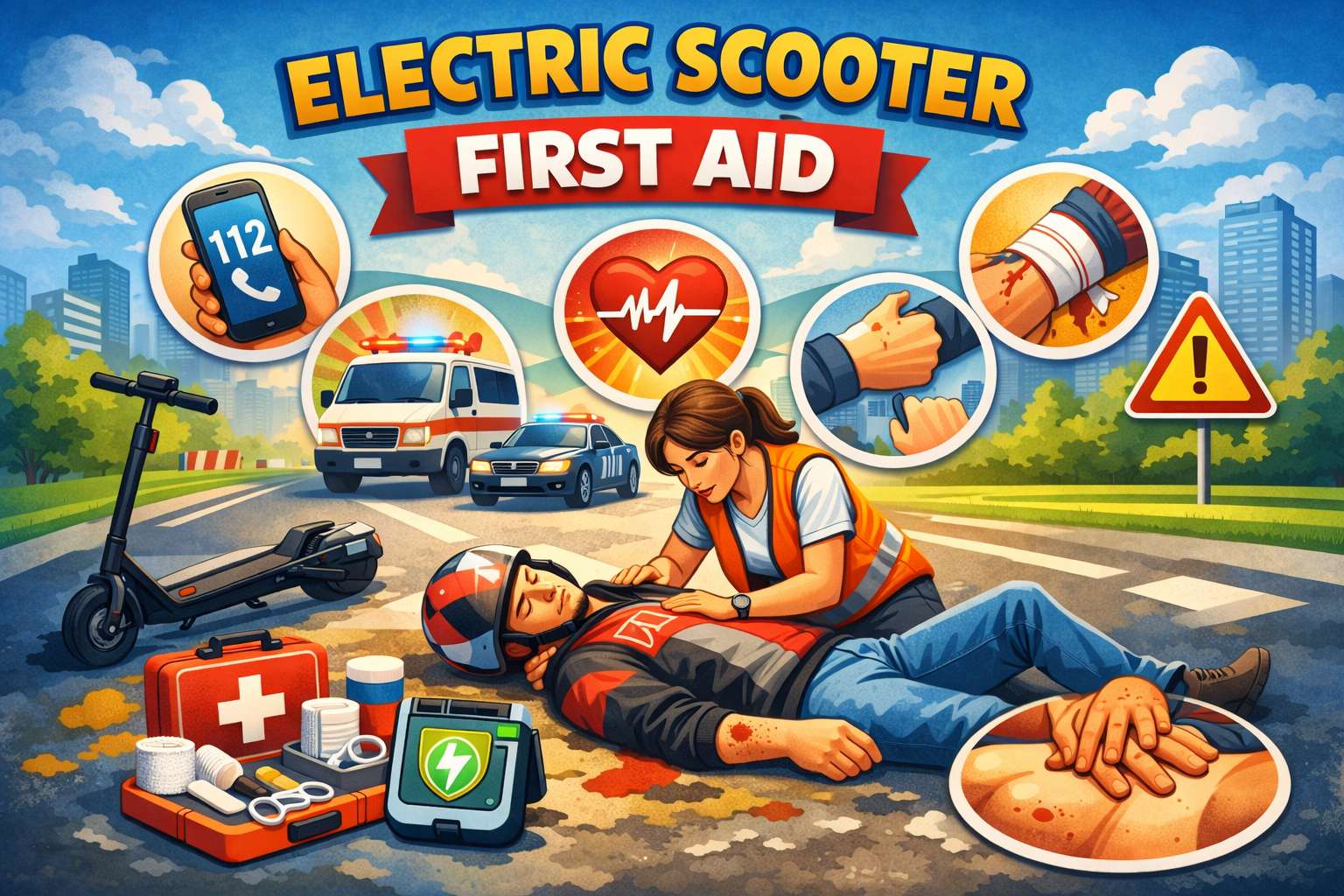
An electric scooter crash can turn serious fast. Road rash can bleed more than you expect. A head hit can look mild, then feel worse later. A broken wrist can swell, and that swelling can squeeze nerves and blood flow.
So keep one goal in mind. Make the scene safer, get help early, and deal with the problems that can kill first.
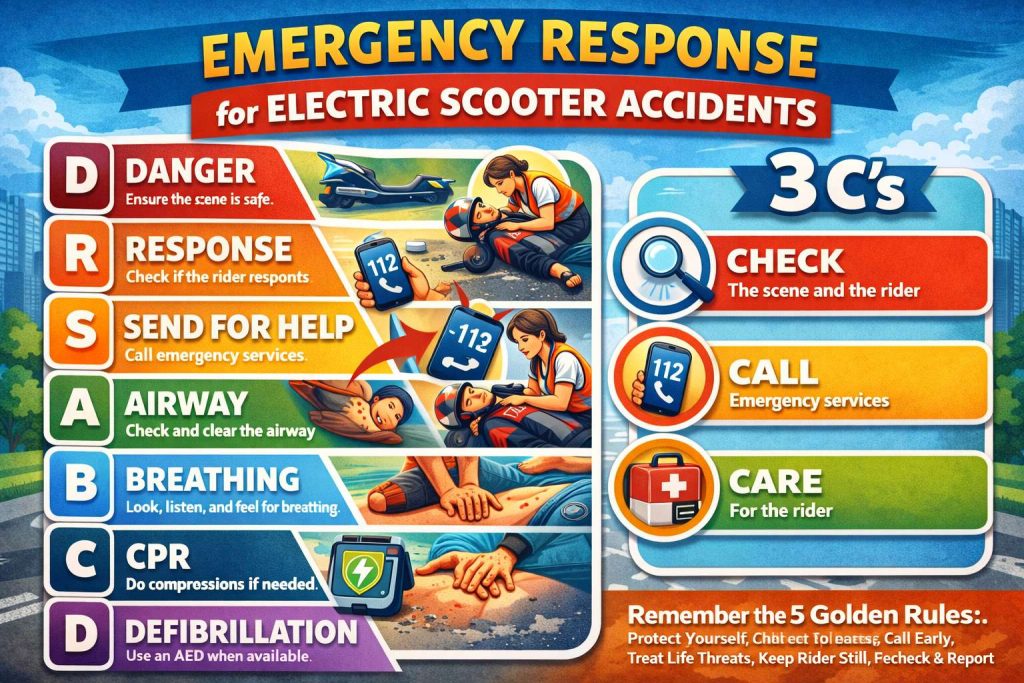
This guide gives you a simple plan you can follow under stress. It uses two common first-aid frameworks riders can remember. The first one is the 3 C’s. Check, Call, Care. The second one is DRSABCD, which breaks the same idea into clear steps.
The first 60 seconds after a scooter crash
Start with safety. A second crash can happen right after the first, and traffic rarely stops on its own.
- Stop and scan for hazards. Look for moving cars, bikes, broken glass, loose dogs, or spilled fuel.
- Step out of the lane, then pull the scooter away if you can do it without risk.
- Get help from bystanders right away. Pick one person, point, and give one job. “Call emergency services now.” Then pick a second person. “Stand there and slow traffic.”
- Put on gloves from your kit if you have them. If you do not, use a clean barrier like a thick cloth.
- Go to the rider and check fast. Look for unresponsiveness, abnormal breathing, and heavy bleeding.
Then take one breath yourself. That small pause helps you think, and it keeps you from rushing into the wrong move.
The 5 golden rules of first aid for scooter riders
Different courses name these rules in different ways. Still, the core actions stay the same. Keep these five rules in your head, and you will make better decisions.
Rule 1. Protect yourself and make the scene safer
You cannot help if a car hits you. So take a wide look first, then move to a safe position. If the scene stays dangerous, pull people back and call for help. Do not play hero in live traffic.
Rule 2. Call for help early
Call emergency services as soon as you see red flags. Think unconsciousness, abnormal breathing, heavy bleeding, seizure, severe chest pain, or a hard head hit. Call early, then you can give care while help is on the way.
If you ride in Ireland, it helps to stay updated on rules that can affect safety gear and enforcement. Read this guide on Ireland’s e-scooter helmet law and what could change next so you know what riders might face on the road.
Rule 3. Treat life threats in the right order
Go in this order.
- Breathing and cardiac arrest
- Severe bleeding
- Airway problems like choking
That order matters. Bleeding can kill fast, and no breathing can kill faster. So focus on the biggest threats first, then move down the list.
Rule 4. Do not move a rider with head, neck, or back risk
A fall can injure the spine even if the person talks and moves. So keep them still and support their head in the position you find it. Move them only if staying put means a bigger danger, like fire or live traffic that you cannot control.
Rule 5. Keep monitoring, then hand over clean details
First aid is not one action. It is a loop. You check, you act, then you check again.
Recheck breathing. Recheck bleeding. Recheck alertness. Then share a short report with responders. Tell them what happened, what you saw first, what you did, and what changed.
The 7 steps in an emergency: DRSABCD
DRSABCD is a simple memory tool. It keeps your actions in a safe order, and it helps you avoid skipping the basics.
D. Danger
Check for danger to you, the rider, and bystanders. Then reduce danger if you can.
R. Response
Check responsiveness. Speak to them. Tap their shoulders. Look for purposeful movement.
S. Send for help
Call emergency services, or direct a bystander to call. Then put your phone on speaker so you can keep working.
A. Airway
Check for a clear airway. If you see a visible object, remove it only if you can reach it easily. Do not sweep blindly.
B. Breathing
Check breathing for about 10 seconds. Look for chest rise. Listen. Feel.
C. CPR
Start CPR if the person is unresponsive and not breathing normally. Place hands in the center of the chest. Push hard and fast at 100 to 120 compressions per minute. Let the chest rise fully between compressions. Then keep going until help takes over, or the person starts breathing normally.
D. Defibrillation
Use an AED as soon as one arrives. Turn it on, then follow its voice prompts.
The 3 C’s of emergency care: Check, Call, Care
The 3 C’s are even simpler, and they work well when your mind goes blank.
- Check the scene and the person.
- Call the local emergency number.
- Care for the person until help arrives.
Think of it like this. DRSABCD gives you the fine steps. The 3 C’s give you the big picture. So you can use either one, and you can switch between them as needed.
The 5 most important first aid skills for scooter riders
A scooter crash creates a predictable set of problems. So the most useful skills are the ones that match those problems.
Skill 1. High-quality CPR and AED use
When breathing stops, time matters. So start CPR fast, then use an AED as soon as one is available. Keep your compressions steady. Keep your arms straight. Push hard, then let the chest rise fully.
Skill 2. Severe bleeding control
Bleeding control is a core rider skill. It is simple, but you must do it with confidence.
Start with direct pressure using gauze or a clean cloth. Press hard and hold. If blood soaks through, add more on top and keep pressure. Then wrap with an elastic bandage to hold pressure when you can.
A tourniquet can save a life in severe limb bleeding. Place it above the wound on the limb, not on a joint. Tighten until bleeding stops. Then note the time.
Here is the common distance conversion riders ask about:
- 2 inches × 2.54 = 5.08 cm
- 3 inches × 2.54 = 7.62 cm
Skill 3. Airway and choking response
Choking can happen after a crash, after vomiting, or even after a snack at a stop. If an adult cannot cough, speak, or breathe, act fast.
Use cycles of back blows and abdominal thrusts. Then repeat until the airway clears or help arrives. If the person becomes unresponsive, start CPR and call emergency services if you have not already.
Skill 4. Head injury and concussion red flags
Treat head hits with respect, even when the rider seems “fine.” Symptoms can show up later, and they can change quickly.
Get urgent medical help for danger signs like repeated vomiting, seizure, worsening headache, increasing confusion, unusual behavior, weakness, trouble walking, trouble speaking, or trouble waking.
Skill 5. Shock care and safe positioning
Shock can follow bleeding, fractures, and major pain. So treat the cause first, then support the body.
Lay the person down when possible. Keep them warm. Do not give food or drink. Then keep checking breathing and alertness.
Scooter crash first aid by injury type
Road rash and cuts
Road rash looks minor, yet it can be messy and painful.
- Rinse with clean water or saline when available.
- Remove visible dirt gently. Do not scrub deep gravel into the skin.
- Cover with a sterile dressing or a non-stick pad.
- Apply pressure for bleeding.
Then watch the wound over the next days. If you see spreading redness, warmth, pus, fever, or worsening pain, get medical care.
Heavy bleeding
Heavy bleeding needs firm action.
- Find the bleeding source.
- Place a dressing on the wound.
- Press hard and steady.
- Keep pressure until help arrives.
If the bleeding comes from an arm or leg and it does not stop with pressure, use a tourniquet and keep it tight.
Suspected fracture or dislocation
Wrist and shoulder injuries are common after a fall. So treat them like a fracture until proven otherwise.
- Keep the limb still.
- Support it in the position you find it.
- Check circulation past the injury. Look at skin color and warmth, then ask about tingling or numbness.
- Use a splint only if you can do it without forcing alignment.
Suspected spine injury
Think spine risk after a high-speed impact, a head-first fall, or numbness and weakness.
- Keep the rider still.
- Support the head with your hands, or use rolled clothing on both sides.
- Call emergency services.
- Monitor breathing and alertness.
Unresponsive but breathing
If the person is unresponsive but breathing normally, protect the airway. Use the recovery position only when you do not suspect spine injury. Then keep checking breathing until help arrives.
What your scooter first aid kit should include
A small kit can still cover the injuries that matter most. Keep it compact, then keep it consistent.
Core items
- Nitrile gloves
- Sterile gauze pads and rolled gauze
- A pressure bandage or elastic wrap
- Non-stick dressings for road rash
- Medical tape
- Saline pods or a small saline bottle
- Trauma shears
- Tweezers
- Blister pads for longer rides
- Emergency blanket for cold and shock support
- CPR face shield
- A compact commercial tourniquet, plus training to use it
- A small notepad, or a phone note template for time and symptoms
Then pack it the same way every time. Put gloves on top, so you do not dig around with shaking hands.
A simple practice plan that makes this work in real life
Training turns this from a nice article into something you can actually do.
- Take an accredited first-aid and CPR course, then refresh yearly.
- Practice DRSABCD out loud, then practice the 3 C’s out loud.
- Do one “mental rehearsal” before a ride. Danger, response, call, airway, breathing, then bleeding.
- Store emergency contact info on your lock screen, then add basic medical notes you want shared.
- Wear a helmet that fits, then replace it after a major impact.
Safety planning is not only about first aid. It is about what happens after the crash too. For practical next steps, read this electric scooter insurance guide for 2026. It can help you think through coverage, claims, and the details riders forget until it is too late.