

Electric scooter mods can be great. They can make your scooter safer, smoother, and nicer to ride day to day. But some upgrades can also push your scooter past its safe limits, and that is when things get risky fast.
So, what’s the real difference between a safe upgrade and a dangerous one? Simple. Safe mods improve control, comfort, and visibility without increasing the scooter’s power load. Unsafe mods raise speed or stress the battery system, and that can lead to crashes, melted connectors, or even fires.
Below, you’ll find a clear list of safe, borderline, and unsafe electric scooter modifications. You’ll also get a practical upgrade plan you can follow, even if you are not a “tuning” person.
The 3 checks that decide if a scooter mod is safe
Before you buy a part, run it through these three checks. It takes one minute, and it can save you a lot of trouble.
Check 1: Does it increase speed or power?
If the mod claims more top speed or faster acceleration, treat it as high risk. Higher speed gives you less time to react, so stopping distance grows quickly. Then the tires, brakes, and steering parts need to work harder than they were meant to.
Common “power” mod terms include:
- speed limiter removal
- speed hack
- custom firmware
- firmware flash
- controller tuning
- shunt mod
- higher current controller
If you see those words, pause right there.
Check 2: Does it touch steering, folding, or brakes?
Steering and folding parts carry your full body weight, and they handle constant vibration. Brakes deal with heat and sudden force. So, a sloppy install can fail at the worst moment.
A safe upgrade improves these systems without changing their core design.
Check 3: Does it touch the battery, charger, or main wiring?
Battery and charging changes are where things can turn serious. A scooter battery sits in a tight space with limited airflow. So if you raise heat or use the wrong parts, you can damage cells and wiring over time.
If a mod involves the battery pack, charger, BMS, or main power lines, it belongs in the “unsafe” category for most riders.
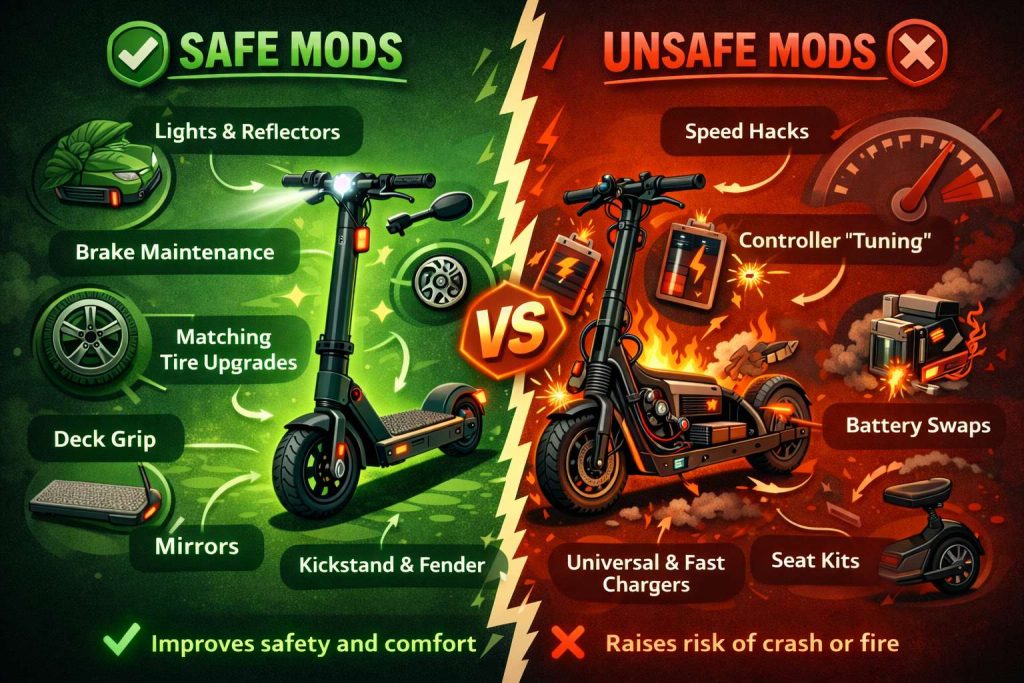
SAFE scooter mods (low risk, high value)
These upgrades are the sweet spot. They add comfort and safety, and they rarely create new problems.
1) Better lights and visibility
First, upgrade the things that help you see and be seen. Night riding feels safer right away, and drivers notice you sooner.
Safe visibility upgrades:
- brighter headlight that matches your scooter’s voltage
- stronger rear light with a solid mount
- rechargeable turn signals (no wiring work)
- reflective tape on the stem and deck edges
- helmet light as a backup beam
Next, keep it simple. If you can avoid cutting wires, do that. A clean rechargeable light setup works surprisingly well.
2) Mirrors that stay stable
Mirrors help you ride with fewer surprises. You can spot cars, bikes, and fast riders behind you in a quick glance. Then you can hold your line with less stress.
Good mirror choices:
- bar-end mirrors with a tight clamp
- compact mirrors that do not shake at speed
Still, skip the flimsy plastic clamps. They drift over time, and that makes the mirror useless.
3) Deck grip upgrades
A slippery deck can ruin your ride, especially in rain. So, traction is not just a comfort upgrade. It is a real safety mod.
Safe traction upgrades:
- high-quality grip tape
- rubber deck mat made for your model
- wider grips for better hand control
After that, press the grip down hard and trim it clean. It looks better, and it lasts longer.
4) Tire upgrades that keep the same size
Tires change how the scooter turns, stops, and holds traction. So, tire upgrades can be a smart move, as long as you keep the original size.
Safe tire upgrades:
- better pneumatic tires in the same size
- new inner tubes
- puncture sealant (for tube setups)
- tread designed for wet grip
At the same time, avoid random size swaps “for looks.” Even a small change can affect clearance, braking feel, and stability.
5) Brake maintenance and brake feel upgrades
Brakes are not a place to go cheap. So, if your braking feels weak or noisy, start here.
Safe brake upgrades:
- fresh brake pads
- new rotor with the same diameter and thickness spec
- new cable and housing for cable brakes
- better brake levers that match the pull ratio
Then test slowly. Do a few gentle stops. After that, do a few harder stops. If the lever pulls to the bar or the wheel rubs, fix it before you ride normally.
6) Small comfort upgrades that actually matter
Comfort changes how long you can focus. So, it can help safety more than people think.
Safe comfort upgrades:
- ergonomic grips
- solid phone mount with a metal clamp
- stronger bell or horn
- fender upgrade for water splash control
- better kickstand made for your scooter
Plus, these upgrades do not stress the battery. That is a win.
BORDERLINE mods (can be safe, but mistakes bite hard)
These upgrades can work well. Still, they need correct parts and careful setup.
1) Hydraulic brake conversions
Hydraulic brakes can feel smoother and stronger than cables. So, riders love them. But a bad kit can leak, rub, or lose pressure.
A safer conversion setup:
- kit that matches your scooter’s mounts
- rotor size that fits the caliper range
- clean hose routing with no kinks
- full steering lock without hose tension
- free wheel spin with no pad drag
After that, bed the pads in slowly. Do ten gentle stops first. Then increase braking force step by step.
2) Suspension kits
Suspension can help on rough roads. It can also make the front end flex and wobble if the kit is cheap.
Red flags:
- loose pivots with side-to-side play
- thin brackets that bend under load
- parts that touch the tire at full compression
- strange steering feel after install
Meanwhile, remember this. Suspension does not fix poor tires or loose hardware. So, tighten and check basics first.
3) Steering damper kits
A damper can reduce wobble for some scooters, especially at higher speed. Still, a bad mount can weaken the stem area.
A safer damper setup:
- solid bracket design
- no drilling into critical stem zones
- smooth movement without binding
- full steering range still available
Instead of chasing a damper right away, check tire pressure and steering bearing play. Many wobble issues start there.
4) Solid tires and tubeless conversions
Solid tires stop flats. That sounds perfect. Yet the tradeoff is real. You often lose grip and comfort, especially on wet roads.
Tubeless conversions can work, but only when the rim and tire match the design. If the seal fails, you can lose air fast.
So, treat these as “only if needed” mods, not automatic upgrades.
UNSAFE mods (high crash risk, high fire risk)
These are the ones that ruin scooters, and sometimes hurt riders. They often look exciting online. In real life, they can be expensive and dangerous.
1) Speed limiter removal and speed hacks
This includes:
- speed limiter removal
- custom firmware
- firmware flashing
- app unlocks that raise top speed
Higher speed feels fun for a few minutes. Then reality hits. You need more braking power, more tire grip, and more stability. On many scooters, you do not have that extra margin.
So, this mod can turn small mistakes into big crashes.
2) Controller tuning and shunt mods
These are popular in “tuning” forums:
- shunt mod
- higher current controller maps
- controller swaps with more amps
- phase wire stress boosts
In fact, heat becomes the main problem here. Motors run hotter. Controllers run hotter. Connectors run hotter. Then small plugs start melting, even when the scooter still rides “fine.”
Common warning signs:
- random power cutouts under load
- burnt smell near the deck
- discolored connectors
- error codes that appear and disappear
If you notice these signs, stop riding and inspect the scooter.
3) Battery upgrades and range extenders
Battery mods look simple on paper. Real packs need correct cell matching, correct fusing, correct BMS logic, and safe mounting. Most DIY setups miss at least one of those.
Unsafe battery actions:
- aftermarket battery pack not made for your model
- parallel battery wiring without proper design
- BMS bypass
- wrong fuse or no fuse
- loose battery inside the deck
- random connector swaps
After that, charging becomes riskier too. So the danger stacks up.
4) Charger swaps and “fast charging” hacks
This is one of the easiest ways to damage a battery quietly.
Unsafe charger choices:
- universal charger that “fits the plug”
- higher voltage charger for faster charging
- unknown fast chargers without a clear match to the pack spec
- DIY power supply charging
So, stick to the correct charger for your scooter. If you want faster charging, buy a model designed for it.
5) Motor swaps without a full build plan
A motor swap changes the whole system load. Then you need stronger brakes, stronger wiring, and better thermal control.
Unsafe motor swap patterns:
- bigger motor with stock brakes
- bigger motor with the same thin wires
- higher power motor with no temperature monitoring
It can feel great for a few rides. Then heat damage catches up.
6) Drilling, cutting, or modifying the frame
Do not drill the stem. Do not drill folding parts. Do not cut supports under the deck.
Unsafe structural mods:
- drilling the steering column for mounts
- cutting deck supports for “more space”
- removing folding safety pins
- welding unknown metal without engineering
A small crack can grow fast. Then the failure happens with no warning.
7) Seat kits on scooters not built for seats
Seat kits shift balance and steering input. They also change how the stem loads under braking.
If your scooter was built for standing, treat seat kits as unsafe. Buy a seated model instead.
A simple upgrade plan that stays safe
If you want a clean build, follow this order. It keeps risk low and value high.
Stage 1: Safety basics
First:
- set correct tire pressure
- refresh brake pads if needed
- add deck grip
- upgrade your front and rear lights
- add a mirror
Stage 2: Comfort and daily ride quality
Next:
- upgrade grips
- install a stable phone mount
- upgrade tires in the same size
- add a better fender
If you like smoother rides, you might enjoy scooters built with comfort in mind. For example, scooters moving to larger tires and suspension are becoming more common. You can see that trend clearly in this update: Xiaomi Electric Scooter 6 with 12-inch tires and dual suspension.
Stage 3: Premium upgrades (only with the right parts)
Then, if you still want more:
- hydraulic brakes from a trusted kit
- a suspension kit made for your exact model
- a steering damper if wobble exists and hardware is tight
After that, keep the power system stock. That one choice prevents most serious problems.
Quick cheat sheet: safe vs unsafe scooter modifications
Safe
- lights, reflectors, horn
- mirrors
- grip tape and deck mats
- tires in the same size
- sealant and new tubes
- brake pads, rotors with matching specs
- brake cables and housing replacement
- fenders and kickstands made for your model
Borderline
- hydraulic brake conversion kits
- suspension kits
- steering damper kits
- tubeless conversions (only with the right rim and tire)
Unsafe
- speed limiter removal
- custom firmware and flashing
- shunt mods and high-current controller tuning
- battery pack swaps not designed for your model
- parallel range extender wiring
- universal chargers and “fast charging” hacks
- motor swaps without full system redesign
- drilling or changing folding parts
- seat kits on standing scooters
One last thought before you start modding
A scooter is a small vehicle with small margins. So, it pays to upgrade smart. Make it easier to see, easier to stop, and easier to control. Then your scooter feels better without becoming unpredictable.
If you want more speed or a different ride style, it is usually safer to buy a scooter built for that job. In fact, the market keeps moving fast, and new models arrive often. You can see it in launches that focus on real-world use, like this one: VinFast electric scooters with a battery swap network.