

Electric scooter insurance sounds simple, but it rarely feels that way in real life. Rules differ by country and even by city. Insurers use different labels for the same risk, and policy wording can hide the one detail that matters.
So let’s make this easy. You will learn what scooter insurance covers, what it often skips, what drives the price, and what to check before you pay.
If you want the full version with extra examples and a deeper walk-through, read this page too: Electric Scooter Insurance Guide 2026: what you need, what it covers, and how to choose.
What “electric scooter insurance” usually means
People say “scooter insurance” and mean different products. So start by sorting it into clear buckets.
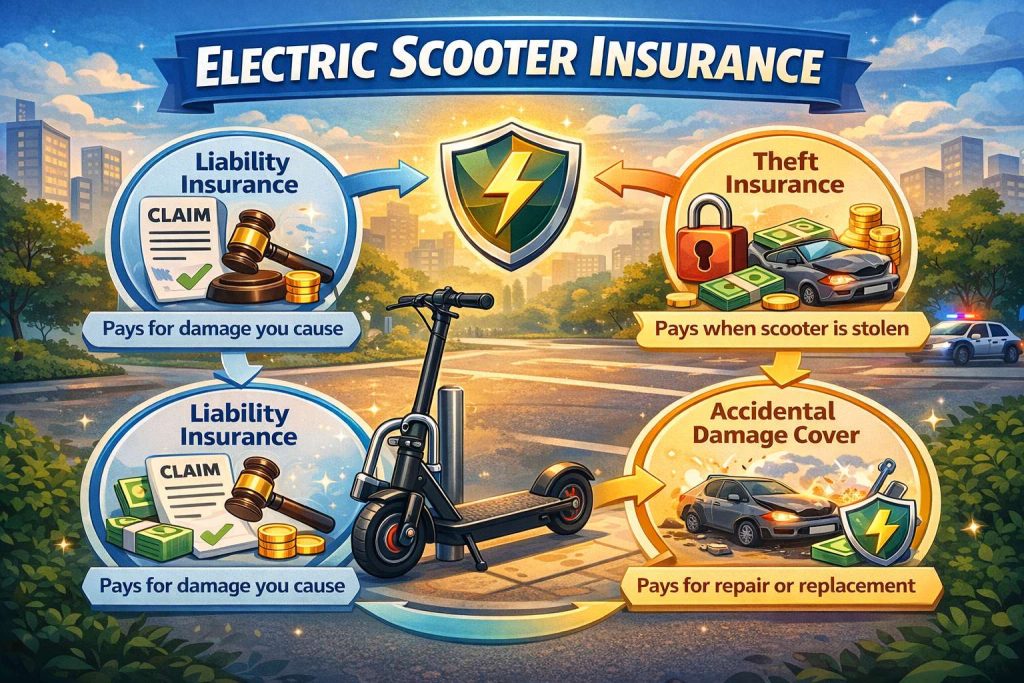
Third-party liability insurance
This pays for injury or property damage you cause to other people. It can cover medical bills, repairs, and legal costs. It depends on the policy, so read the scope.
Theft insurance
This pays when someone steals your scooter. Policies often ask for proof of ownership and proof of locking, so keep those ready.
Accidental damage cover
This helps with repairs or replacement after a crash, vandalism, or another covered event. It usually comes with a deductible.
Rider injury cover
This pays a set benefit after injury, or it reimburses medical costs. Terms vary a lot, so compare details.
Most riders start with liability cover. That makes sense. A scooter can cost a few hundred or a few thousand, but an injury claim can cost far more.
The legal check you should do before you buy anything
Insurance ties to local law. That sounds obvious, but it catches people all the time. A scooter can count as a bicycle in one place, then count as a motor vehicle in another place. Speed limits and power limits often decide the class, and the class decides the rules.
Use this quick routine. It takes ten minutes, and it can save you from buying the wrong policy.
- Write down your scooter’s top speed, motor power, and weight.
- Check how your local rules classify a scooter with those numbers.
- Check where that class can ride, road, bike lane, shared path, or private land only.
- Check what proof you must carry, sticker, plate, registration, or certificate.
- Ask the insurer which class they cover, and ask what proof they need at claim time.
Do not trust a seller’s summary. It can be old, and it can be vague, so your policy ends up vague too.
Coverage types, in plain language, with the common traps
Third-party liability cover
Liability cover pays for harm you cause to others, and it is often the most important part. It can cover injuries to pedestrians and cyclists, and it can cover damage to cars, doors, fences, or shop windows. It can include legal defense too, but you need to confirm that part.
Check these items:
- Liability limits for injury
- Liability limits for property damage
- Legal defense and claim handling
- Where the policy applies, local only or wider territory
- Rider rules, age limits, license rules, and any training rules
A common trap is location scope. Some policies cover you only on private property, then a crash on a public path sits outside cover. That hurts.
Theft cover
Theft cover helps, but it comes with strings. Insurers usually want:
- Proof of purchase and the serial number
- A police report filed within a set time window
- Proof of locking, type of lock and how you used it
- Proof of storage, indoor, outdoor, shared garage, or street
Another common trap is street theft. Some policies cover theft from a locked building, but not from the street. So be honest about your routine. If you lock outside at work, then buy cover that fits that.
Accidental damage and collision cover
This pays for repairs or replacement after a crash, and it can cover vandalism too. Still, the payout method matters more than most people expect.
Check these items:
- Deductible amount
- Payout basis, new replacement, market value, or depreciation
- Repair rules, approved shops only or your choice
- Parts cover after impact
- Claim limits per year, and total payout caps
A common trap is commuting and work use. Some policies exclude commuting. Some exclude any paid work use. So if you ride to work, or you deliver for pay, you must read that part with care.
Rider injury cover
Rider injury cover can help, and it can fill gaps. Still, it is not the same as health insurance, and the fine print varies a lot.
Check these items:
- What the policy counts as an accident
- Waiting periods
- Payout type, reimbursement or fixed benefit
- Limits per injury and per year
- Rehab rules and follow-up care rules
Some plans pay only for hospital stays. Then you get outpatient rehab bills, and the plan pays nothing. So read the benefit trigger.
Accessory cover
Some insurers cover locks, helmets, lights, and accessories. Others treat them as separate property.
Check:
- A list of covered items
- Maximum payout per item
- Proof rules, receipts and photos
This one sounds small, but it matters. A claim goes smoother when you have proof ready.
Where scooter cover usually comes from
You can get scooter cover in a few ways, and each has pros and cons.
Standalone scooter policy
This usually matches scooter risks best, and it can bundle liability, theft, and damage.
An add-on to another policy
Some insurers add scooter cover to a home or renters policy. Some add it to a motor policy. Coverage depends on definitions and exclusions, so do not assume.
Rental operator cover
Shared scooters often include some cover during the rental session. Still, the scope can be limited, and it can come with deductibles, so read the rental terms.
Think of every option as a contract. Then treat definitions like “public place” and “road” as deal-breakers. One line can flip a claim from paid to denied.
Exclusions that break claims most often
Most claim issues come from the same small list. Read these and check your habits.
- Riding where your scooter class is not allowed
- Riding under the influence of alcohol or drugs
- Carrying a passenger on a single-rider scooter
- Modifying the scooter for higher speed or higher power
- Paid delivery or paid work use, when the policy is personal use only
- Lock rules not followed, like not locking to a fixed object
- Police report filed too late after theft
- Wear, battery aging, and maintenance issues
Modifications deserve extra attention. A speed mod can change the legal class. Then the policy no longer fits, and a claim can fail.
What drives the price
Scooter insurance pricing usually follows a few core inputs.
Scooter value
Higher value raises theft and damage premiums, and it raises replacement payouts.
Performance
Higher top speed and higher power raise risk, and they can change legal category too.
Riding area and routine
City commuting raises exposure, and it raises theft risk. Quiet leisure riding can price lower.
Storage
Indoor storage lowers theft risk. Street storage raises it.
Coverage limits and deductible
Higher limits cost more, and a higher deductible costs less.
Claims history
Prior claims can raise prices.
You can trim cost and still stay protected. Keep strong liability cover. Then adjust theft and damage with a deductible you can pay without stress.
Picking limits that match real risk
Liability limits matter more than scooter value. A scooter can be replaced. A serious injury claim can follow you for years.
Use a simple approach:
- Pick a liability limit that matches worst-case injury risk in your area.
- Pick a deductible you can pay on short notice.
- Set insured value close to real replacement cost for theft and damage.
- Check payout basis, market value or replacement value, and read how depreciation works.
This part feels boring, but it is where good cover becomes real cover.
Theft prevention that supports your claim
The best theft plan is the one you really use, day after day. It also needs to match your policy rules, so your claim does not collapse on a technicality.
A practical routine:
- Use a high security U-lock or heavy chain lock.
- Lock the frame to a fixed object.
- Avoid locking only the front wheel.
- Store indoors when you can.
- Keep photos of the scooter, the serial number, and your lock setup.
- Save the receipt in a folder on your phone and in cloud storage.
If you want a clean storage plan that protects the battery too, use this guide: How to store your electric scooter long term without killing the battery.
What to do right after a crash or theft
Fast, calm steps help your health, and they help your claim.
After a crash:
- Move to safety.
- Get medical help if you need it.
- Take photos of the scene, the damage, and the road markings.
- Record names, phone numbers, and vehicle plate numbers.
- Get witness details.
- Notify the insurer through their claim channel.
After theft:
- File a police report fast.
- Gather proof, receipt, serial number, photos, lock details, and last known location.
- Notify the insurer, then follow their document list.
Keep your description factual. Keep it short. Then add detail only when they ask.
A simple buying checklist that works in most places
Use this list to compare policies quickly:
- Your scooter class matches local rules for your riding areas.
- The policy covers the places you ride, road, bike lane, shared path.
- Liability limits match real injury risk.
- Theft cover includes your real parking routine, street or indoor.
- Lock and storage rules match your habits.
- Damage cover pays on a fair value method.
- Deductible fits your budget.
- The policy covers commuting if you commute.
- Work use is covered if you ride for pay.
- Claim steps are clear, and time windows are clear.
- Territory fits your travel plans.
- Exclusions match your scooter setup and riding style.
If you get stuck between two policies, pick the one with clearer definitions. Clarity beats vague promises.
Search terms people use for this topic
These terms show up in quotes and policy pages. Use them when you compare cover:
- e-scooter insurance
- electric scooter liability insurance
- scooter third-party insurance
- personal mobility vehicle insurance
- scooter theft insurance
- electric scooter insurance cost
- e-scooter insurance quote
- accidental damage scooter cover
- rider injury scooter cover