

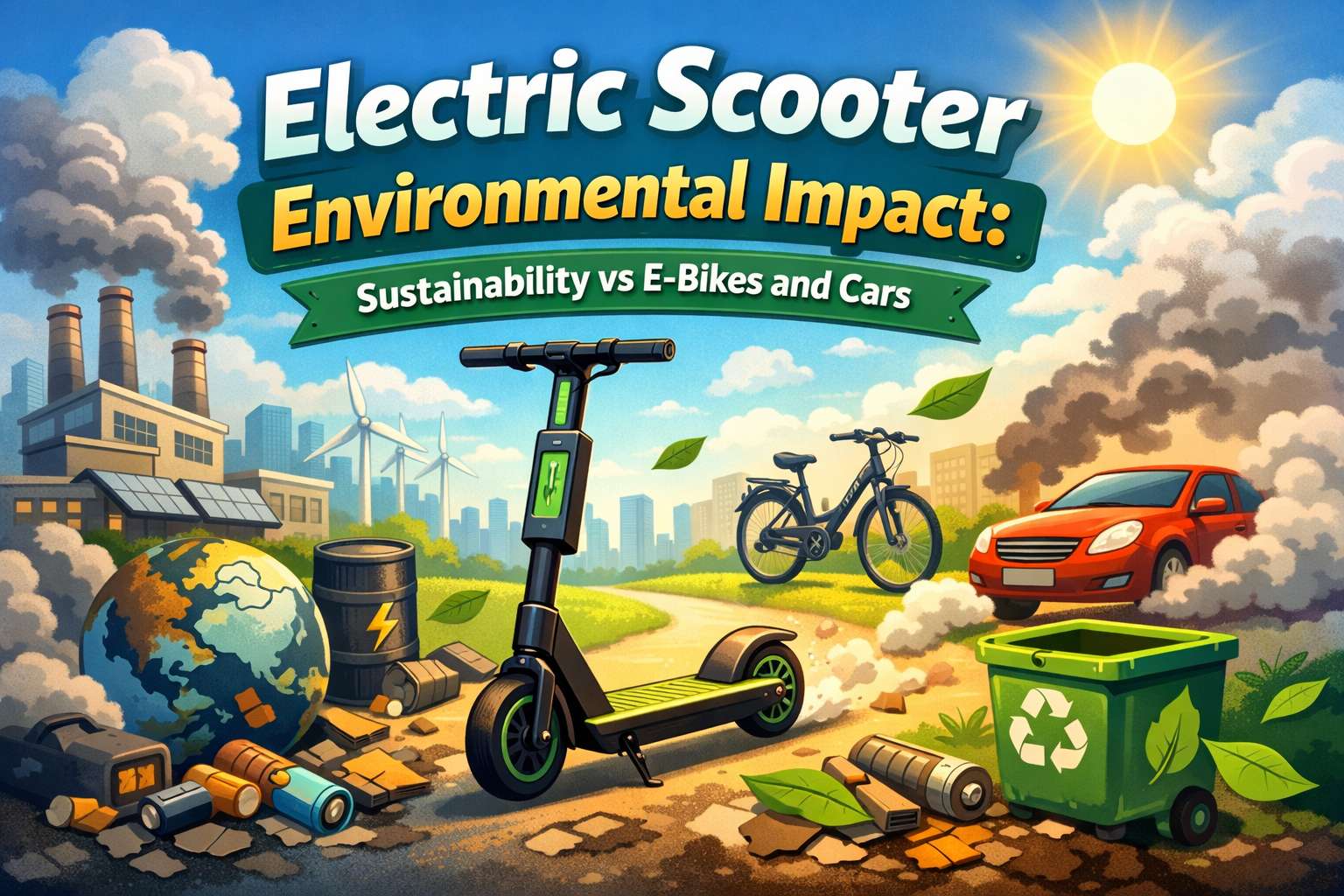
Electric scooters look clean when you ride them. You plug in a small battery, you roll across town, and you skip the tailpipe fumes. So it is easy to assume the story ends there.
It does not. A scooter has a footprint before you ever stand on the deck. Then it has a footprint each time you charge it. Shared scooters add one more layer, since crews repair them, move them, and swap batteries. So the “green” answer depends on the full life cycle, plus the trip you replace.
This guide keeps it practical. You will learn what makes e-scooters unsustainable, what sustainability changes in the real environment, how e-bikes compare, and when scooters can beat cars, or fall short.
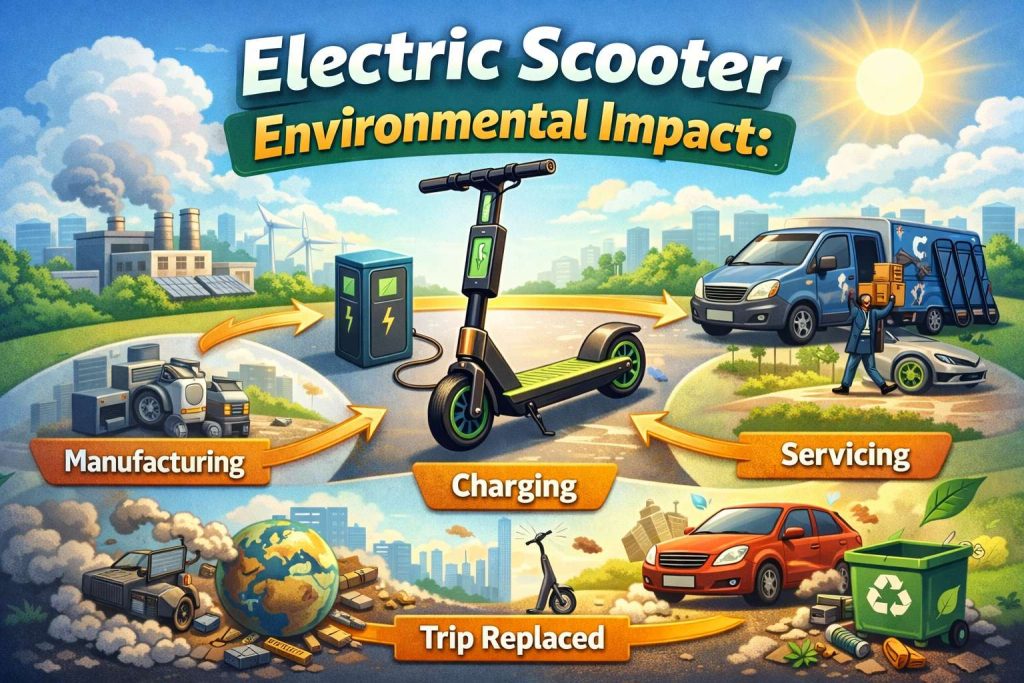
A simple way to judge scooter sustainability
Start with four buckets. Then add one reality check.
1) Manufacturing and materials
This is the upfront footprint. It comes from mining, processing, parts manufacturing, and assembly. Batteries and electronics carry a lot of weight here.
2) Energy for use
Charging adds emissions tied to your local electricity mix. So your grid matters.
3) Servicing and operations
Private scooters have basic upkeep, like tires and brakes. Shared scooters add fleet work, like collection, repositioning, battery swaps, and repairs.
4) End of life
Batteries and electronics need proper collection and recycling. So end-of-life handling matters for waste and safety.
Then the reality check, what trip did the scooter replace?
If the scooter replaces a car trip, that is usually good news. If it replaces a walk, the climate benefit can shrink fast.
So you can judge almost any scooter situation with one question. Does the scooter last long and replace car miles?
What makes e-scooters unsustainable?
Short lifespan and low lifetime distance
A scooter has a built-in problem. Its manufacturing footprint is fixed at day one. So the only way to lower “per km” impact is to spread that footprint across more riding.
That is why lifespan matters so much. A scooter that breaks early pushes a lot of footprint into a small number of trips. Then each km looks worse.
Shared scooters get hit hardest here. They face weather, curb drops, heavy daily use, and sometimes vandalism. So durability becomes the core lever, not a bonus feature.
A quick rule helps.
- Longer life and more total km, lower footprint per km.
- Short life and low total km, higher footprint per km.
High servicing footprint in shared fleets
Shared scooters can look clean on paper. Then the vans show up.
Servicing can include pickup routes, battery swaps, repairs, charging hubs, and rebalancing. So the support miles can add up. If support vehicles travel far relative to scooter riding, the footprint can spike.
So the key metric is simple.
- How many support km happen per 100 km of scooter riding?
Lower is better. Operators cut this with swappable batteries, tighter service zones, local depots, and stronger scooters that need fewer repairs.
Mode shift from walking, cycling, or public transport
Sustainability lives or dies on what the scooter replaces.
If a scooter replaces walking, the scooter adds manufacturing and charging impacts on top of a trip that was already low impact. So the net outcome can turn negative, even if the scooter itself feels “clean.”
If a scooter replaces a short car trip, the math swings the other way. City driving has idling, cold starts, traffic, and stop-and-go. So replacing those trips can cut emissions and reduce street-level exhaust.
Mode shift is not theory. You can see it in real cities. For a local example, check this report on Boise scooter and e-bike trips topping 900,000 rides, and why low-income discounts still struggle. It shows how adoption patterns and access programs shape who rides, and what trips get replaced.
“Disposable electronics” design
Some scooters are easy to keep alive. Some are not.
If a scooter is hard to repair, the owner often gives up. Then it turns into e-waste sooner than it should. So design choices matter a lot.
- Modular parts help, since you can swap what fails.
- Standard fasteners help, since repairs stay simple.
- Battery access helps, since batteries age faster than frames.
So repairability is not just a convenience feature. It is a sustainability feature.
Weak battery end-of-life handling
Batteries deserve respect. They need safe storage, safe transport, and proper recycling. If that chain fails, batteries can end up in the wrong waste stream. Then you get pollution risk and safety risk.
EU rules now push stronger controls on batteries across their life cycle. So recycling and take-back should keep getting better. Still, real-world results depend on collection systems and compliance.
What impact does sustainability have on the environment?
Sustainability sounds like a big word. So let’s tie it to outcomes you can actually picture.
Lower climate impact per trip
A scooter can cut climate impact when it lasts long and replaces car trips. That is the headline. Yet the path to that headline is practical, not magical.
- Build scooters that survive real use.
- Keep them in service longer.
- Ride them often enough to spread the upfront footprint.
So durability and usage patterns drive the climate result.
Cleaner air on busy streets
Scooters have no tailpipe emissions at the point of use. So riders and pedestrians do not get fresh exhaust from the scooter itself.
That does not mean “zero pollution.” Tires and brakes shed particles. Still, scooters are light, and they use small tires. So non-exhaust particles are usually far lower than a car’s, per trip.
So the local air quality story often improves most in dense areas where cars stop and start all day.
Less resource extraction and less waste
Longer product life means fewer scooters need to be manufactured per year. Then mining demand and processing demand can drop over time. At the same time, better recycling pulls materials back into use instead of pushing them into landfill.
So sustainability links directly to resource use and waste reduction, not just emissions.
How environmentally friendly are e-bikes?
E-bikes usually look very good in life cycle comparisons. So it is fair to ask why.
They often rack up more km over their life
Many people use e-bikes for commuting, errands, and regular trips. So lifetime distance can be high. Then the manufacturing footprint gets spread across many km.
They use very little energy per km
E-bikes sip energy. So charging emissions stay low, even on a grid that still uses fossil fuels.
Still, e-bikes follow the same core rule as scooters. The best results show up when e-bikes replace car trips, not walking trips.
So if you want a simple ranking for city trips, e-bikes usually sit near the top, as long as people ride them regularly.
Are scooters more polluting than cars?
Most of the time, no. A scooter tends to produce far less life cycle emissions per passenger-km than a fossil fuel car.
Yet there are two common cases where scooters can disappoint.
Case 1, the scooter replaces walking trips
Walking has near-zero operational emissions. So a scooter adds manufacturing and charging on top of a trip that was already low impact. Then the “green win” can vanish.
Case 2, a shared fleet runs heavy support logistics
If a shared fleet needs lots of van miles per scooter mile, servicing can become a large part of the footprint. Then the scooter advantage shrinks.
So the honest answer is conditional.
- Replace car trips with durable scooters and low support miles, scooters tend to beat cars.
- Replace walking trips, or run high support miles, scooters can look far less impressive.
A practical way to compare scooters, e-bikes, and cars
People love one simple chart. Real life is messier. So use this checklist instead.
Step 1, compare the trip you plan to replace
Replacing a short car trip is the high-impact move. Replacing a walk is not.
Step 2, check lifetime quality
A sturdy scooter that lasts years looks better per km than a cheap scooter that dies early.
Step 3, check electricity
Cleaner electricity lowers charging emissions. So your grid makes a difference.
Step 4, check shared fleet operations
Support miles matter. Battery swapping methods matter. Repair cycles matter.
If you want a real-world example of product details people care about, look at this update on the Suzuki e-Access electric scooter, its claimed range, charging, pricing context, and warranty angle. Product choices like battery size, charging method, and warranty terms can shape how long a scooter stays on the road, and that feeds straight into sustainability.
What makes scooters greener in the real world?
Extend scooter life
This is the main lever. So focus on what keeps a scooter alive.
- Keep tire pressure right, since low pressure eats tires fast.
- Replace brake pads early, since metal-on-metal ruins rotors.
- Keep water out of connectors, since corrosion kills electronics.
- Store the battery at moderate temperatures, since heat ages cells.
For shared fleets, durability and repair culture matter even more. So a modular scooter with easy part swaps can cut waste and cut emissions per km.
Ride it enough to matter
A scooter used once a month will never look great per km. So regular use matters.
Commuting and errands are the sweet spot. Short car trips are common, and scooters can replace them well in many cities. Then the footprint per trip can drop fast.
Shift trips away from cars, not away from walking
This is the big reality check. So try to use scooters where they make a clear substitution.
- Replace car runs for groceries, short visits, and local errands.
- Use scooters for the first mile and last mile around transit, if it replaces a car pickup.
If you mainly replace walking, the sustainability case weakens. So it helps to be honest about your own travel habits.
Clean up shared scooter operations
Shared fleets can improve fast with the right choices.
- Use swappable batteries to cut warehouse time and reduce pickup routes.
- Use smaller service vehicles, and electrify them where possible.
- Use smarter rebalancing so scooters sit less and ride more.
- Fix scooters quickly so broken units do not get scrapped early.
So the fleet story is not fixed. It can improve a lot with operations discipline.
Treat batteries as regulated products at end of life
Batteries need approved recycling channels. So use local collection systems, and follow your city or country rules for lithium-ion disposal. It protects workers and reduces fire risk.
Quick take, are e-scooters sustainable?
They can be. Yet it depends on how you use them and how long they last.
If you ride a durable scooter often, and you replace car trips, the sustainability case is strong. Then you cut tailpipe pollution, and you usually cut climate impact per trip.
If the scooter dies early, or it mostly replaces walking, the case gets weaker. Then you add manufacturing footprint without removing much from the system.
So the best path is simple. Buy quality, maintain it, ride it often, and use it to replace car miles.