

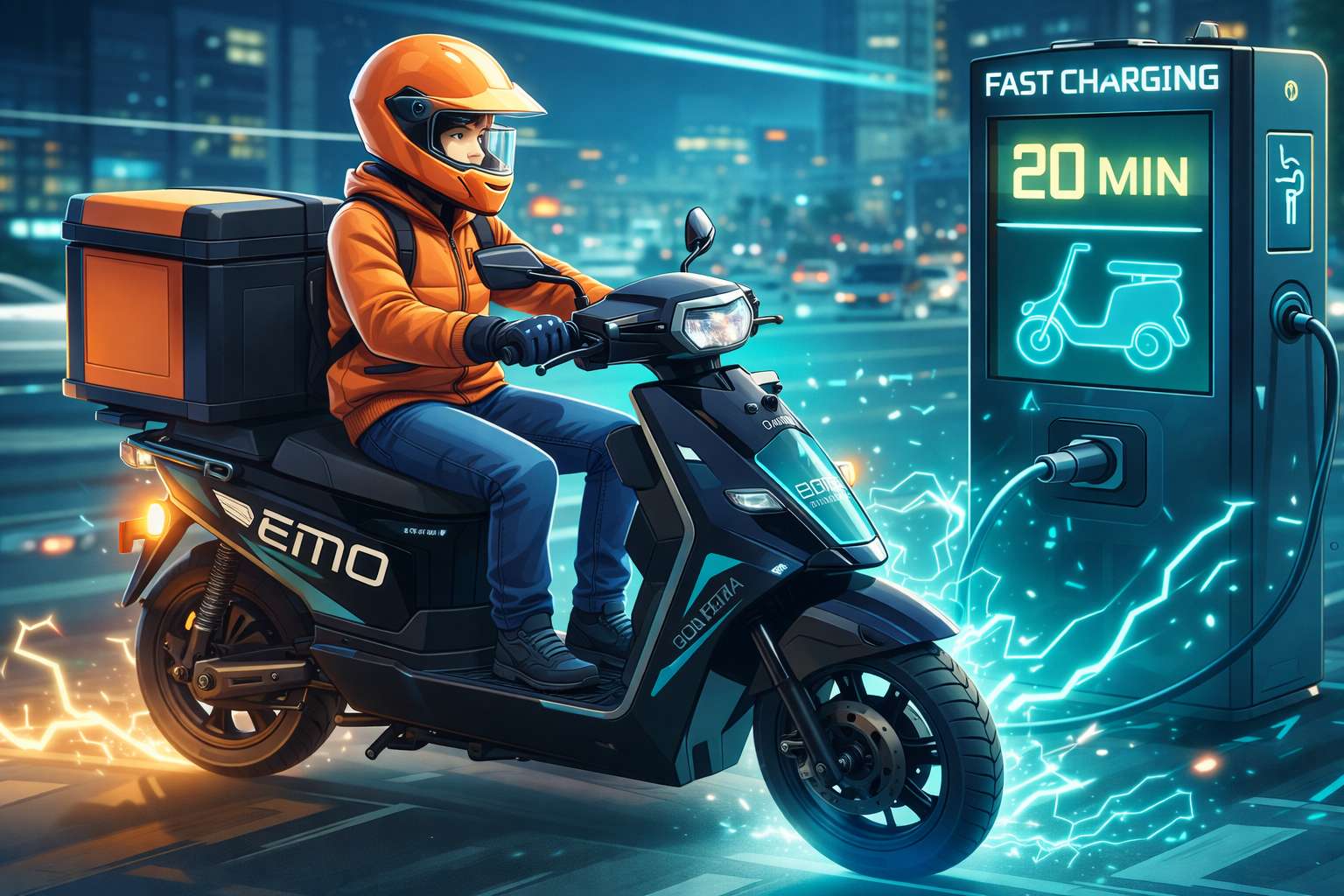
Quantum Energy and EMO Energy have launched the Quantum Bziness EMO, an electric scooter aimed at last-mile delivery fleets in India. This one clearly targets daily commercial work, not casual weekend rides.
If you’ve ever watched a delivery rider in city traffic, you know what their scooter goes through. Stop. Go. Stop again. Tight turns, bad roads, heavy bags, long shifts. Fleet owners care about one thing first. How much time the scooter spends working.
That’s the idea behind the Bziness EMO. Charge fast, carry more, stay stable, and keep moving.
Built for delivery work, not a commuter scooter with a box
Delivery scooters need a tougher setup than personal commuters. Riders deal with constant braking, quick acceleration, and uneven streets. Some scooters feel fine on paper, then fall apart once the workload gets real.
Quantum Bziness EMO tries to match that reality with a 200 kg payload rating and a 2,500 W peak hub motor. That should help with heavier cargo loads and repeated takeoffs from traffic lights.
The scooter also comes with 12-inch wheels, which usually means better balance and fewer “oh no” moments when the road gets rough. For braking, it uses CBS (Combined Braking System). CBS spreads braking force between the wheels, which can help riders stay steadier during quick stops.
Battery size, range, and speed: the basics fleets actually track
The Bziness EMO uses a 2 kWh ZenPac battery supplied by EMO Energy. The companies list a real-world range up to 80 km on a full charge, plus a top speed of 50 km/h.
That speed won’t sound wild, but it fits the job. In delivery work, riders spend more time weaving through traffic and stopping at gates than cruising wide open. Consistency matters more than high numbers.
The big headline: 20-minute fast charging
Charging time decides if a scooter can run full-day routes without turning into a parked problem. EMO Energy states the ZenPac battery supports a 20-minute fast charge when used with its Swft fast charger.
For fleets, that can be a deal-maker. A short charging window can fit into real routines, like quick hub stops, rider breaks, or those awkward gaps between peak delivery runs. It can also reduce the need for extra backup scooters sitting around “just in case.”
Cooling, battery control, and long-term health
Battery health turns into real money once a fleet scales up. Batteries age. Capacity drops. Performance starts to vary between scooters. That’s the part fleet managers hate, since it makes planning messy.
EMO Energy says ZenPac uses active immersion cooling, plus systems like energy management and an active balancing BMS. The company links that setup to stable performance, even with frequent fast charging and heavy daily usage.
EMO Energy also shares big operational numbers. It says ZenPac has logged 150 million km in real-world use. It reports about 1.2% degradation at 300 cycles and under 2% beyond 400 cycles. The company also mentions 25 global patents tied to its battery and charging tech.
Those numbers will catch attention, especially from operators thinking long-term. Still, real-world fleet performance across seasons will tell the full story.
Charger coverage across Indian cities
Fast charging only helps if you can actually access chargers on your routes. EMO Energy states it operates more than 1,300 fast chargers across 12+ cities in India.
That kind of footprint can make rollouts easier. Fleets can start small, test routes, and expand into more cities without waiting for private charging hubs to be built everywhere.
Service reach matters more than people admit
Charging is one piece of the puzzle. Service is the other.
In fleet use, small problems happen all the time. A brake issue, a broken panel, a tire that gives up at the worst moment. If repairs take too long, scooters sit idle, and the delivery schedule takes a hit.
Quantum Energy states it has more than 100 service touchpoints across India. That sounds promising, at least on paper. The real test will be turnaround time and parts availability when fleets start stacking up real mileage.
A 10,000-scooter deployment plan
Quantum Energy and EMO Energy also state a plan to deploy 10,000 scooters over the next 12 months.
That tells you they want fleet adoption, not a slow “one showroom at a time” launch. Delivery companies often buy in batches, and they usually expand after early results look good.
More manufacturing capacity with a clear timeline
Quantum Energy says it has started operations at a new 6-acre facility in Maheshwaram. The company lists a two-phase plan:
- Phase 1: 55,000 sq. ft. built-up area by March 2026, with capacity of 10,000 units per month
- Phase 2: 150,000 sq. ft. built-up area by mid-2026, with capacity of 20,000 units per month by mid-2027
For fleet buyers, this matters more than most people think. A big operator might want hundreds of scooters at once. If production can’t keep up, expansion plans stall, even if the scooter looks great.
What fleets will watch next
This launch focuses on payload, charging speed, and day-to-day practicality. That’s the right direction for last-mile delivery.
Now fleets will want the details that decide real value:
- Cost per kilometer across a full year
- Battery behavior in heat, rain, and heavy traffic
- Charger access during peak hours
- Service speed across multiple cities
If the Bziness EMO holds up in real work conditions, it could end up as a common fleet choice. Not flashy, not trying too hard, just built to get the job done.
And if you’re also tracking other major launches in India right now, you’ll probably want to read this one too: Suzuki e-Access Electric Scooter lands in India: price, 95 km range, fast charging, and the big warranty hook.