

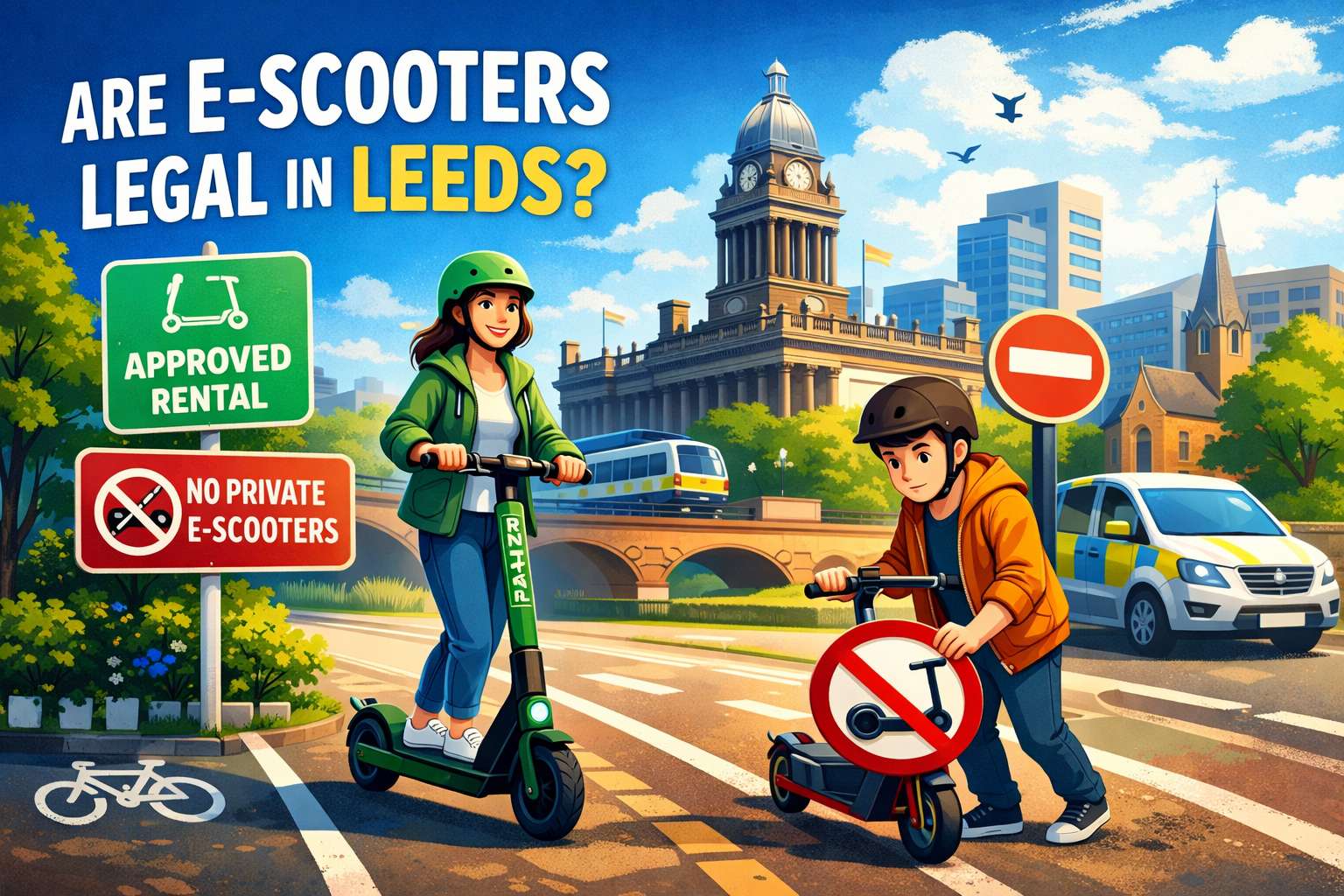
Leeds now has a legal rental e-scooter scheme, and that is a big change for local travel. It also raises a question that many people ask right away. Are e-scooters now legal in Leeds?
The answer needs a bit of context. Leeds has launched a legal rental trial through Beryl, but private e-scooters still cannot go on public roads, pavements, or other public land. So yes, you can now ride certain e-scooters in Leeds. No, that does not mean every e-scooter in the city is legal.
That difference matters. A lot of people see rental scooters on the street and assume the law changed for everyone. It did not. The new scheme gives Leeds residents one legal route to ride an e-scooter, but only under the trial rules.
Leeds now has a legal rental e-scooter trial
Leeds joined the UK rental e-scooter trial system in March 2026. The city launched the service through its existing Beryl partnership, and the first phase started with 100 e-scooters. These scooters joined the LNER Beryl Bikes network and expanded the city’s shared transport options.
This move matters because the UK had not added a new e-scooter trial city for years. Leeds now stands out as the first city to roll out a new trial in that latest wave. For riders, that means one simple thing. If you hire an approved rental e-scooter in Leeds and follow the rules, your ride can be legal.
That legal route only covers the official rental fleet. It does not cover a private scooter that you bought online or from a local shop.
Are e-scooters illegal in Leeds?
Private e-scooters are still illegal on public land in Leeds. That includes roads, pavements, and most public spaces. You can still use a private e-scooter on private land if you have the landowner’s permission, but public use remains off limits.
So when people search for “Are e-scooters illegal in Leeds?”, the honest answer is yes for private scooters, and no for approved rental scooters inside the official trial.
That split can confuse buyers. It also catches new riders off guard. A scooter may look road-ready, but that does not make it road legal. In Leeds, the law still draws a hard line between private ownership and approved rental use.
If you want the wider national picture, this guide to UK private e-scooter laws in 2026 explains the rules in plain English.
What rules apply to the Leeds rental scooters?
The Leeds rental scooters must follow the same broad rules used in other UK trial areas. Riders can use them on roads, except motorways, and in cycle lanes. Riders cannot use them on pavements. Only one person can ride at a time, and the top assisted speed stays capped at 15.5 mph.
Leeds riders also need to meet the operator’s access rules. In practice, that means riders must meet the minimum age and licence requirements set in the app before they unlock a scooter. For Beryl’s e-scooter system, riders must be at least 18 and verify a valid physical UK driving licence. Provisional licences count too.
Those details matter because they shape who can actually use the scheme. A teenager who can legally ride a bicycle may still not qualify to rent an e-scooter.
Why are electric scooters illegal in the UK but not electric bikes?
This is where the legal framework starts to make sense. UK law already has a clear category for many electric bikes. It calls them EAPCs, or electrically assisted pedal cycles. If an e-bike meets the EAPC rules, the law treats it much like a normal bicycle.
That means the bike must have pedals, the motor must stay within the legal power limit, and motor assistance must cut out at 15.5 mph. When a bike meets those rules, the rider does not need registration, road tax, insurance, or a driving licence.
E-scooters do not fit into that same category. UK law does not treat them like bicycles. Instead, the law places them under motor vehicle rules unless they operate inside an approved rental trial. That legal gap explains the situation in simple terms. The UK built a legal route for certain e-bikes, but it still has not created a full public-use route for private e-scooters.
So the issue is not that the UK likes e-bikes and dislikes scooters. The real issue is that the law already has a working box for compliant e-bikes, while private e-scooters still sit outside a permanent public-road category.
Are all electric bikes legal in the UK?
No, and this is another point many people miss. An electric bike only gets the easier legal treatment if it meets the EAPC rules. If it has too much power, keeps assisting above 15.5 mph, or lacks usable pedals, the law may treat it as a moped or motorcycle instead.
That means the rider may need registration, insurance, and a licence. So when people compare e-bikes and e-scooters, they should not assume every electric bike gets a free pass. Only compliant e-bikes do.
Still, for most commuters and casual riders, a legal e-bike remains the safer and simpler option in the UK.
What does this mean for Leeds residents?
For Leeds residents, the takeaway is clear. If you want to ride an e-scooter legally in public, use the approved rental scheme and follow its rules. If you own a private e-scooter, do not take it onto public roads or pavements in Leeds.
If you want an electric option that gives you fewer legal headaches, a compliant e-bike still makes more sense for everyday use. It fits into a clearer legal framework, and it gives buyers more certainty.
That matters even more now, because the rental trial may make the local picture look more relaxed than it really is. The sight of shared scooters can make private ownership seem legal. It still is not.
Why the Leeds trial matters
Leeds did not just add another gadget to the street. The city added a new test case for low-emission urban travel. Rental e-scooters can help with short commutes, station links, and first-mile or last-mile journeys. They can also give councils better data on rider behaviour, street design, parking habits, and safety risks.
That said, the legal trial does not settle the bigger national debate. The UK still needs a long-term answer on private e-scooters. Until that happens, cities like Leeds can only work inside the trial model.
So yes, Leeds now has legal e-scooters. But only some of them. Only in specific conditions. And only through the approved rental scheme.
That may sound messy, but it is the real position in 2026. Riders need to know that before they buy, rent, or ride.
Final answer for Leeds riders
If you rent an approved e-scooter through the Leeds trial, you can ride it legally where the trial rules allow. If you own a private e-scooter, you still cannot use it on public land in Leeds.
Electric bikes follow a different path because UK law already created a legal category for compliant pedal-assist bikes. E-scooters do not have that same legal route yet.
That is why Leeds can have legal rental e-scooters and still ban private ones at the same time. It sounds odd at first, but once you know the legal split, it becomes much easier to understand.