

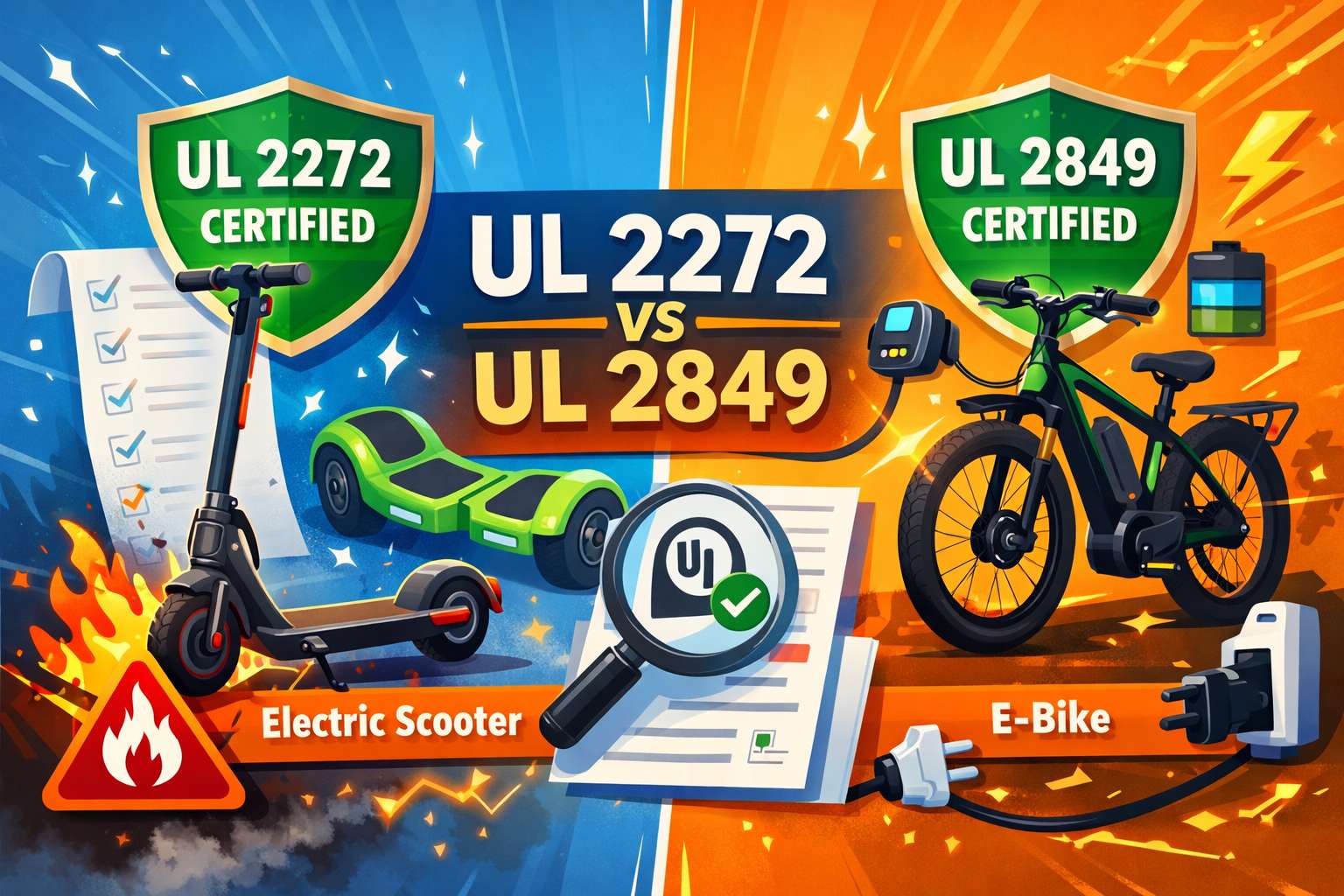
Buying an electric scooter or e-bike feels easy until you run into one loaded word: certified. Brands put it everywhere, and it sounds reassuring, but it can also be vague if you do not know what to look for. So let’s make it simple. What does UL 2272 certified mean, and how is it different from UL 2849?
This guide breaks down what each standard is meant to cover, what certification can actually prove, and what you can do to check a claim before you buy.
What “UL certified” means in plain terms
You will see people say “UL certified” like it is one single thing, but it is not. UL standards are the written safety requirements. Certification is when an independent lab tests a specific product to a specific standard and then issues a certification decision.
So the key idea is this. A standard is the rulebook. Certification is evidence that a certain model was evaluated against that rulebook.
Also, not every UL mark means the same thing. Some marks apply to finished products, while others apply only to parts or components. If you only see a component-type claim, it might not mean the whole scooter or e-bike is certified. I cannot confirm a product’s status without a verifiable listing tied to its exact model.
Why these standards focus so much on the electrical system
Most serious micromobility safety issues come back to the electrical system, especially the battery pack and charging setup. Lithium-ion packs store a lot of energy in a small space. When something goes wrong, the failure can escalate quickly.
That is why these standards focus on electrical and fire hazards. They aim to reduce risk during normal use, charging, and common fault conditions. They do not exist to tell you how fast a scooter is, how far it goes, or whether it feels smooth on rough pavement.
UL 2272 explained, and what it covers
UL 2272 is most commonly linked to personal e-mobility devices like stand-up electric scooters, hoverboards, and similar small rideables. In plain terms, it focuses on the electrical system. That includes the battery system, control electronics, wiring, and how the device behaves in stressful electrical scenarios.
When you see “UL 2272 certified” on a scooter listing, the claim usually means the device’s electrical system has been evaluated as a complete setup, not just one loose part. Still, you should treat “usually” carefully. Marketing language can get sloppy, and some listings use certification terms in a way that is hard to verify.
Here is the practical takeaway. UL 2272 is about reducing electrical hazards, including risks tied to charging, overheating, and electrical faults. It is not a performance badge.
UL 2849 explained, and what it covers
UL 2849 is most commonly associated with e-bikes and their electrical systems. Like UL 2272, it focuses on the drive system, the battery system, and the charger relationship as a complete package.
Think of UL 2849 as the e-bike lane. It targets electrical safety concerns, including charging-related shock and fire risk, and how the electrical system behaves across typical use conditions.
If you are shopping for an e-bike, UL 2849 is one of the labels you will see brought up most often in safety discussions. If a brand claims it, you still need to confirm it using a reliable listing tied to the exact model you want.
UL 2272 vs UL 2849, the real-world difference
Both standards aim to reduce electrical and fire hazards. The difference is the product category they are built around.
Use this simple rule when you shop.
- If it is an electric scooter or a similar stand-on personal rideable, UL 2272 is the certification you will see referenced most.
- If it is an e-bike, UL 2849 is the certification you will see referenced most.
There is another piece people miss. Some safety conversations also include battery pack standards that focus on the battery itself, separate from the full vehicle. Whether that matters to you depends on where you live, how strict your building rules are, and what your local market expects. I cannot confirm what rules apply in your area without the location and the current local regulations.
What certification does not guarantee
Certification is important, but it is not a magic shield. Even a certified product can fail if it is abused, damaged, modified, or charged incorrectly.
Certification also does not mean the scooter or e-bike is safe to ride in traffic, safe to use in wet weather, or safe at any speed. It is about reducing specific electrical hazards under defined test conditions.
So if you want a realistic mindset, use this one. Certification lowers risk, but it does not remove risk.
When certification is required by rules or building policies
In some places, certification is no longer just a nice bonus. It can be tied to sales rules, rental rules, workplace policies, or building rules. The details vary a lot, and they can change.
If you are buying for use in an apartment building, shared hallway storage, or a workplace, check the written policy. If a policy demands a certain standard, you want the certification record to match the exact model you own, not just a similar-looking version.
How to verify a UL 2272 or UL 2849 claim before you buy
This is the part that saves people headaches. Do not rely on a product page line that says “UL certified.” Instead, verify the claim.
Use this checklist.
- Look for a certification mark on the device, the charger, the manual, or the packaging.
- Write down the exact brand and model name, plus any file number or identifier shown near the mark.
- Confirm that the model appears in an official certification database or listing provided by the certification body or a recognized testing lab.
If you cannot match the exact model, treat the claim as unverified. Counterfeit labels exist, and model names can be reused across regions, so the details matter.
Other safety terms you will see, and what they often mean
Product listings throw around a lot of labels. Some help. Some are just noise.
Here are common categories you will run into.
- System-level certifications. These focus on the whole electrical system of the rideable, not only the battery.
- Battery-focused standards. These focus on the pack itself, and they may show up in places with strict building or fire-safety policies.
- Regional compliance labels. These can cover electrical compatibility, electromagnetic compatibility, or radio equipment rules, depending on the product.
If a listing only says something vague like “tested to UL standards,” that is not the same as “certified.” Testing without certification can be real, but it is harder to verify, so you should treat it cautiously.
A simple buying decision rule
If you want a quick way to shop smarter, do this.
- For electric scooters, prioritize a verifiable UL 2272 certification claim tied to the exact model.
- For e-bikes, prioritize a verifiable UL 2849 certification claim tied to the exact model.
- If you store or charge indoors, pay extra attention to battery and charger quality, and avoid off-brand replacement chargers.
Also, stick to basic charging habits. Use the original charger. Charge on a hard, open surface. Stop using the device if the pack swells, smells odd, or gets unusually hot.
Why this matters right now for new scooter releases
The scooter market moves fast, and new models show up with bigger tires, more suspension, and higher power. That is great for comfort, but it also means more buyers are charging larger battery packs at home.
If you want a current example of how modern scooters are changing, this update on the Xiaomi lineup is a useful reference: Xiaomi Electric Scooter 6 is here and the ride looks smoother than ever with 12-inch tires and dual suspension.
And if you want the wider trend view, including what is shaping buying decisions in 2026, this market overview will help you connect the dots: Compact e-scooter market in 2026.
Bottom line
UL 2272 and UL 2849 are not just buzzwords when they are real and verifiable. They are safety standards focused on electrical hazards in micromobility devices. UL 2272 tends to show up for scooters and similar personal rideables. UL 2849 tends to show up for e-bikes.
Still, the label is only as good as the proof behind it. So look for the mark, capture the model details, and verify the listing. It takes a few minutes, and it is worth it.