

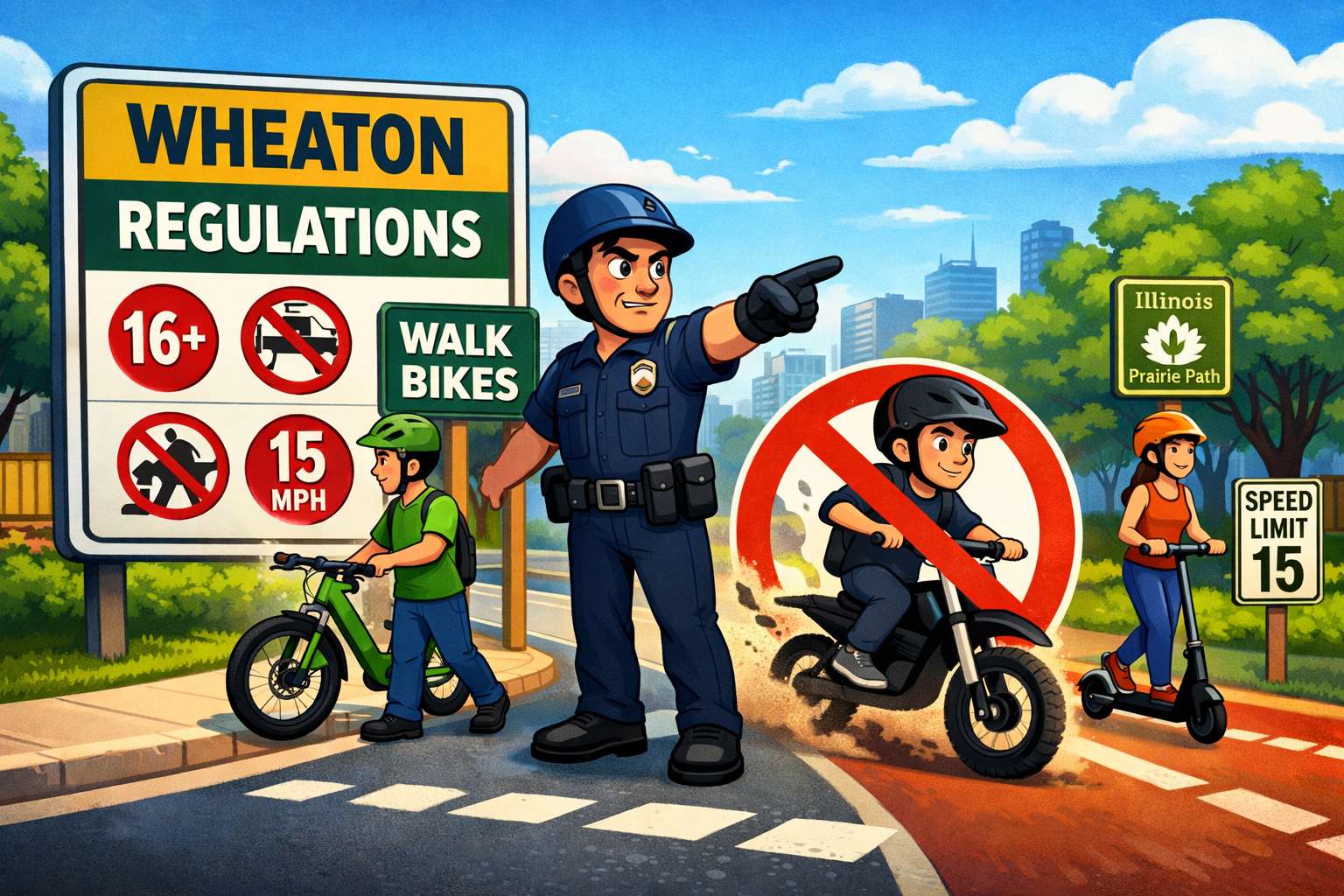
Wheaton has new rules for e-bikes, e-scooters, and faster electric vehicles. The change matters now, not months from now. City leaders approved the ordinance in early April 2026, and the public guidance that followed made the message plain. Regular low-speed devices still have a place in town, but fast electric vehicles and reckless riding now face stricter limits.
That shift answers a problem many towns now face. A normal commuter e-bike does not create the same risk as a modified electric dirt bike. A small rental-style scooter does not behave like a machine that pushes well past typical bike speeds. So the new Wheaton rules try to draw a cleaner line between those categories.
For riders, that line matters on the street, on shared paths, and downtown. It matters for parents too. Age limits, sidewalk access, speed caps, and fines all sit inside the new framework. So if you ride in Wheaton, or if you plan to buy an electric bike there, these are the details worth knowing.
What changed under the new Wheaton ordinance
The biggest change is how Wheaton handles vehicles that sit outside normal state definitions for low-speed e-bikes and electric scooters. The city now targets what it treats as out-of-class electric vehicles. That group can include modified e-bikes, electric dirt bikes, and other machines that run with more than 750 watts or move faster than 28 mph.
Those out-of-class vehicles now face harder local rules. Riders must be at least 16. They must hold a valid driver’s license too. Road use stays allowed, but sidewalks and multi-use paths are off limits for those vehicles.
At the same time, Wheaton added a broader rule against reckless riding. That part reaches farther than one type of device. It covers bicycles, e-bikes, e-scooters, and similar electric vehicles. So the issue is not just what you ride. It is how you ride it.
Reckless operation can include riding too fast for conditions, ignoring traffic signs, failing to yield at crosswalks, weaving through traffic, clinging to moving vehicles, using a phone during operation, or riding under the influence. A crash does not need to happen first. The unsafe act itself can trigger enforcement.
Where riders can and cannot ride in Wheaton
Downtown is one of the clearest parts of the new rule set. Riders must walk their wheels on downtown sidewalks. That applies in the Central Business District, where bicycles, e-bikes, e-scooters, and other wheeled devices are barred from sidewalk riding. Municipal parking areas carry similar restrictions.
The Illinois Prairie Path has its own split. Low-speed electric bicycles and low-speed electric scooters are allowed there. Out-of-class electric vehicles are not. So a rider on a standard Class 1 or Class 2 e-bike does not face the same limit as a rider on a faster off-road style machine.
Shared paths bring another important rule. Wheaton sets a 15 mph speed cap for bicycles, low-speed e-bikes, and electric scooters on multi-use paths. On public roads, riders must follow posted speed limits. That sounds simple, but it matters a lot in daily use. Many riders think of a bike path as a free-speed zone. It is not.
Night riding rules matter too. Electric devices need working brakes. Front white lights and rear red reflectors are required for riding after dark. Those details do not get much attention during a sale, yet they matter once police start checking compliance.
How Illinois state law fits into the local rules
Wheaton did not build this from scratch. The city lines up its treatment of standard e-bikes with Illinois law, which already uses a three-class system.
Class 1 e-bikes use pedal assist and stop assisting at 20 mph. Class 2 e-bikes can use a throttle and top out at 20 mph. Class 3 e-bikes use pedal assist and can reach 28 mph. Illinois law sets a minimum age of 16 for Class 3 riders. State law also bars low-speed electric bicycles from sidewalks.
Electric scooters sit under a separate state definition. In Illinois, a low-speed electric scooter must weigh under 100 pounds and top out at no more than 10 mph. State law sets the rider age at 18 or older. It bars those scooters from roads posted above 35 mph, and it leaves room for cities to set local operating rules on their own rights of way.
So riders in Wheaton need both layers. State law gives the broad class rules. The city ordinance adds location rules, conduct rules, and local treatment for vehicles that do not fit the standard classes.
Why these new rules matter for families and daily riders
A lot of public debate around e-bikes and e-scooters misses one key point. Not every electric rideable is the same. A pedal-assist commuter bike used for school or errands does not match the risk profile of a high-speed electric dirt bike ridden on a path full of walkers, kids, and dog owners.
Wheaton’s rules reflect that difference. The city did not ban standard e-bikes. It did not erase scooter access across town either. Instead, it tightened the rules for machines that run faster, hit harder, and create more danger in places built for mixed traffic.
For parents, the new rules deserve close attention. Local guidance says parents or guardians can be held responsible for violations tied to minors under their care. That means the purchase itself matters. A bike that looks cool online can create legal trouble fast if it falls outside the low-speed categories or if it gets ridden where it should not.
Money matters here too. Some violations start low, but repeat offenses and prohibited acts can climb much higher. That makes this more than a small etiquette update. It is a real enforcement change.
This issue is not unique to Wheaton. Other towns are wrestling with the same mix of safety, access, and speed. You can see that trend in this related report on Wake Forest’s proposed e-scooter and e-bike rule changes, where local leaders are weighing speed caps, greenway access, and broader limits for electric devices.
What riders should do before the next trip
Start with the basics. Check the label on the bike or scooter. Look at the top assisted speed. Check the motor output too. A standard Class 1, Class 2, or Class 3 e-bike fits a known rule set. A modified bike or mini electric dirt bike can fall outside that structure very fast.
Then check where you plan to ride. Downtown sidewalks are not open riding space. Shared paths carry a 15 mph limit. The Prairie Path allows low-speed devices, but not out-of-class vehicles. Road use stays open for some faster machines, yet those riders still need to follow city and state traffic rules.
Riding style matters just as much as equipment. Slow down near walkers. Yield at crosswalks. Stay alert at intersections. Keep the phone away. Use your lights after dark. Small habits make a huge difference, and they cut the risk of both crashes and tickets.
For buyers, the lesson is simple. Do not shop by looks alone. Check the real specs, not just the marketing. A machine sold as an e-bike can fall into a very different category once power and speed rise past the local threshold.
The bottom line for Wheaton riders
Wheaton now has a clearer rule book for e-bikes, e-scooters, and faster electric vehicles. Standard low-speed devices still fit into daily life in the city. Yet the space for high-speed electric machines is much narrower now. Sidewalk riding downtown is restricted, path speeds are capped, and reckless riding can trigger penalties even without a crash.
So if you search for Wheaton e-bike law, Wheaton scooter rules, Illinois Prairie Path e-bike rules, electric dirt bike laws in Wheaton, or downtown sidewalk scooter limits, this is the change to watch in 2026. The headline is simple. Wheaton wants safer riding, clearer categories, and stronger control over vehicles that move too fast for the spaces people share every day.