

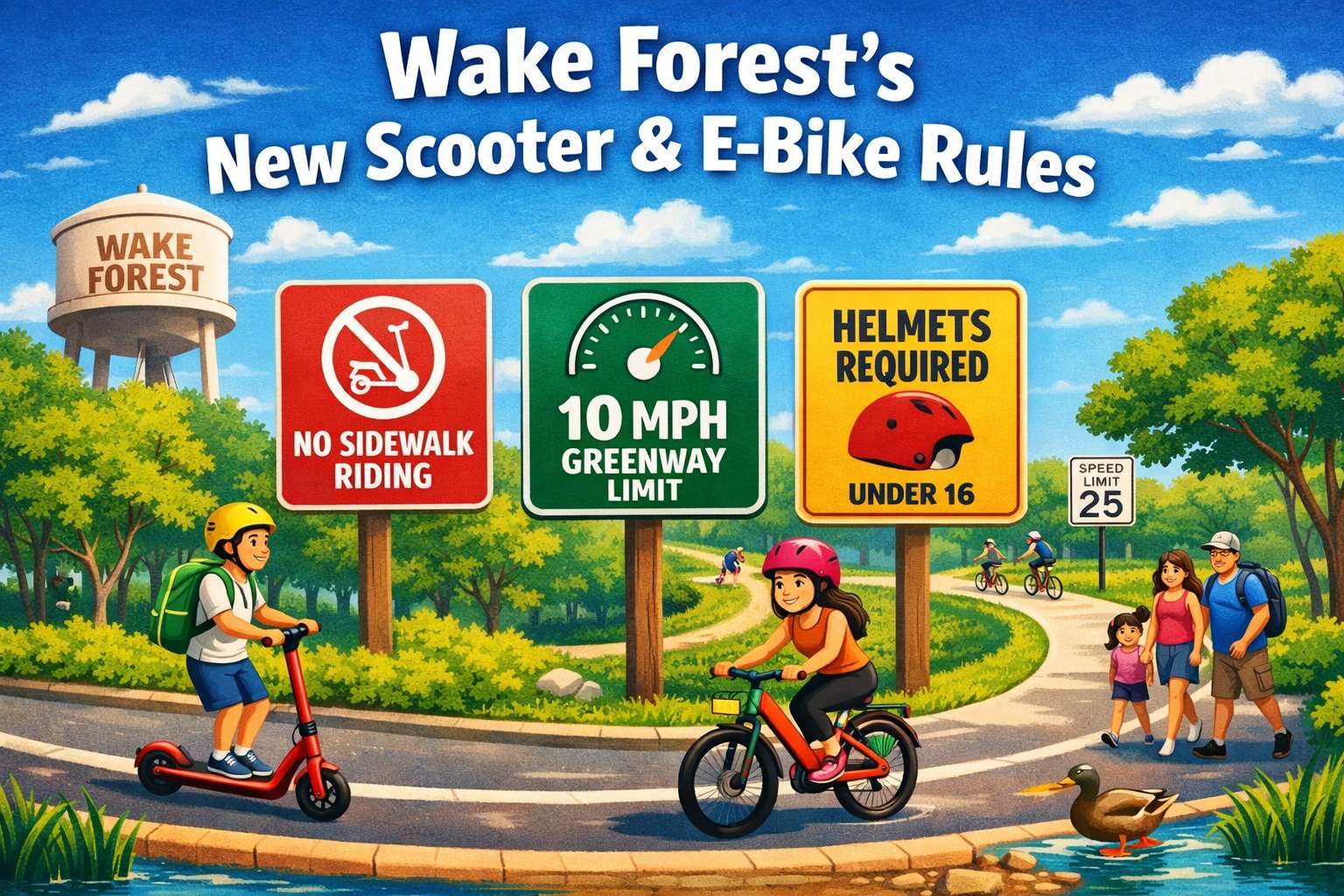
Wake Forest may be ready to change how people ride electric scooters and e-bikes around town. For a long time, the rules were simple. Motorized scooters were basically not allowed in public spaces. Now the town is talking about replacing that full ban with a clearer set of limits that riders can actually follow.
A draft ordinance scheduled for discussion at the Wake Forest Board of Commissioners work session on January 6, 2026, would lay out new definitions, new speed rules, and stricter expectations around shared spaces. And if it passes later, it could reshape how scooters and e-bikes fit into daily life, from neighborhood streets to greenway trails.
This isn’t just a policy update for hobby riders. It affects walkers, parents pushing strollers, runners, and anyone who spends time on the paths. So it makes sense that the town is focusing on safety first, then writing rules that are easy to explain and easy to enforce.
What the current scooter rule looks like right now
At the moment, Wake Forest treats motorized scooters as banned across many public areas. Wake Forest Police have pointed residents to the town’s code ordinance language that prohibits motorized scooters on sidewalks, greenways, parks, and town streets, plus other public areas.
That wide ban is part of why people keep asking the same question. “If scooters are common everywhere else, why are they still blocked here?” The short answer is that the town has worried about injury risk and close calls in shared areas, especially around kids and pedestrians.
And the town has pushed the parent angle too. Police messaging has warned that parents can be held responsible when juveniles ride in violation of the ordinance. That part has been clear for months.
The draft ordinance would remove the blanket ban, then add strict limits
So what would change under the new plan? The biggest shift is simple. The town would stop treating e-scooters as illegal in most places by default.
Instead, the ordinance would define what counts as a scooter, what counts as an e-bike, and where each device can operate.
The draft would add updated definitions for:
- Motorized scooters
- Electric bicycles
- Electric assisted bicycles
And the wording matters. Once the town defines each device type, officers and riders have fewer gray areas. That reduces arguments on the trail, and it reduces “I didn’t know” moments on the street.
What counts as a “motorized scooter” under the draft
The draft ordinance describes a motorized scooter as a device with up to three wheels, handlebars, and electric or gasoline power. It ties the definition to a top speed of 15 mph on a paved level surface. It also limits wheel size to 12 inches or smaller.
That definition does two things at once. It sets a performance ceiling, and it separates scooters from faster machines that belong in a different category.
And yes, 15 mph can still feel quick on a crowded greenway. So the town is pairing the definition with location-based speed rules.
How the draft defines e-bikes and pedal-assist bikes
For e-bikes, the draft splits devices into two groups.
An electric bicycle is described as having a seat, no pedals, a motor up to 750 watts, and a max motor-only speed of 20 mph.
An electric assisted bicycle is described as having pedals, a motor up to 750 watts, and the same 20 mph max motor-only speed.
So both categories share the same power cap and speed cap. The difference is pedals. That makes enforcement simpler, and it keeps the focus on behavior, not branding.
The draft points out another key rule too. If an electric bicycle goes over 20 mph on level ground, it falls under motorcycle or moped requirements under North Carolina law. That’s a serious line in the sand, and riders should treat it that way.
Sidewalk riding would stay off-limits
Even with the ban lifted, one part stays strict. The draft would not allow motorized scooters, electric bicycles, or electric assisted bicycles to operate on sidewalks.
That makes sense. Sidewalks are full of tight spacing, driveways, pets on leashes, and kids who change direction fast. A fast device in that space creates close calls in seconds.
And this rule is easy to follow. If you are on a motorized device, you stay off the sidewalk. No debate. No guessing.
Greenways would get a hard 10 mph cap for motorized devices
Wake Forest already posts a 10 mph speed limit on greenway trails. The town has used signage and trail etiquette to push safe sharing. Now the draft ordinance would turn that expectation into a real rule for motorized devices.
Under the draft, motorized scooters, electric bicycles, and electric assisted bicycles would not be allowed to exceed 10 mph on a greenway, in a park, or on a multi-use path.
That number matters a lot. Ten miles per hour feels slow in open space, but it’s a safer speed when people are walking two-wide, kids drift across the lane, and dogs stop without warning.
And it gives the town a clear enforcement tool. Speed becomes a measurable line, not a vague complaint.
A similar shift is happening elsewhere too. For a recent example, see Mesa parks allowing e-scooters and e-bikes, plus new helmet rules for kids.
Scooters would face road limits based on posted speed
The draft ordinance would still limit where scooters can ride on streets.
A motorized scooter would not be allowed on roads where the posted speed limit is over 25 mph.
That means scooters would fit best on lower-speed neighborhood streets, not fast main roads. And that’s a practical safety move. Mixing small wheels with higher-speed traffic raises risk fast.
The draft adds another rule for shared spaces too. When using parks, greenways, or multi-use paths, riders would need to follow posted traffic rules. And they must stop or yield before entering or crossing a public street.
So even if scooters become legal in more places, riders still have to ride like they’re part of traffic. That expectation is built into the text.
Pedestrians would keep the right of way
Wake Forest’s park and greenway guidance has pushed a common-sense idea for years. Walkers come first. Riders slow down, pass carefully, and give space.
The draft ordinance makes that priority official. It states that operators of bicycles, electric bicycles, electric assisted bicycles, and motorized scooters must yield the right of way to pedestrians across sidewalks, parks, shared streets, greenways, bike lanes, and multi-use paths.
That’s a strong baseline rule. It helps everyone share space without turning every encounter into a standoff.
Helmet rules would tighten for riders under 16
The draft goes further with youth safety. It states that a parent or legal guardian cannot knowingly allow a child under 16 to operate or ride as a passenger on a motorized scooter, electric bicycle, or electric assisted bicycle without a properly fitted helmet strapped on.
That rule is direct, and it’s built for enforcement. It targets the adult who can control the situation, not only the child riding fast down a trail.
So what should families do if this passes? Start with helmets that fit well, then talk about speed and passing etiquette. That quick talk can prevent a lot of drama later.
What happens next
The next step is discussion at the Board of Commissioners work session on January 6, 2026. After that, the town could revise the draft, then move toward a formal vote at a later meeting.
If the ordinance becomes law, riders will need to adjust habits fast. And pedestrians may see more scooters on paths, just moving slower and following stricter rules.
This change won’t fix every conflict on day one. Still, clearer rules tend to reduce confusion, and that’s a win for everyone sharing the same space.