

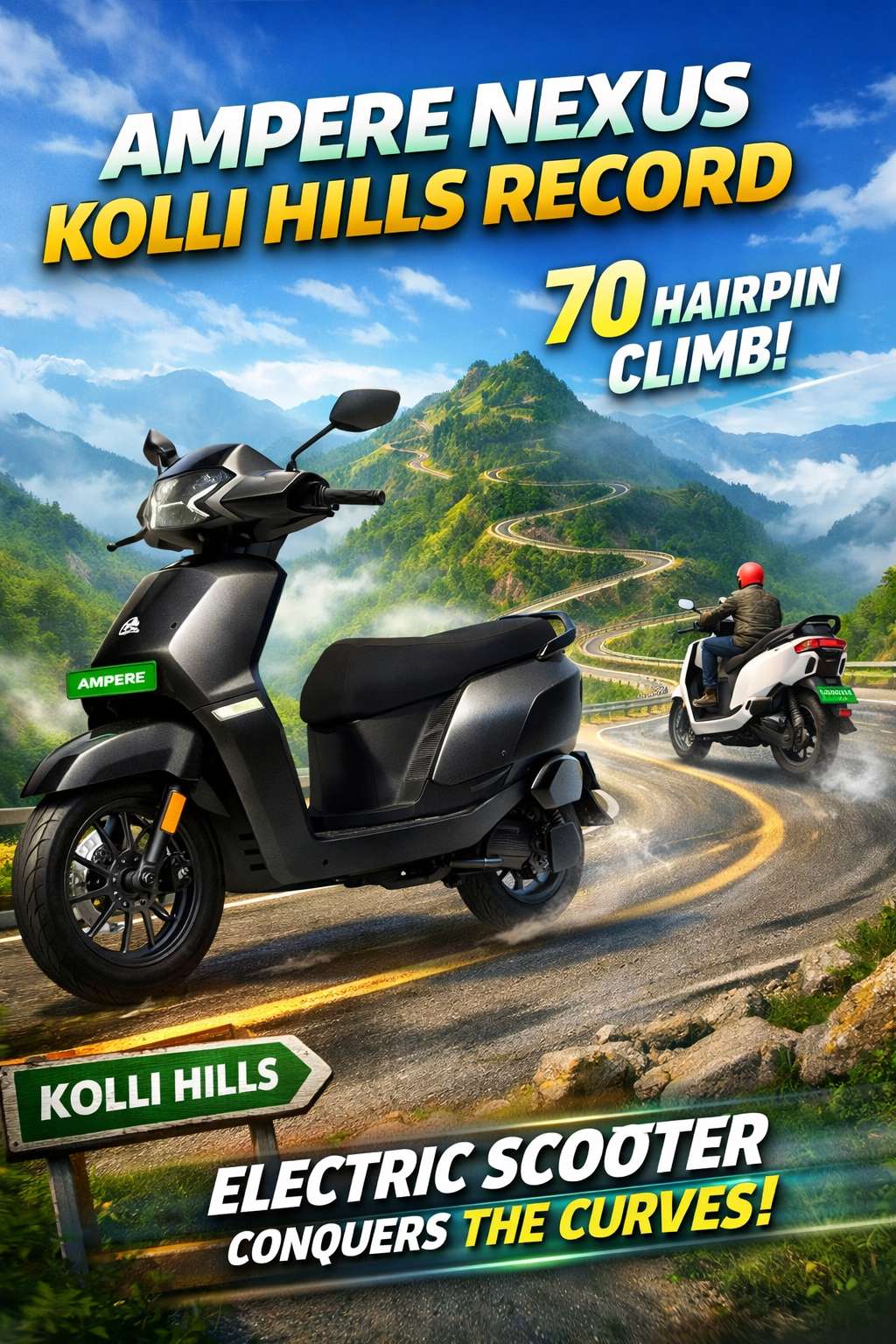
A record run that got real attention
Ampere Nexus grabbed headlines after a timed climb at Kolli Hills in Tamil Nadu. The route is famous for its 70 tight hairpin turns, and that makes it a strong stress test for any scooter. Reports state the run started at 7:00 AM on January 7, 2026, from Belukurichi and finished in 22 minutes and 10 seconds at the summit stretch. The attempt was reported as validated by Asia Book of Records on the same day.
That headline matters for buyers who want proof from real roads, not only from ads. City flyovers, broken edges, steep ramps, and hill sections expose weak scooters very fast. So, a high-pressure climb gives people one more practical signal before they spend money.
Why Kolli Hills is a serious real-world test
Kolli Hills is not a smooth straight line. It forces repeat cycles of acceleration, braking, lean, and reset. Then the next bend comes almost right away. This pattern pushes many core parts at once:
- Motor response on steep exit points
- Brake feel and balance at entry speed
- Chassis stability through quick direction changes
- Suspension control on uneven patches
- Rider confidence under constant load
For example, a scooter with jumpy throttle mapping feels fine on flat roads. Yet on hairpins, that same mapping can feel jerky and tiring. In fact, riders often notice this in the first few turns. Then fatigue builds, and control quality starts to matter even more.
Ampere Nexus specs buyers search first
Most people search the same terms before shortlisting. They look for range, top speed, charging time, and climb strength. Reported Nexus figures in public material include:
- 3 kWh LFP battery
- Claimed top speed up to 93 km/h
- Peak power up to 4.0 kW
- Claimed CMVR range near 136 km
- Claimed charging time near 3.3 hours
- Claimed gradeability of 16 degrees
Next, buyers compare these numbers against common options in this price band, like TVS iQube variants, Bajaj Chetak variants, Ola S1 variants, and Ather entry trims. Then they check ride feel, service, and warranty, since sheet numbers alone do not tell the full ownership story.
What this means for daily users, not just record headlines
A record run is exciting, and the video story helps brand recall. Still, daily ownership depends on routine things: traffic heat, potholes, stop-go riding, pillion weight, and service speed after wear appears. So this event should be used as one decision input, not the only one.
At the same time, the climb gives strong context for one buyer fear. Many users worry that electric scooters lose punch on slopes. A public hill test reduces that fear for many people, at least at first glance. Then a local test ride should confirm how the scooter feels on your own roads.
Price band, warranty talk, and service footprint
Price is still a top search term in this story cluster. Public coverage has placed Nexus in the premium mass segment, with market listings near the low to mid ₹1 lakh range depending on city and variant. On-road totals vary by registration, insurance, and dealer offers, so local quotes still matter most.
Then comes battery confidence. Ampere communication has highlighted long warranty terms in recent model messaging, and that is a key point for cost control over years, not weeks. Plus, service network size can shape real ownership comfort. A scooter with great paper specs can still frustrate owners if the nearest workshop is far or overloaded.
Cross-shopping Ampere models in the same research session
A lot of users who read about Nexus then check other Ampere models in one sitting. That behavior is normal in EV shopping. They want to map price vs battery vs space vs use case.
If you are doing that comparison now, this breakdown on the Magnus line will help: Ampere Magnus G Max electric scooter launch, ₹94,999 price, 3 kWh LFP battery, and 33L boot.
That side-by-side read gives better buying clarity. Nexus sits in a stronger performance narrative. Magnus G Max can attract value-focused city riders who care about storage and practical daily use.
A short test-ride plan you can use this week
First, do a standstill start on an incline. Check throttle smoothness in the first two seconds.
Next, brake into a tight U-turn at safe low speed. Feel front-end confidence and rear stability.
Then ride over rough patches at mixed speeds. Watch for bounce and rebound control.
After that, check low-speed balance in dense traffic. This tells you a lot about daily stress.
Still, do one more pass with a pillion if that matches your routine.
Finally, ask the dealer about parts wait time, battery claim process, and workshop load.
This simple plan beats spec-sheet guessing. It takes little time and gives cleaner answers.
The bigger market signal from this event
Indian EV buyers now reward real-road validation stories. They still care about range and speed, and they now care more about hill starts, braking trust, chassis composure, and after-sales reliability. That shift is clear in search behavior across scooter forums, video comments, and dealer conversations.
So, the Kolli Hills run is more than a one-day PR win. It taps into a clear buyer need. People want proof that a scooter can handle messy roads and hard turns, then keep doing it week after week.
For that reason, this record story will likely keep trending in searches tied to performance proof, hill capability, and Ampere model comparisons.