

DES MOINES, Iowa. January 21, 2026.
E-bikes and e-scooters are showing up across Iowa in a big way. People ride them to work, to class, to parks, and even just for a quick coffee run. And as more riders jump on, more city leaders are getting the same calls from residents. They hear about close passes on trails, fast riding on sidewalks, and near-misses downtown.
That is why Iowa e-bike and e-scooter rules keep getting updated. Leaders want more transportation choices, but they still need streets and trails that feel safe for everyone.
More riders means more speed in the same small spaces
The biggest change is simple. E-bikes and e-scooters let people move faster with less effort, so more riders cover more distance every day. That sounds great, and it often is. But it creates a new speed mix on sidewalks and multi-use trails.
A walker expects a calm pace. A traditional cyclist can pass smoothly, and most people handle it. Then an e-scooter comes up faster than expected, and the moment feels tense. It happens even more in places with tight corners, short sightlines, and lots of families.
So the problems pile up in the same spots. Downtown cores get crowded. Trail pinch points turn into bottlenecks. And campus pathways get busy between classes.
Iowa DOT guidance stays simple, and it still matters
Even with local rule changes, the basics stay the basics. Iowa DOT’s bicycle safety guidance keeps repeating the core habits that reduce crashes. Riders should follow traffic signs, ride predictably, signal turns, and use proper lighting at night.
That lighting point comes up again and again in local conversations. Iowa DOT states that from sunset to sunrise, riders should use a white front light and a red rear light or reflector, and both must be visible from at least 300 feet.
E-bikes and e-scooters fit right into that same safety logic. Riders still share space with cars, bikes, and people on foot, so they need to be seen early.
Downtown sidewalks are becoming “walk your wheels” zones
Many Iowa communities now push a simple downtown message. If sidewalks are busy, riders should get off and walk.
Iowa City is one of the clearest examples. Its city code requires safe operation of electric devices, and it states that riders must avoid colliding with pedestrians, yield the right of way, and avoid reckless behavior.
That message even appears in public reminders. Iowa City’s “Walk Your Wheels” approach highlights how risky it gets when riders use crowded sidewalks like a travel lane.
So the idea is not anti-rider. It is pro-safety in tight spaces where pedestrians have very little room.
Independence tightened rules for business districts, and it shows a trend
Independence, Iowa has moved toward clearer sidewalk restrictions in its business district. A 2026 ordinance document states that no person shall ride a bicycle or micromobility device on a sidewalk within the Business District as defined by city code.
That one change is easy to explain and easy to sign. It also reflects what many cities already learned. Sidewalk riding becomes a problem when foot traffic is heavy and unpredictable.
So business districts end up with stricter rules, while trails and quieter streets get more flexibility.
On campus, the University of Iowa treats it as real traffic management
College campuses feel micromobility pressure quickly. The University of Iowa’s policy covers bicycles and electric mobility devices, and it includes enforcement tools that many cities now copy.
For example, the policy includes impoundment, with a stated $25 impound fee and storage costs that can accrue daily after the first day.
That is a strong signal. The university does not just “suggest” good behavior. It backs up its rules with penalties that are real enough to change habits.
And that matters because campus pathways often look like sidewalks, but they work like busy roads during peak hours.
West Des Moines draws a bright line between e-bikes and faster machines
Some of the hardest conversations in Iowa focus on what counts as an e-bike, and what does not.
West Des Moines gives residents a clear checklist on its Trail Ethics page. It states that electric bicycles are permitted on city trails if they are under 750 watts, have pedals, and do not exceed 20 mph.
That last part is key. Many riders follow the rules, but some devices look like bikes and ride like small motorcycles. And that is where confusion starts.
Axios Des Moines reported in October 2025 that West Des Moines warned parents about high-speed “e-motos” that get mistaken for e-bikes, and it noted that some can reach 30 to 60 mph.
So leaders are trying to avoid a blanket crackdown. They want legitimate e-bike riders to keep access to trails, and they want the faster machines off pedestrian-heavy spaces.
Algona’s reminders show what smaller cities deal with
This is not only a big-metro topic. Smaller Iowa towns are seeing the same behavior, and they are responding with public safety reminders.
Algona’s official city news update from June 17, 2025 shared road safety reminders for bikes and scooters from Police Chief Bo Miller.
Those reminders stay practical. Yield to pedestrians. Follow the rules of the road. Ride responsibly. It is the kind of message a family can read in 30 seconds and understand right away.
And that is the point. Many issues come from kids riding fast, or from riders who never learned where scooters belong.
What leaders want riders to do, starting today
Cities cannot place an officer on every trail corner. So they push for habits that reduce risk fast.
Here is what local rules and public guidance keep coming back to:
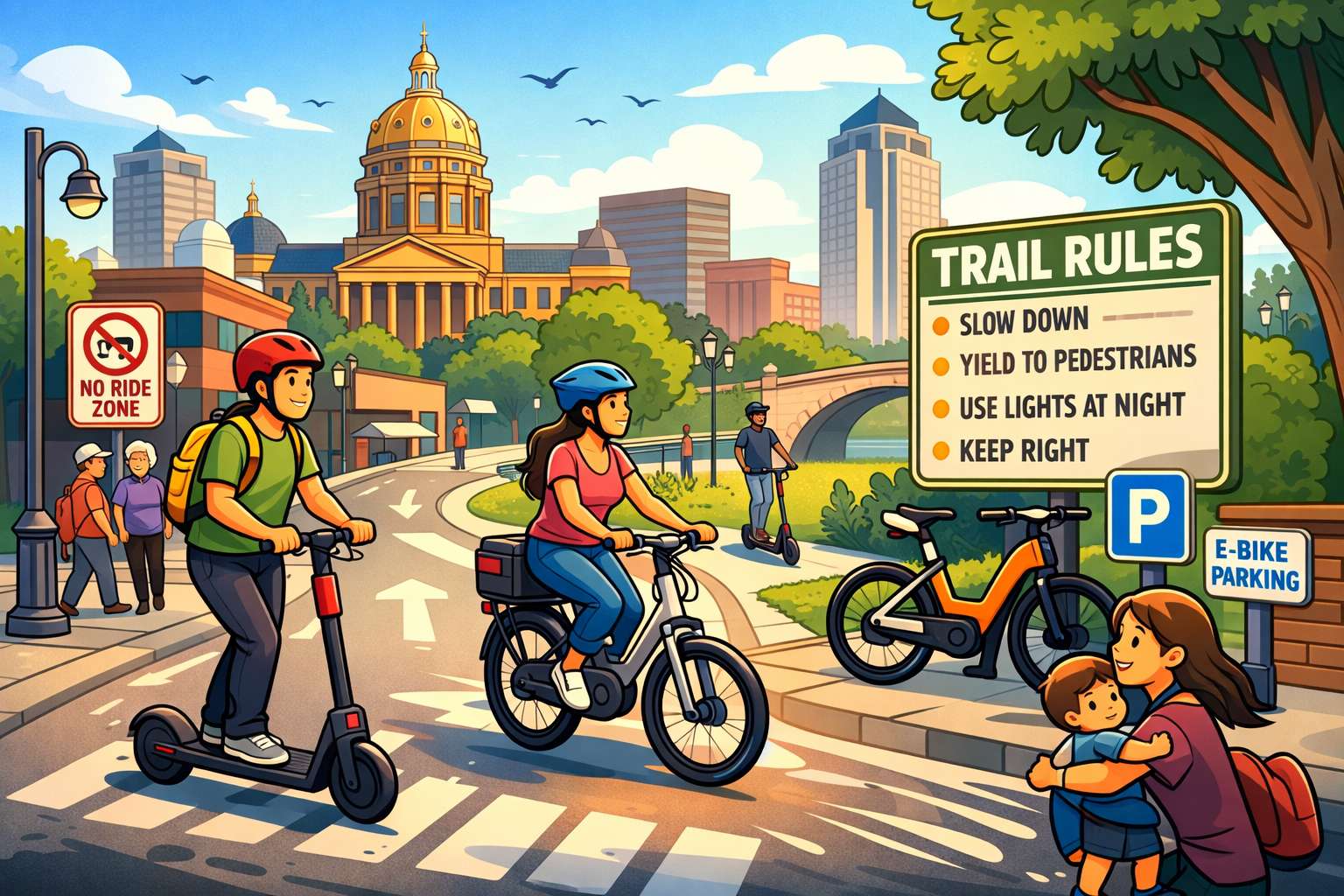
- Slow down when you enter crowded areas, then slow down again near kids and pets
- Yield to pedestrians on sidewalks and trails
- Signal and give an audible warning before passing
- Use lights after sunset, and stay visible
- Follow downtown sidewalk restrictions, and walk your wheels when space is tight
This list may sound repetitive, but repetition helps. Riders hear it in Iowa DOT guidance, in city updates, and in campus policies.
A quick example from another city that explains rules clearly
Sometimes the easiest way to understand good micromobility rules is to see how another city communicates them. This article breaks down park access, helmet rules for kids, and what changes on a specific date, in plain language:
https://scooterpick.com/mesa-parks-now-allow-e-scooters-and-e-bikes-new-helmet-rules-for-kids-start-feb-11/
It is a good reminder that rule updates do not need to feel scary or confusing. A city can write clear rules, explain the “why,” and keep things friendly.
What happens next in Iowa
Iowa e-bike and e-scooter rules will keep evolving. Cities want safer sidewalks, safer trails, and fewer crashes. At the same time, they do not want to shut down a mode of transport that helps people get around cheaply and quickly.
So expect more signage, clearer downtown zones, and more education campaigns. And expect more enforcement when riders ignore the basics.
In the end, the goal is not complicated. Riders should enjoy the ride, and everyone else should feel safe sharing the same space.