

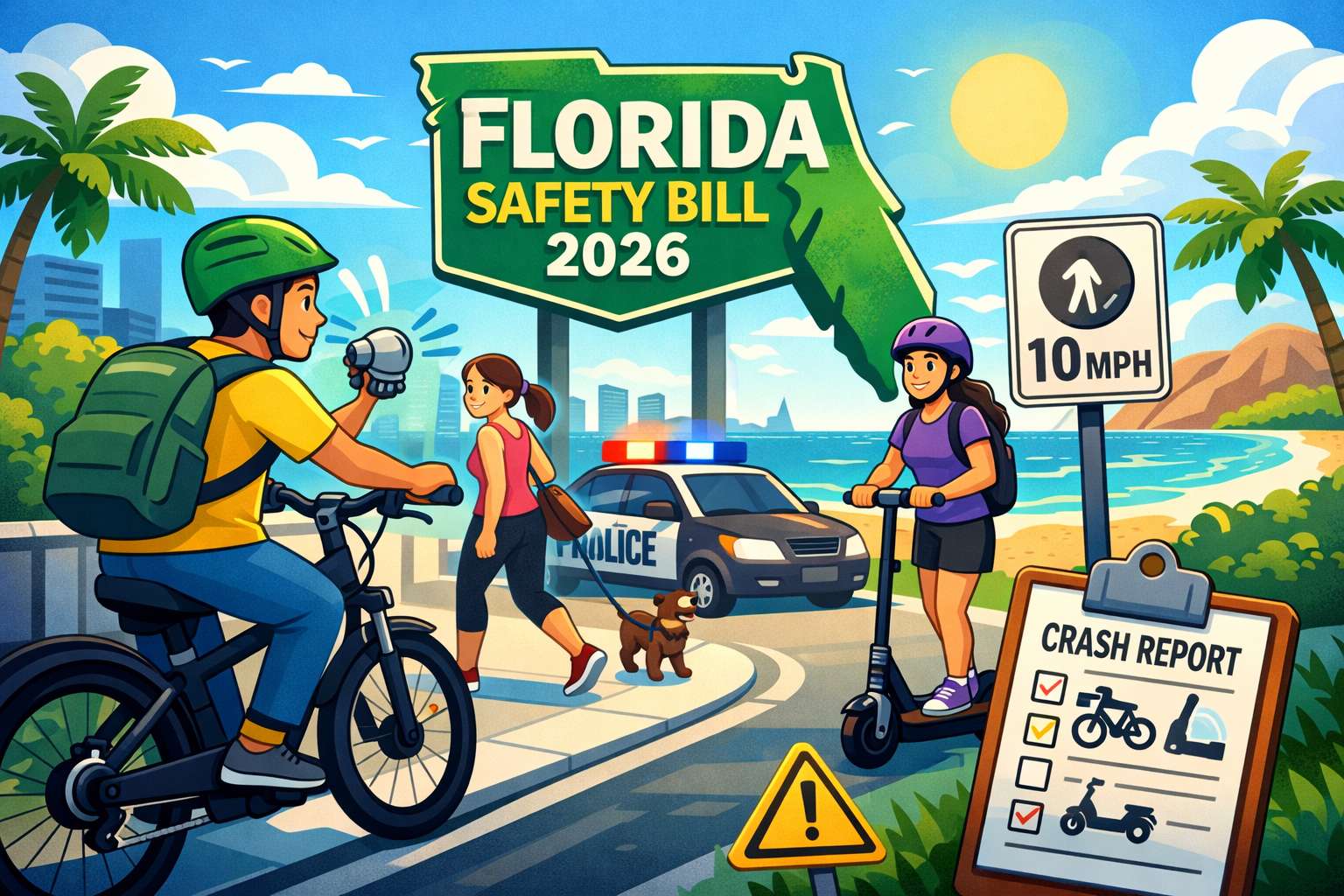
Florida is moving toward stricter rules for e-bikes
Florida lawmakers are close to putting new e-bike safety rules into state law. The bill is CS/SB 382, and it deals with micromobility devices. It passed the Florida Senate 37 to 0 and the House 112 to 0. As of March 17, 2026, the Florida Senate bill page shows the measure as ordered enrolled.
That matters for riders, parents, and city trail users. It matters for people who search terms like Florida e-bike laws 2026, Florida scooter laws, e-bike sidewalk speed limit Florida, or do you need a license for an electric bike in Florida. This bill does not rewrite every part of Florida traffic law. Still, it changes key parts of daily riding near pedestrians, and it starts a broader state review of micromobility safety.
The biggest change is the new 10 mph sidewalk rule
The clearest part of the bill is the new speed limit near pedestrians. Under the enrolled text, a person riding an electric bicycle on a sidewalk, or in another area set aside for pedestrian use, may not ride faster than 10 miles per hour if a pedestrian is within 50 feet. That is a direct rule with a clear number. It is not a vague warning about safe behavior.
The bill adds another rule too. An e-bike rider on a shared pathway that is not next to a roadway, including a path in a park or recreation area, must yield to pedestrians and give an audible signal before passing. So the message is simple: slow down, give space, and warn people before you pass them.
That will affect real rides in real places. Think about beach paths, mixed-use greenways, neighborhood sidewalk stretches, and town center routes where people walk, jog, or push strollers. Riders who move fast through those areas may soon face a noncriminal traffic infraction treated as a nonmoving violation.
Scooter riders should watch this bill too
The direct riding section focuses on electric bicycles. Yet scooter riders should not ignore it. Florida law defines a micromobility device in broad terms. The state says it can include a bicycle, an electric bicycle, a motorized scooter, or another device used by one person, as long as it fits the size and speed limits in statute.
That broader definition matters. The same bill creates a Micromobility Device Safety Task Force. This group is not limited to e-bikes. It is meant to study micromobility laws and the wider rule structure around these devices, with a goal of cutting crashes, injuries, and deaths. The enrolled bill text lists members from the Department of Highway Safety and Motor Vehicles, the Department of Transportation, local law enforcement, local government, the micromobility industry, and injury prevention and medical fields.
So even if the headline sounds e-bike specific, the larger policy story reaches scooters too. That makes the bill relevant for anyone who follows Florida electric scooter laws, sidewalk riding rules, shared path access, or future age and equipment rules. It fits a broader trend seen in other places too, and that is one reason debates like this keep growing. You can see the same public safety pressure in this Queensland e-scooter licence push.
Florida wants better crash data, and that could shape the next round of rules
One of the most important parts of the bill is easy to miss. Florida is not just adding conduct rules. The bill would require the Florida Highway Patrol, plus each police department and sheriff’s office, to maintain a list of all traffic crashes they investigate that involve a micromobility device.
That list must include the date and time of the crash. It must include the class of e-bike, if that applies. It must include the age of the operator. It must include whether the rider had a valid Florida learner’s license or driver license at the time, if that information is known. Local agencies must send their data to the Department of Highway Safety and Motor Vehicles by October 15, 2026. Then DHSMV must send a statewide summary report by October 31, 2026, broken down by device type and county.
This part of the bill may have the longest life. Better crash data gives lawmakers a stronger base for future rules. It gives cities more detail. It gives safety groups better numbers. It gives parents more facts before they buy a fast e-bike or scooter for a teen. Then it gives the public a clearer view of where crashes happen and which devices show up most often.
What Florida law already says about e-bikes and scooters
Current Florida law already places electric bicycles close to regular bicycles in many ways. The statute says an electric bicycle rider has the same rights and duties as a bicycle rider in most cases. It also says an electric bicycle and its rider are not subject to laws on financial responsibility, driver licenses, motor vehicle registration, or title certificates.
The state definition is clear too. Florida law says an electric bicycle must have fully operable pedals, a seat or saddle, and an electric motor of less than 750 watts. The law then places e-bikes into three classes. Class 1 and Class 2 provide assistance up to 20 miles per hour. Class 3 provides assistance up to 28 miles per hour.
Florida already has separate language for motorized scooters and micromobility devices. That law says operators have the rights and duties that apply to bicycle riders, with a few listed exceptions. It says riders do not need registration, insurance, or a driver license for a motorized scooter or micromobility device. It says local governments may set a minimum age and may require government-issued photo identification.
Helmet rules matter too, especially for families. Florida bicycle law says a rider or passenger under 16 must wear a properly fitted bicycle helmet that is fastened securely. Since electric bicycle riders fall under bicycle duties in state law, that helmet rule remains one of the most useful safety rules for younger riders.
What riders should do now
For now, the smart move is simple. Riders should watch the final status of the bill. E-bike users should learn the 10 mph rule near pedestrians. People who ride shared paths should get used to giving an audible signal before passing. Families should check local rules too, since Florida law still leaves room for cities and counties to set their own rules in some riding areas.
This bill feels targeted, but it is not small. It touches sidewalk behavior, path etiquette, crash reporting, and future scooter policy all at once. So if Florida signs it into law, riders will not just see a new speed rule. They will see the start of a bigger state push to tighten micromobility safety.