

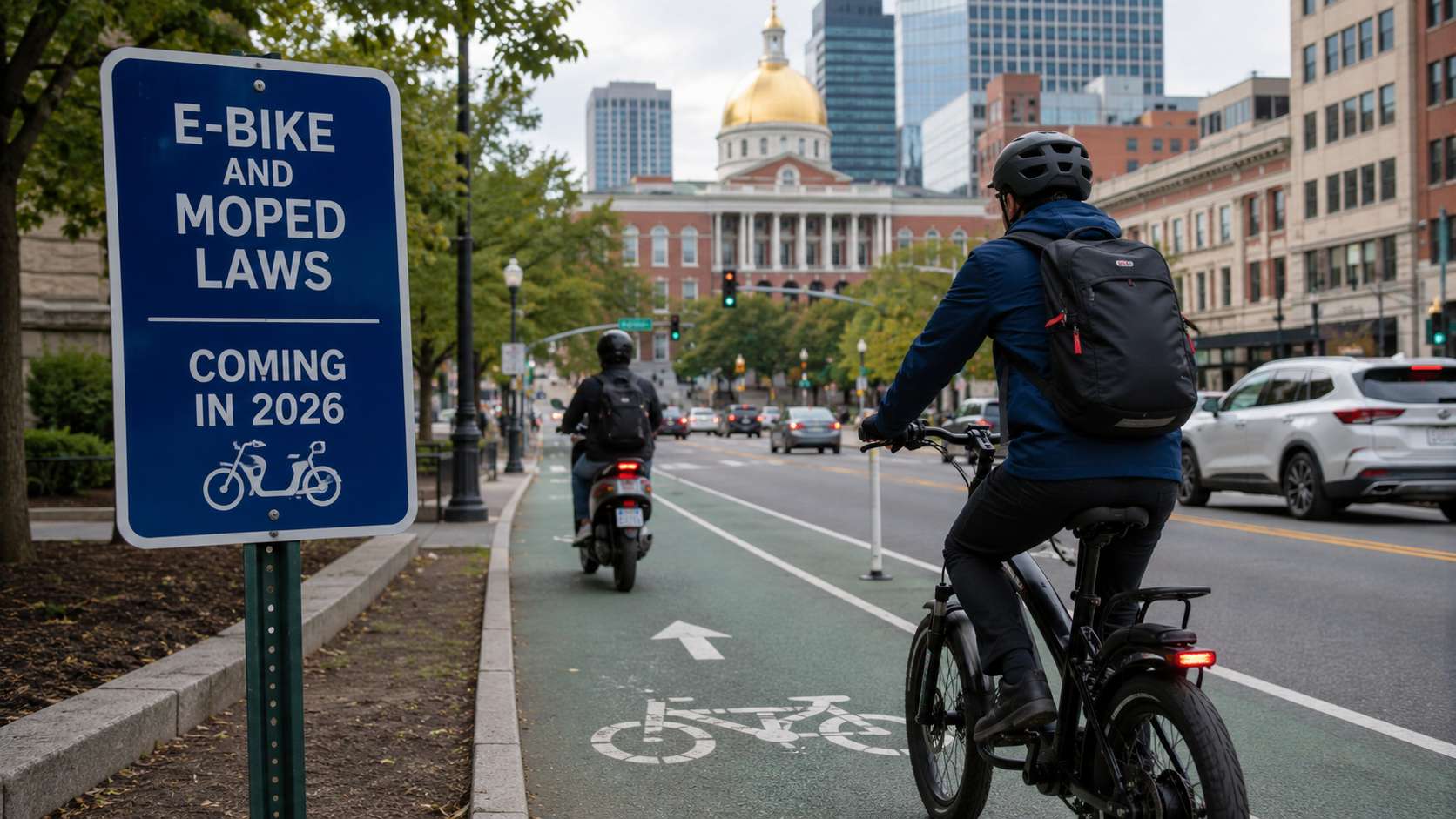
Massachusetts is moving toward a new set of micromobility rules, and the proposal could change how riders use e-bikes, electric scooters, mopeds, and faster electric bikes across the state.
Governor Maura Healey filed Senate No. 3077 on May 4, 2026. The bill is called “An Act to enhance the safe use of micromobility devices.” The governor’s office refers to it as the Ride Safe Act.
The main idea is simple. Massachusetts wants to sort small electric vehicles by speed. That matters for riders, parents, police, shops, delivery workers, and rental fleets. Right now, many people see an e-bike, scooter, moped, or electric dirt bike and ask the same question: which rules apply?
Under this proposal, the answer starts with speed.
Why Massachusetts Wants New E-Bike Rules
E-bikes and scooters now fill city streets in Boston, Cambridge, Somerville, Worcester, Springfield, and many college towns. They help people skip traffic, save money, and make short trips without a car.
Still, the market has changed fast. A basic pedal-assist e-bike is not the same as a high-powered electric bike that can reach road traffic speeds. Some models look like bicycles, but they ride more like mopeds. For that reason, Massachusetts wants clearer rules.
The state already recognizes Class 1 and Class 2 e-bikes. A Class 1 e-bike gives motor help only during pedaling and stops helping at 20 mph. A Class 2 e-bike can move with motor power alone, but motor help must stop at 20 mph.
The new bill adds Class 3 e-bikes. These bikes use pedal assist and stop motor help at 28 mph. So, Class 3 bikes sit above normal low-speed e-bikes, but below the fastest electric mopeds and off-road-style electric bikes.
How the New Speed Tiers Work
The proposed Massachusetts e-bike law creates four speed tiers. This is the part riders will notice most.
Speed Tier 0 covers unpowered devices and powered devices with a top assisted or designed speed of 20 mph. This group includes Class 1 e-bikes, Class 2 e-bikes, regular bicycles, and some mobility devices.
Speed Tier 1 covers powered micromobility devices from 21 mph to 30 mph. Class 3 e-bikes fit here.
Speed Tier 2 covers powered micromobility devices from 31 mph to 40 mph. These machines move much faster than a normal e-bike, so the bill treats them differently.
Speed Tier 3 covers powered micromobility devices that can go faster than 40 mph. At that speed, the vehicle starts to look much closer to a motorcycle in real street use.
This setup gives buyers a clearer checklist. Instead of trusting a product name, riders can check the rated speed. Then, they can see which rules apply before they ride.
Helmet Rules and Age Limits Get Clearer
The Ride Safe Act also adds new helmet and age rules.
For Speed Tier 0 devices, riders age 16 or younger must wear a helmet on public ways, bike paths, and public rights-of-way. Passengers age 16 or younger fall under the same rule, except in protected enclosed carriers.
For Speed Tier 1, Tier 2, and Tier 3 devices, every rider and passenger must wear approved protective headgear. That means Class 3 e-bike riders, faster scooter riders, and high-speed electric bike riders face stricter helmet rules.
The bill also blocks anyone younger than 16 from buying, renting, leasing, or operating Speed Tier 1, Tier 2, or Tier 3 devices. So, faster electric bikes and scooters would no longer sit in a gray area for younger teens.
This matters for families. Many fast electric bikes look fun and easy to ride, but they carry real road risk. A 35 mph electric bike can mix with cars, crosswalks, parked vehicles, and pedestrians in ways a 15 mph bike does not.
For riders tracking similar state-level changes, Florida has moved into the same safety debate with its own e-bike safety bill for 2026. That shows a wider shift across the U.S. States are now trying to catch up with faster electric mobility products.
Bike Lanes, Sidewalks, and Shared Paths
The proposed law draws a clear line between slower e-bikes and faster machines.
Speed Tier 0 devices get bicycle-style rights and duties. Speed Tier 1 devices get electric-bicycle-style rights and duties. That gives standard e-bikes and Class 3 e-bikes a clearer place in the road system.
Then the rules tighten. Speed Tier 2 and Speed Tier 3 devices cannot use sidewalks, bike lanes, bike paths, bike routes, separated micromobility lanes, or shared-use paths under the bill.
That change makes sense from a safety point of view. A narrow bike lane works for normal bicycle speeds. It does not work as well for a 40 mph electric moped. Pedestrians, cyclists, and slower scooter riders need space from faster vehicles.
Cities will still need clear signs and public education. Still, the speed-tier system gives local officials a better way to explain the rules.
Battery Safety, Brakes, Lights, and Horns
The proposal does not focus only on where people ride. It also looks at the devices themselves.
Powered micromobility devices sold, rented, leased, or operated in Massachusetts would need battery and electrical safety standards. E-bike systems would need to meet UL 2849 or an equal standard. Battery packs would need UL 2271 or an equal standard. Other powered micromobility systems would need UL 2272 or an equal standard.
That part matters. Cheap batteries, mismatched chargers, and poorly built packs have raised fire concerns in many cities.
The bill also sets equipment rules. Speed Tier 0 and Speed Tier 1 devices need lights, brakes, and an audible warning device. Speed Tier 2 and Speed Tier 3 devices need lights, brakes, and a horn that meets motor vehicle equipment standards.
So, the faster the device, the closer it gets to motor vehicle-style safety expectations.
Modified E-Bikes Face New Limits
The bill also targets aftermarket changes.
Under the proposal, riders and shops cannot modify a micromobility device to increase its designed speed, motor power, or passenger capacity, except where future rules allow it.
This could affect unlocked e-bikes, tuned scooters, throttle swaps, controller upgrades, and electric dirt bikes sold for street-style riding. It also gives shops a clearer warning. A product cannot start as one type of device and then become a faster one without legal risk.
For buyers, the rule is simple. Buy the correct device from the start. Avoid listings that promise easy speed unlocks or hidden power modes.
Registration and Insurance Details Are Still Ahead
The bill does not settle every detail yet. It gives the registrar power to create rules for registration, licensure, insurance, fines, and other safety requirements.
The proposal also creates a working group. That group would study decals, license rules, dealer duties, manufacturer duties, insurance, speed limits, education, signs, penalties, and travel rules.
The working group must finish its report by December 31, 2027. Several major parts of the act would then take effect on January 1, 2028.
So, riders should not treat every detail as final today. Still, the direction is clear. Massachusetts wants a stricter system for fast electric vehicles and a clearer system for standard e-bikes.
What Massachusetts Riders Should Do Now
Riders should check three things before buying or riding an electric bike, scooter, or moped in Massachusetts.
First, check the top assisted speed. A 20 mph e-bike sits in a very different category from a 35 mph electric bike.
Next, check the battery and electrical system rating. Look for UL 2849 on e-bikes, UL 2271 for battery packs, and UL 2272 for other powered micromobility devices.
Then, think about where the device belongs. A standard e-bike fits many bike routes. A faster electric moped does not belong on sidewalks or shared paths.
The proposed Massachusetts e-bike law sends a clear message. Slow e-bikes still fit the bicycle network. Faster electric scooters, mopeds, and high-powered e-bikes need stricter rules, better safety gear, and clearer limits.
For daily riders, that means one practical thing: speed now matters more than the name on the box.