

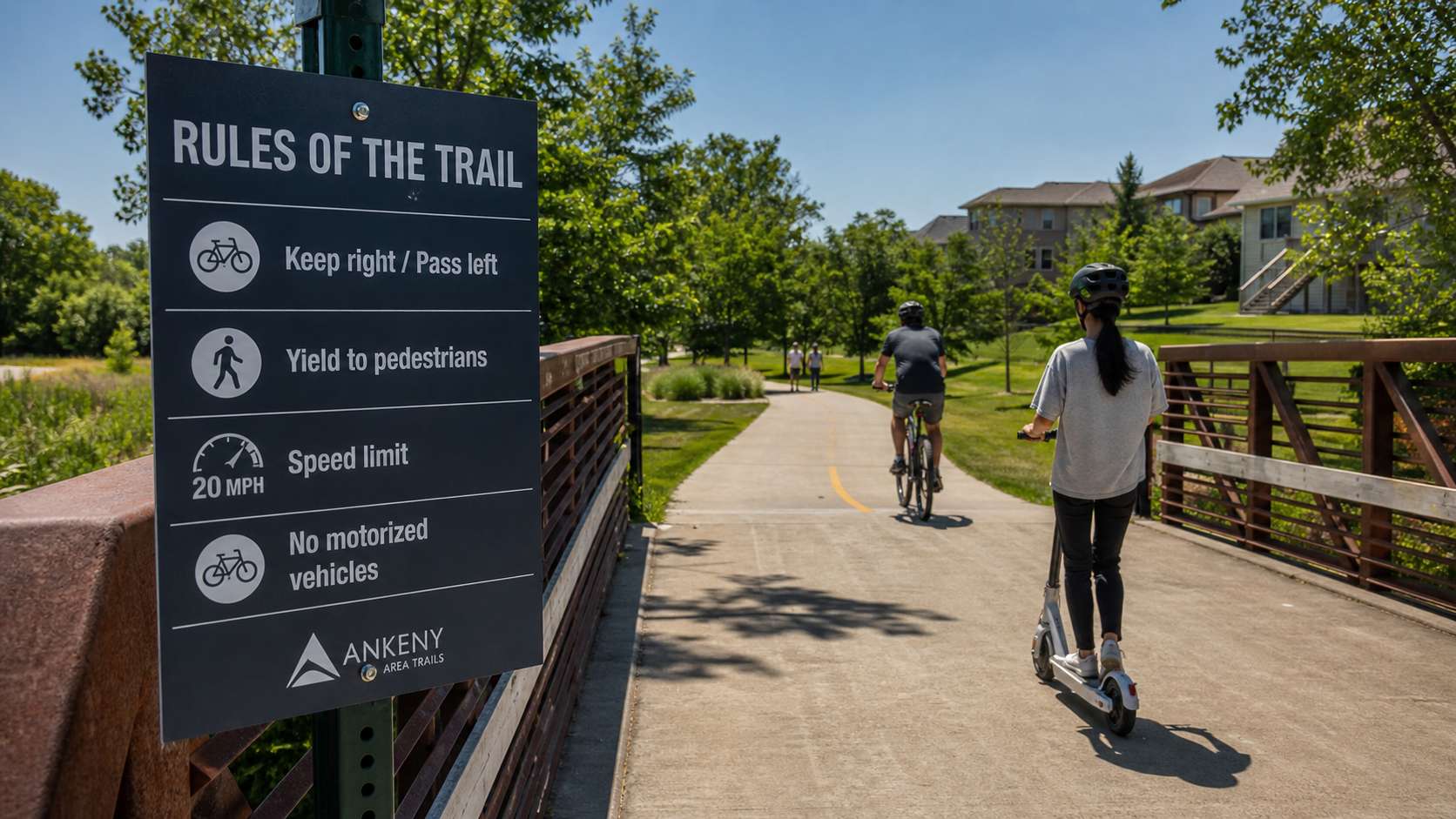
Ankeny has new rules for electric riders
Ankeny has changed its local rules for e-bikes, e-scooters, e-motos, electric motorcycles, and similar personal mobility devices. The City Council approved the ordinance update on April 20, 2026, and the city shared public guidance shortly after.
The update gives riders a clearer answer to a simple question: where can I ride?
That question matters more now than it did a few years ago. More people use e-bikes and electric scooters for school runs, short errands, trail rides, and weekend trips around town. At the same time, walkers, cyclists, drivers, kids, and pet owners all share the same public space.
So Ankeny’s new ordinance tries to separate lower-speed devices from faster, heavier electric vehicles. E-bikes and electric scooters still have broad access across many public areas. E-motos and electric motorcycles now face much stricter limits.
E-bikes and e-scooters still have many places to ride
Under the new Ankeny e-bike ordinance, bicycles, low-speed electric bicycles, and electric scooters can use city streets, bike lanes, and multi-use trails. Riders still need to follow traffic rules, signs, and posted limits.
That means street riders should act like regular road users. Stop at signs. Yield where needed. Ride predictably. Use lights in poor visibility. Keep enough space from parked cars and moving traffic.
On trails, speed is a key part of the new rule. If a sidewalk, trail, or bike lane has no posted speed limit, riders must stay at or below 20 mph. That limit applies to electric scooters, e-bikes, bicycles, and similar devices.
Still, 20 mph is not always safe. A rider should slow down near walkers, kids, dogs, curves, busy crossings, and narrow paths. Wet pavement, leaves, snow, or low light can make a normal ride riskier. So the real rule is simple: ride at a speed that fits the space.
Sidewalk rules depend on the part of town
Ankeny allows bicycles, low-speed e-bikes, and electric scooters on public sidewalks in residential districts. For many families, that rule keeps short neighborhood trips practical. A teen riding to a friend’s house or a parent riding with a child can still use local sidewalks in many residential areas.
But riders must stay careful. Pedestrians have priority. That means riders should slow down, give space, and avoid sudden passes. Near driveways, alleys, crosswalks, and parked vehicles, extra care matters.
The rule changes in business districts. Riders must walk their bike, low-speed e-bike, or electric scooter on sidewalks in business areas and posted dismount zones. That includes busy places such as Uptown Ankeny and The District at Prairie Trail.
This difference can confuse riders at first. A scooter ride that feels normal in a quiet neighborhood does not follow the same rules near shops, restaurants, and packed sidewalks.
Parks and trails have a clear paved-path rule
Ankeny still allows electric scooters and low-speed e-bikes in city parks, but only on paved parts of bike paths and sidewalks. Riders cannot cut across grass, fields, soft ground, or green space.
For park users, this rule makes sense. Parks serve many people at once. Someone may walk a dog, push a stroller, coach a youth game, or cross a path with small children. So riders need to stay on paved areas and keep their speed low near people.
A paved path is not a race track. It is a shared route. A bell, a friendly “passing on your left,” and a slower speed can prevent most close calls.
Cities across Iowa are facing the same challenge as electric mobility grows. Leaders are trying to balance access, safety, and public space. We covered a similar issue in this report on how e-bikes and e-scooters are everywhere in Iowa City and leaders say the rules need to catch up.
E-motos and electric motorcycles face tighter limits
The biggest change affects e-motos and electric motorcycles. In Ankeny, these devices can use city streets, but they cannot use sidewalks, bicycle paths, multi-use trails, parks, or green spaces.
That is a major difference from low-speed e-bikes and electric scooters.
The city defines an e-moto or electric motorcycle as a motor vehicle with a seat or saddle, no more than three wheels on the ground, peak motor power from 3 kW to 20 kW, and the ability to go faster than 39 mph on level ground without human power.
That definition matters for buyers. Some machines look like beefy e-bikes, but their speed and power place them in a very different class. If a device can move like a small motorcycle, Ankeny treats it much closer to a motor vehicle.
For that reason, parents should check specs before buying an electric ride for a teen. Motor power, top speed, pedals, weight, and vehicle classification all matter. A product photo alone will not tell the full story.
Licenses and registration may apply
E-motos, electric motorcycles, and motorized bicycles fall under state motor vehicle rules. Riders need the proper license or permit. Registration, title, inspection, and financial liability coverage requirements may also apply.
So the buying question should not stop at price, range, or battery size. A rider also needs to ask where the device can legally operate.
A low-speed electric bike may fit city trails, bike lanes, neighborhood roads, and some sidewalks. An e-moto may need to stay on streets only. That difference can change the whole value of the purchase.
Lights, brakes, and parking rules still matter
Ankeny’s ordinance includes safety gear rules too. Riders need a white front light and a red rear light or reflector during nighttime riding or poor visibility. The light or reflector can be mounted on the rider or the device, as long as it meets the visibility rule.
Brakes matter as well. Bikes, e-bikes, and scooters need working brakes. A rider should test them often, mainly after rain, winter storage, or a hard curb hit.
Parking has rules too. Riders cannot leave scooters or bikes where they block sidewalks, curb ramps, ADA paths, fire hydrants, mailboxes, crosswalks, driveways, building entries, bus stops, loading zones, accessible parking areas, or public amenities.
That part is easy to overlook. A badly parked scooter can turn into a real barrier for someone using a wheelchair, walker, stroller, or cane.
Drivers have responsibilities under the ordinance
The new rules do not only target riders. Drivers have duties too.
Motorists must give at least 3 feet when passing a bicycle or electric scooter on a paved shoulder or in a bike lane. They must yield to people in crosswalks, including people walking bikes or scooters and riders already inside marked or unmarked crosswalks.
Drivers cannot park in bike lanes, bicycle paths, or multi-use trails. They also cannot steer unreasonably close to pedestrians, cyclists, or scooter riders.
That part matters for safety. E-bike and scooter riders need to follow the rules, but drivers still control the heaviest vehicles on the road.
What Ankeny riders should do now
Start by identifying your device. Is it a low-speed e-bike, an electric scooter, a motorized bicycle, an e-moto, or an electric motorcycle? The answer decides where you can ride.
Next, check your route. Streets, bike lanes, trails, sidewalks, parks, and business districts do not all have the same rules. A legal route through a neighborhood can become a dismount zone near a busy shopping area.
Then, slow down in shared spaces. Use 20 mph as the maximum where no lower limit appears, but treat it as a ceiling, not a target. Most trail and sidewalk conflicts happen when riders move too fast near people.
Ankeny’s new ordinance does not remove e-bikes and e-scooters from public spaces. It draws cleaner lines. Lower-speed riders still have access to many parts of the city. Faster e-motos now belong on streets, with the right motor vehicle paperwork.
For residents, that makes the rule easier to follow. Ride the right device in the right place, keep your speed under control, and leave space for everyone else.