

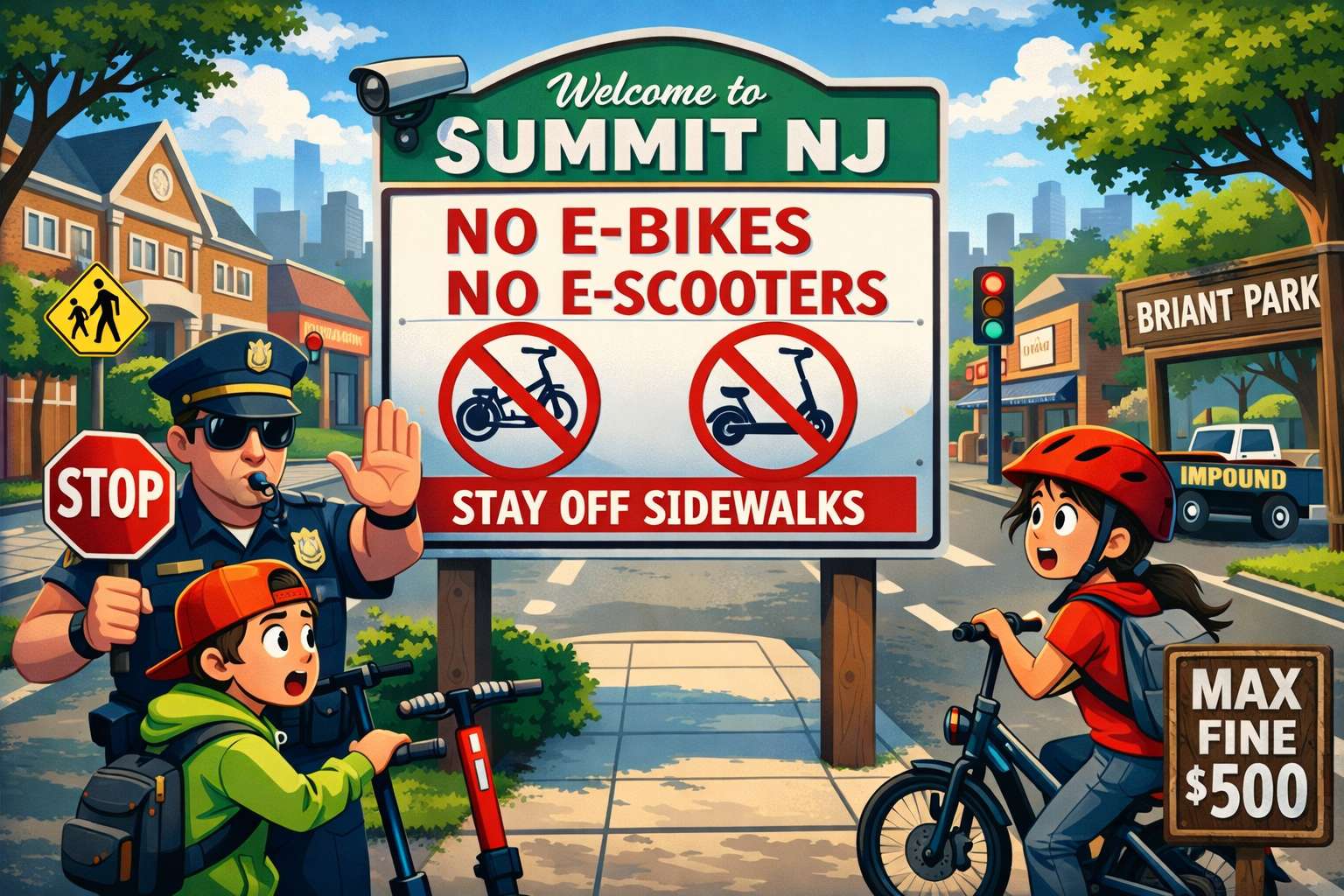
Summit, New Jersey has taken a firmer stance on e-bikes and e-scooters. If you ride one in town, the biggest rule is easy to remember. Do not use it on the sidewalk.
The city now bans electric bikes and electric scooters on all sidewalks and pedestrian pathways. Riders must stay on roads where bicycles can legally travel. Police can issue fines of up to $500. They can also take the device for 24 hours. If the rider is under 17, a parent or guardian must pick it up.
That rule matters because many people still think a quiet sidewalk is fine for a short ride. In Summit, it is not. The city has made its position clear, and it has backed that rule with enforcement, school outreach, and downtown signs.
At the same time, New Jersey has moved toward stricter statewide e-bike rules in 2026. So riders in Summit now need to follow both local rules and state rules. That mix has made many people search for terms like Summit NJ e-bike law, Summit e-scooter rules, sidewalk ban in Summit NJ, and where can you ride an electric scooter in Summit.
The sidewalk ban applies across the city
This is the point most riders need to understand first. Summit does not limit the sidewalk ban for e-bikes and e-scooters to one busy block or one shopping area. The ban applies across the city on sidewalks and pedestrian pathways.
That makes Summit stricter than many riders expect. Some parents may assume an e-bike works like a normal bicycle on a residential sidewalk. Some teens may think a short ride past stores will not matter. But the city treats electric bikes and electric scooters differently from many non-motorized devices.
That difference matters. In parts of downtown Summit, the city also bans regular bikes, skateboards, and similar non-motorized devices from sidewalks. Outside that downtown zone, non-motorized devices may still use sidewalks in some cases if riders slow down and yield to pedestrians. E-bikes and e-scooters do not get that wider sidewalk access. Summit bars them from sidewalks citywide.
This debate is not unique to one town either. Other communities have also started looking more closely at sidewalk safety, bike access, and rider behavior. A good example is Pittsford’s debate over banning bikes, e-bikes, and e-scooters from sidewalks, which shows how quickly local rules can change when pedestrian safety becomes a concern.
Police are enforcing the rule
This is not just a rule on paper. Summit police have said they are actively enforcing both the city ordinance and traffic laws tied to e-bikes and e-scooters.
That means riders face real consequences. A stop can lead to a fine. It can also lead to temporary confiscation of the device. For families, that creates a bigger headache than many expect. If a minor loses the device during enforcement, a parent or guardian has to retrieve it after the 24-hour hold.
The city has also tried to explain the rule before writing tickets. Officials have spoken with students in local schools about safe riding. They have shared safety materials. They have also added signs in the downtown area so riders can see the restrictions more clearly.
So this is not a one-time warning campaign. Summit appears to view the ordinance as a long-term safety measure. The city wants to protect pedestrians and reduce risky riding behavior.
Why Summit says the rules matter
The city has framed the issue as a pedestrian safety problem. Sidewalks are for people walking, pushing strollers, using mobility aids, or moving through town on foot. Faster electric devices can create conflict in those spaces, especially in busy shopping areas or near schools.
That concern has grown in many towns, but Summit has acted in a more direct way than some communities. Instead of relying on informal warnings, it adopted a rule with clear penalties and then followed with public education.
For local officials, the goal seems simple. Keep sidewalks predictable for pedestrians, and move electric devices onto roads where traffic rules already apply.
New Jersey changed the bigger picture in 2026
Local riders also need to watch state law. New Jersey moved toward new e-bike requirements in 2026, and that has added another layer to the issue.
Under the statewide changes described by Summit and the New Jersey Motor Vehicle Commission, e-bike riders must meet age requirements and carry the proper driving credential, permit, or e-bike license where required. The state has also moved toward registration, insurance, and helmet requirements for e-bike use.
For many riders, that is the real surprise. People often buy e-bikes because they expect simple bicycle-style rules. But in New Jersey, the 2026 changes push e-bikes into a more regulated space.
That means Summit riders need to think about two separate questions before every trip. First, where can I ride in town? Second, do I meet the current state requirements for my e-bike?
E-scooters follow local rules too
E-scooters also deserve their own attention. Riders often assume state rules for e-bikes and e-scooters match perfectly. In practice, local governments still play a major role, especially for sidewalk access.
New Jersey’s micromobility framework allows municipalities to control whether low-speed electric scooters may use sidewalks. Summit has used that authority in a strict way. The city bans e-scooters from sidewalks and pedestrian pathways across the city.
So if you are asking whether you can ride an electric scooter on the sidewalk in Summit, the answer is no.
That answer matters for commuters, students, and short-trip riders. Many scooter trips begin or end on quiet side streets, so it can feel natural to hop onto the sidewalk for a block or two. In Summit, that choice can still bring enforcement.
County property adds another restriction
There is one more layer that some riders miss. County-owned land can carry its own rules.
Summit has also pointed riders to Union County restrictions that prohibit e-bikes, e-scooters, and other motorized vehicles on county-owned parks and properties. For local residents, that includes places like Briant Park.
So a rider may avoid the city sidewalk ban and still break rules on county property. That is why route planning matters more now than it did a year ago. A safe and legal ride depends on the street, the town, and sometimes the landowner too.
What parents, teens, and commuters should do now
Parents should talk through these rules with kids before the next ride. Teens often use e-bikes and e-scooters for quick trips to school, practice, or downtown shops. Those short rides can feel harmless, but the city treats the rules seriously.
Commuters should do the same. Plan routes on legal roadways, not sidewalks. Check whether your e-bike fits current state rules. Wear a helmet. Keep the bike in stock form, and avoid speed-related modifications that can create more legal and safety problems.
One simple question helps here. What is the safest way to ride in Summit right now? The answer is to stay off sidewalks, follow roadway rules, and check both local and state requirements before you head out.
Summit has made its position clear in 2026. E-bikes and e-scooters do not belong on city sidewalks. Police are enforcing that rule, and the city has built a wider safety message around it. Add New Jersey’s newer e-bike requirements, and riders now face a much stricter environment than before.
For anyone who rides in Summit, this is the key takeaway. Treat your e-bike or e-scooter like a regulated vehicle, not like a casual sidewalk toy. That mindset will help you avoid fines, avoid confiscation, and ride with fewer surprises.