

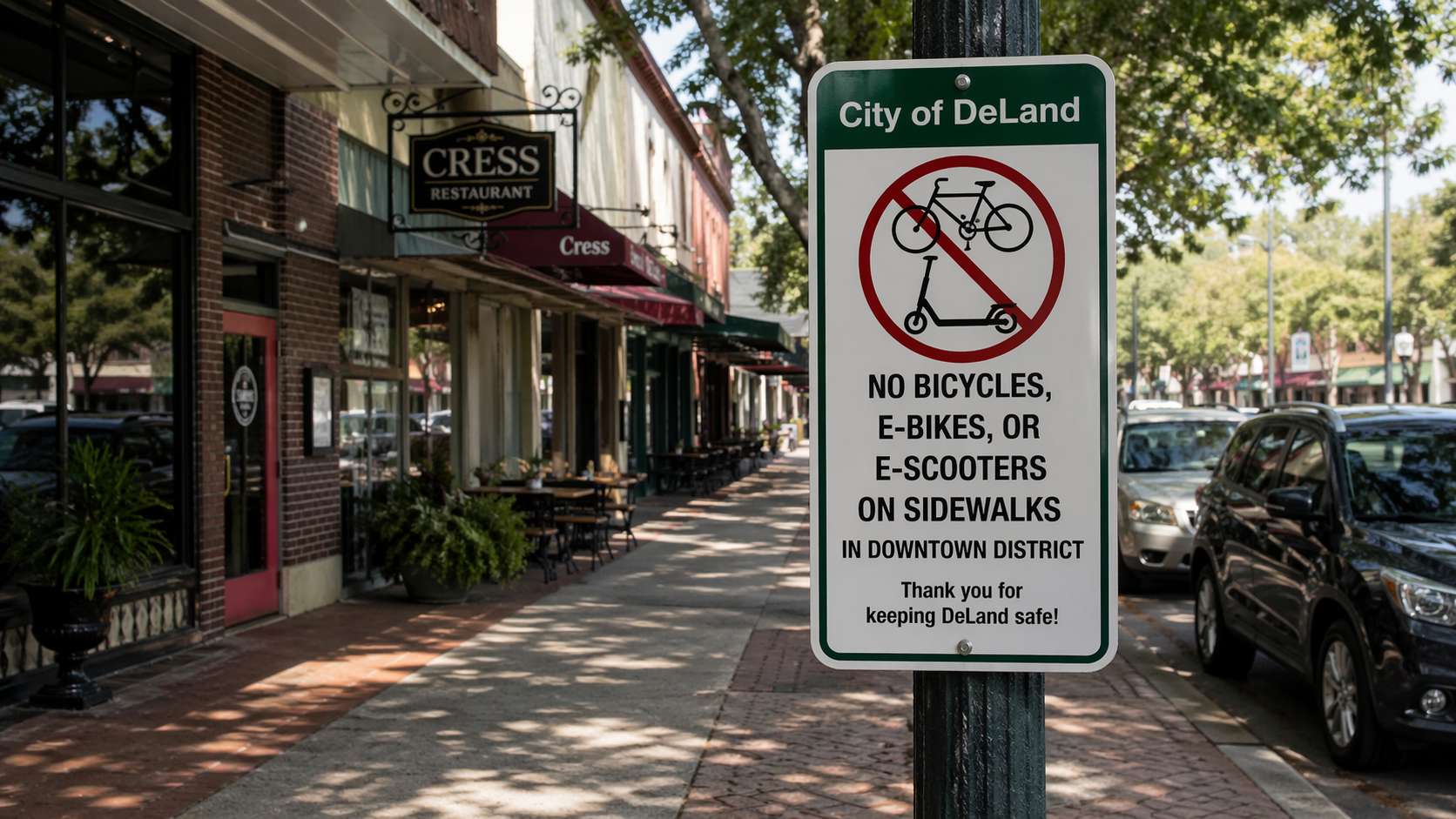
DeLand has approved a new rule for its downtown area, and it will affect a lot of riders. E-bikes, e-scooters, and other small wheeled devices are now banned from part of the downtown sidewalk zone. The city did not ban them across all of DeLand. The change targets a busy pedestrian area where people walk, shop, eat, and cross narrow sidewalks every day.
That point matters. A downtown sidewalk ban is not the same as a citywide riding ban. Riders can still use many streets and bike spaces where local and state rules allow it. Still, anyone who rides through central DeLand now needs to pay close attention. One wrong turn onto a restricted sidewalk can lead to trouble.
What changed in DeLand
City leaders moved ahead with the new ordinance after months of public discussion. The focus stayed on safety in the downtown core. Officials and local reports described concerns about fast-moving devices on sidewalks filled with pedestrians. People walking near shops and restaurants felt squeezed. Business owners raised concerns too. The city then decided to tighten the rules.
The new rule covers more than just standard bicycles. It pulls e-bikes and e-scooters into the same downtown sidewalk ban. That means riders who once treated those sidewalks like quick cut-through routes need a new plan. Downtown riding habits will need to change.
The city paired that action with extra attention on younger riders. Reports on the ordinance said DeLand added a helmet rule for riders under 18. That stands out, since Florida’s statewide bicycle helmet rule covers riders under 16. So families in DeLand need to think about local rules, not just state law.
Why the city acted
This change grew out of a simple problem. Downtown sidewalks are for people on foot first. In a busy area, even a small scooter or e-bike can feel fast at close range. A rider may feel in control. The person walking nearby may feel very different.
DeLand’s downtown has restaurants, shops, events, and regular foot traffic. That mix creates conflict fast. A sidewalk can feel open one minute and crowded the next. A rider coming around a corner has little room to react. A person stepping out of a shop has little time to move. City leaders saw that risk and chose to step in.
This story fits a wider pattern across Florida. Cities are taking a closer look at e-bike and e-scooter use in pedestrian areas. Sidewalk riding, shared path speed, helmet rules, and rider conduct now get more attention than they did a few years ago. That trend is shaping local rules in many places, not just DeLand.
What Florida law says about e-bikes
Florida law sets a clear definition for an electric bicycle. A legal e-bike must have working pedals, a seat or saddle, and an electric motor under 750 watts. The state uses three classes. Class 1 gives pedal assist up to 20 mph. Class 2 can use motor power up to 20 mph. Class 3 gives pedal assist up to 28 mph.
That legal definition is a big deal. A machine sold online as an e-bike may not qualify under Florida law. Some models push higher power. Some have weak or token pedals. Some blur the line between a bicycle and a small electric motorcycle. Riders often find that out too late.
Florida does give local governments room to regulate where e-bikes can go. So even if a bike is legal under state law, a city can still restrict sidewalk use in places under local control. That is the lane DeLand used here.
Where riders can still ride
The new DeLand rule does not wipe out legal riding across town. It targets part of the downtown sidewalk area. Riders still have other places to travel, based on local rules and normal bicycle access. Streets, bike lanes, and other lawful routes remain part of the picture.
That means route planning matters more now. If you ride into downtown DeLand, check your path before you leave home. Do not assume the sidewalk is the easy option. In many cases, it no longer is.
Night riding rules matter too. Florida requires basic lighting for bicycles used after dark. A front white light and a rear red light or reflector are not optional details. They are part of safe and lawful riding. A downtown rule may grab the headlines, yet basic equipment rules still matter every day.
What parents and teen riders should watch
Families need to pay special attention to this change. Teen riders often use e-bikes and scooters for short trips, and downtown areas attract them. A quick ride to meet friends or grab food can now cross into a restricted zone if the rider stays on the sidewalk.
The local helmet rule for riders under 18 raises the stakes. Parents should check the type of device their child uses, the route they take, and the protective gear they wear. A fast e-bike feels fun and easy. In a crowded downtown block, it can become a risk in seconds.
It is smart to check the bike itself too. Look for the class label. Check the wattage. Make sure the pedals actually work. That sounds basic, but it matters. A device that falls outside Florida’s e-bike definition can create far more legal trouble than many buyers expect.
Why this matters beyond DeLand
DeLand’s move is not happening in a vacuum. Florida lawmakers have been looking at broader e-bike safety rules too. Shared paths, sidewalk speed, pedestrian right of way, and safe passing have all come under review. That tells riders one thing clearly. Scrutiny is rising.
So what are people searching for right now? They are looking up terms like DeLand e-bike ban, DeLand sidewalk scooter rule, Florida e-bike law, Florida e-scooter rules, downtown sidewalk ban, helmet law for teens, and legal e-bike class in Florida. Those searches all point to the same need. Riders want clear rules before they spend money or take a ride.
Anyone following the statewide debate should read this breakdown of the proposed changes in Florida law: Florida e-bike safety bill 2026. It adds useful context to what cities like DeLand are doing right now.
What riders should do now
Riders in DeLand need to adapt fast. Stay off restricted downtown sidewalks with e-bikes, e-scooters, and similar devices. Use lawful streets and bike routes where they are available. Slow down near pedestrians. Wear a helmet if the local rule applies to you. Check your device before you ride.
Visitors should be careful too. A person riding in from another part of Florida may assume local rules match what they know at home. That is a mistake. Small local ordinances can change the riding experience in a very real way.
For buyers, this is a good reminder to shop carefully. Do not focus only on speed claims and battery size. Look at the class, motor output, pedal setup, and local riding rules. A bike that looks perfect on paper may not fit the rules where you plan to use it most.
The bottom line
DeLand has made its message clear. Downtown sidewalks are for pedestrians, and the city wants e-bikes and e-scooters out of that space. The rule is limited in scope, but the effect is real. Riders now need better route choices, better awareness, and a closer look at local law.
This is the kind of local change that spreads fast once one city acts. So even riders outside DeLand should pay attention. Similar rules can appear in other downtown districts, college areas, and tourist zones. The best move is simple. Know your device, know your route, and know the local rules before you ride.