

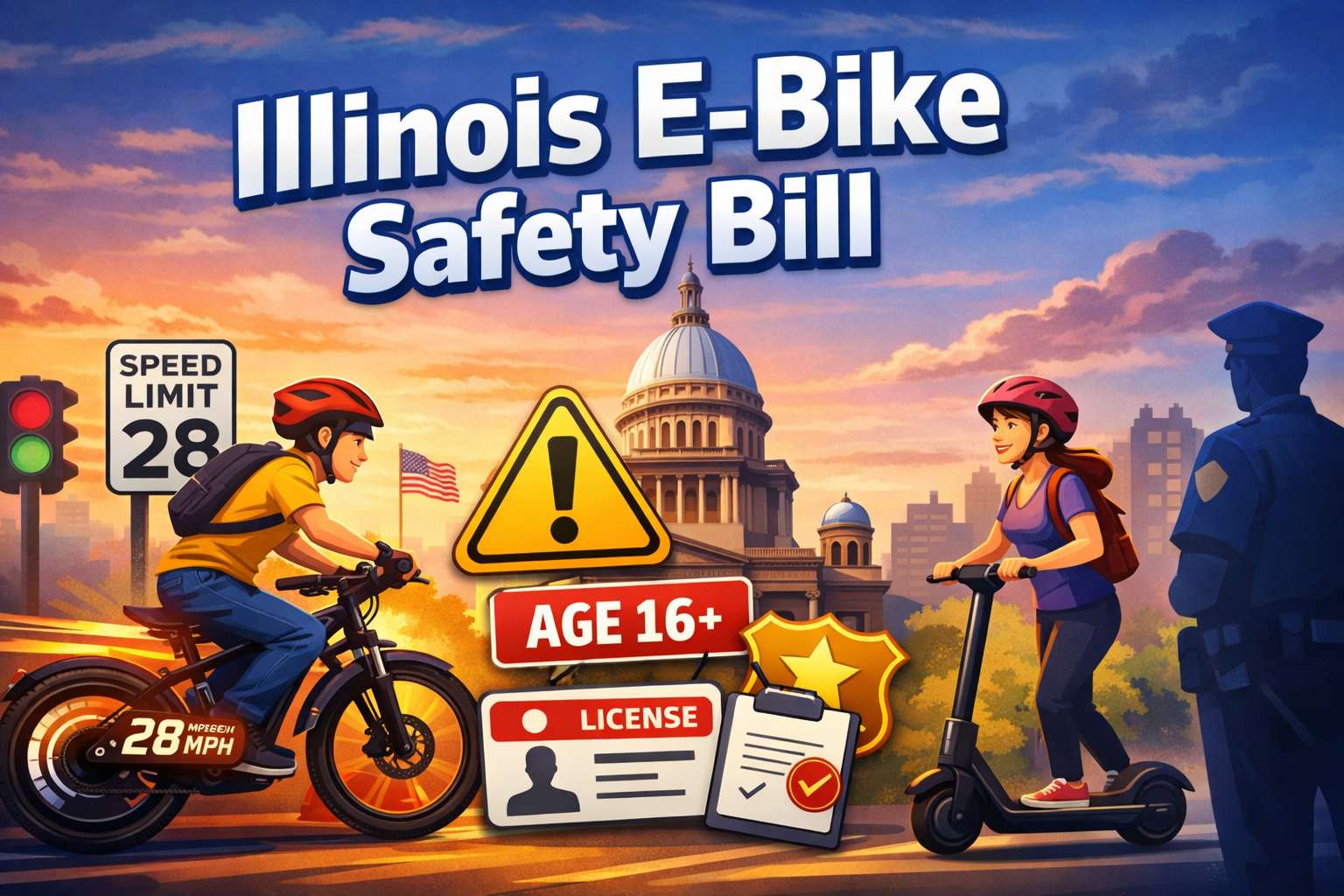
Illinois moves closer to new e-bike and e-scooter rules
Illinois is one step closer to new statewide rules for electric bikes and electric scooters. On April 15, 2026, the Illinois Senate passed SB3336 without opposition. State leaders say the bill aims to clear up a problem that riders, parents, schools, police, and sellers now face every day. More devices look like e-bikes or e-scooters, but many of them go much faster than the law now allows for low-speed models.
That gap matters on real streets and trails. A legal low-speed e-bike in Illinois sits inside a defined class system. Yet many new machines blur the line between a bicycle, a scooter, a moped, and a small electric motorcycle. State officials say SB3336 is meant to draw a cleaner line, so riders know the rules and law enforcement has a clearer standard to use.
The timing makes sense. Micromobility use keeps growing, and so do safety concerns. The Secretary of State’s office has tied the bill to its Ride Safe, Ride Smart, Ride Ready campaign, which focuses on education and new rules for fast electric devices.
What SB3336 tries to do
SB3336 is broader than the headline suggests. It does not deal with one narrow trail rule or one city rule. The official bill summary says it covers toy vehicles, motor driven cycles, and electric micromobility devices. It reaches into licensing, age rules, equipment rules, sales rules, violations, signs, title requirements, and limits on local rule changes.
That matters for one simple reason. Illinois already has rules for low-speed e-bikes and low-speed electric scooters. The state now wants stronger rules for machines that go past those low-speed limits. Senate amendment text shows that an electric bicycle that does not meet the current low-speed definition would be treated as a motor driven cycle under the Illinois Vehicle Code. The Secretary of State’s office has said the measure targets dangerous high-speed e-bikes, e-motos, and other electric devices that exceed 28 mph.
So this bill is not just about casual riders on neighborhood paths. It is also about faster and more powerful machines that are now sold in ways that can confuse buyers. Some of them look like bicycles, but they perform more like mopeds or small motorcycles. That is where Illinois wants clearer legal categories.
What Illinois law says right now
Current Illinois law uses a three-class system for low-speed electric bicycles. A Class 1 e-bike gives pedal assist up to 20 mph. A Class 2 e-bike can use a motor to move the bike up to 20 mph. A Class 3 e-bike gives pedal assist up to 28 mph. State law says low-speed electric bicycles are not mopeds or motor driven cycles. It says Class 3 riders must be at least 16 years old, and each Class 3 bike must have a speedometer. It says low-speed e-bikes must meet federal equipment rules, and makers or distributors must label the bike with its class, top assisted speed, and motor wattage.
Illinois law already has separate rules for low-speed electric scooters too. A rider must be at least 18 years old. A low-speed electric scooter cannot be used on a highway posted above 35 mph. State law sets nighttime light and reflector rules, and it limits where scooters can operate based on local and state control of the property.
That is the key point for readers who search Illinois e-bike law 2026, Illinois e-scooter law 2026, Class 3 e-bike Illinois, or Illinois electric scooter age limit. The current rules already cover true low-speed devices. SB3336 tries to deal with the machines that sit outside those limits.
Why this bill will get attention beyond Illinois
Illinois is not acting in a vacuum. States across the country are trying to sort out fast-growing e-bike and e-scooter use. That is one reason searches for e-bike registration law, e-bike license law, e-scooter speed limit, and high-speed e-bike rules keep rising. Riders want to know where the bicycle rules stop and where motor vehicle rules begin.
That same debate has picked up in other states too. For readers who want to compare how this issue is spreading, the Florida e-bike safety bill in 2026 shows that lawmakers in other places are dealing with many of the same questions.
Illinois has a practical reason to act now. Local governments and schools have dealt with more complaints about fast electric devices, especially around young riders and mixed-use areas. State officials say current law leaves too much room for confusion. So this bill tries to replace that patchwork with one statewide framework.
What riders, parents, and sellers should watch next
Riders should pay close attention to speed and device class. Under current Illinois law, a legal Class 3 low-speed e-bike tops out at 28 mph with pedal assist. Once a device goes past the low-speed definition, the legal picture changes fast under the Senate plan.
Parents should focus on age rules and on what kind of machine their child is actually riding. Right now, Illinois sets 16 as the minimum age for operating a Class 3 e-bike and 18 as the minimum age for operating a low-speed electric scooter. Those rules already matter, and a broader bill like SB3336 puts even more focus on who is riding what.
Retailers and online sellers should watch the sales language in the bill. The official summary says SB3336 touches sale requirements, title requirements, and licensing requirements. That means sellers may face more pressure to classify products correctly and stop marketing fast devices like they are ordinary low-speed e-bikes.
What happens after the Senate vote
The Senate vote does not change street rules overnight. SB3336 still needs the rest of the legislative process before it can become law. So riders in Illinois still need to follow the current rules for low-speed e-bikes and low-speed electric scooters right now.
Still, the Senate vote sends a clear signal. Illinois wants a sharper line between a legal low-speed e-bike and a faster electric machine that belongs under tighter rules. That line matters for daily commuters, teen riders, parents buying a first e-bike, trail users, police officers, and every shop that sells electric rideables.
For now, the big takeaway is simple. Illinois is not banning e-bikes or e-scooters. It is trying to sort them into clearer categories, tighten safety rules, and reduce the confusion around fast devices that no longer fit the low-speed label. If SB3336 becomes law, Illinois e-bike rules in 2026 and 2027 may look much clearer than they do today.