

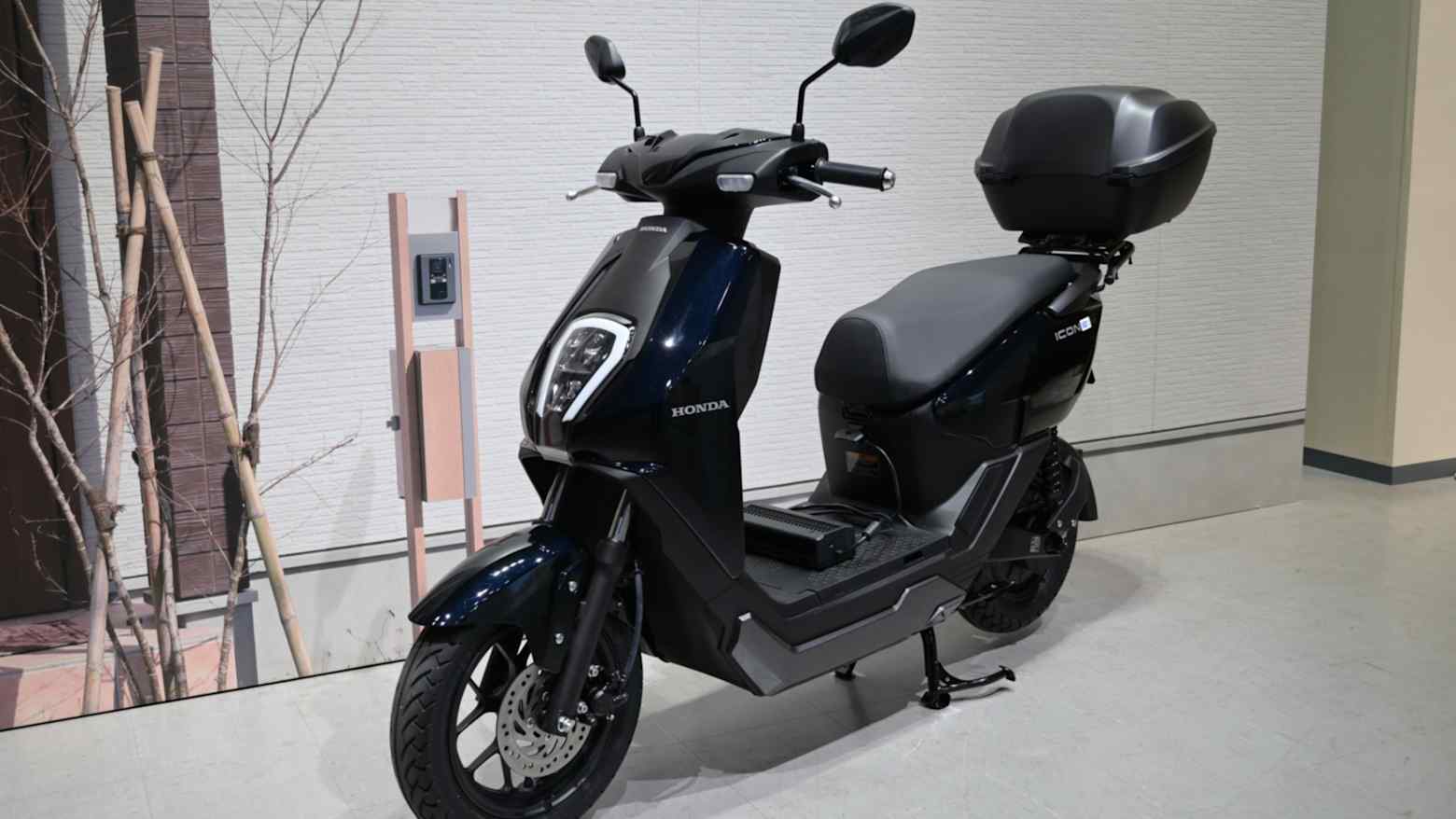
Honda sets a low entry price for its newest electric two wheeler
Honda announced the ICON e on February 19, 2026, and it plans to start sales in Japan on March 23, 2026. Honda lists a suggested retail price of 220,000 yen with Japan’s 10 percent consumption tax included. At recent exchange rates, that lands at roughly $1,400, so you will see that number in many headlines.
Even so, the price alone does not tell the whole story. Honda includes one removable battery and one charger in that suggested price. Honda also says dealers set the final selling price, so the number you pay can still move a bit.
Honda aims the ICON e at daily commuting, school runs, and quick shopping trips. So, it focuses on ease, storage, and simple charging, instead of high speed or long distance touring.
The quick spec rundown that actually matters for commuting
Honda built the ICON e as a Class 1 moped under Japan’s road vehicle rules. That choice shapes everything. It keeps the bike compact, and it also keeps the use case clear.
Honda lists an 81 km range per charge from a steady 30 km per hour test. Honda also says the charge time from empty to full takes about 8 hours when you use a 100V power source. Those numbers help you plan your routine, and they also show who this bike is for.
Here are the practical highlights Honda calls out:
- Removable lithium ion battery rated at 48V and 30.6Ah
- Under seat storage rated at 26 liters for a helmet and small items
- A front inner rack that fits a 500 ml bottle
- A USB Type A socket rated up to 5V and 2.1A
- Honda’s linked braking system, plus a front disc brake
- Vehicle weight listed at 87 kg, with one seat
Honda Vietnam builds the ICON e in Vietnam, and Honda imports it into Japan.
So what does the 81 km range number really mean?
It means you should treat it as a benchmark, not a promise. Honda measured that 81 km figure in a steady speed test at 30 km per hour. In daily riding, you stop more often, you climb hills, and you deal with wind and traffic. So, your real range will usually come in lower.
Still, the test result gives you a useful anchor. If your round trip commute sits around 10 to 20 km, then the ICON e should cover several days for many riders, as long as conditions stay mild and you ride smoothly. Also, the removable battery helps if you live in an apartment. You can carry the battery inside, then you can charge it without parking near a socket.
Honda’s real strategy. Make an everyday EV and keep it simple
Honda describes the ICON e as an easier and economical commuter. That message fits the hardware. The bike uses an in wheel motor in the rear, and Honda says a power control unit manages output for efficiency. Honda also adds an ECON mode that reduces motor response, so you can stretch range when you do not need quick acceleration.
At the same time, Honda tries to remove small annoyances. The 26 liter under seat box aims at real life storage. The bottle rack sounds minor, but it helps on hot days and on long waits at lights. The USB port also matters, because riders often need their phone for navigation and messages.
If you like Honda’s more futuristic electric ideas too, you can also check this related ScooterPick deep dive on the Honda UC3 concept https://scooterpick.com/honda-uc3-electric-scooter-looks-like-sci-fi-yet-its-built-for-daily-city-rides
The 100 mile range question, and why it points to a different class of bike
Many shoppers ask for an electric motorbike with a 100 mile range. That target usually pulls you into larger, more expensive machines. Those bikes often carry bigger batteries, and they also support faster charging.
For example, LiveWire lists a combined range of 95 miles at 55 mph for the LiveWire ONE, and it also lists a city range of 146 miles. LiveWire also lists fast charging times on DC fast charge equipment. Those numbers sit close to the 100 mile ask, and they show how different the bigger EV class looks.
So, the ICON e does not compete with those bikes on range or speed. Instead, it competes on price, simplicity, and daily usability.
Why Chinese electric two wheelers sit in Honda’s line of sight
Honda clearly enters a crowded space. Chinese makers already sell electric two wheelers at huge scale, and that scale can push prices down. It also lets brands refresh models quickly, which matters in fast moving urban mobility.
Yadea’s 2024 annual report says its combined sales of electric scooters and electric bicycles fell from about 16.5 million units in 2023 to about 13.0 million units in 2024. In that same report, Yadea says electric scooter sales volume reached about 3.931 million units in 2024, while electric bicycle sales volume reached about 9.089 million units.
NIU also shows meaningful scale, although it plays in a more mixed line that includes e mopeds, e motorcycles, and smaller devices. NIU reported total sales volume of 1,197,978 units for full year 2025, and it reported 178,702 units in the fourth quarter of 2025.
Because of that background, buyers often ask a blunt question about the best Chinese electric motorcycle brand. I cannot confirm this. It depends on your country, your dealer network, spare parts access, warranty support, and the exact model you choose.
Still, you can use a practical filter. A brand with strong local support often beats a brand with a better spec sheet but weak service in your area. So, look for parts availability and repair options before you chase small spec differences.
Honda Monkey 2025 price, and why some riders still choose gas
Some riders also compare the ICON e with a small gas mini bike, especially if they want fast refueling and weekend fun. Honda lists the 2025 Monkey ABS with a base MSRP of $4,349 in the United States, and Honda also lists a destination charge on top of that.
That gap matters. The Monkey costs more, but it also offers a different experience. You refuel in minutes, and you ride longer distances without planning your charge. On the other hand, the ICON e can feel cheaper to run day to day, and it stays quiet in dense neighborhoods.
Which country owns Honda, and why that matters in this EV push
Honda Motor Co., Ltd. is a Japanese company, and it is headquartered in Minato, Tokyo, Japan. That matters because Honda now has to defend its home market while it expands electric two wheeler options. It also has to do that while Chinese competitors push hard on price and product cycles.
Honda’s approach here looks cautious but clear. It picks a simple commuter product, then it puts a sharp price on it, and then it limits the initial plan to an annual domestic sales target of 2,200 units. If demand rises, Honda can adjust. If demand stays modest, Honda limits risk.
For riders, the ICON e offers a straightforward deal. You get a Honda badge, a removable battery, real storage, and city focused range. You also avoid the stress of hunting for a charging station every day. However, you still need to accept the slower charging pace, and you need to accept that the range number comes from a controlled test.