

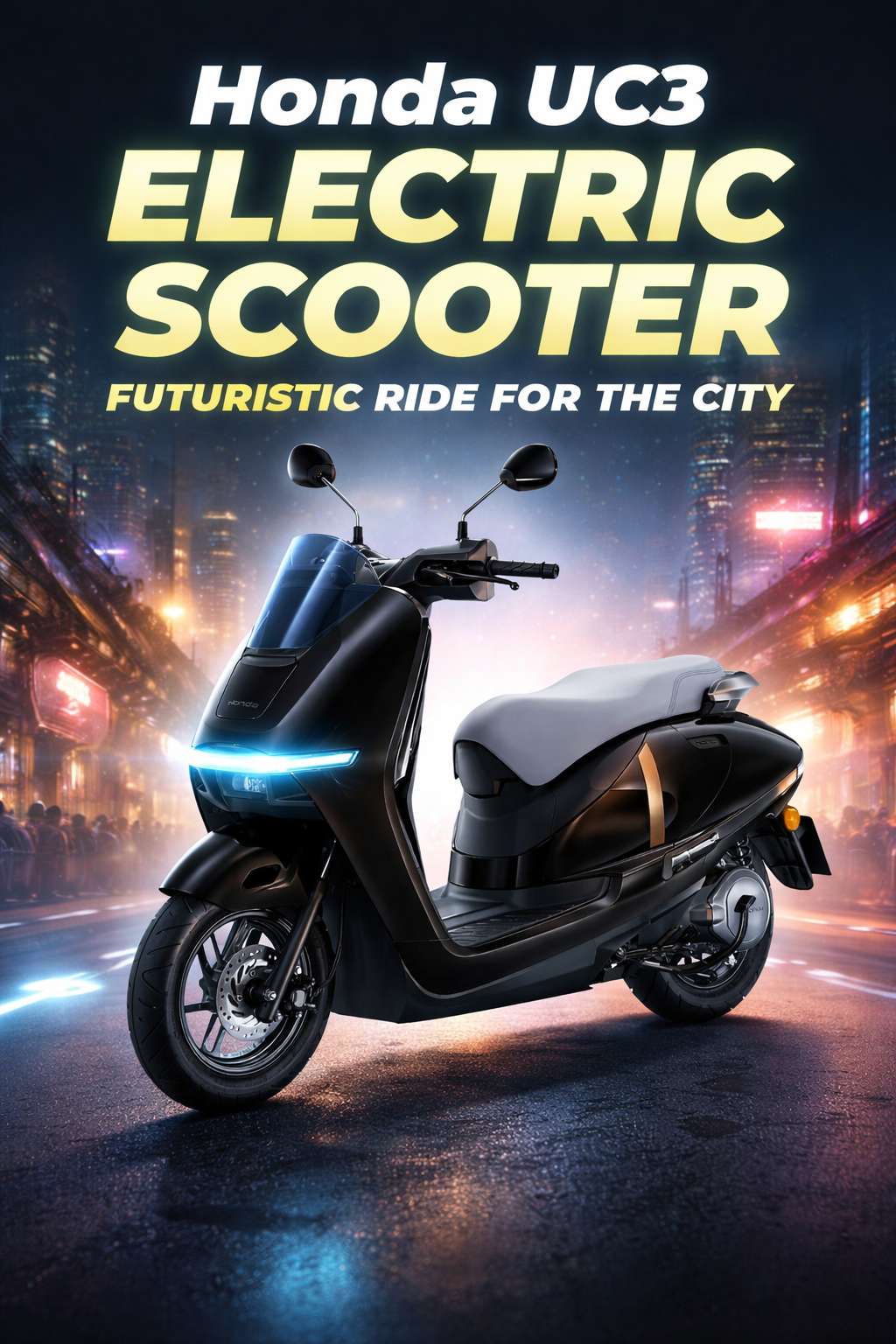
Honda just revealed a new electric scooter called the UC3, and the design grabs you right away. It has that clean, futuristic face with a thin horizontal light bar, plus a dark body and gold accents. So yes, it gives off strong “Cylon” energy. Still, this scooter is not here just to look cool. Honda built it as a real commuter for busy streets.
Honda plans to start sales in Thailand and Vietnam in spring 2026. At the same time, the company is preparing charging support in both markets. That matters, since a scooter is only as useful as the routine around it.
A practical EV scooter in the 110cc class
The UC3 sits in the same “everyday rider” space as a 110cc-class gas scooter. So it targets the daily commute, short errands, and all the stop-and-go city riding people do nonstop.
Honda powers it with a fixed-battery setup, not a swap pack. It uses Honda’s first fixed-type LFP battery in this commuter category. Then it pairs that with a Honda-built wheel-side motor rated at 6.0 kW peak output.
That number puts it in a sweet spot for city use. It should feel quick off the line, and it should stay smooth at the speeds that matter most in traffic.
The range number Honda wants you to notice
Range is still the first question most people ask. So Honda came in with a clear claim: 122 km per charge under WMTC Mode 1 certification in Thailand.
That figure will not match every rider’s daily reality, but it gives a clean baseline. Then you can do the math for your own route. For many city riders, 122 km covers multiple days, not just one.
The Cylon-style light bar is the headline feature
Honda knows the look will pull attention. The front light signature sits as one thin band across the face, and it changes the whole personality of the scooter.
So where did that idea start? Honda says the same signature showed up first on its electric motorcycle called the Honda WN7. Now Honda brings it into scooter form, and it instantly reads as “EV.”
The rest of the body stays clean too. Honda shaped it with flowing lines from front to rear, and it adds a bold arched form around the tail section. So the scooter looks modern, but it does not look overworked.
Honda even gave it a distinct EV identity with color and branding. You get a black body, gold-accented components, and a special Honda product mark with a new font that Honda reserves for electric motorcycles.
Ride modes and reverse, so city life feels easier
Honda kept the rider controls simple, and that is a smart move for commuters. The UC3 includes three riding modes:
- STANDARD
- SPORT
- ECON
So you can pick a calm feel for cruising, then switch to a sharper response when traffic opens up.
Then there is reverse mode. That might sound like a small feature, but it helps a lot in tight parking spots. It feels even more natural on an EV, since the motor can run smoothly at very low speed.
Charging details look clear and predictable
Charging always decides if an EV scooter fits your life. So Honda shared the numbers, and they are easy to follow.
The UC3 supports a standard Honda calls “CHAdeMO for two-wheelers.” It follows an international specification recommended by the CHAdeMO Association, and Honda offers two charger options:
1200W charger
- 0 to 100%: 4 hours
- 20 to 80%: 2 hours
450W charger
- 0 to 100%: 9 hours
- 20 to 80%: 5 hours
So you can pick speed or simplicity, depending on your setup. A faster charger suits daily riders who park at home and want a quick top-up. A slower one can still work fine for overnight charging.
Charging stations are part of the plan, not an afterthought
Honda is not launching the UC3 and hoping riders “figure it out.” The company plans charging station expansion in both Thailand and Vietnam.
In Thailand, Honda will expand CHAdeMO for two-wheelers charging stations. The focus will sit on Honda motorcycle dealerships and shopping malls in and around Bangkok. That’s a solid match for city riders, since malls and dealers already sit on common routes.
In Vietnam, Honda will start installing charging stations at Honda dealerships in major cities. Honda named Hanoi, Ho Chi Minh City, and Da Nang as key locations. Then Honda targets operation from June 2026.
So riders can plan their week with real charging points in mind, not just a home outlet.
Honda still pushes battery swap too
At the same time, Honda is not abandoning swapping. The company plans to expand Honda e:Swap BATTERY STATION installations at dealerships in Bangkok and Hanoi.
So two systems will live side-by-side. The UC3 goes with fixed-battery charging. Other Honda EV scooters can keep using the Mobile Power Pack swap approach.
That mix is interesting. It gives Honda more room to fit different users and different cities. Some riders want the simplest home charge routine. Others want fast swap convenience.
If you like keeping track of how brands build city-first scooters, this recent model is worth a look too: Bajaj Chetak C2501. It shows how another big name is aiming for practical commuting, with a cleaner tech package and a sharper price story.
Production started in Thailand, then Vietnam takes over
Honda already set the manufacturing plan in motion. The company started production in December 2025 at Thai Honda Co., Ltd. Honda will supply both Thailand and Vietnam from Thailand at first.
Then Honda plans to transfer production to Honda Vietnam Co., Ltd. during 2026. That step can speed up supply in Vietnam and tighten service support locally. It can even help pricing in the long run, since local production often reduces shipping and logistics pressure.
What the UC3 really signals for Honda’s EV future
The UC3 is more than a stylish launch. It shows Honda’s current idea of what an everyday electric scooter should be. It should look modern, feel easy to ride, charge in a clear way, and fit normal commuting without drama.
Honda also tied the UC3 to its electric motorcycle brand message: “Expected life. Unexpected discoveries.” In plain terms, Honda wants the UC3 to feel familiar day to day. Then it wants the EV ride feel to win you over little by little, with quiet movement and smooth throttle response.
Honda still holds a long-term goal too. The company targets carbon neutrality across all products and corporate activities by 2050. So the UC3 is one step in a long plan, not a random experiment.
So yes, the UC3 looks like it belongs in a sci-fi show. But it reads like a commuter first. That is what makes it interesting.