
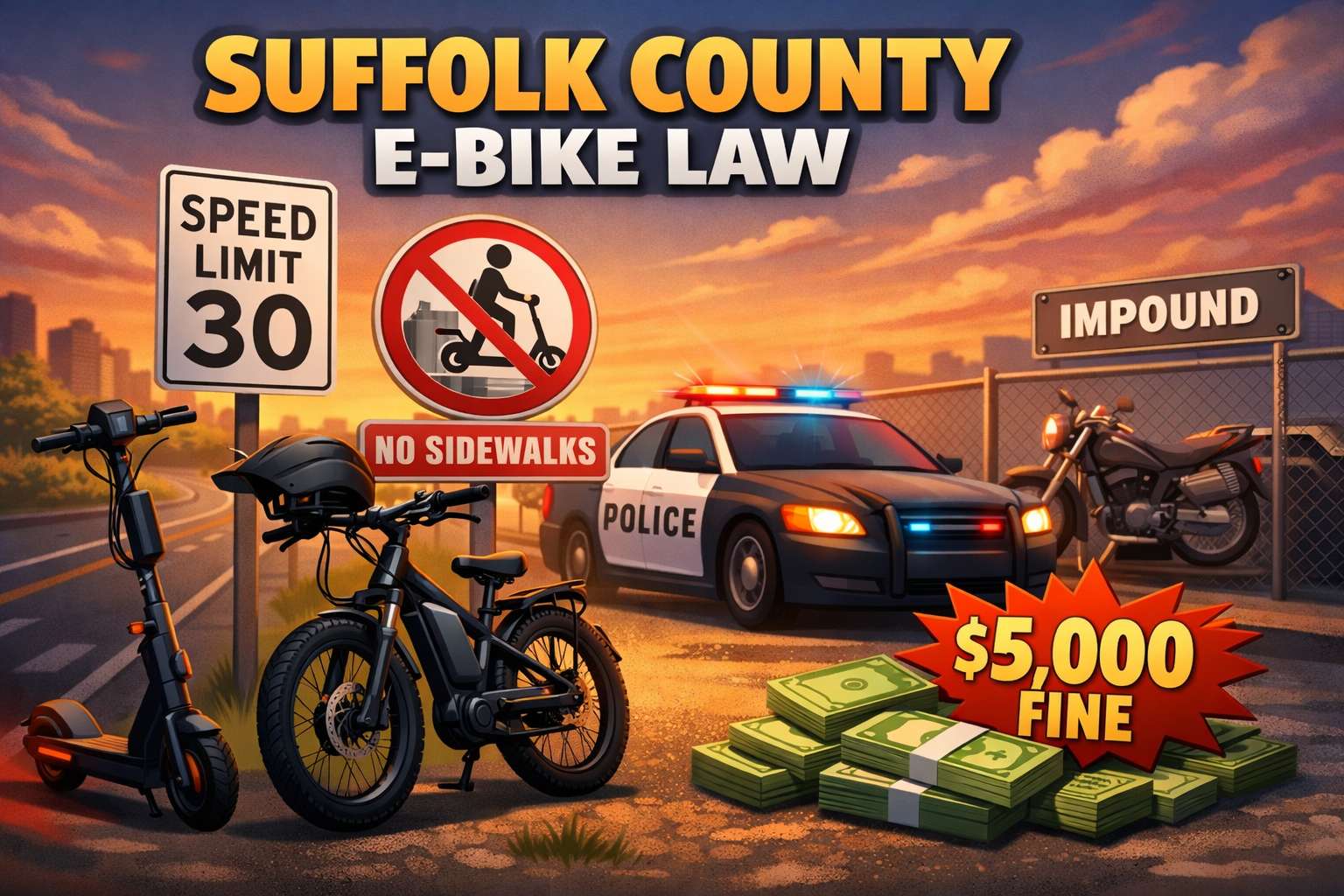
Suffolk County just drew a brighter line around e-bikes and e-scooters. The county approved Introductory Resolution 1835-2025 on December 16, 2025. So if you ride on Long Island, these rules matter right now.
This local law focuses on two things. It limits where you can ride. Then it adds penalties that climb fast if you keep breaking the rules.
People have argued for months about safety and speed. At the same time, more riders keep showing up on roads and sidewalks that were never built for them. So Suffolk County went with clear boundaries, and stronger enforcement.
The big changes riders will notice
The headline rule is simple. If a road has a posted speed limit above 30 mph, e-bikes and e-scooters are not allowed there. That applies to county roads and local roads inside the county.
Sidewalks are off limits too. That point sounds obvious to some riders. Still, this ban is spelled out, and it covers the whole county.
Helmet use is another major piece. Riders and passengers need helmets when riding an e-bike or an e-scooter in Suffolk County. So parents should pay attention, and so should adults who ride to work.
Age rules show up as well. Riders 15 and under cannot operate these devices on public property or roadways. That is strict, and it will catch families off guard if they have been riding casually in the neighborhood.
Where you can ride. And where you cannot
These devices fit best on calmer streets. So the county tied legal riding to posted speed limits.
You can ride on roads posted 30 mph or less. You cannot ride on roads posted over 30 mph. That is the cleanest way to read it.
Sidewalk riding is not allowed. So even a slow cruise near shops can become a problem if you hop onto the sidewalk for a short stretch.
County-owned off-highway property is also restricted. That can include certain county spaces that look rideable, like wide paved paths in some areas. So it is worth checking signs, and it is worth asking a park office when rules look unclear.
Towns and villages can add their own local limits too. So a spot that feels fine in one area may be restricted in another, even inside Suffolk.
The fines climb fast, and the stakes feel higher
This is where the law gets sharp.
A first violation can bring a fine up to $500. That alone can ruin your week.
A second conviction within five years raises the pressure. It becomes an unclassified misdemeanor. Then the fine starts at $1,500. Plus the law calls for impound.
A third or later violation within five years is even tougher. The fine can reach $5,000. Jail time can reach one year.
Parents can get pulled into this too. If the person found guilty is under 18, a parent or guardian can be responsible for the fine. So even a “quick ride” can turn into a painful bill for the household.
Impound rules can separate you from your ride
The law also gives a route for seizure and impound in certain cases. That mainly targets riders under 16 when there is reasonable cause tied to a violation.
After impound, fees can stack up. A processing fee can apply. A daily storage fee can apply too. Then there is a deadline. If no valid claim is made within 90 days, the agency can take title to the device. So waiting it out is not a plan.
That risk changes behavior. Riders who used to ignore rules may rethink it when the device itself is on the line.
How this fits with New York State rules
New York State already sets statewide boundaries for these devices. Suffolk County’s move sits on top of that and tightens the local picture.
State guidance links lawful operation to streets posted 30 mph or less. Sidewalk riding is generally not allowed unless a local law permits it. So Suffolk County’s countywide sidewalk ban lines up with a stricter reading.
If you want a quick comparison with another county that is pushing for tougher rules, take a look at this update on Orange County. It lays out what riders may face next and what to watch for in local enforcement. Orange County plans tougher e-scooter and e-bike rules, what riders need to know.
What riders should do next
Start with your usual route. Then check posted speed limits on the roads you use most. If a stretch is posted above 30 mph, plan a different path.
Next, stay off sidewalks even for short hops. It feels convenient, but it can trigger a stop.
Then gear up. A helmet is a small hassle, yet it is cheaper than a ticket and safer in a fall.
Finally, keep younger teens off public roads and public property with these devices. This rule is not a gray area.