

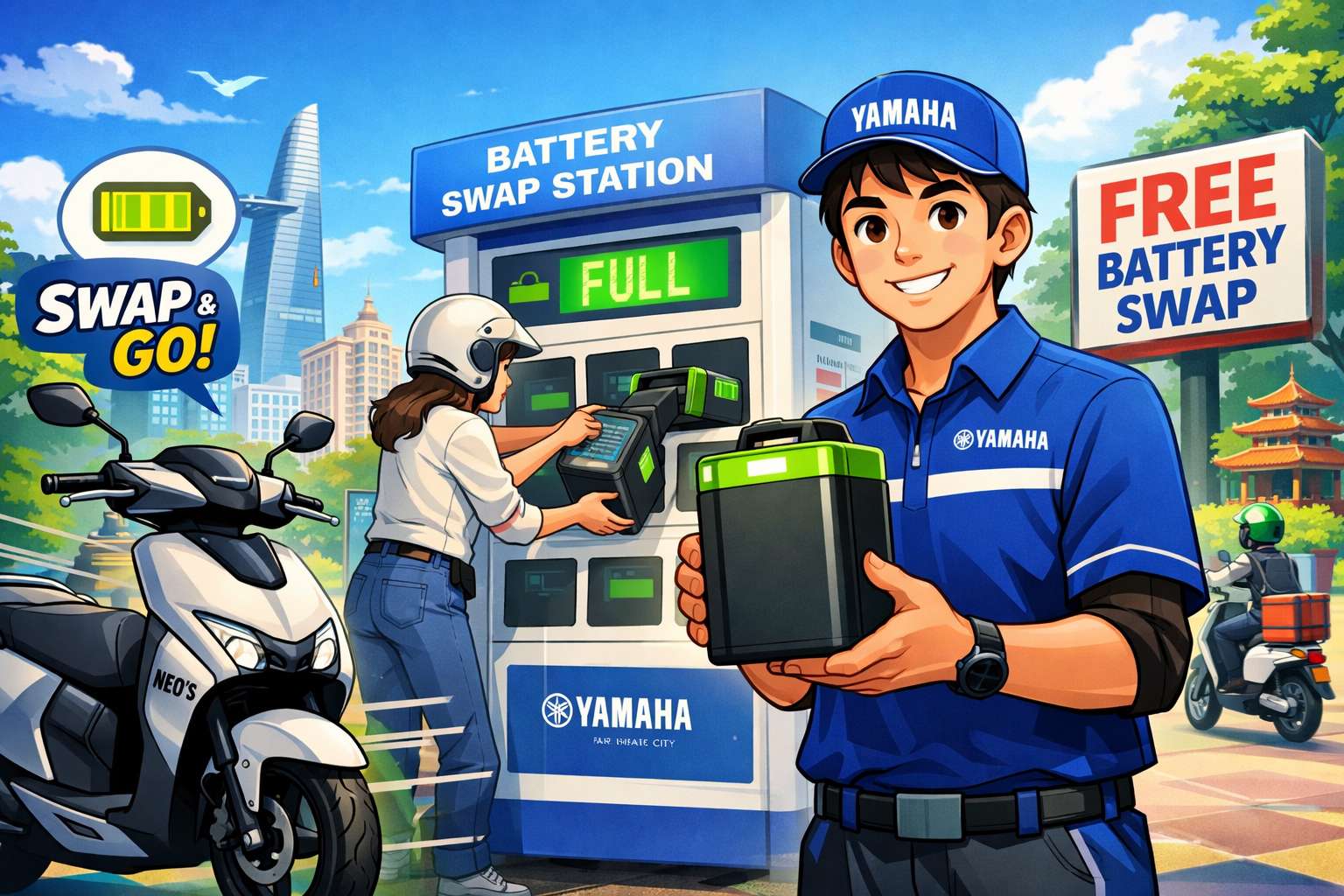
Yamaha has rolled out a free battery swap program for Yamaha NEO’s riders in Ho Chi Minh City. This is a practical move, and it addresses one of the biggest concerns people still have about electric scooters. Many riders like the low running costs and quiet ride, but they still worry about charging time, battery range, and what happens when the battery runs low far from home.
That is why this new Yamaha offer matters. It gives eligible NEO’s owners in Ho Chi Minh City access to support that can keep them moving with less stress. Instead of treating battery service as an afterthought, Yamaha is trying to turn it into a clear ownership benefit.
For city riders, that can make a real difference.
What Yamaha is offering
The program centers on a free member card for eligible Yamaha NEO’s owners in Ho Chi Minh City. That card unlocks several useful services. The most important one is free battery swapping at participating Yamaha Town locations. Riders can exchange a low battery for a charged one and continue their trip.
Yamaha also allows riders to borrow a fully charged battery. The borrowed battery must then be returned within five days. That can help when a rider has an unexpected longer trip, a sudden schedule change, or no easy charging option nearby.
The service package goes further than battery swapping alone. Eligible riders can also get battery delivery to a requested address in the supported area. There is also roadside support, flat tire help, and vehicle transport if the scooter cannot be fixed on the spot.
That broader support gives the program more value. It is not just about the battery itself. It is about reducing the small headaches that can make electric scooter ownership feel less convenient than it should.
Why this is important for electric scooter riders
Battery convenience still shapes buying decisions in Vietnam’s electric scooter market. People do not only compare speed, range, or price. They also ask simple questions. Where do I charge it? How long does charging take? What if I run out of battery during the day?
Yamaha’s new program answers those questions in a practical way. It does not remove every limitation, but it makes daily use feel more manageable. That matters most in a large city like Ho Chi Minh City, where traffic, delivery runs, work trips, and last minute errands can quickly add mileage.
For some buyers, a strong support program can matter as much as the scooter’s spec sheet. A scooter can look great on paper, but real ownership depends on how easy it is to live with each day. This launch helps Yamaha look stronger in that area.
It also fits a wider shift in the market. More riders now want electric scooters that feel simple, dependable, and easy to support. Brands that solve those practical issues may stand out faster than brands that only push flashy numbers.
Who can use the free battery swap program
Yamaha has set clear eligibility rules for the Ho Chi Minh City offer. Existing NEO’s owners who bought the scooter before April 1, 2026 can qualify. New customers who buy a Yamaha NEO’s from April 1, 2026 through March 31, 2027 can also qualify.
The member card distribution period runs from April 1, 2026 to March 31, 2027. Once activated, the card stays valid for one year. Yamaha has also placed an overall final limit on the program period through March 31, 2028.
There are service limits too. Eligible riders can use the free services up to five times per month, with a maximum of 60 times per year. The card is linked to the registered scooter, so it cannot be transferred from one vehicle to another.
These limits are important. They show that the offer is generous, but not unlimited. Even so, five uses per month should be enough for many regular city riders.
Where the service is available
This is one detail buyers should pay close attention to. The free battery swap and loan service is not available at every Yamaha location in Ho Chi Minh City. Yamaha has participating Yamaha Town dealers for this program, and riders should check their nearest supported location before relying on the service.
That does not weaken the program, but it does shape how useful it will feel in daily life. A rider who lives near a participating dealer may see strong value right away. A rider farther away may view it more as a backup option.
Even so, this is still a strong step. It gives Yamaha a more practical electric scooter story in Ho Chi Minh City, and that could help the brand attract buyers who were still unsure.
How riders can register
Yamaha has tried to make the registration process fairly simple. Existing NEO’s owners can register at participating Yamaha Town dealers. They can also register through remote channels such as email, hotline support, website chat, Zalo, and Facebook.
That flexibility should help adoption. Not every owner wants to visit a dealer just to start the process. Giving people several ways to register removes friction, and that usually improves real world participation.
New buyers may have it even easier. Customers who buy a NEO’s during the program window at participating locations can receive the member card as part of the buying process. That creates a smoother ownership start and gives the program immediate value from day one.
What this means for Yamaha NEO’s buyers
The Yamaha NEO’s already targets urban riders who want a clean and simple electric scooter for city use. A support program like this strengthens that identity. It tells buyers that Yamaha is not only selling the scooter. It is also trying to support the daily experience after the sale.
That is a smart move. In many markets, electric scooter growth depends on trust. People want to know the product will fit into real life without too much hassle. They want backup if something goes wrong. They want flexibility when plans change.
This free battery swap offer helps build that trust.
It may also help Yamaha stand out in online searches around terms like Yamaha battery swap Vietnam, electric scooter battery swap Ho Chi Minh City, Yamaha NEO’s battery support, battery loan for electric scooters, and free battery delivery service. Those are the kinds of real questions shoppers search before making a purchase decision.
Buyers who are also researching Yamaha’s wider support record may want to see how the company handles service campaigns in other markets. For example, Yamaha has also dealt with safety related aftersales action in India, including this Yamaha scooter recall in India, which focused on a free front brake fix for affected RayZR 125 and Fascino 125 units. That kind of support history can matter when buyers judge how seriously a brand takes ownership care.
The bigger picture in Ho Chi Minh City
This launch also lands at a time when battery swap infrastructure is getting more attention in Ho Chi Minh City. That gives Yamaha’s move extra relevance. Riders are not only hearing about electric mobility in theory. They are seeing more real discussion around the systems needed to support it.
That matters because infrastructure often shapes adoption more than hype does. People rarely switch because of marketing alone. They switch when the product starts to feel easy, practical, and safe for daily use.
Yamaha’s battery swap program supports that shift. It does not solve every charging challenge, but it helps close the gap between interest and confidence. For many urban riders, that is exactly where brands need to win.
Final thoughts
Yamaha’s free battery swap program in Ho Chi Minh City looks like a smart and useful move for NEO’s owners. It offers more than a simple battery exchange. It adds battery loan support, delivery help, and roadside assistance, which makes the package feel more complete.
The biggest strength is convenience. The biggest limitation is location coverage, since riders still need access to participating service points. Still, for many city users, this could make Yamaha NEO’s ownership feel easier and more dependable.
That is the real story here. Yamaha is not only selling an electric scooter. It is trying to remove some of the everyday friction that stops people from going electric in the first place.