

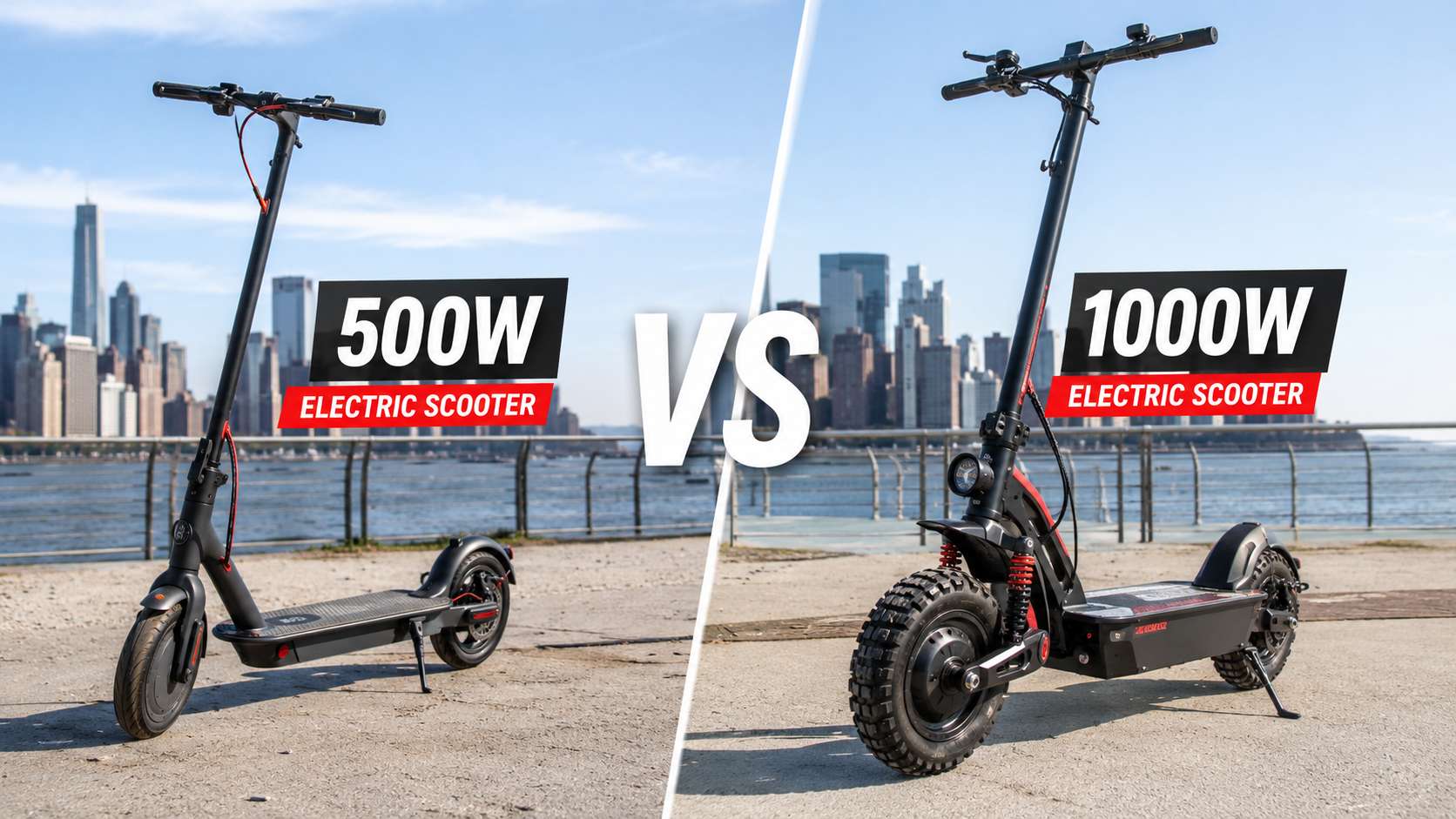
Electric scooter power ratings can look simple at first. A 1000W electric scooter sounds twice as strong as a 500W electric scooter, so many riders expect twice the speed, twice the hill power, and twice the fun. In real life, the difference feels more complex.
A 500W scooter can handle daily city rides, light hills, and short commutes very well. A 1000W scooter gives stronger acceleration, better hill climbing, and more rider weight support. Still, more power also brings extra weight, higher battery use, higher cost, and more legal concerns.
So, which one makes more sense? For most casual riders, 500W offers the better balance. For heavier riders, steep hills, rougher roads, or faster private-land riding, 1000W can feel much more capable.
What Does 500W or 1000W Mean on an Electric Scooter?
The watt rating describes motor power. In simple terms, watts show how much electrical power the motor can use to move the scooter.
A 500W electric scooter usually sits in the commuter category. It has enough strength for city streets, bike lanes, moderate slopes, and average rider weights. Many models in this range aim for comfort, portability, and simple daily use.
A 1000W electric scooter moves closer to the performance category. It usually accelerates harder, climbs hills with less struggle, and carries heavier riders with more confidence. Many 1000W scooters also use larger batteries, stronger brakes, wider tires, and heavier frames.
One issue confuses many buyers. Brands often advertise peak power, not just rated power. A scooter listed as 1000W may have a 1000W peak output, but a lower continuous rating. Another scooter may list 1000W as continuous motor power. These are not the same thing.
For daily riding, continuous power matters more. Peak power helps during short bursts, such as starting from a stop or climbing a hill. Continuous power shows what the motor can handle for longer periods without overheating.
Speed Difference: Is a 1000W Scooter Twice as Fast?
No, a 1000W scooter is not twice as fast as a 500W scooter.
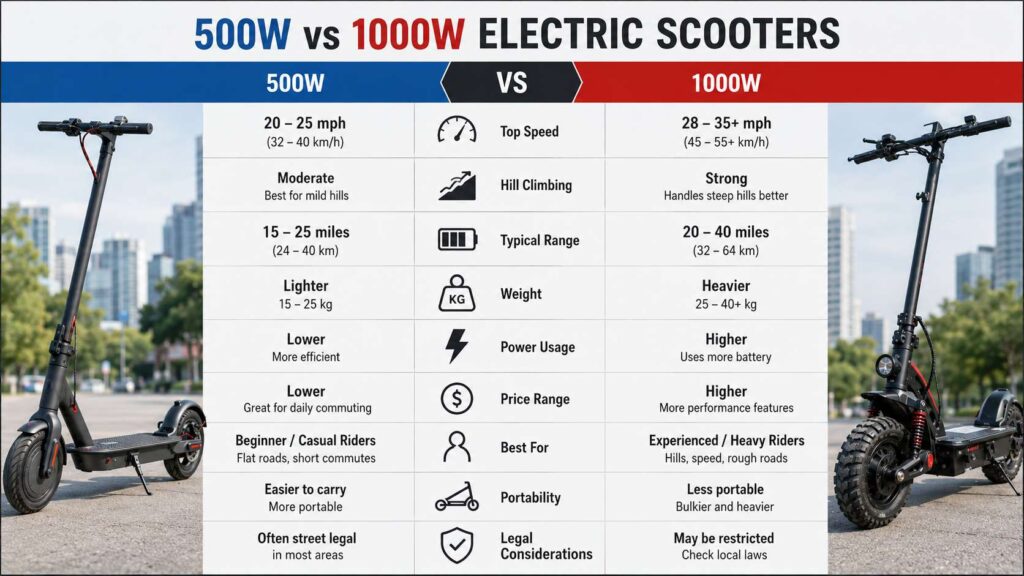
A typical 500W scooter often reaches around 20 to 25 mph, depending on the model, rider weight, battery charge, tire pressure, road surface, and local speed limits. Some models go slower to meet local rules.
A typical 1000W scooter often reaches around 28 to 35 mph, and some performance models go higher. Still, speed depends on gearing, controller limits, battery voltage, motor design, and firmware settings.
This is where real-world riding matters. A 1000W scooter may not feel much faster at low legal speeds. At 15 to 20 mph, both scooters can cruise comfortably. The bigger difference appears during acceleration, hill climbs, and riding with extra load.
If your city limits scooters to 15.5 mph, 20 km/h, or 25 km/h, extra motor power will not always give you legal extra speed. It may only help the scooter reach that legal speed faster.
Acceleration: The First Big Real Difference
Acceleration is one of the clearest differences between 500W and 1000W electric scooters.
A 500W scooter usually feels smooth and predictable. It pulls away from traffic lights without drama. It works well for riders who prefer a calm ride and do not need aggressive throttle response.
A 1000W scooter feels stronger right away. It can launch faster, pass slow cyclists more easily, and recover speed quicker after slowing down. That extra punch feels useful in traffic, but it also demands more control.
This is where some riders get surprised. A powerful scooter can spin the front wheel, jerk forward, or feel twitchy on wet pavement. New riders may feel more comfortable on 500W at first, especially in busy areas.
My honest view: 1000W feels more exciting, but 500W feels easier to trust for normal commuting. Power is fun, but smooth control matters more on crowded streets.
Hill Climbing: Where 1000W Makes Sense
Hill climbing is one of the best reasons to choose a 1000W electric scooter.
A 500W scooter can handle mild and moderate hills. It works well on gentle city climbs, especially with a lighter rider. But it may slow down on steeper roads. It may also heat up faster during long climbs.
A 1000W scooter handles hills with less effort. It keeps better speed, feels less strained, and works better for heavier riders. If your commute includes steep roads, bridges, or long inclines, 1000W gives a clear advantage.
Still, motor power alone does not tell the full story. Torque, controller output, battery voltage, tire size, scooter weight, and motor type all affect hill performance. A well-built 800W scooter can beat a weak 1000W scooter on hills.
For hill climbing, check these details before buying:
- Claimed hill grade, such as 15%, 20%, or 25%
- Rider weight limit
- Battery voltage
- Motor type and controller strength
- Real rider reviews from people near your weight
- Brake quality for downhill control
Going up is only half the story. Coming down safely matters just as much.
Range and Battery Use: More Power Can Drain Faster
Many buyers expect a 1000W scooter to have much better range. That is not always true.
A 1000W motor can use more energy during hard acceleration and hill climbing. So, if you ride fast, climb often, or use sport mode all the time, the battery drains faster.
To balance that, many 1000W scooters come with larger battery packs. That can give them strong range on paper. Yet the real range still depends on how you ride.
A 500W scooter often gives better energy use at city speeds. It may travel farther per watt-hour if you ride calmly. For stop-and-go commuting, this can make a 500W scooter feel more practical.
A 1000W scooter gives better performance headroom. It can feel less stressed with a heavier rider or steep route. But that power comes at a cost.
Real issues riders report include:
- Range drops sharply in cold weather
- Sport mode cuts range faster than expected
- Heavy riders get less range than advertised
- Low tire pressure reduces range
- Long hills drain the battery quickly
For range, battery capacity matters more than motor wattage. Look for watt-hours, often written as Wh. A scooter with a larger Wh rating usually has more range potential.
Rider Weight: Why Heavier Riders Feel the Difference
Rider weight changes everything.
A 500W scooter may feel quick with a 65 kg rider and slow with a 110 kg rider. It may still move, but acceleration drops. Hill climbing gets weaker, and range falls.
A 1000W scooter gives heavier riders more usable power. It keeps better speed on slopes and feels safer when merging into traffic or moving away from a stop.
This does not mean every heavier rider needs 1000W. Flat-city commuters can still use a good 500W scooter. But for riders above 90 to 100 kg, 1000W often feels more relaxed and less strained.
Check the maximum payload before buying. Then leave a safety margin. If a scooter claims a 120 kg limit and you weigh 115 kg with a backpack, it may work, but it will not perform at its best.
Portability: 500W Scooters Are Usually Easier to Live With
A 500W scooter usually weighs less than a 1000W scooter. That makes a big difference if you carry it upstairs, lift it into a car, or bring it into an office.
Many 500W commuter scooters weigh around 15 to 25 kg. Many 1000W scooters weigh 25 to 40 kg or more. Some performance models get even heavier.
That extra weight comes from larger batteries, stronger frames, bigger motors, suspension parts, larger tires, and better brakes. These parts help performance, but they make the scooter harder to move by hand.
This is one of the most common buyer regrets. Riders buy more power than they need, then discover the scooter is awkward to carry. If you live in an apartment without an elevator, weight matters every single day.
For city commuting, a lighter 500W scooter often wins.
Brakes, Tires, and Suspension: Power Needs Better Hardware
A faster scooter needs better stopping power.
A 500W scooter may use drum brakes, disc brakes, electronic braking, or a mix of systems. For city speeds, a good brake setup can work well.
A 1000W scooter should have stronger brakes. Hydraulic disc brakes are common on better models. Mechanical disc brakes can work too, but they need more adjustment.
Tires matter too. A 1000W scooter with small solid tires can feel harsh and nervous at higher speeds. Pneumatic tires with good width give better grip, comfort, and control.
Suspension also becomes more useful as power rises. At 30 mph, potholes and rough pavement feel much more serious than they do at 15 mph. A 1000W scooter without proper suspension can feel tiring and unsafe on bad roads.
Before buying a 1000W model, check the full package. Power alone does not make a scooter good.
Legal Rules: 1000W Scooters Can Be a Problem
This is a key point many buyers miss.
Electric scooter laws vary by country, state, city, and road type. Many areas limit scooter speed, motor power, or public road use. Some places allow only rental scooters. Some treat high-power scooters like mopeds or motor vehicles.
In several European-style frameworks, legal e-scooter speeds often sit around 20 km/h or 25 km/h. In the UK rental trial rules, trial scooters use a 500W maximum continuous motor power rating and a 15.5 mph speed limit. Germany’s small electric vehicle framework also uses a 500W limit for standard handlebar e-scooters, with different rules for some self-balancing vehicles.
This means a 1000W scooter may not be legal for public roads in some places. It may need registration, insurance, approval, or use only on private land.
Before buying, check your local rules for:
- Maximum motor power
- Maximum assisted speed
- Helmet rules
- Age limits
- Road and bike-lane access
- Insurance needs
- Registration needs
- Lighting and braking requirements
A powerful scooter is not useful if you cannot ride it legally where you live.
Safety and Battery Quality Matter More at Higher Power
A 1000W scooter pulls more current from the battery and controller. So, battery quality matters a lot.
Look for a scooter from a trusted brand with clear battery specs, proper charger information, and recognized safety testing where available. Cheap high-power scooters can look attractive, but weak batteries, poor wiring, and low-grade chargers can create serious risks.
Good buying signs include:
- Clear battery voltage and capacity
- Quality charger included
- Water-resistance rating listed
- Proper brake specs
- Real warranty support
- Replacement parts available
- Clear user manual
- No vague power claims
Charging habits matter too. Use the supplied charger. Do not charge near exits, beds, or flammable items. Let the battery cool after a long ride before charging. Stop using the scooter if the battery smells strange, swells, leaks, overheats, or makes unusual noises.
More power should come with more care.
500W Electric Scooter: Best For These Riders
A 500W electric scooter makes sense if you ride mostly in the city. It suits commuters, students, casual riders, and people who value portability.
Choose 500W if you want:
- A lighter scooter
- Better portability
- Lower cost
- Smooth acceleration
- Easier control
- Good city range
- Less legal risk in many areas
- A practical daily commuter
A 500W scooter is not weak. A good model can feel quick, comfortable, and reliable for normal riding. It works best on flatter routes and moderate hills.
The main downside is limited performance headroom. Heavy riders, steep climbs, and fast riding can expose its limits.
1000W Electric Scooter: Best For These Riders
A 1000W electric scooter makes sense if you need more strength, not just more speed.
Choose 1000W if you want:
- Strong hill climbing
- Faster acceleration
- Better support for heavier riders
- Stronger performance on rougher roads
- Higher speed on private land where allowed
- More confidence with cargo or backpacks
- A scooter that feels less strained
A 1000W scooter feels more powerful and more fun. It also feels heavier, more expensive, and less simple.
The main downside is practicality. You must think about weight, storage, charging space, legal rules, tire wear, brake maintenance, and safety gear.
500W vs 1000W Electric Scooters: Quick Comparison
500W electric scooter:
- Best for daily commuting
- Better for flat city routes
- Easier to carry
- Usually cheaper
- Better for new riders
- Lower battery demand
- Less exciting, but more practical
1000W electric scooter:
- Best for hills and heavier riders
- Faster acceleration
- Better performance feel
- Usually heavier
- Usually more expensive
- Higher battery demand
- More likely to raise legal issues
Common Mistakes Buyers Make
The biggest mistake is buying by wattage alone. A scooter is more than its motor rating.
A poor 1000W scooter can feel worse than a well-made 500W scooter. Weak brakes, cheap tires, poor suspension, low battery capacity, and bad build quality can ruin the ride.
Another mistake is ignoring scooter weight. A 35 kg scooter may sound fine online, but it feels very different at the bottom of a staircase.
Many riders also trust advertised range too much. Real range is often lower than the listed number. Cold weather, hills, rider weight, fast starts, and high speed all reduce it.
The final mistake is ignoring local law. A scooter that looks perfect on paper may be restricted on public roads.
Final Verdict: Which One Should You Choose?
For most riders, a good 500W electric scooter is the smarter choice. It is easier to carry, easier to control, cheaper to buy, and strong enough for normal city trips.
A 1000W electric scooter is better for riders who need real performance. It makes sense for steep hills, heavier riders, rough roads, and private-land riding where higher speed is allowed.
My practical opinion is simple: buy 500W if you want transport. Buy 1000W if you need power and accept the trade-offs.
The real difference is not just speed. It is control, weight, range, hill strength, legal risk, and long-term ownership. Pick the scooter that fits your route, your body weight, your storage space, and your local rules. That choice will matter more than the number printed on the motor.
Focus keyphrase
500W vs 1000W electric scooters
Meta description
500W vs 1000W electric scooters explained: speed, hill climbing, range, rider weight, safety, legal rules, and which one to buy.
Keyphrase synonyms
500W electric scooter vs 1000W electric scooter, 500W scooter vs 1000W scooter, electric scooter motor power comparison, best wattage for electric scooter, 1000W electric scooter guide
Transition words: Only 27.9% of the sentences contain transition words, which is not enough. Use more of them. Rewrite this to sound more human with slight imperfections, fix all mistakes in this text like grammar and make sure the punctuation, typos, flow is correct and rewrite it in a friendly, warm, human tone that still sounds professional. Insert a in text backlink that points to /how-rider-weight-affects-electric-scooter-range and one that points to /electric-scooter-hill-climb-ratings-explained
I’ll keep the same topic and structure, but I’ll smooth the flow, add more natural transition phrases, and place the two internal links inside relevant sections without making them feel forced.Thought for 16s
500W vs 1000W Electric Scooters: The Real Difference Before You Buy
Choosing between a 500W and a 1000W electric scooter sounds simple. More watts should mean more speed, more power, and more fun. Still, real riding does not work that cleanly.
A 500W electric scooter can be a great daily commuter. It is usually lighter, easier to handle, and cheaper to run. Also, it often fits better into city rules, especially in places with strict speed and power limits.
A 1000W electric scooter feels stronger right away. It accelerates faster, climbs hills with more confidence, and handles heavier riders better. At the same time, it costs more, weighs more, and uses more battery when you ride hard.
So, the real question is not just “which one is faster?” The better question is: which scooter fits your roads, your weight, your riding style, and your local laws?
What Does 500W or 1000W Mean on an Electric Scooter?
The watt rating shows how much power the motor can use. In simple terms, more watts usually mean the scooter has more strength.
A 500W electric scooter usually sits in the commuter category. It works well for city streets, short trips, moderate hills, and everyday riding. Because of that, many riders pick 500W scooters for work, school, errands, and relaxed weekend rides.
A 1000W electric scooter belongs closer to the performance category. It gives stronger acceleration and better hill climbing. Also, it usually supports heavier riders with less struggle.
Still, there is one catch. Some brands show peak power, not continuous power. Peak power is the short burst the motor can deliver for a few seconds. Continuous power is what the motor can handle for longer rides.
For example, one scooter may advertise “1000W peak power” but use a lower rated motor in normal riding. Another scooter may use a true 1000W continuous motor. As a result, two scooters with the same watt number can feel very different on the road.
For daily use, continuous power matters more than the big number in the ad.
Speed Difference: Is a 1000W Scooter Twice as Fast?
No, a 1000W electric scooter is not twice as fast as a 500W electric scooter.
A good 500W scooter often reaches around 20 to 25 mph, depending on the model, battery, rider weight, tire pressure, and speed settings. Some models go slower because local rules require it.
A 1000W scooter often reaches around 28 to 35 mph. Some performance models go faster, but that depends on the controller, battery voltage, motor design, and software limits.
Even so, speed is not the only difference. In fact, many riders notice acceleration before top speed. A 1000W scooter gets moving faster from a stop. It also recovers speed better after corners, traffic lights, or slow sections.
Still, if your area limits e-scooters to 15.5 mph, 20 km/h, or 25 km/h, extra power may not give you legal extra speed. Instead, it helps the scooter reach the allowed speed faster.
That matters for comfort, but it does not always make the scooter more useful.
Acceleration: The First Difference You Feel
Acceleration is where 1000W scooters feel much stronger.
A 500W scooter usually feels calm and predictable. It moves away from traffic lights smoothly and does not feel too aggressive. For new riders, that is a good thing.
A 1000W scooter feels more powerful from the first push of the throttle. It pulls harder, reacts faster, and feels more exciting. Also, it gives you more confidence when you need to keep up with traffic on a shared road.
But there is a downside. More power can make the scooter harder to control, especially on wet roads, loose gravel, or poor pavement. A sharp throttle can feel jerky. Also, some riders may find 1000W too much for crowded bike lanes.
My honest opinion: 500W feels better for relaxed commuting. 1000W feels better for riders who already feel confident and want stronger performance.
Hill Climbing: Where 1000W Makes the Biggest Difference
Hill climbing is one of the main reasons to choose 1000W over 500W.
A 500W electric scooter can handle mild hills. It works well on gentle city slopes, especially with a lighter rider. Still, it may slow down on longer or steeper climbs.
A 1000W scooter handles hills with less effort. It keeps speed better and does not feel as strained. Also, it usually works better for heavier riders, riders with backpacks, and routes with repeated climbs.
For example, if your commute includes steep streets, bridges, or long uphill sections, a 1000W scooter can feel much more comfortable. It will not always fly up every hill, but it will usually feel stronger and safer than a 500W model.
Still, watts do not tell the whole story. Torque, battery voltage, controller output, tire size, scooter weight, and motor type all affect climbing power. For that reason, a well-built 800W scooter can sometimes beat a cheap 1000W scooter on hills.
If hill performance matters to you, read this guide on electric scooter hill climb ratings explained. It gives a clearer picture of grade percentages, torque, and real riding limits.
Range and Battery Use: Bigger Motor, Bigger Appetite
A 1000W scooter does not always travel farther than a 500W scooter. In many cases, it uses more energy.
A 1000W motor pulls more power during hard acceleration and hill climbs. So, if you ride fast, use sport mode often, or climb a lot, the battery can drain quickly.
A 500W scooter usually uses less energy at normal city speeds. Because of that, it can feel more practical for commuting, especially on flat routes.
That said, many 1000W scooters come with larger batteries. So, they may still offer good range. The key number to check is not only watts. Look at watt-hours, often written as Wh. A bigger Wh rating usually means more stored energy.
Real riders often notice these range issues:
- Cold weather cuts range.
- Heavy riders get less range than advertised.
- Low tire pressure drains the battery faster.
- Sport mode reduces range quickly.
- Long hills use more battery than expected.
- Stop-and-go riding can lower range.
Also, rider weight plays a huge role. A scooter that gets good range with a 70 kg rider may feel very different with a 110 kg rider. For a deeper look, read this guide on how rider weight affects electric scooter range.
Rider Weight: Why Power Matters More for Some People
Rider weight can change the whole riding experience.
A 500W scooter may feel quick with a lighter rider. The same scooter may feel slow with a heavier rider, especially uphill. It may still work, but acceleration drops and range falls.
A 1000W scooter gives heavier riders more breathing room. It reaches speed with less effort and handles climbs better. Also, it feels less stressed during longer rides.
For riders above 90 to 100 kg, a 1000W scooter often makes more sense, especially on hilly roads. Still, flat-city riders can use a good 500W scooter if they do not need fast acceleration.
Before buying, check the maximum payload. Then leave some margin. If the scooter supports 120 kg and you weigh 115 kg with a backpack, it may run, but it will not perform at its best.
Portability: 500W Scooters Are Easier to Live With
This is where 500W scooters win for many riders.
A 500W electric scooter is usually lighter. That makes it easier to lift, fold, store, and carry. If you live in an apartment, take stairs, use public transport, or place the scooter in a car trunk, weight matters every day.
A 1000W scooter often comes with a larger frame, bigger battery, stronger suspension, and wider tires. Those parts improve performance, but they add weight fast.
Many 500W scooters weigh around 15 to 25 kg. Many 1000W scooters weigh 25 to 40 kg or more. After a few weeks, that difference becomes very real.
This is one of the most common buyer regrets. Some riders buy a powerful scooter online, then realize they hate carrying it. So, before you chase more watts, think about where you will store the scooter and how often you need to lift it.
Brakes, Tires, and Suspension Matter More on 1000W Scooters
More power needs better hardware.
A 500W scooter can work well with a good drum brake, disc brake, electric brake, or a mixed braking system. At lower city speeds, a simple setup can still feel safe if the scooter is well built.
A 1000W scooter needs stronger brakes. Hydraulic disc brakes are a major plus. Mechanical disc brakes can work too, but they need more adjustment.
Tires matter just as much. Small solid tires may feel fine at slow speeds, but they can feel harsh and nervous at higher speeds. Wider pneumatic tires give better comfort, better grip, and more control.
Suspension also matters more as speed rises. At 30 mph, rough pavement feels much more serious than it does at 15 mph. So, a 1000W scooter without proper suspension can feel tiring, noisy, and less safe.
Power is exciting, but brakes and tires decide how safe that power feels.
Legal Rules: 1000W Scooters Can Cause Problems
Legal rules can make or break your choice.
Many places limit electric scooter speed, motor power, road access, and rider age. Some cities allow scooters in bike lanes. Some ban private scooters from public roads. Others treat high-power scooters more like mopeds.
This matters because a 1000W electric scooter may not be street legal in your area. It may need registration, insurance, lights, mirrors, or a different vehicle category.
A 500W scooter usually has a better chance of fitting commuter rules, but you still need to check local laws. Also, speed limiters do not always solve the problem if the law also limits motor power.
Before buying, check:
- Maximum allowed motor power
- Maximum allowed speed
- Helmet rules
- Age limits
- Insurance rules
- Registration needs
- Bike lane access
- Road and sidewalk rules
- Lighting and reflector rules
A powerful scooter is not a good buy if you cannot ride it legally where you live.
Safety and Battery Quality: Do Not Cheap Out
A 1000W scooter puts more stress on the battery, controller, wiring, brakes, and tires. For that reason, build quality matters a lot.
Cheap high-power scooters can look tempting. They offer big watt numbers at low prices. Still, weak batteries, poor chargers, bad wiring, and soft brakes can create real problems.
Look for clear battery specs, proper charger details, water resistance ratings, real warranty support, and replacement parts. Also, check owner feedback about brakes, stem wobble, battery life, and controller problems.
Good signs include:
- Clear battery voltage and capacity
- Quality brakes
- Wide pneumatic tires
- Strong frame design
- Stable folding mechanism
- Clear warranty terms
- Replacement parts available
- Real rider reviews
Charging habits matter too. Use the supplied charger. Let the battery cool after a hard ride. Also, avoid charging near beds, exits, or flammable items. If the battery smells strange, swells, leaks, or overheats, stop using the scooter.
500W Electric Scooter: Best For These Riders
A 500W electric scooter is the better choice for many daily riders.
Choose 500W if you want:
- A lighter scooter
- Lower cost
- Easier handling
- Better portability
- Good city range
- Smooth acceleration
- Less maintenance stress
- A simple commuter ride
A 500W scooter works best on flat or mildly hilly roads. It suits riders who care more about practical transport than high speed.
Also, it is a smart pick for beginners. The power feels easier to manage, and the scooter usually feels less intimidating in traffic.
The downside is clear. A 500W scooter can struggle with steep hills, heavier riders, and fast riding. So, if your route is demanding, it may feel underpowered.
1000W Electric Scooter: Best For These Riders
A 1000W electric scooter is the better choice for riders who need more strength.
Choose 1000W if you want:
- Stronger hill climbing
- Faster acceleration
- Better support for heavier riders
- More power for rough roads
- Stronger performance with cargo
- More confidence on demanding routes
- Higher speed where legal or on private land
A 1000W scooter feels more fun and more capable. It also feels more serious. You need better safety gear, more storage space, and more care during riding.
Also, it costs more to buy and may cost more to maintain. Tires, brake pads, batteries, and controllers all work harder on performance scooters.
So, 1000W makes sense if you truly need the power. If you only ride short flat trips, it may be more scooter than you need.
500W vs 1000W Electric Scooters: Quick Comparison
500W electric scooter:
- Better for daily commuting
- Better for beginners
- Easier to carry
- Usually cheaper
- Better for flat city routes
- Smoother and calmer
- Often easier to store
1000W electric scooter:
- Better for hills
- Better for heavier riders
- Faster acceleration
- Stronger performance feel
- Usually heavier
- Usually more expensive
- More likely to face legal limits
Common Problems Riders Notice After Buying
Many riders focus too much on wattage and ignore the rest of the scooter. That can lead to disappointment.
A weak 1000W scooter can feel worse than a quality 500W scooter. Bad brakes, poor tires, loose folding parts, weak suspension, and low battery capacity can ruin the ride.
Also, advertised range can mislead buyers. Real range often drops in cold weather, on hills, or with heavier riders. Fast acceleration also drains the battery faster than many people expect.
Weight is another issue. A heavy scooter feels fine during the ride but annoying when you carry it. If you deal with stairs every day, this matters more than top speed.
Finally, many people forget about local laws until after they buy. That can turn a fun purchase into a frustrating one.
Final Verdict: Which One Should You Buy?
For most riders, a good 500W electric scooter is the smarter buy. It is lighter, easier to control, cheaper, and strong enough for normal city commuting.
A 1000W electric scooter makes more sense if you ride on steep hills, weigh more, carry extra load, or want stronger acceleration. It also suits riders who use private roads or areas where higher power is legal.
Still, do not buy by watts alone. Look at battery size, brakes, tires, suspension, weight, water resistance, and real rider feedback.
My honest advice is simple: buy 500W if you want easy daily transport. Buy 1000W if your route demands power and you accept the extra weight, cost, and legal checks.
The best electric scooter is not always the most powerful one. It is the one that fits your roads, your body weight, your storage space, and your riding habits.