

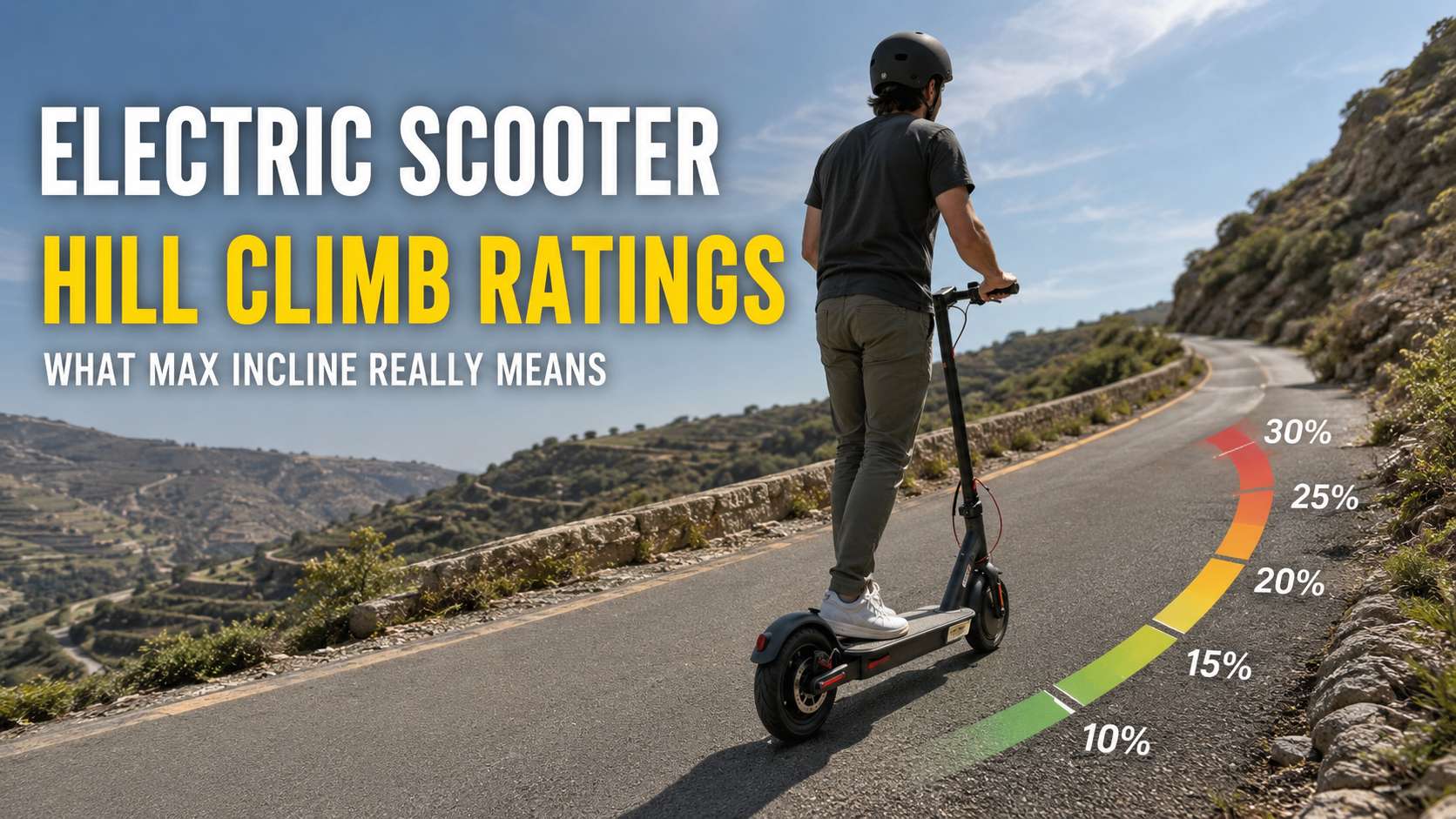
Why Hill Climb Ratings Matter More Than Most Buyers Think
Electric scooter hill climb ratings look simple at first. A scooter says it can climb 15%, 20%, 25%, or even 30% slopes. So, many buyers assume a higher number means the scooter will power up every hill without slowing down.
Real riding is rarely that clean.
A hill climb rating tells you what a scooter can manage under certain test conditions. It does not always tell you how fast it will climb, how long it can keep climbing, or how it will feel with a heavier rider, low battery, cold weather, or rough pavement. That is why hill climb ratings need a bit of decoding.
This matters a lot if your daily route includes steep roads, bridges, parking ramps, hilly neighborhoods, or long uphill sections. A weak scooter can slow to walking speed, overheat, drain the battery fast, or stop before the hill ends. A stronger scooter feels safer and more relaxed, since it keeps momentum and gives you more control.
So, before buying an electric scooter for hills, look past the big marketing number. Pay attention to percent grade, motor power, torque, rider weight, battery voltage, tire grip, and heat control.
What Does an Electric Scooter Hill Climb Rating Mean?
An electric scooter hill climb rating shows the maximum slope the scooter is designed to climb. Brands often describe this as max incline, climbing slope, hill climb ability, gradeability, uphill climb, or max slope percentage.
Most modern scooters list this number as a percentage. For example, a commuter scooter may claim a 15% hill climb rating. A stronger model may claim 20% or 25%. Some high-power scooters list 30% or more.
The percentage does not mean degrees. This is where many buyers get confused.
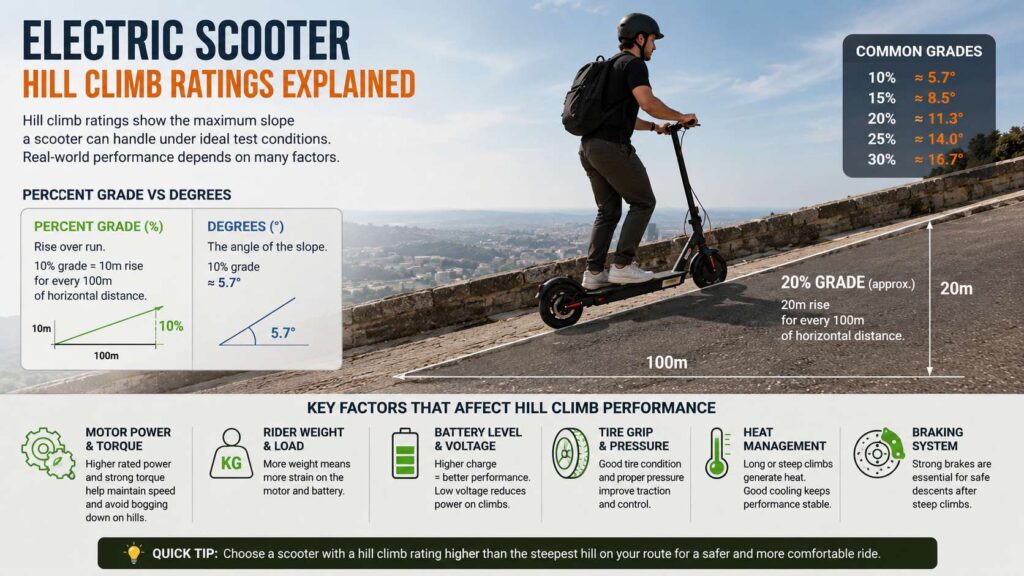
A 20% grade is not a 20-degree hill. A 20% grade means the road rises 20 units for every 100 units of horizontal distance. That equals about 11.3 degrees. So, a 30% grade sounds extreme, but it equals about 16.7 degrees.
That still feels steep on a scooter. Still, it is not the same as a 30-degree ramp.
Here is a simple guide:
- 10% grade: about 5.7 degrees
- 15% grade: about 8.5 degrees
- 20% grade: about 11.3 degrees
- 25% grade: about 14 degrees
- 30% grade: about 16.7 degrees
For most riders, a 10% hill feels noticeable. A 15% hill feels steep. A 20% hill can challenge basic commuter scooters. Once you reach 25%, the scooter needs strong power, good traction, and a healthy battery. At 30%, you are usually looking at high-performance models, not basic city scooters.
Percent Grade vs Degrees: Why the Difference Matters
The best way to understand grade is rise over run.
If a road climbs 10 meters over 100 meters of horizontal distance, the grade is 10%. If it climbs 20 meters over the same distance, the grade is 20%.
This matters because brands, sellers, and reviewers do not always use the same language. One product page may say “20% slope.” Another may say “20-degree incline.” Those are not the same thing.
A 20-degree incline equals about a 36% grade. That is much steeper than a 20% grade. So, check whether the brand uses percent or degrees before comparing two scooters.
In my opinion, percent grade is more useful for buyers. It matches how roads are often described, and it gives a clearer idea of real-world steepness. Degrees can make a scooter sound stronger than it really is, especially if the wording is vague.
Why Official Hill Climb Tests Do Not Always Match Real Riding
Official hill climb ratings come from controlled testing. That is normal, but the test setup matters.
Some manufacturers test with a rider weight around 75 kg. Some test with the battery charged to a certain level. Others test on a short slope, not a long hill. In many cases, the scooter only needs to finish the climb without stopping. It does not need to keep a strong speed all the way up.
That last part matters.
A scooter may “climb” a hill at 6 km/h. Technically, it passed. In real traffic, though, that can feel slow and awkward. You may feel pressure from cyclists, cars, or other riders behind you. You may also lose balance if the scooter crawls and the road surface gets rough.
So, treat the rating as a ceiling, not a comfort zone.
For example, if a scooter claims a 20% max incline, it may feel confident on 10% to 15% hills. It may climb 20% only for a short distance, with a light rider, good battery charge, and warm conditions. That does not make the rating useless. It just means you should leave a safety margin.
Motor Power: Rated Watts vs Peak Watts
Motor power plays a huge role in hill climbing, but wattage can still mislead buyers.
Most scooters list two power numbers:
- Rated power
- Peak power
Rated power is the motor output the scooter can hold for longer periods. Peak power is the short burst the motor can deliver during acceleration or heavy load.
For hills, rated power matters more than many buyers expect. Peak power helps at the start of a climb, but the scooter needs steady output to keep moving. A scooter with 350W rated power and 700W peak power may feel fine on mild hills. A scooter with 450W rated power and 900W peak power usually feels stronger.
Dual-motor scooters go further. They give much better launch power and reduce strain on one motor. Still, they cost more, weigh more, and use more battery on hard climbs.
Wattage does not tell the full story, though. Two scooters with the same motor rating can climb differently. Controller tuning, battery voltage, wheel size, tire grip, motor design, and heat limits all change the result.
A scooter with smooth torque delivery often feels better than one that only has a high peak number on paper.
Torque Is the Part Riders Feel on Hills
Torque is the pulling force that helps the scooter start and keep moving uphill. It is the part you feel when the scooter pushes forward from low speed.
A scooter with weak torque may reach its top speed on flat roads, but struggle once the road rises. It may start strong, then fade. Soon, the motor whines, the speed drops, and the ride feels forced.
That is why hill riders should not shop by top speed alone. A scooter built for 25 km/h on flat roads may still struggle on a steep grade. A stronger scooter may have the same legal top speed, yet climb much better because it has better torque and a stronger electrical system.
Rear-wheel drive can help on climbs too. As your weight shifts slightly backward uphill, the rear tire can get more grip. Front-wheel drive scooters can still work, but they may lose traction more easily on steep, dusty, or wet surfaces.
Rider Weight Changes Everything
Rider weight has a huge effect on electric scooter hill climbing. A scooter tested with a 75 kg rider will not feel the same with a 95 kg rider and a backpack.
That extra load makes the motor work harder. It also increases battery drain and heat. On flat roads, the difference may feel small. On hills, it becomes obvious fast.
This is why heavier riders should buy above the minimum rating they think they need. If your route has 15% hills, do not choose a scooter rated for 15% and expect strong performance. Look for a model rated closer to 20% or 25%, with higher rated power and a good max rider weight.
The same rule applies if you carry cargo. A scooter that feels sharp on flat roads can feel tired on hills once you add a lock, laptop bag, groceries, or delivery backpack.
For a deeper look at this topic, read this guide on how rider weight affects electric scooter range. The same forces that reduce range also make hill climbing harder.
Battery Charge and Voltage Sag on Hills
A scooter climbs best with a healthy, charged battery. As the battery drops, voltage falls under load. Riders often notice this as weaker acceleration and slower hill climbing.
This effect is called voltage sag. It becomes more obvious during long climbs, cold weather, or heavy rider load.
A scooter that climbs a hill well at 90% battery may feel much weaker at 30%. Near the bottom of the battery, some scooters reduce power to protect the battery pack. That is good for battery safety, but it can make the scooter feel underpowered.
For hilly commutes, battery capacity matters too. Hills drain energy fast. A scooter that claims a long range on flat test routes may deliver much less if your route has steep roads.
So, for hills, battery capacity in watt-hours is more useful than the advertised range alone. A larger battery gives the scooter more room to handle load. It also lowers the chance that one long climb will leave you with poor performance for the rest of the ride.
Heat and Overheating: The Hidden Hill Climb Problem
Hill climbing creates heat in the motor, battery, and controller. Short hills may not cause trouble. Long hills can expose weak thermal design fast.
Common hill-related issues include:
- Sudden power loss
- Slower acceleration after a climb
- Warning lights or error codes
- Hot motor casing
- Burning smell in rare cases
- Scooter refusing to climb again until it cools
This is where cheap scooters often fall short. They may list a bold incline rating, but their controller and battery may not handle repeated climbs well.
For daily hill use, I prefer scooters with realistic specs, strong cooling, and proven commuter hardware over scooters that chase big numbers. A scooter that climbs 18% every day without drama is more useful than one that claims 25% but overheats after two hard hills.
Real hill performance also depends on how long the climb lasts. A scooter can look strong on a short test ramp, then struggle on a long mountain road. That is why real-world climbing stories, like the Ampere Nexus climbs 70 hairpins at Kolli Hills, are useful for understanding how sustained climbing can stress a scooter far more than a short urban slope.
Tire Grip and Road Surface Can Beat Motor Power
A strong motor cannot help much if the tire loses grip.
Hill climbing puts extra load on the tire contact patch. Wet pavement, loose gravel, painted road markings, leaves, sand, or worn tires can cause slipping. Small solid tires can feel harsh and nervous on rough uphill roads. Pneumatic tires usually give better grip and comfort.
Tire pressure matters too. Underinflated tires create drag and heat. Overinflated tires reduce grip and comfort. For hills, correct tire pressure is one of the easiest performance fixes.
Wheel size matters as well. Larger 10-inch or 11-inch tires roll better over bumps and broken pavement. Smaller wheels can climb, but they feel less stable on rough steep roads.
For steep city routes, I would pick good pneumatic tires before fancy app features. Grip is not exciting on a spec sheet, but it matters every day.
Brakes Matter as Much as Climbing Power
A scooter that climbs hills must also come back down safely.
Many buyers focus on uphill power and forget downhill braking. That is risky. Long descents heat brakes, increase stopping distance, and put more load on tires.
Look for:
- Front and rear braking where possible
- Disc brakes on faster or heavier scooters
- Regenerative braking as a helper, not the only brake
- Good tire grip
- Stable suspension
- A frame that does not wobble at speed
Regenerative braking can help control speed downhill, but it should not replace a strong mechanical brake. On steep routes, dual braking gives more confidence.
A scooter with poor brakes and strong climbing power feels unbalanced. It can get you up the hill, then make the descent stressful.
What Hill Climb Rating Should You Choose?
The right rating depends on your route, rider weight, and riding style.
Here is a simple buying guide:
- Mostly flat roads: 10% to 15% rating is fine
- Mild city hills: 15% to 20% rating is better
- Regular steep hills: 20% to 25% rating makes more sense
- Long steep climbs: 25% or higher, with strong rated power
- Very steep areas: dual motors are usually the safer choice
For many commuters, a 20% hill climb rating is a good starting point. It gives enough headroom for moderate hills without pushing the scooter too hard.
For heavier riders or hilly cities, I would look closer to 25%. The scooter will not need to work at its limit on every climb. That usually means better comfort, less heat, and longer battery life.
For flat routes, do not overpay for hill power you will not use. High-performance scooters are heavier and harder to carry. They also cost more to maintain.
How to Read Scooter Specs for Hill Climbing
Do not judge a scooter by the incline rating alone. Read the full spec list.
Focus on these details:
- Rated motor power
- Peak motor power
- Battery voltage
- Battery capacity in Wh
- Max rider weight
- Tire type and size
- Drive layout
- Scooter weight
- Brake setup
- Suspension
- Water resistance
- Real-world owner feedback
A scooter with 450W rated power, 900W peak power, a 48V battery, pneumatic tires, and a 120 kg max load will usually climb better than a basic 300W scooter with a small battery.
Still, scooter weight matters. A heavy scooter can have more power, but it also has more mass to move uphill. Good design balances power, battery size, frame weight, and tires.
Common Mistakes Buyers Make
The most common mistake is buying for top speed instead of hill power. Top speed sells scooters, but torque gets you up a hill.
Another mistake is trusting only the max incline number. A 25% claim sounds great, but the scooter may only manage it on a short test slope. It may not feel strong on a long climb with a heavier rider.
Battery size gets ignored too. Hills drain power fast. Small batteries lose punch sooner, and that can turn a good morning ride into a slow ride home.
Some buyers forget about braking. A scooter that climbs steep roads needs safe downhill control. This is not optional.
Tire maintenance gets missed as well. Low tire pressure can make a scooter feel weak. Many riders blame the motor, but the tires are the real problem.
My Honest Opinion on Hill Climb Ratings
Hill climb ratings are useful, but they are not enough on their own. They help you compare scooters, but they do not predict every real ride.
For practical buying, I treat the listed rating as a best-case number. Then I subtract a safety margin. If a scooter claims 20%, I expect it to feel good on 12% to 15% hills. If it claims 25%, I expect better comfort on 15% to 20% hills. For anything steeper, I want more power, more battery, better brakes, and ideally dual motors.
That may sound strict, but it prevents disappointment. A scooter that climbs with spare power feels calmer, safer, and more pleasant. It also works less hard, which helps with heat and battery stress.
For most commuters, the best hill scooter is not the fastest one. It is the scooter that keeps a steady speed, does not overheat, brakes well downhill, and still has enough battery left after the climb.
Final Verdict: Buy for Real Hills, Not Perfect Test Conditions
Electric scooter hill climb ratings explain part of the story. They show what a scooter can do under controlled conditions, but real roads add weight, wind, rough surfaces, heat, low battery, and stop-start traffic.
So, use the hill climb rating as a guide, not a promise.
For flat commutes, a basic rating is enough. For hilly cities, choose a scooter with stronger rated power, good torque, a larger battery, pneumatic tires, and reliable brakes. For steep daily climbs, leave a wide performance margin and consider dual motors.
A scooter that barely meets your route on paper will probably feel weak in real life. A scooter with extra hill capacity will feel easier, safer, and more useful every day.