

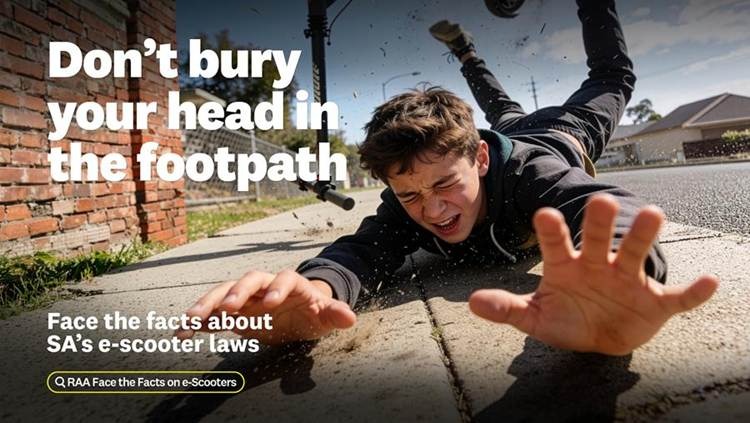
RAA puts e-scooter and e-bike safety back in the spotlight
RAA has launched a new e-scooter and e-bike safety campaign during National Road Safety Week, and the message is clear: riders need to know the rules before they ride.
The campaign, called Don’t bury your head in the footpath. Face the facts, focuses on unsafe riding, speed limits, helmet use, underage riding, phone use, and the risks that come with using e-scooters and e-bikes in public spaces.
National Road Safety Week runs from 17 to 24 May 2026. So, the timing gives RAA a strong chance to remind riders, parents, and everyday road users that small electric vehicles can still cause serious harm.
At first, e-scooters and e-bikes may look simple and harmless. They are quiet, compact, and easy to ride. Still, they share space with pedestrians, cyclists, cars, buses, pets, and children. For that reason, one careless move can turn a quick trip into a serious crash.
RAA’s campaign does not try to scare people away from e-scooters or e-bikes. Instead, it pushes a more practical message. These devices can be useful, but riders must treat them like real transport, not toys.
Why RAA launched the campaign now
E-scooters and e-bikes have become a familiar part of daily travel in South Australia. People use them for short commutes, campus trips, shopping runs, and quick rides around local areas. Because of that, more riders now mix with pedestrians and traffic every day.
That creates a simple problem. More riders mean more chances for mistakes.
RAA says many people still do not know the basic rules. For example, many riders do not understand where they can ride, how fast they can go, or how old they need to be. Parents can also miss key details, especially when a child or teenager asks for an e-scooter or a fast electric bike.
This is where the campaign becomes useful. Instead of only talking about crashes after they happen, it gives people clear reminders before they ride.
The message is especially important for families. A young rider may feel confident after a few minutes on an e-scooter. Still, confidence is not the same as control. Speed, balance, braking distance, footpath hazards, and traffic all matter.
For readers following electric mobility news, this campaign also fits into a wider pattern. Brands, councils, and road safety groups are paying more attention to how people use light electric transport. The topic now goes beyond product ads and new model launches. For example, ScooterPick recently covered how the TVS iQube new ad campaign spotlights electric scooter awareness from a consumer angle, and RAA’s safety push adds another side to the same conversation.
The main e-scooter rules riders need to know
South Australia has clear rules for personal mobility devices, including private e-scooters. These rules matter every time a rider leaves home.
Riders should keep these points in mind:
- Riders must be at least 16 years old to use an e-scooter in public.
- Riders must wear an approved helmet.
- The speed limit is 10 km/h on footpaths, shared paths, beaches, and crossings.
- The speed limit is 25 km/h on bicycle paths, bike lanes, separated paths, and approved roads.
- Riders must give way to pedestrians.
- Riders must not carry passengers.
- Riders must not hold or rest a mobile phone on their body while riding.
- Riders need lights at night or in low light.
- Riders must park without blocking footpaths, ramps, crossings, or access points.
These rules are not hard to understand. Still, many riders break them without thinking. A short ride to the shops can still involve crossings, driveways, blind corners, and crowded paths. So, even a low-speed mistake can hurt someone.
For that reason, the 10 km/h footpath limit matters. A rider moving too fast near pedestrians has less time to stop. A pedestrian stepping out of a shop, driveway, or side path may not hear the scooter coming. Then, both people have almost no time to react.
E-bike safety needs attention too
RAA’s campaign also talks about e-bikes, and that part deserves attention. E-bikes can be excellent for commuting, fitness, and short trips, but not every electric bike sold online is legal or safe for public roads.
In South Australia, legal road-use e-bikes must follow power and pedal-assist rules. A legal e-bike should still work mainly like a bicycle. The motor assists the rider, but it should not turn the bike into an unregistered motorbike.
This matters because some high-powered models look like bicycles at first glance. Yet, they can be heavier, faster, and harder to stop. That creates extra risk for teenagers, new riders, and people who have not used electric assist before.
Before buying an e-bike, families should check a few things:
- Motor power rating
- Pedal-assist setup
- Speed assistance limit
- Brake quality
- Tyre condition
- Frame size
- Helmet fit
- Lights and reflectors
- Local road rules
A cheaper online model can look tempting. Still, a low price does not help much if the bike is too powerful for legal road use or too hard for the rider to control.
Children face serious risks on e-scooters
One of the strongest parts of RAA’s campaign is its focus on children. E-scooters can look fun and easy, so families may underestimate the risk. Yet children can suffer serious injuries, especially head injuries, after a fall or collision.
There are several reasons for this. Children have less road experience. They can misjudge speed, braking distance, and traffic movement. They may also panic near cars, dogs, other riders, or crowded footpaths.
A helmet helps, but only if it fits properly. It should sit level on the head, cover the forehead, and stay firm under the chin. A loose helmet can shift during a crash. A cracked or damaged helmet should be replaced.
Parents should use a simple rule: no helmet, no ride. Also, no legal age, no public e-scooter ride.
That may sound strict, but it gives children a clearer boundary. It also helps parents avoid mixed messages. If a device is only allowed for riders aged 16 and over in public, younger children should not use it on roads, footpaths, or shared paths.
What safer riding looks like in real life
Good e-scooter and e-bike safety starts before the ride. A quick check can prevent a lot of trouble.
Before setting off, riders should ask a few simple questions. Is the helmet fastened? Are the tyres in good condition? Do the brakes work? Is the battery secure? Are the lights working? Is the route suitable?
Then, once the ride starts, behaviour matters most.
Safer riders slow down near pedestrians. They give extra room to children, older people, pets, and anyone using a mobility aid. They do not weave through crowds. They do not ride with headphones blocking traffic noise. They do not check messages while moving.
Good riders also park properly. A scooter left across a footpath can block prams, wheelchairs, delivery workers, and people with vision impairment. So, safe riding does not end when the motor stops.
For e-bike riders, safe riding also means choosing the right speed for the area. A legal e-bike can still feel quick on a narrow path. So, riders should slow down before corners, crossings, parked cars, and driveways.
Why pedestrians are part of the safety message
E-scooter safety is not only about the rider. Pedestrians carry part of the risk too, especially on footpaths and shared paths.
A person walking may not expect a scooter to come from behind. A child may step sideways without warning. A dog may pull across the path. An older pedestrian may need more time to move.
For that reason, riders must treat pedestrians as the priority on footpaths and shared areas. The rider has the faster vehicle, so the rider has more responsibility.
A bell, light, or polite voice warning can help, but speed matters more. If a rider is already moving slowly, there is more time for everyone to react.
This is one of the most practical lessons from the RAA campaign. Safety is not only about knowing the law. It is about riding in a way that gives people around you enough space and time.
National Road Safety Week gives the message more weight
National Road Safety Week asks Australians to think about the real cost of crashes. It covers drivers, passengers, motorcyclists, cyclists, pedestrians, and now, more clearly, people using e-scooters and e-bikes.
That wider context matters. Road safety is not only a police issue or a council issue. It is a daily behaviour issue. Every trip involves choices, such as speed, attention, patience, and respect for others.
RAA’s campaign fits that message well. It reminds people that new transport options still need old-fashioned care. Look where you are going. Wear the right gear. Follow the rules. Slow down near people. Do not ride distracted.
These points sound basic, but they prevent real injuries.
What this means for riders and families
RAA’s e-scooter and e-bike safety campaign gives South Australians a timely reminder: electric mobility is useful, but it needs responsible riders.
For riders, the message is simple. Learn the rules before using an e-scooter or e-bike in public. For parents, the message is even clearer. Check the law, check the device, and do not assume a child can safely handle a fast electric ride.
For councils and communities, the campaign also points to a growing challenge. Footpaths, bike lanes, crossings, and shared spaces now carry more types of movement than before. So, safety education has to keep up.
E-scooters and e-bikes are not going away. In many places, they will become even more common. Because of that, campaigns like this can help riders build better habits early.
RAA’s core message is easy to remember: face the facts before riding. Know the age limit. Wear a helmet. Respect pedestrians. Keep to the speed limit. Put the phone away. Park with care.
Those small choices can make a short ride safer for everyone.