

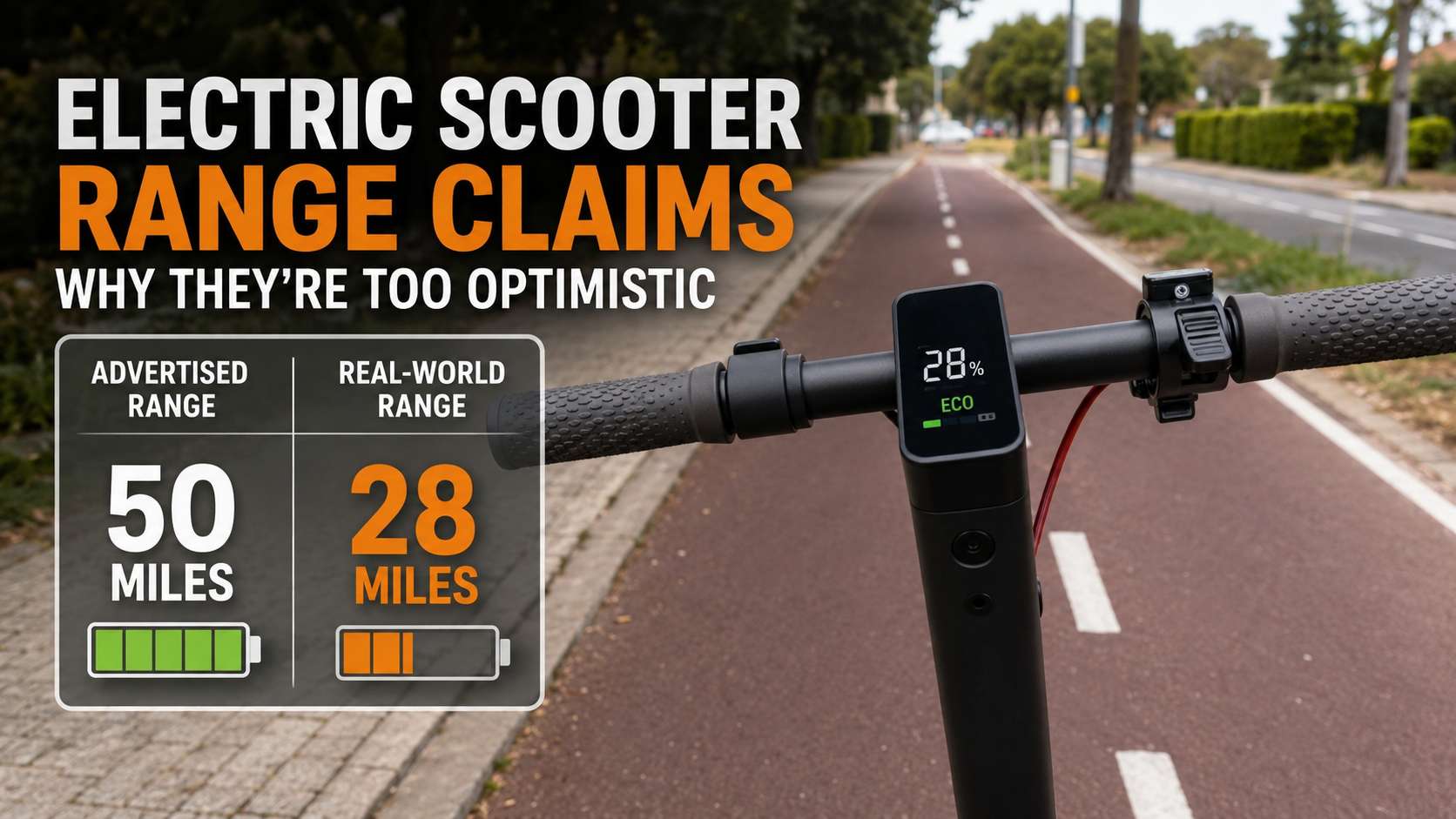
Electric scooter range claims can look very tempting. A model that says “up to 50 miles” or “up to 80 km” sounds ready for long commutes, weekend rides, and almost every short trip in between. Still, many riders find out quickly that the number on the product page is not the number they get on the road.
This does not always mean the brand is trying to mislead buyers. Most range claims come from controlled test conditions. The scooter runs with a light rider, on flat ground, in warm weather, at a steady low speed, and often in Eco mode. That kind of ride gives the battery its best chance to last.
Real riding feels very different. You stop at traffic lights. You climb hills. You carry a backpack. You ride into wind. You speed up, slow down, brake, and start again. So, the battery works harder.
That is why electric scooter range claims are usually too optimistic. They show what the scooter can do in ideal conditions, not what most people get on a normal day.
What Electric Scooter Range Really Means
Electric scooter range means the distance a scooter can travel on one full charge. Brands often describe this number with phrases like “maximum range,” “up to range,” or “tested range.” These words matter more than many shoppers realize.
“Up to 50 miles” does not mean every rider will get 50 miles. It means the scooter reached that number during a specific type of test. In real life, your result can be much lower.
For that reason, it helps to think about range in four ways:
- Advertised range: the best-case number from the brand
- Real-world range: what riders usually get in mixed conditions
- Safe commute range: the distance you can trust without stress
- Low-battery range: the final miles, often with reduced power
The safe commute range matters most. For example, a scooter with a 50-mile claim may not be a smart pick for a 45-mile round trip. You still need room for wind, hills, cold weather, traffic, and battery aging.
A better plan is to use the advertised range as a starting point. Then, reduce it based on your weight, route, speed, weather, and riding style.
Why Range Claims Look So Good on Product Pages
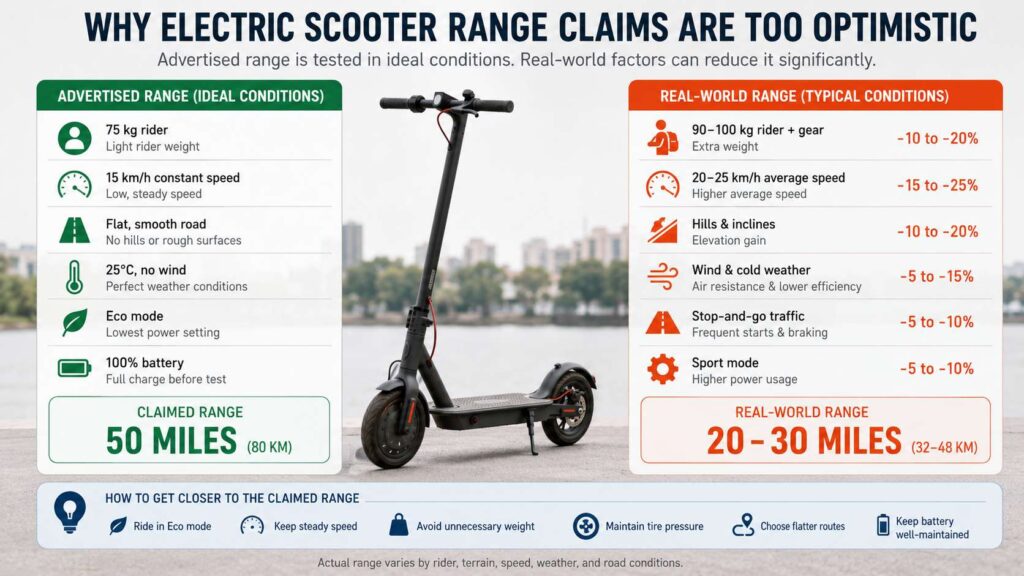
Range claims look strong because test conditions usually favor the scooter. The test often uses a lighter rider, smooth pavement, flat roads, low speed, and mild weather. Also, the scooter usually starts with a full battery and runs without many stops.
That setup is not how most people ride.
In the city, you stop often. Then you accelerate again. Each start uses extra battery power. On longer routes, wind and road surface make a difference too. Even small hills can drain the battery faster than expected.
Speed plays a large role as well. A scooter tested at a slow steady speed will go farther than the same scooter ridden near its top speed. This is one reason a scooter can claim a long range yet feel average on a daily commute.
So, the problem is not only the battery size. The problem is the gap between test riding and real riding.
For a deeper look at how big these gaps can feel in daily use, you can read this guide on the 50-mile scooter range claim.
Rider Weight Has a Big Effect on Range
Rider weight affects electric scooter range right away. The motor has to move the scooter, the rider, and anything the rider carries. A heavier load asks for more power, mostly during acceleration and hill climbs.
Many range tests use a rider around 75 kg. That does not match every buyer. Some riders weigh more. Others carry a laptop bag, a lock, groceries, delivery gear, or rain clothing. All of that weight counts.
As a result, two riders can get very different range from the same scooter. A lighter rider on flat roads may come close to the claim. A heavier rider on hills may get far less.
Before buying, add up your real riding weight:
- Your body weight
- Backpack or laptop bag
- Lock and accessories
- Groceries or work gear
- Rain jacket or winter clothing
- Delivery bag, if used
Next, compare that total with the scooter’s maximum load rating. If you ride close to that limit, expect lower range and slower hill performance.
Speed Can Cut Electric Scooter Range Quickly
Speed is one of the biggest reasons scooter range drops. Riding faster feels better, but it pulls more energy from the battery. Wind resistance also rises as speed increases, so the motor has to work harder.
For example, a scooter may travel far in Eco mode at a steady low speed. Yet the same scooter can lose a large part of that range in sport mode. The battery drains faster, and the motor runs under more load.
This matters for commuters. Many riders do not want to ride slowly for the whole trip. They want to keep up with bike lane traffic, pass slow sections, and arrive on time. That is normal. Still, faster riding means shorter range.
To stretch your battery, try these habits:
- Use Eco mode on longer trips
- Save sport mode for hills or short bursts
- Accelerate gently after stops
- Keep a steady speed when possible
- Avoid riding at top speed for the whole route
Small changes can make a real difference. For instance, riding slightly below top speed often gives you more usable distance without making the trip feel too slow.
Hills, Wind, and Rough Roads Drain the Battery
Flat roads help electric scooters look great in tests. Hills do the opposite.
Climbing a hill forces the motor to fight gravity. A short slope may not hurt much, but repeated climbs can drain the battery fast. This is even more noticeable on scooters with smaller motors or smaller batteries.
Wind can be just as frustrating. A headwind makes the scooter work harder even on flat ground. The ride may feel normal, but the battery percentage drops faster.
Road surface matters too. Smooth asphalt helps the scooter roll easily. Rough pavement, gravel, brick paths, potholes, and cracked streets create more rolling resistance. Then the scooter wastes energy through vibration and repeated speed changes.
That is why a scooter can perform well on one route and poorly on another. One rider may travel on smooth, flat bike paths. Another may deal with traffic, hills, rough pavement, and wind. Same scooter, different result.
Tire Pressure Is Easy to Ignore, but It Matters
Tire pressure has a direct effect on scooter mileage. Underinflated tires create more rolling resistance. The scooter may feel softer, but the motor has to work harder.
This can reduce range and make the ride feel sluggish. It can also raise the chance of flats on pneumatic tires. When tire pressure drops too low, the tire flexes more and heats up more. That wasted energy comes from the battery.
So, check your tire pressure often. Do not rely on a quick squeeze by hand. Small scooter tires can feel firm even when they are below the recommended pressure.
Good tire habits include:
- Check pressure once a week
- Use a proper tire gauge
- Inflate before longer rides
- Check again after cold weather
- Inspect tires for cuts, wear, and slow leaks
Pneumatic tires need more care, but they often ride better than solid tires. Solid tires avoid flats, yet they can feel harsher and less forgiving on rough roads. Either way, tire condition affects how far your scooter can go.
Cold Weather Reduces Battery Range
Cold weather can reduce electric scooter battery range. Lithium batteries work best in mild temperatures. In colder conditions, the scooter may feel weaker, and the battery percentage may fall faster.
This is why a scooter that feels strong in summer can feel less impressive in winter. Acceleration may soften. Top speed may feel harder to hold. Near low battery, the scooter may reduce power sooner.
Storage matters too. If the scooter sits in a cold garage or shed, the battery starts the ride cold. That can lower usable range from the first mile.
To ride smarter in colder weather:
- Start with a full charge
- Store the scooter indoors when safe and allowed
- Expect lower range than in summer
- Keep a larger battery buffer
- Ride smoothly
- Avoid draining the battery to zero
Also, follow the manual for charging temperature. Charging a very cold battery can damage it. Let the scooter warm up first.
Battery Capacity Tells a More Honest Story
Range claims are useful, but battery capacity tells you more. Battery capacity is usually listed in watt-hours, or Wh. A higher Wh number means the scooter stores more energy.
For example, a scooter with a 700 Wh battery has more stored energy than one with a 350 Wh battery. That does not mean it will go exactly twice as far. Motor power, speed, scooter weight, tires, and software still matter. Even so, Wh is one of the best numbers to compare.
Many buyers look only at miles or kilometers. That can lead to mistakes. Two scooters may both claim 40 miles, but one may have a much larger battery. In most cases, the larger battery gives more real-world headroom.
Before you buy, check these specs:
- Battery capacity in Wh
- Motor power
- Maximum rider load
- Scooter weight
- Tire size and type
- Hill grade rating
- Charging time
- Braking setup
- Water resistance rating
Next, compare the scooter to your real route. A small battery can work fine for short flat trips. A larger battery makes more sense for longer commutes, heavier riders, hills, and colder weather.
How to Estimate Real-World Scooter Range
A simple rule works well: do not plan your ride around the full advertised range. Plan around a lower number.
For mixed real-world use, many riders should expect about 60% to 75% of the claimed range. Use the lower end if you ride fast, weigh more than the test rider, climb hills, face cold weather, or stop often. Use the higher end if you ride slowly, stay on flat roads, keep the tires inflated, and travel in warm weather.
Here is a simple example:
- Claimed range: 50 miles
- Realistic range at 75%: 37.5 miles
- Realistic range at 60%: 30 miles
So, a scooter with a 50-mile claim is better suited to a 20 to 30-mile round trip than a 45-mile round trip. That extra buffer protects you from bad weather, detours, battery aging, and unexpected stops.
Before choosing a scooter, ask yourself:
- How long is my full round trip?
- Can I charge at work or school?
- Do I ride in winter?
- Are there hills on my route?
- Do I carry a heavy bag?
- Do I prefer top speed?
- How much battery do I want left at the end?
For a daily commute, try to finish with at least 20% battery left. More buffer is better if your route is long or weather changes often.
If you want a simple buying process, this electric scooter comparison checklist can help you avoid models that look good on paper but do not match your real needs.
How to Get More Range From Your Electric Scooter
You cannot control the brand’s test conditions, but you can improve your own range. The goal is not to ride slowly all the time. The goal is to waste less battery.
Try these practical tips:
- Ride in Eco or standard mode on longer routes
- Accelerate smoothly
- Keep a steady pace
- Avoid hard braking
- Choose flatter streets when possible
- Keep your tires inflated
- Remove extra weight from your bag
- Charge fully before long trips
- Keep the scooter clean and maintained
- Update firmware through the official app when needed
- Store the scooter in a dry, mild place
Route planning helps too. A slightly longer flat route can use less battery than a shorter hilly route. Smooth bike paths can also save energy compared with broken pavement and heavy traffic.
Your riding style matters every day. Fast starts, sudden braking, and constant top-speed riding drain the battery faster. Smooth riding feels calmer and usually gives better range.
Battery Aging Makes Range Drop Over Time
Even with good care, scooter batteries age. After many charge cycles, the battery stores less energy than it did when new. That means a scooter that once handled your commute easily may feel tighter after a year or two.
This is normal for lithium batteries. Heat, deep discharges, long storage at 0%, and heavy use can speed up the process.
To help the battery last longer:
- Avoid storing the scooter empty
- Avoid leaving it fully charged for long periods during storage
- Store it away from extreme heat
- Charge it before the battery gets very low
- Follow the manual for long-term storage
- Use the original charger or an approved replacement
Good care will not make the scooter exceed its design limits. Still, it can help the scooter keep more of its range over time.
Why Better Range Planning Leads to a Better Scooter Choice
Range anxiety is not only a problem for electric cars. Scooter riders feel it too. A low battery far from home can turn a simple ride into a stressful one, mainly if the scooter is heavy or the weather is bad.
That is why honest range planning matters before purchase. A short-distance rider may not need a huge battery. A compact scooter can work well for a short flat commute. Yet a long-distance rider needs more battery, better comfort, stronger brakes, and more power for hills.
Delivery riders, heavier riders, and year-round commuters need even more headroom. For them, a small scooter with a big range claim is usually not enough.
The best electric scooter is not the one with the largest number on the product page. It is the one that fits your route, your weight, your speed, and your weather.
Final Verdict: Treat Range Claims as Best-Case Numbers
Electric scooter range claims are usually too optimistic because they come from ideal test conditions. Warm weather, flat roads, low speeds, light riders, correct tire pressure, and steady riding all help the scooter travel farther.
Real life adds more battery drain. Hills, wind, cold weather, rough pavement, extra weight, faster speeds, and stop-and-go riding all reduce range.
So, use the advertised number as a guide, not a promise. Then reduce it for your own route. For most riders, planning around 60% to 75% of the claimed range gives a safer estimate.
A scooter with more range than you need is usually easier to live with. It gives you room for detours, winter rides, aging batteries, and days when you simply ride harder than usual. In the end, a realistic range estimate helps you buy a scooter that feels dependable, not disappointing.