

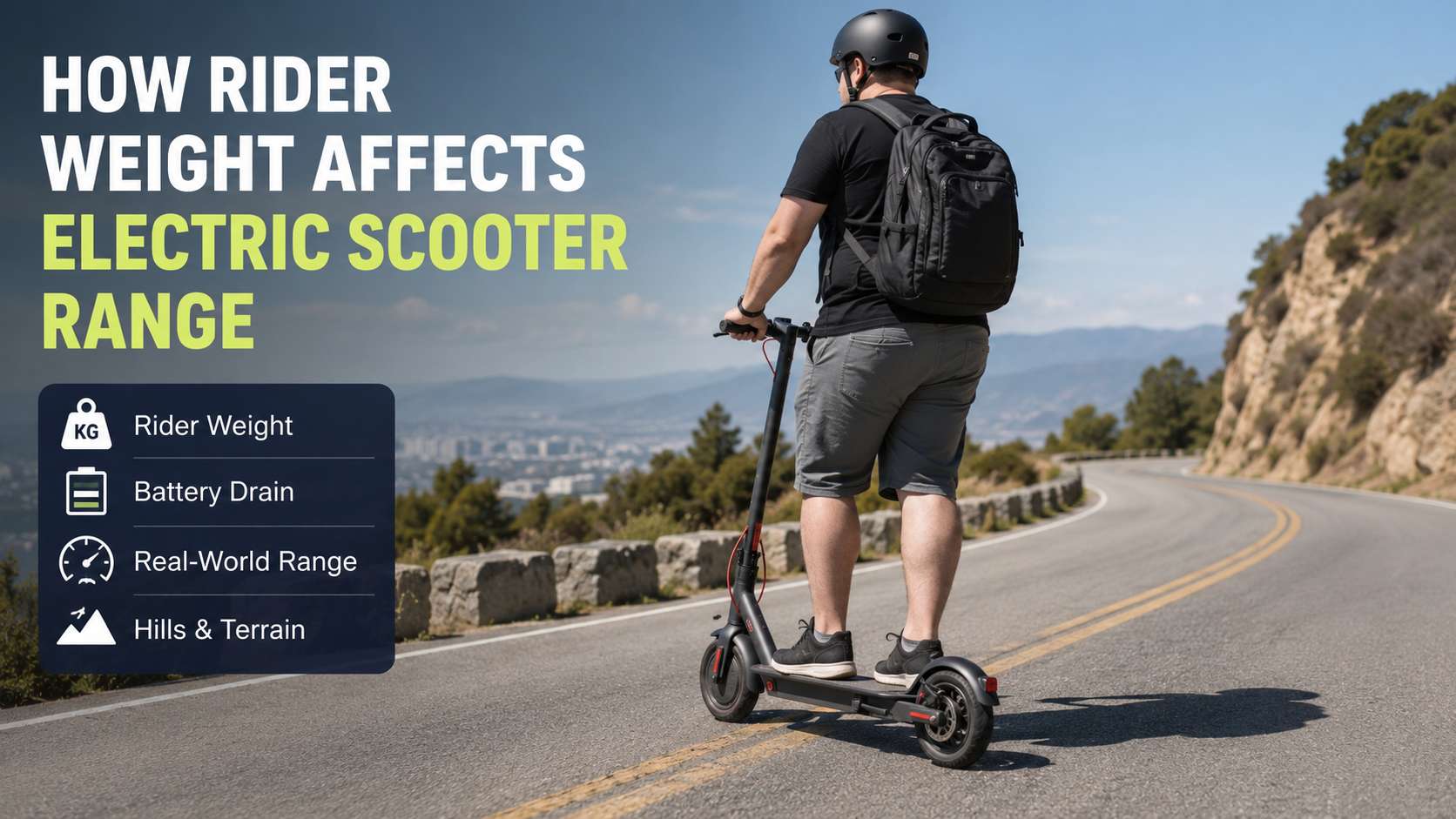
Electric scooter range sounds simple at first. A scooter says it can travel 25 miles, 40 miles, or even more on one charge, so many riders expect to see a number close to that in daily use. Then real life steps in. The rider is heavier than the test load. The road has hills. The tires are a bit soft. The weather is cold. The scooter still rides fine, but the battery drops faster than expected.
Rider weight plays a bigger role than many buyers realize. It affects acceleration, hill climbing, tire wear, braking, motor strain, and battery use. A lighter rider may get close to the advertised range on a calm, flat route. A heavier rider on the same scooter may see a much shorter trip before the battery runs low.
That does not mean heavier riders should avoid electric scooters. It simply means the scooter needs to match the rider, the route, and the real load. Once you understand how weight changes electric scooter range, it becomes much easier to choose the right model and avoid disappointment.
Why Rider Weight Changes Electric Scooter Range
An electric scooter does not only move the rider. It moves the rider, the scooter, and anything else carried on the trip. That total load matters.
For example, a 17 kg scooter with a 70 kg rider has to move 87 kg. The same scooter with a 100 kg rider has to move 117 kg. Add a backpack, lock, laptop, or groceries, and the number goes up again.
More weight means the motor needs more power to get moving. It also needs more power to climb hills and hold speed. So, the battery drains faster. This is most obvious during starts, slopes, and full-speed riding.
Weight also increases rolling resistance. The tires press harder into the road, so the scooter uses more energy to roll forward. On smooth flat pavement, this may not feel dramatic at first. Still, over a full commute, it can cut several miles from the range.
Why Advertised Scooter Range Often Feels Too Optimistic
Most advertised electric scooter range numbers come from controlled tests. These tests usually use a lighter rider or test load, mild temperatures, flat ground, low wind, and steady riding.
That is useful for comparing scooters, but it does not reflect every rider’s day-to-day route. A rider who weighs 95 kg, carries a bag, rides at 25 km/h, stops often, and climbs hills will not get the same range as a lab-style test.
This is where many people feel misled. The scooter may not be bad. The range claim may simply represent a best-case scenario.
A good way to look at advertised range is this: treat it as a comparison number, not a promise. If two scooters claim 25 miles and 40 miles, the 40-mile scooter will usually go farther. Still, neither number may match your real route exactly.
How Much Range Can Heavier Riders Lose?
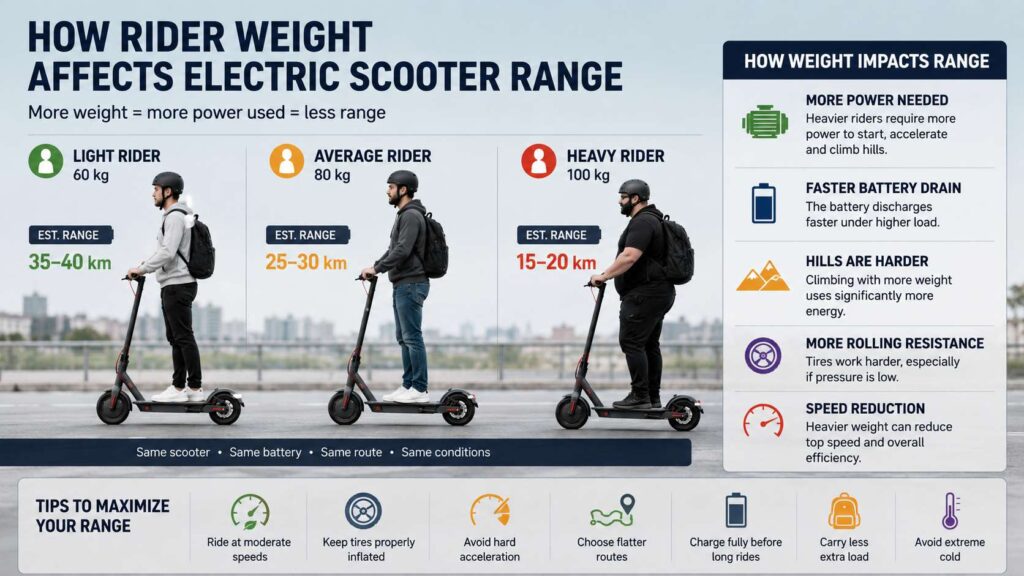
There is no perfect formula for every scooter, but the pattern is clear. More rider weight usually means less range.
A light rider on flat roads may get 70% to 90% of the advertised range. An average rider in mixed city use may get 60% to 80%. A heavier rider on hills, rough roads, or higher speeds may get 45% to 70%. If the rider is close to the scooter’s maximum weight limit, the real range can fall even more.
For example, a scooter advertised for 40 miles may deliver around 22 to 28 miles for a heavier rider in normal city use. Add steep hills or cold weather, and the number may drop again.
This is why it helps to buy more range than you think you need. If your daily round trip is 18 miles, a scooter that claims 20 miles is too close for comfort. A model with a larger battery gives you breathing room.
Total Load Matters, Not Just Body Weight
Many riders only think about body weight, but the scooter feels the full load. That includes:
- Rider weight
- Backpack
- Laptop bag
- Scooter lock
- Helmet and accessories
- Groceries
- Delivery bag
- Rain gear
A 90 kg rider with a 7 kg backpack and a 2 kg lock becomes a 99 kg load. That can push a smaller scooter much closer to its working limit.
This matters most on budget scooters with small batteries and lower-powered motors. A small commuter scooter may feel fine with a light rider on flat streets. With a heavier rider and extra cargo, it may accelerate slowly, lose speed on hills, and drain the battery fast.
Hills Make the Weight Problem Much Bigger
Flat roads are forgiving. Hills are not.
Climbing takes much more energy than cruising on level ground. A heavier rider makes that climb harder for the motor. As the motor works harder, it pulls more current from the battery. Range drops quickly.
This is why two riders can review the same scooter and give very different opinions. A 65 kg rider in a flat city may call the scooter smooth and powerful. A 105 kg rider in a hilly area may call it weak and frustrating. Both riders can be right.
If your route has long slopes or sharp climbs, do not focus only on advertised range. Look at motor power, battery size, peak power, braking, and weight limit. Real hill performance matters just as much as battery capacity.
For a useful comparison, look at how steep climbs can test electric two-wheelers in real conditions. The article on the Ampere Nexus climbing 70 hairpins at Kolli Hills shows why elevation, load, and motor strength matter so much during tough rides.
Speed Can Cut Range Faster Than You Expect
Rider weight matters, but speed can be just as punishing. The faster you ride, the harder the scooter has to work against air resistance. Near top speed, the battery drains much faster.
Now combine high speed with a heavier rider. The scooter uses more energy to accelerate, more energy to hold speed, and more energy on climbs. This can turn a decent range estimate into a short ride.
Eco mode helps a lot. Riding at 15 to 20 km/h can stretch the battery much farther than riding at 25 km/h all the time. The scooter may feel slower, but the range gain is real.
For heavier riders, smoother riding makes a big difference. Hard launches from traffic lights drain the battery quickly. Gentle starts, steady speed, and fewer full-throttle bursts can add useful miles.
Tire Pressure Has a Big Impact on Range
Soft tires are one of the easiest range problems to fix. Low tire pressure creates more rolling resistance. The tire squashes more under load, and the scooter needs extra power to keep moving.
Heavier riders feel this problem faster. A tire that feels acceptable under a lighter rider may feel sluggish under a heavier one. The battery percentage may fall quicker, and the scooter may feel less responsive.
Check tire pressure often. Do not rely on squeezing the tire by hand. Small scooter tires can feel firm even when they are below the correct pressure. Use a proper gauge and follow the pressure range listed by the scooter or tire maker.
Solid tires remove puncture worries, but they often ride harder. They can also feel rough on broken pavement. For many riders, pneumatic tires with correct pressure give better comfort, grip, and range.
Battery Size Matters More for Heavier Riders
A bigger battery gives the scooter more energy to work with. That is useful for every rider, but it matters even more for heavier riders.
Battery capacity is usually listed in watt-hours, or Wh. A scooter with a larger Wh rating stores more energy. In real use, this often means better range, less range anxiety, and more margin for hills or cold weather.
Small batteries can work well for short, flat rides. For heavier riders, they leave less room for real-world losses. A scooter with a small battery may look affordable, but it can feel limited after a few weeks.
If you are a heavier rider, try not to buy a scooter based only on its top speed or folding weight. A slightly heavier scooter with a stronger motor and larger battery can be a much better daily ride.
Maximum Rider Weight Is Not the Same as Real Range
The maximum rider weight tells you the load the scooter is rated to carry. It does not mean the scooter will deliver its best range at that weight.
This is a common mistake. A scooter may list a 120 kg maximum rider weight and a 40-mile range. That does not mean a 120 kg rider will get 40 miles. It usually means the scooter is rated to carry that load under normal use.
Near the weight limit, range can drop hard. Acceleration can feel slower. Hill climbing can suffer. Brakes may wear faster. Tires and folding parts may face more stress too.
A safer rule is to leave some headroom. If your loaded weight is close to the stated limit, look for a stronger scooter. A scooter rated for 120 kg will usually feel better with a 95 kg rider than with a 118 kg rider.
Real Issues Heavier Riders Often Notice
Heavier riders often notice the same range and ride problems:
- The scooter starts slower from traffic lights
- Battery drops quickly during hard acceleration
- Speed falls on hills
- The motor gets warmer on long climbs
- Tires wear faster
- Brakes need more attention
- The ride feels harsher on small solid tires
- Cheap frames may feel less stable
- Range drops sharply in cold weather
- The scooter needs more frequent checks
These issues do not make electric scooters a bad choice. They simply show why matching the scooter to the rider matters.
A stronger scooter with a larger battery, wider deck, better tires, and solid brakes can feel much more relaxed. It will not need to work as hard, so the ride feels safer and more predictable.
How to Choose a Scooter if You Are a Heavier Rider
Start with the real loaded weight, not just body weight. Add your bag, lock, laptop, and anything else you carry often. Then compare that number with the scooter’s maximum rider weight.
Next, look at the battery and motor. A larger battery helps range. A stronger motor helps acceleration and hills. Better brakes help safety. Wider tires and a wider deck help comfort and control.
A good heavier-rider scooter should have:
- A rider weight limit above your real loaded weight
- A battery large enough for your route with spare range
- A motor strong enough for hills
- Good braking, ideally front and rear braking
- Pneumatic tires or quality suspension for comfort
- A wide deck for a stable stance
- Solid frame construction
- Real reviews from riders near your weight
Newer scooter lines often give buyers more choice across range, power, and portability. For example, the Xiaomi Electric Scooter 6 Series in Europe shows how brands now offer several models for different rider needs instead of one basic commuter option.
How to Improve Electric Scooter Range at Any Weight
You cannot remove the effect of rider weight, but you can reduce wasted energy. A few simple habits can make your scooter go farther.
Try these:
- Ride in eco or standard mode on longer trips
- Avoid sudden full-throttle starts
- Keep tire pressure correct
- Charge fully before longer rides
- Avoid storing the scooter in very cold places
- Slow down into headwinds
- Choose flatter routes where possible
- Remove unnecessary cargo
- Check that brakes are not rubbing
- Replace worn tires before they drag or slip
- Keep the scooter clean around the wheels and fenders
The biggest gains usually come from three habits: ride a little slower, keep tires properly inflated, and accelerate smoothly. These changes sound basic, but they work.
A Simple Way to Estimate Real Range Before Buying
Before buying a scooter, take the advertised range and reduce it for real-world use.
Use this simple guide:
- Reduce by 20% for a light rider on flat roads at moderate speed
- Reduce by 30% for mixed city riding
- Reduce by 40% for heavier riders or frequent top-speed riding
- Reduce by 50% for heavier riders near the weight limit, steep hills, or cold weather
Here is a simple example. A scooter claims 40 miles of range. A heavier rider with a hilly route should plan for about 20 to 24 miles. That is far more realistic than expecting the full 40 miles.
If your daily trip is 18 miles, that scooter may work. If your daily trip is 25 miles, it is too close. You would be better off with a larger battery.
This estimate is not perfect, but it helps prevent bad buys. It also gives you a more honest idea of what the scooter will do after the excitement of the first ride wears off.
Final Verdict: Rider Weight Can Make or Break Scooter Range
Rider weight has a clear effect on electric scooter range. It changes how much power the motor needs, how hard the battery works, how the tires roll, and how well the scooter climbs.
Advertised range numbers can help you compare models, but they rarely tell the full story. Real-world range depends on total load, speed, hills, tire pressure, weather, battery size, and riding style.
For heavier riders, the best choice is usually a scooter with extra battery capacity, a stronger motor, good brakes, and a weight rating that leaves room to spare. A cheap scooter with a small battery may still move, but it may not feel good for long rides or hills.
Buy for your real route, not the perfect test route. Keep the tires firm. Ride smoothly. Give the battery some margin. Do that, and your scooter will feel more reliable, more comfortable, and far less stressful on longer rides.