

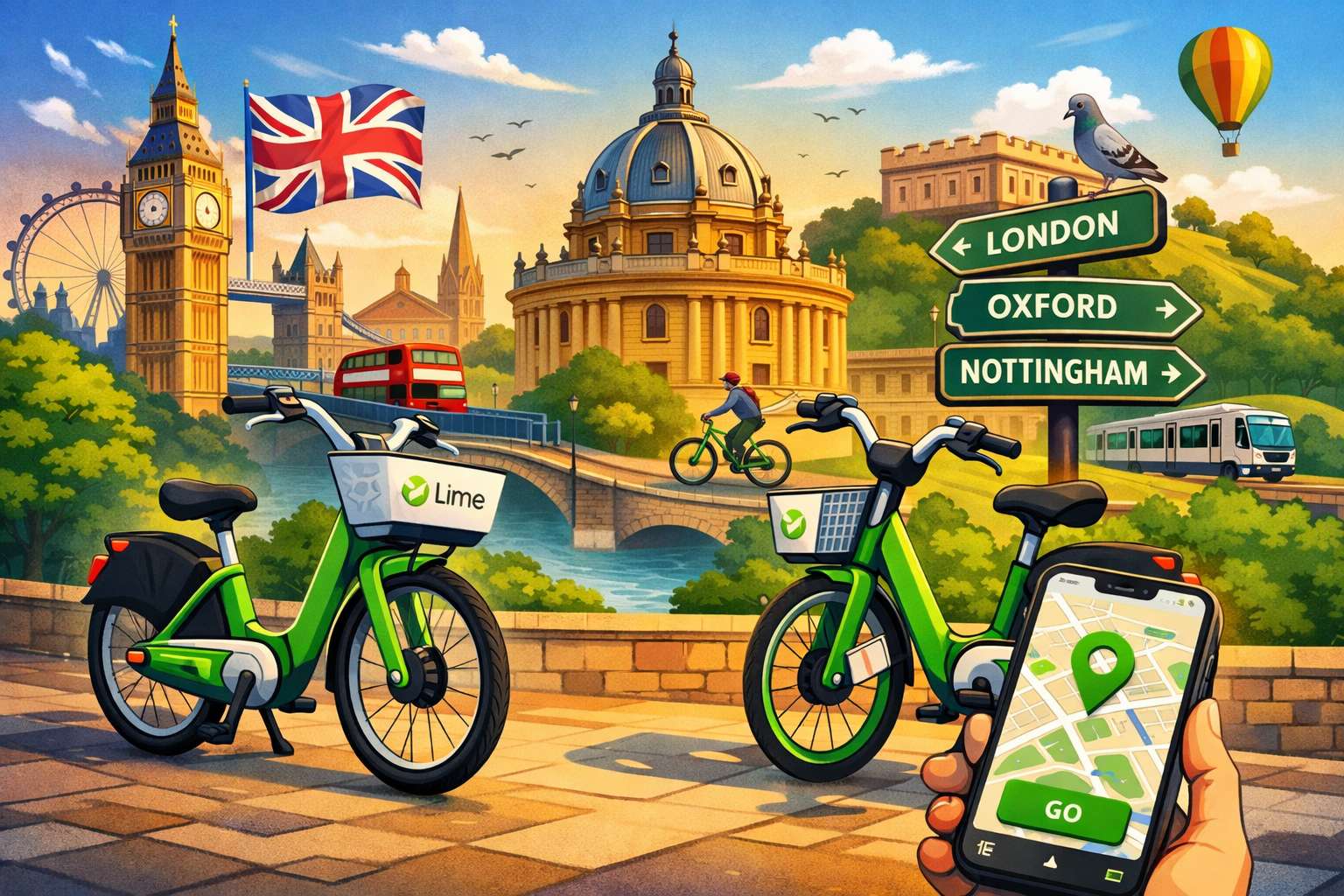
Lime e-bikes are growing across the UK, and the story is getting more interesting. What started as a limited urban mobility option now looks like a bigger part of daily transport in several British cities. Riders searching for Lime bike rental, shared e-bikes, electric bike hire, or dockless bikes in the UK now have more real options than before.
Right now, the clearest confirmed Lime e-bike markets in the UK are London, Milton Keynes, Nottingham, and Oxford. Those cities appear across Lime’s latest official UK pages, and each market shows a slightly different stage of growth. Some are mature and well used. Others still feel newer and are clearly building momentum.
At the same time, Lime has not publicly confirmed a full nationwide 2026 rollout plan for brand-new UK cities. That matters. There is clear evidence of growth in active markets, but there is not yet a full city-by-city launch calendar for every place people may be hoping for. So the better way to frame this story is simple. Lime e-bikes are expanding in the UK, but the next launches will likely depend on local council approval, parking space, and operating rules.
Where Lime e-bikes are available in the UK now
London remains Lime’s biggest and most visible UK market. It is the city most people think of first when they search for Lime bikes in Britain. The network is already large, and Lime has been putting serious effort into making it work better on busy streets.
Milton Keynes is another confirmed market and has become an important part of Lime’s UK footprint. It shows that the company is not focused only on London. Nottingham also has an established Lime e-bike presence, and Oxford stands out as one of the most interesting recent growth stories.
Manchester appears on Lime’s broader UK pages, but the most recent local information has focused on e-scooters in Salford and Manchester. Because of that, I cannot confirm a current Lime e-bike rollout there based on the latest official local page alone.
For riders, that detail matters. A brand can have a presence in a city, but that does not always mean the same vehicle type is live everywhere. So when people search for Lime bikes near me, or ask whether Lime e-bikes have launched in their city, the answer still depends on the local market.
Oxford shows how fast a newer market can grow
Oxford gives one of the best clues about what Lime’s UK expansion can look like in practice. Lime launched its Oxford e-bike service in September 2024 with 100 bikes. In the first 10 days, riders completed more than 3,000 trips. By November 2024, Lime said the system had passed 30,000 trips.
That is a strong early signal. It shows demand can ramp up quickly when a city already has cycling culture, dense travel patterns, and a user base that wants short urban trips without needing a car.
Oxford is also interesting for another reason. Local council material has pointed to the possibility of a much larger Lime fleet in the future. One official discussion referred to Lime suggesting 1,000 hire e-bikes instead of the 100 already in service at the time. That would be a major jump, but it would also need far more parking bays. So while the scale talk is real, it is still not the same as a confirmed launch date for that larger fleet.
London is scaling, not starting over
London is no longer a launch story. It is now a scaling story. Lime has been investing heavily in the city, and much of that effort has gone into infrastructure, parking, and operations.
In early 2025, Lime announced a £20 million London Action Plan. A big part of that plan focused on parking and street management. Lime said it wanted to create at least 2,500 more dedicated e-bike parking spaces across London. Later updates said the company had already funded hundreds of new parking bays, which increased parking capacity significantly. Lime also said it expanded its on-street team to help keep bikes parked correctly and reduce street clutter.
That might sound like background detail, but it is actually one of the biggest factors behind future growth. Shared e-bike systems only work well when cities can manage parking, pavement access, and rebalancing. If those parts go wrong, councils push back and expansion slows down. London shows that Lime understands this, and is trying to fix the hard operational parts while demand keeps rising.
What riders should know before using Lime e-bikes
Using a Lime e-bike is fairly simple. You open the app, find a nearby bike, unlock it, then end the ride in an approved spot. But the local rules matter more than many new riders expect.
In several UK cities, riders must be at least 18 years old. Lime also strongly advises riders to wear a helmet, even where it is not legally required. The riding rules can vary a bit by place, especially when it comes to where you should ride and where you can park.
Oxford is a good example. There, e-bikes can be used on roads, cycle lanes, and shared cycle and footpaths, but not on pavements. Nottingham also has clear parking expectations, and riders are required to leave bikes in designated parking bays shown in the app. Oxford uses mandatory bays too.
Milton Keynes is a little more flexible. There, Lime has said riders may park on the pavement, but only if they do so carefully and do not block people walking, pushing strollers, or using mobility aids.
That means one thing for riders. The bike may be the same, but the parking rule can be very different from city to city. It is worth checking before every first ride in a new place.
If you are also comparing these rules with scooter regulation, this guide to UK private e-scooter laws in 2026 helps explain how the legal picture differs.
Why Lime e-bikes appeal to more than tourists
It is easy to assume shared e-bikes are mainly for visitors, but that is not really the full picture anymore. In many UK cities, they are also useful for commuters, students, and people making short daily trips. They can fill the gap between walking and public transport, especially when someone wants a faster trip without the cost of a taxi or the hassle of parking a car.
Some local schemes also include discounted access for eligible users. That can make shared e-bikes more attractive for regular travel, not just one-off rides on sunny weekends. It also helps city officials make the case that these schemes are part of public mobility, not just a lifestyle extra.
What this means for the next phase of UK expansion
The overall direction is clear. Lime is not treating the UK like a small side market. London is getting major investment. Milton Keynes has already seen heavy use over time. Nottingham remains part of the active network. Oxford has shown strong demand and room to grow.
So yes, Lime e-bikes are expanding across UK cities. The network is broader, and the company is still building. But the next stage will probably look practical, not flashy. Growth will depend on where Lime can add parking, work with councils, and keep streets organized.
For riders, the takeaway is simple. Check the Lime app, watch local council updates, and pay close attention to parking rules in your city. That is usually where the next real signs of expansion show up first.