

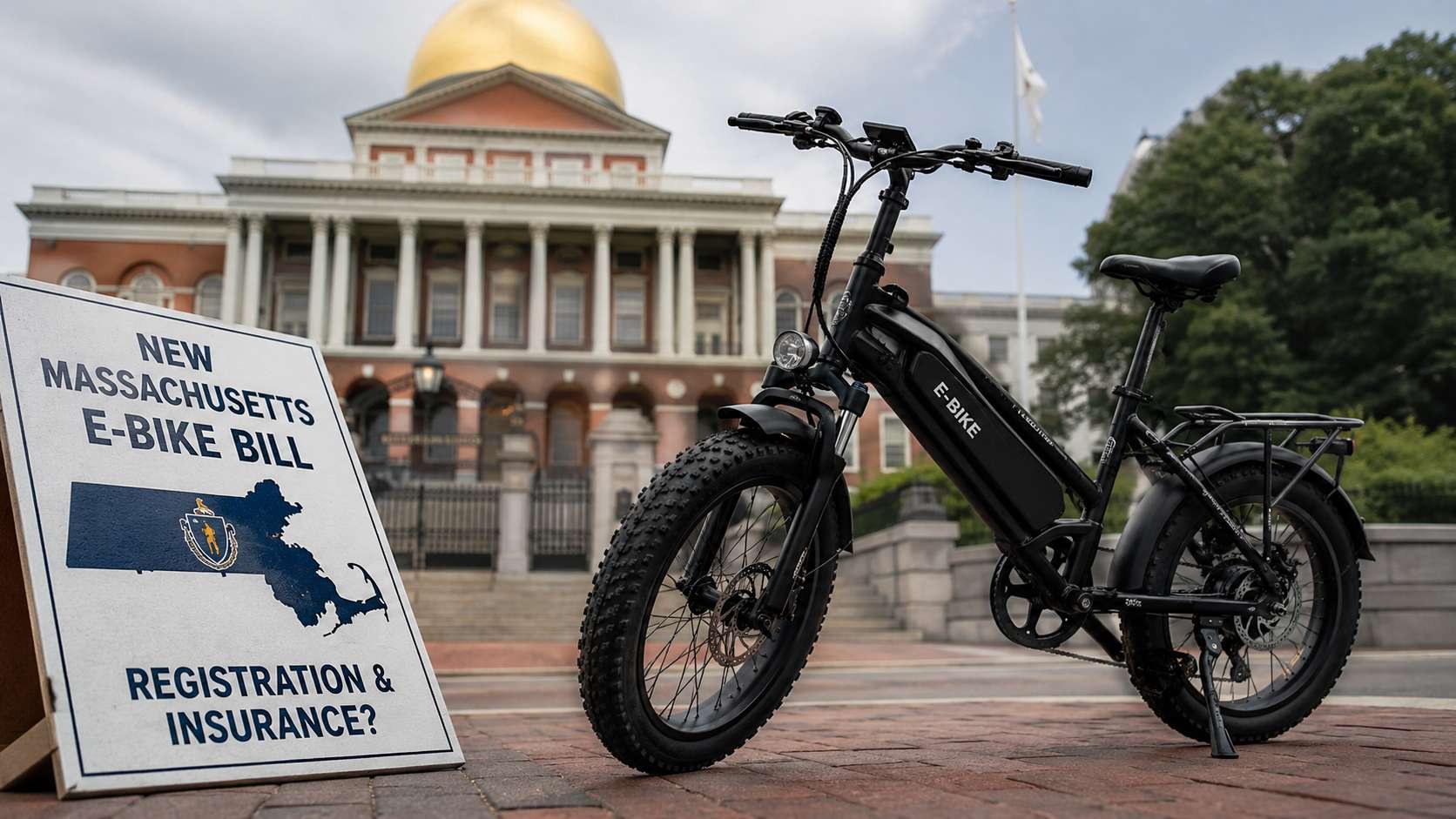
Massachusetts riders may soon see new rules for faster e-bikes, electric scooters, mopeds, and other small electric vehicles. The proposal is called the Ride Safe Act, and it targets the fast-growing gap between regular bicycles and high-speed electric rides.
For many riders, the big question is simple: will Massachusetts require e-bike registration and insurance? The answer depends on the type of vehicle, the motor system, and the top assisted speed.
The bill does not treat every e-bike the same. A slower pedal-assist bike does not create the same road risk as a throttle-powered ride that can reach moped-style speeds. So the bill sorts these vehicles into speed groups and applies stricter rules to faster models.
This matters for commuters, parents, delivery riders, students, and anyone shopping for an electric bike in 2026. It also matters for police and city officials, since many of these vehicles look similar at first glance.
For more background on the proposal, see this related guide on the Massachusetts micromobility bill and 2026 e-bike rules.
Why Massachusetts wants new e-bike rules
E-bikes and electric scooters have become common in cities, suburbs, college towns, and beach communities. Many riders use them for short trips, work commutes, food delivery, and school travel. That growth has created new safety questions.
A basic Class 1 or Class 2 e-bike usually feels close to a regular bicycle. It has pedals, a motor capped at 750 watts, and motor help that stops at 20 mph. A Class 3 e-bike goes faster, with pedal assist up to 28 mph.
Then there are moped-style electric bikes, modified e-bikes, and off-road electric bikes used on public streets. Some can reach 30, 40, or even more miles per hour. At that point, the risk changes. The stopping distance grows. Crash force rises. Pedestrians get less time to react.
So lawmakers want clearer rules. They want riders, sellers, parents, and police to know which devices count as bicycles and which ones need stricter treatment.
How the bill sorts e-bikes by speed
The Ride Safe Act uses a speed-tier system. This is one of the most useful parts of the bill, since it focuses on performance instead of marketing labels.
Speed Tier 0 covers unpowered devices and slower powered devices that top out at 20 mph. This group includes Class 1 and Class 2 e-bikes.
Speed Tier 1 covers powered micromobility devices from 21 mph to 30 mph. This group includes Class 3 e-bikes, which use pedal assist and stop motor help at 28 mph.
Speed Tier 2 covers devices from 31 mph to 40 mph.
Speed Tier 3 covers devices that can go over 40 mph.
That structure makes the rules easier to understand. A rider does not need to guess based only on the product name. Instead, the key detail is the maximum assisted or designed speed.
Registration and insurance may apply to faster rides
The bill adds stronger registration rules for motorized bicycles. It also links registration to proof of liability insurance for those vehicles.
That does not mean every normal e-bike needs plates and insurance. Class 1 and Class 2 e-bikes still sit in the slower category. These are the models most casual riders use for commuting, errands, and bike paths.
Class 3 e-bikes get more attention, since they can assist up to 28 mph. They still use pedal assist, not full throttle power at higher speeds. Even so, they fall into a faster tier than standard e-bikes.
The bill also gives the Registrar of Motor Vehicles power to create detailed rules for micromobility devices. Those rules can cover registration, insurance, decals, licensing, fines, and other safety items.
For riders, the safest reading is this: faster and more powerful devices face more scrutiny. A true Class 1 or Class 2 e-bike remains closer to a bicycle. A moped-style or high-speed electric ride moves closer to motor vehicle treatment.
What younger riders need to know
Age limits form another major part of the proposal. Riders under 16 would not be allowed to buy, rent, lease, or operate Speed Tier 1, Speed Tier 2, or Speed Tier 3 devices.
That rule would affect many teens who use faster e-bikes or scooters near schools, parks, and downtown areas. It would also affect parents who buy electric rides without checking the speed rating first.
Helmet rules change by tier too. Riders age 16 or younger must wear a helmet on Speed Tier 0 devices. Riders and passengers on Speed Tier 1, Speed Tier 2, and Speed Tier 3 devices must wear protective headgear.
The bill also limits passengers. Riders cannot carry more people than the device was built to carry. That rule targets unsafe use on long-seat e-bikes, scooters, and cargo-style electric rides.
Bike lanes and sidewalks face tighter limits
Access rules matter just as much as insurance rules. Many riders want to know where they can use a faster e-bike.
Under the bill, slower Speed Tier 0 devices stay close to bicycle rules. Speed Tier 1 devices get rights and duties tied to electric bicycles, but local rules can still shape where riders can go.
Speed Tier 2 and Speed Tier 3 devices face tighter limits. These faster vehicles would be barred from sidewalks, bike lanes, bike paths, bike routes, separated micromobility lanes, and shared-use paths.
That change could have a real effect in busy areas. A high-speed electric ride in a narrow bike lane creates more risk for cyclists and pedestrians. It also creates confusion for drivers, since some devices move much faster than a normal bike.
For daily riders, this means one detail matters before every trip: know the vehicle’s speed tier. The label on the box is not enough.
Modified e-bikes face closer review
The bill also targets aftermarket changes. Some riders add stronger batteries, new controllers, throttle kits, or software changes that raise the top speed. Those upgrades can turn a normal e-bike into a much faster vehicle.
Under the proposal, riders cannot make changes that raise the designed speed, power, or passenger capacity, except where future rules allow it.
That matters for online buyers. A cheap upgrade kit can look harmless, but it may change the legal status of the ride. It may also affect insurance, crash liability, and where the vehicle can be used.
So buyers should check three details before purchase: motor wattage, assisted speed, and throttle behavior. A Class 1 e-bike uses pedal assist up to 20 mph. A Class 2 e-bike can use throttle assistance up to 20 mph. A Class 3 e-bike uses pedal assist up to 28 mph.
A device that exceeds those limits may fall outside the normal e-bike category.
Battery and equipment standards get stricter
The Ride Safe Act also focuses on product safety. It sets standards for batteries, electrical systems, brakes, lights, and warning devices.
Battery safety has become a serious concern in many cities. Poorly made lithium-ion batteries can overheat, fail, or catch fire. Stronger standards help reduce that risk.
The bill calls for recognized electrical safety standards for powered micromobility devices and e-bikes. It also requires lights, brakes, and audible warning equipment for slower tiers. Faster tiers face rules closer to motor vehicle equipment standards.
For shoppers, this creates a useful checklist. Look for clear battery certification. Check the brake type. Check the lights. Check the rated top speed. A low price does not help much if the product fails basic safety checks.
What Massachusetts riders should do now
The bill is not final law yet. Lawmakers can still change the text before any final vote. Still, riders should prepare now, mainly if they own or plan to buy a faster electric bike.
Start with the speed rating. Then check if the device has pedals, throttle control, or pedal assist only. Next, check the motor rating and the manufacturer’s stated class.
Parents should review any e-bike used by a teen. A bike that looks like a bicycle may still fall into a faster tier. That can affect helmet rules, age limits, and where the rider can legally go.
Commuters should pay attention too. A faster e-bike may save time, but it may also face more limits in bike lanes and shared paths.
Sellers should make product labels clear. Buyers need to see the class, wattage, top assisted speed, battery rating, and intended street use before purchase.
The bottom line for e-bike owners
Massachusetts wants clearer rules for a fast-changing mix of e-bikes, scooters, mopeds, and modified electric rides. The Ride Safe Act does not treat every device the same. It draws a sharper line between slower bicycle-style e-bikes and faster machines that act more like mopeds.
For most riders, the key details are speed, class, throttle design, and motor power. Class 1 and Class 2 e-bikes remain the simplest category. Class 3 e-bikes receive more attention. Faster electric rides face the strongest rules.
For now, riders should watch the bill closely and check their device before assuming it counts as a regular e-bike. The rules may affect registration, insurance, helmets, age limits, bike lane access, and future enforcement across Massachusetts.