

What Peak Power vs Rated Power Means on Electric Scooters
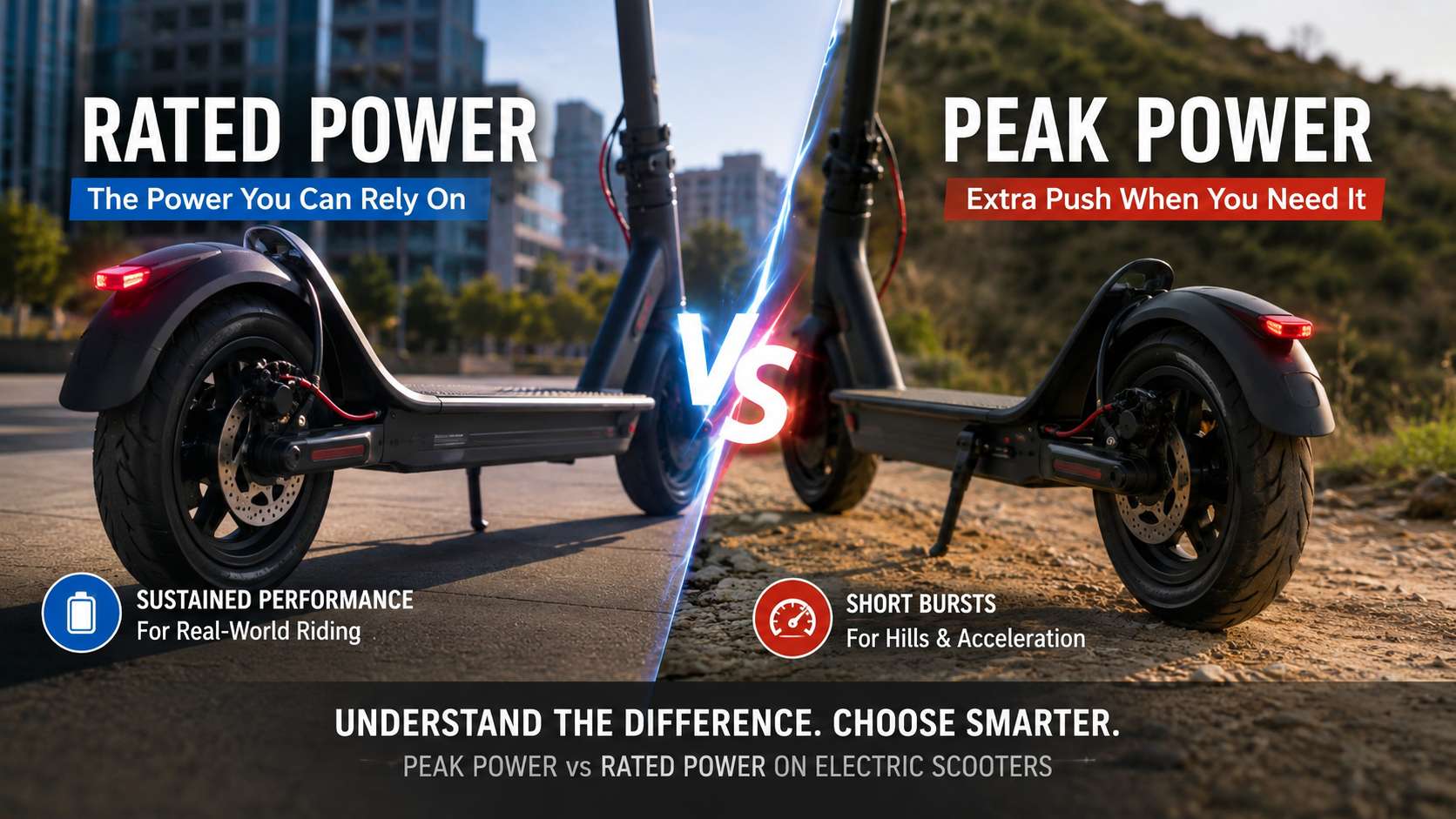
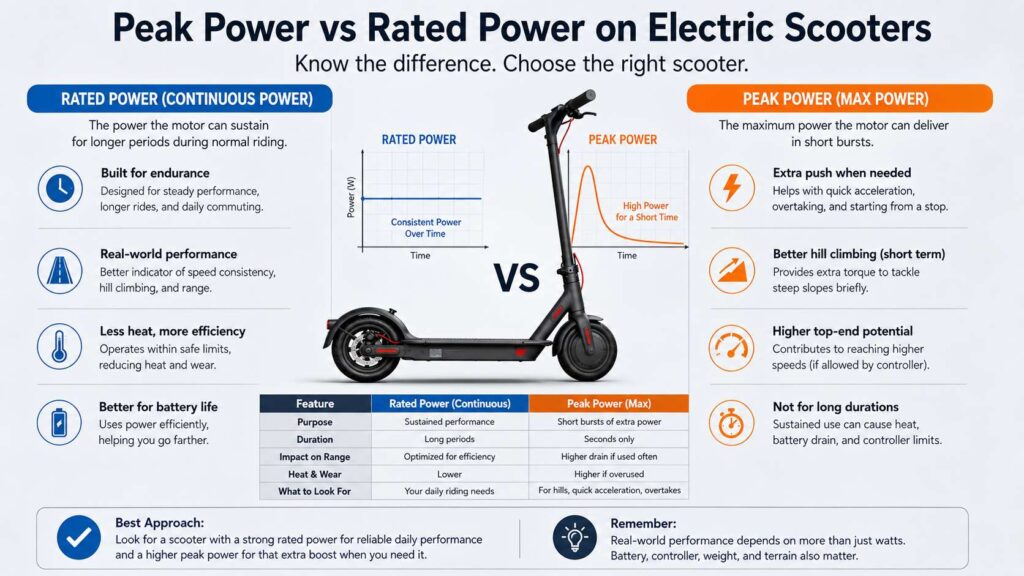
Peak power vs rated power on electric scooters sounds technical, but the idea is simple. Rated power tells you what the motor can deliver during normal riding. Peak power tells you the short burst the motor can push out during harder moments.
So, rated power is the number you should trust first. It gives a better picture of how the scooter will behave on your daily route. For example, a 350W rated motor can work well for flat city streets. A 500W rated motor gives stronger pull from a stop and handles hills with more confidence.
Peak power, in contrast, is the bigger number that often appears in product titles. A scooter may list 900W max power, yet the rated motor power may be 450W. That does not mean the brand lied. It means the scooter can hit 900W for short bursts, not for the full ride.
This is where many buyers get caught. They see a large watt number and expect strong performance all the time. Then, after a few rides, the scooter feels weaker on long hills or when the battery drops below half. In practice, the rated power gives a much clearer idea of daily performance.
Rated Power Is the Number That Matters Most
Rated power is often called nominal power or continuous motor power. It shows the power level the motor can handle for longer periods without too much heat or stress.
For most riders, this number matters more than peak power. It affects how the scooter performs during normal cruising, longer climbs, and stop-start riding. It also tells you how much real strength the motor has once the short launch burst is over.
For example, a scooter with 350W rated power and 700W peak power can feel fine on flat roads. It may even feel quick during the first few meters. Still, it will not ride like a scooter with 500W rated power and 1000W peak power. The second scooter has more steady output, so it can hold speed better under load.
This matters even more for heavier riders. A rider who weighs 60 kg may feel happy on a 350W scooter. A rider closer to 95 kg may find the same scooter slow on climbs. So, rider weight, hills, wind, road surface, and battery size all change the real result.
Peak Power Gives You Short Bursts of Extra Push
Peak power is not useless. In fact, it can make a scooter feel more fun and more responsive. You feel it most during takeoff, short hills, and quick acceleration.
For example, peak power helps when you leave a traffic light. It helps when you climb a short bridge. It also helps when the scooter needs to move a heavier rider from a standstill.
Still, peak power does not last for long. The motor, battery, and controller all have limits. After a short burst, the scooter drops back toward its rated output. That is normal. It protects the electrical system and reduces heat.
So, peak power is best viewed as a short boost, not the scooter’s real working strength. A high peak number can feel nice, but it should not be the only reason you buy a scooter.
Why Scooter Brands Promote Peak Power
Brands often promote peak power because it looks impressive. A product title that says 1000W motor sounds stronger than one that says 500W rated power. Yet both numbers may describe the same scooter.
For this reason, you need to read the full specification list. Look for phrases such as rated power, nominal power, continuous power, max power, and peak power. If the page only shows the biggest number, read more carefully.
Some brands present both figures clearly. That is the best case. For example, a listing may show 500W rated power and 1000W max power. That gives you a fairer idea of how the scooter works. The motor can run near 500W in normal use and push higher for short moments.
A weaker product page may only say “1000W motor.” That sounds powerful, but it hides the more useful detail. In that case, the scooter may use a 500W rated motor, or it may use something lower. If the rated power is missing, treat the listing with caution.
How Motor Power Affects Hill Climbing
Hill climbing is one of the clearest places where rated power matters. Peak power helps at the start of the hill, but rated power helps the scooter keep climbing.
A 350W rated motor can handle gentle slopes with a lighter rider. On steeper hills, though, it may slow down fast. A 500W rated motor gives better results for mixed city routes. A 650W or higher rated motor gives more confidence on longer climbs, mainly for heavier riders.
At the same time, watts are not the full story. Battery voltage, controller current, tire pressure, scooter weight, rider weight, and hill grade all matter. A scooter with poor battery support may still struggle, even if the peak power number looks high.
If hills are part of your daily ride, read this related guide on electric scooter hill climb ratings explained. It helps connect motor power with slope ratings, rider weight, and real climbing performance.
My honest view is simple: do not buy a scooter for hills based only on peak watts. For regular slopes, start with at least 450W rated power. For steeper routes or heavier riders, 500W rated power or higher is the safer choice.
How Power Affects Acceleration
Acceleration depends on peak power, rated power, controller tuning, and scooter weight. A scooter with a strong peak output usually feels quicker from a stop. So, if you ride in busy traffic, that extra push can feel useful.
Yet stronger acceleration is not always better. Some scooters launch too sharply in sport mode. That can feel fun on an empty road, but it can feel uncomfortable near pedestrians, curbs, or wet surfaces.
For daily commuting, smooth acceleration often feels better than raw punch. A scooter that pulls away in a controlled way gives you more confidence. It also feels easier to ride in bike lanes and crowded areas.
So, acceleration is not only about the highest watt number. The best scooters balance power with control. They feel quick enough without making every start feel jumpy.
How Power Affects Range
A stronger motor can drain the battery faster. So, more power does not always mean a better scooter. It depends on how much battery capacity the scooter has and how you ride it.
For range, battery capacity in watt-hours matters a lot. A scooter with a 608Wh battery stores more energy than one with a 365Wh battery. If both scooters use the same riding speed and similar tires, the larger battery usually gives more range.
Still, riding style changes everything. Fast starts, sport mode, hills, low tire pressure, cold weather, and heavier rider weight can all reduce range. In many cases, real range is much lower than the advertised number.
This is why you should compare motor power and battery size together. A powerful motor with a small battery may feel exciting, but it may run out of charge too soon. A moderate motor with a larger battery can be a better commuter choice.
500W vs 1000W Scooters: Why the Label Can Mislead You
Many buyers compare 500W vs 1000W electric scooters and assume the 1000W model is twice as strong. That can be true in some cases, but not always.
The key question is this: are those rated watts or peak watts?
A scooter sold as 1000W may have 1000W peak power and 500W rated power. Another scooter may have 1000W rated power and much higher peak output. Those two scooters will feel very different.
So, before you compare scooters by watts, check what the number means. If you want a deeper buying comparison, read this guide on 500W vs 1000W electric scooters. It covers real-world differences in speed, hills, torque, range, and rider needs.
In practice, a 500W rated scooter can be enough for many commuters. A true 1000W rated scooter moves into a stronger class. It may climb better and accelerate harder, but it usually weighs more, costs more, and uses more battery.
Heat, Power Limits, and Long-Term Wear
Electric scooter motors create heat under load. The controller and battery heat up too. For that reason, scooters cannot hold peak power forever.
During a long hill climb, the scooter may reduce power to protect itself. Riders often call this power throttling. It can feel annoying, but it helps prevent damage.
Heat problems show up more often on cheaper scooters with big advertised peak power and weaker electrical parts. They may feel strong for a few seconds, then lose strength on longer climbs. In hot weather, the drop can feel even worse.
This is why build quality matters. A clear spec sheet, good battery system, proper charger, quality wiring, and strong controller all matter more than a huge watt number in the title.
If a scooter hides the rated power, battery capacity, and safety details, that is a red flag. Big numbers alone do not make a safe or durable scooter.
Single Motor vs Dual Motor Power
Single-motor scooters are common for commuters. They are lighter, cheaper, and easier to maintain. For flat roads and moderate hills, a strong single motor is often enough.
Dual-motor scooters use one motor in each wheel. They offer stronger acceleration and better hill climbing. They can also help with traction under heavy load. At the same time, they cost more and drain the battery faster.
Power ratings can get confusing with dual motors. Some brands list total system power. Others list power per motor. For example, “dual 500W motors” often means 1000W rated power total. A vague “1000W scooter” may mean something else.
So, read carefully. Check whether the power number is per motor, total rated power, or total peak power.
What Power Level Should You Choose?
The right motor power depends on your route, weight, speed needs, and local rules. Still, these ranges help:
- 250W to 350W rated power: best for flat roads, short trips, and lighter riders
- 350W to 500W rated power: good for most adult commuters
- 450W to 650W rated power: better for mixed routes and regular hills
- 500W or higher rated power: better for heavier riders
- 650W+ rated power or dual motors: best for steep hills and stronger performance
For most people, the sweet spot is around 450W to 500W rated power. It gives enough pull for daily riding without making the scooter too heavy or too expensive.
Still, if your route has long hills, do not cheap out on power. A weak scooter can turn a simple commute into a slow and frustrating ride.
Legal Limits Still Matter
Motor power is not only a performance detail. It can affect road legality too.
Many regions limit speed, motor power, or both. Some rules focus on rated continuous power instead of peak output. So, a scooter with a high peak figure may still meet local rules if the rated power and speed limit fit the law.
Check your local rules before buying. Look at speed limits, motor limits, age rules, insurance needs, lighting rules, helmet rules, and where scooters can ride.
A scooter that works legally in one country may not meet the rules in another. So, never judge legality from the peak power number alone.
Common Problems Riders Notice After Buying
Many riders only understand motor power after the first week of use. The scooter may feel strong at full battery, then weaker after the charge drops. That happens because voltage falls as the battery drains.
Another common issue is poor hill performance. A scooter with a large peak number may still slow down if the rated power is low. This gets worse with heavier riders, long hills, low tire pressure, or cold weather.
Some riders also notice heat throttling. The scooter pulls well at first, then reduces power during a long climb. That can feel disappointing, but it means the scooter is protecting the motor and controller.
There is one more issue: braking. More power needs better brakes. A fast scooter with weak brakes does not feel safe. So, if you choose a stronger motor, pay close attention to braking, tire grip, and suspension too.
How to Read a Scooter Spec Sheet Like a Smarter Buyer
Start with the rated motor power. Then check the peak power. After that, check the battery capacity in Wh.
Next, look at rider weight limit, hill grade, tire size, brake type, suspension, scooter weight, and IP rating. These details tell you more than a single watt number.
A good spec sheet should make these points clear:
- Rated motor power
- Peak or max motor power
- Battery capacity
- Battery voltage
- Claimed range
- Test conditions for range
- Max rider weight
- Hill climbing rating
- Brake system
- Tire size and tire type
- Scooter weight
- Water resistance rating
- Warranty details
If several key specs are missing, be careful. A trustworthy product page should not hide the basics.
Final Verdict: Rated Power Tells the Real Story
Peak power vs rated power on electric scooters comes down to one simple idea. Peak power tells you the short burst. Rated power tells you the real working strength.
Peak power helps with takeoff, quick acceleration, and short hills. Rated power matters more for daily rides, longer climbs, heavier riders, and steady performance.
So, do not buy only by the biggest number in the title. A clear 500W rated motor with 1000W peak power tells a better story than a vague “1000W motor” claim. The first spec gives context. The second one leaves too much out.
For most riders, a balanced scooter beats a scooter that only looks powerful on paper. Look for the right rated power, enough battery capacity, good brakes, decent tires, and clear safety details. That mix gives a smoother ride, better control, and fewer surprises after purchase.