

Neenah moves toward clearer e-bike and scooter rules
Neenah is preparing a new local ordinance for e-bikes and electric scooters, and the city seems focused on three main goals: safer riding, better public education, and stronger helmet habits for young riders.
The draft ordinance would update city rules for bicycles, electric bicycles, and electric scooters. That matters, since more people now use small electric vehicles for short trips, school rides, errands, and downtown travel. They are no longer rare on local streets and trails.
For many residents, this change will feel practical. E-bikes and scooters can reduce car trips, lower fuel use, and make short-distance travel easier. At the same time, they create new safety questions for sidewalks, trails, intersections, and busy downtown blocks. That is why cities like Neenah are trying to set clearer rules before problems grow.
The proposal does not appear to attack e-bike or scooter use. Instead, it tries to draw a cleaner line between safe riding and risky behavior.
Downtown walk zones would be a key change
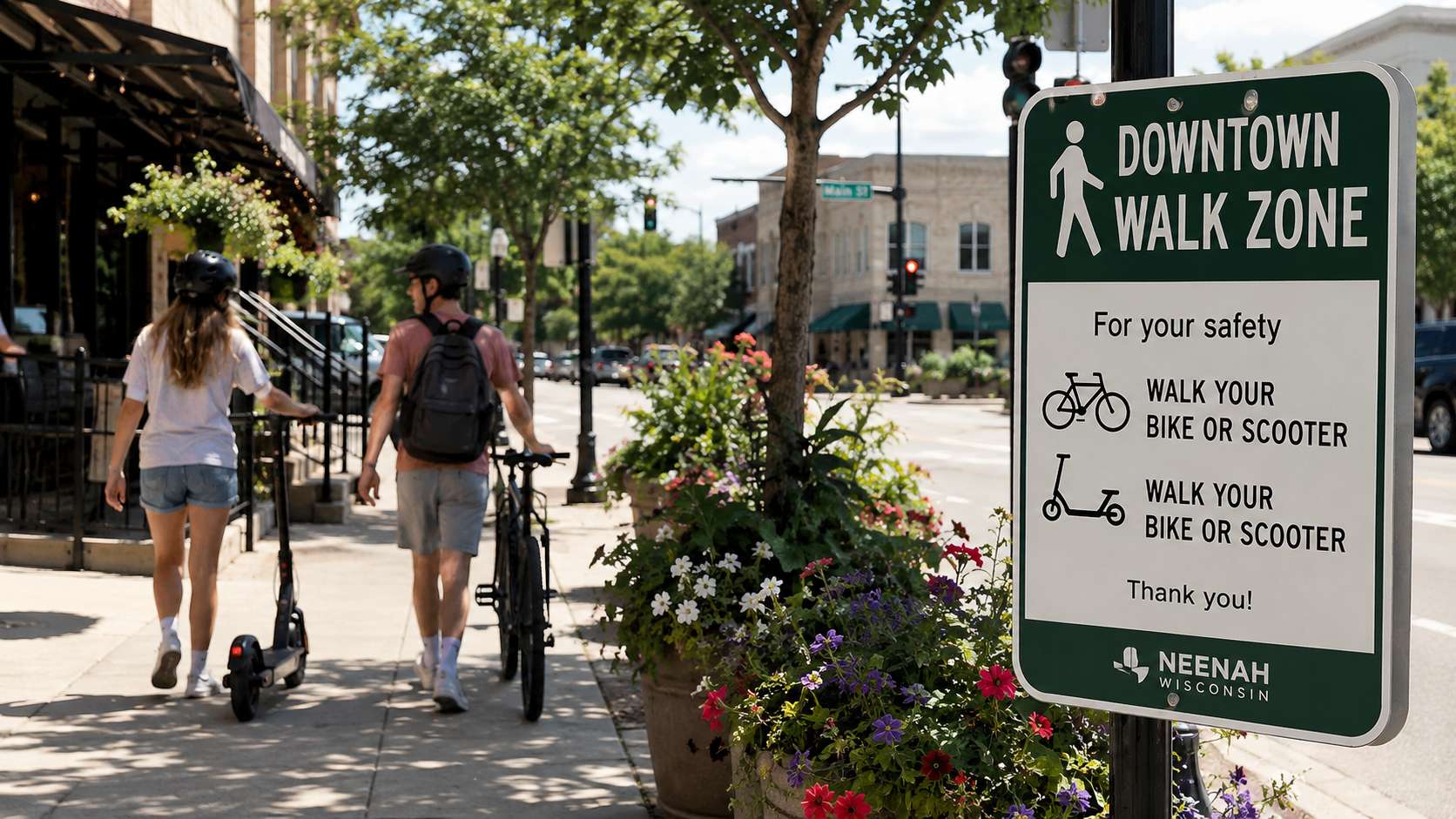
One of the biggest parts of the proposed Neenah e-bike and e-scooter ordinance is the downtown walk-zone rule.
Under the draft, riders would need to get off and walk their e-bike or scooter along Main Street and Wisconsin Avenue from W. Doty Avenue to S. Commercial Street. The same rule would apply in any other location where signs tell riders to walk their device.
This would affect busy pedestrian areas first. Downtown sidewalks often have shoppers, restaurant guests, children, workers, and older pedestrians. A scooter or e-bike moving too fast through that space can create real tension, even if the rider does not mean to cause a problem.
So the city’s idea is simple: ride where riding fits, then walk where foot traffic is heavier.
The draft would also restrict e-bikes and scooters on public sidewalks, city-owned parking ramps, and any road, trail, path, or city property where posted signs limit or ban them. That means riders will need to pay closer attention to signs, not just assume every sidewalk or trail is open.
Riders would still have places to ride
The proposal does not mean e-bikes and scooters disappear from Neenah streets. Riders would still be allowed to use bike lanes, bike paths, trails, and other areas meant for bicycle use, as long as signs do not say otherwise.
On two-way streets, riders would need to stay as close as practical to the right curb or road edge. They could move left to pass, avoid hazards, or prepare for a left turn. On one-way streets, riders could use either side where practical.
For everyday riders, the rule set is easy to understand:
- Use bike lanes and paths where they are available.
- Watch for signs.
- Walk the device in marked downtown walk zones.
- Do not ride on sidewalks where the city bans it.
- Slow down near people, driveways, corners, and crossings.
- Do not race, tow people, cling to vehicles, or perform stunts in public spaces.
That last part matters. Many local concerns around e-bikes and scooters are not about careful adults riding to work. They are about reckless riding, sudden passing, groups blocking paths, and riders moving too fast around pedestrians.
Helmet rules would focus on young riders
The draft ordinance would place a stronger helmet rule on riders under 16.
Under the proposal, a person younger than 16 would need to wear a properly fitted and fastened helmet while operating or riding on an e-bike or scooter in public areas controlled by the city. That includes public roads, sidewalks, bike paths, trails, bicycle ways, and similar public rights-of-way.
The helmet language would also cover public skate parks for bicycles, unicycles, skateboards, scooters, in-line skates, and roller skates.
Parents and guardians would have a role too. The draft says a parent or guardian could not knowingly allow a child to break the helmet rule. A violation could bring a forfeiture of up to $50, though the court could waive it if the person later shows that a proper helmet was obtained.
For families, this is probably the part of the ordinance that will get the most attention. Some parents will welcome it. Others may wonder how it will be enforced. The draft points toward education and awareness, so the city may use warnings and outreach before strict ticketing becomes common.
Education may matter as much as enforcement
Neenah’s plan appears to lean on education, not only penalties. That is a smart move, since many riders are still confused about e-bike and scooter rules.
Some people do not know where they can ride. Some parents do not know that faster e-bike classes can come with age rules. Some teens treat e-scooters like toys, even though they move fast enough to cause serious injuries.
Clear public education can help. The city, schools, police, and local bike shops can all play a part.
Useful education could include:
- Simple signs in downtown walk zones.
- School reminders about helmet use.
- Handouts that explain where e-scooters can ride.
- Social media posts before summer riding season.
- Police warnings for first-time minor violations.
- Clear examples of reckless riding that can lead to citations.
This kind of outreach helps riders understand the rules before they break them. It also helps drivers and pedestrians know what to expect.
Why this ordinance matters for Neenah
E-bikes and electric scooters are part of a larger shift in short-distance transportation. People want cheaper, easier ways to move around town without taking a car for every small trip.
That shift can be good for traffic, parking, and the environment. A small electric scooter or e-bike uses far less space than a car. It can also make short trips cleaner and simpler. For a deeper look at how scooters compare with e-bikes and cars, read this guide on electric scooter environmental impact.
Still, local rules need to catch up. A busy downtown sidewalk is not the same as a bike path. A child riding near traffic faces different risks than an adult commuter. A quiet trail can change fast once faster electric vehicles become common.
That is why Neenah’s draft ordinance is not just about banning bad behavior. It is about making e-bike and scooter use easier to manage for everyone.
Fox Cities riders need clear and consistent rules
Neenah is part of a wider Fox Cities conversation about electric mobility. Nearby communities have been looking at e-bike and scooter rules too, especially on shared routes and trails.
Consistency matters. A rider should not need a legal guide just to move from Neenah into Menasha or Fox Crossing. Clearer local rules can help riders stay compliant, and they can help police enforce rules in a fairer way.
Shared trails make this even more important. One city’s rule can affect riders who start in another community. If the rules are close across nearby areas, people are more likely to follow them.
What riders should do now
The most practical step is to treat the proposal as a warning sign of where local rules are heading. I cannot confirm final adoption from the information available here, so riders should check the city’s final ordinance language before assuming the draft is active law.
Still, Neenah riders can prepare now by building safer habits:
- Wear a helmet, especially children and teens.
- Slow down near pedestrians.
- Use bike lanes and paths where allowed.
- Avoid downtown sidewalks where walk-zone rules apply.
- Watch for new signs.
- Teach young riders the difference between a toy and a road vehicle.
- Do not ride with extra passengers unless the device is built for it.
- Avoid racing, tricks, and sudden passing in public areas.
These steps are simple, but they matter. They reduce conflict and make it easier for cities to support e-bikes and scooters instead of restricting them further.
A balanced step for safer micromobility
Neenah’s draft e-bike and e-scooter ordinance shows how local governments are trying to respond to fast-changing transportation habits. The city is not just looking at tickets. It is looking at education, helmets, downtown walk zones, and safer shared spaces.
That balance matters. E-bikes and scooters can help people move around town with less cost and less reliance on cars. Yet they only work well in public spaces when riders respect pedestrians, signs, traffic rules, and basic safety.
For Neenah, the next step is final approval and clear communication. For riders, the message is already clear: ride with care, wear the right safety gear, and walk the device where the city says walking is required.