

Electric scooters make short trips easier, cheaper, and more fun. They help you move through traffic, avoid parking stress, and cover daily routes without using a car. Still, a scooter is not a toy. Even a slow crash can hurt your wrists, knees, back, or head.
That is why electric scooter safety tips matter. Most safe riding habits are simple, yet many riders skip them once they feel confident. They ride without a helmet, check their phone, carry a bag on the handlebar, or brake too late near a crossing. Then one pothole, one wet metal cover, or one distracted driver can turn a normal ride into a painful fall.
The good news is clear. Safer scooter riding does not make your trip less fun. In fact, it makes the ride smoother, calmer, and more predictable. Plus, your scooter will often last longer when you treat it with care.
Why Electric Scooter Safety Matters
Electric scooters sit in a tricky space between walking, cycling, and driving. They are faster than walking, smaller than bikes, and much harder for drivers to notice. Also, many scooters have small tires, so bumps and cracks can feel sharper than expected.
For this reason, new riders often feel safe too soon. After five minutes, a scooter feels easy. After one week, it may feel familiar. Still, balance, braking, and road scanning take more practice than most people think.
Common scooter accidents often start with basic problems:
- Low tire pressure
- Weak brakes
- Loose handlebars
- Poor lights
- Wet roads
- Gravel or sand
- Sudden swerving
- One-hand riding
- Drivers not seeing the rider
- Pedestrians stepping into the path
A useful opinion from real city riding: the safest rider is not always the slowest rider. The safest rider is the one who reads the road early and leaves room for mistakes.
Check Your Scooter Before Every Ride
A quick scooter check takes less than one minute. Even so, it can prevent a bad ride.
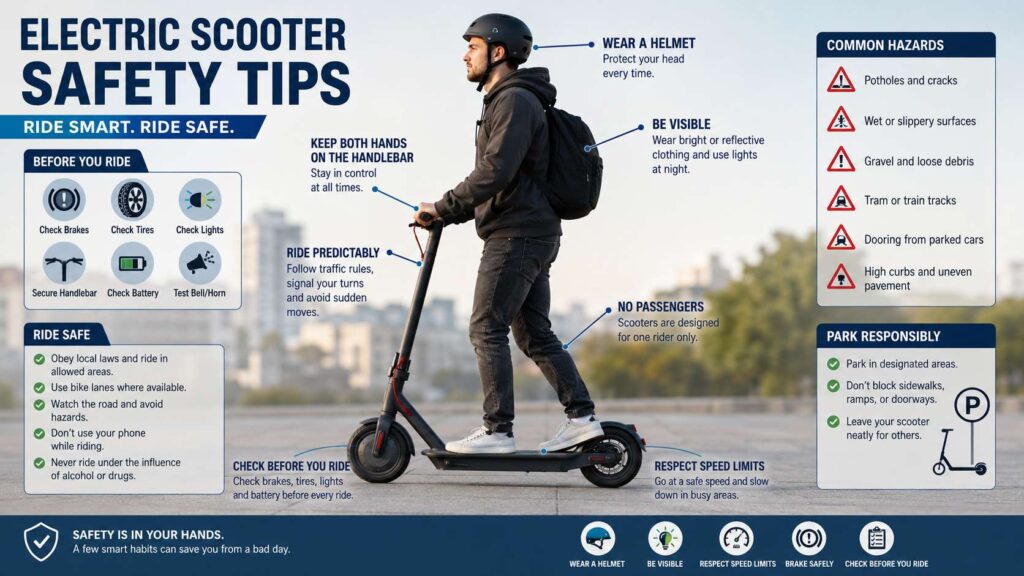
Before you start, check these parts:
- Brakes: Squeeze the levers and roll the scooter forward. The scooter should stop cleanly.
- Tires: Look for low pressure, cracks, cuts, or objects stuck in the tread.
- Handlebar stem: Make sure it locks firmly and does not wobble.
- Lights: Test the front light, rear light, and brake light.
- Bell or horn: Make sure people can hear you.
- Throttle: Press it gently in a safe spot and check for smooth response.
- Battery level: Check the charge before longer trips.
- Folding latch: Confirm that it clicks into place.
This check matters even more on shared scooters. Many people ride them each day, and not all riders treat them well. So, before you unlock one, look at the tires, deck, brakes, and handlebar stem. If something feels loose, bent, or cracked, pick another scooter.
Wear a Helmet Every Time
A helmet is the first piece of electric scooter safety gear you should buy. It protects your head during a fall, and head injuries can happen even at low speeds.
Choose a proper bicycle or scooter helmet that fits your head well. It should sit level, not tilted back. The straps should form a V shape around your ears. Also, the chin strap should feel snug without hurting.
For faster electric scooters, a stronger helmet makes sense. Many riders choose a full-face helmet for higher speeds, rough roads, or long commutes. It may feel like too much at first, but it can protect your face and jaw in a forward fall.
My honest view is simple. Riding without a helmet for a short trip is still a poor trade. The ride may last only five minutes, but one fall can affect you for weeks or months.
Use the Right Safety Gear
A helmet matters most, but other gear helps too. You do not need to dress like a racer for a casual ride. Still, bare hands, thin shoes, and dark clothing at night create extra risk.
Good scooter safety gear includes:
- Gloves to protect your palms
- Closed shoes with good grip
- Bright clothing for daytime rides
- Reflective strips for night riding
- Clear glasses or sunglasses for dust and bugs
- Knee and elbow pads for new riders
- A light jacket for cooler weather
Gloves are easy to ignore, but they help a lot. During a fall, most people put their hands out first. For that reason, scraped palms are one of the most common and annoying scooter injuries.
Learn Your Scooter Before Riding in Traffic
Every electric scooter feels different. Some models have sharp throttles. Others brake softly. Some turn quickly, and heavier scooters need more room to stop.
Before you ride near cars, practice in a quiet area. Start slowly, stop several times, and make a few gentle turns. After that, practice stronger braking so you know how the scooter reacts.
Pay attention to:
- Throttle response
- Brake strength
- Turning radius
- Stability over bumps
- Deck comfort
- Handlebar height
- Tire grip
- Speed mode behavior
Next, choose the right riding mode. Eco mode works well for busy areas. Standard mode suits most city rides. Sport mode should stay for open, legal, and low-risk roads.
Keep Both Hands on the Handlebars
One-hand riding looks easy until the front wheel hits a bump. Since scooter wheels are small, the handlebar can twist fast. Then balance disappears quickly.
Keep both hands on the bars. Do not carry coffee, shopping bags, phones, umbrellas, or takeaway food. Also, avoid hanging bags from the handlebar. A swinging bag can pull the steering sideways.
Use a backpack, a small chest bag, or a scooter bag mounted to the stem. That small change makes the scooter easier to control.
Ride Predictably
Drivers, cyclists, and pedestrians need to understand what you plan to do. So, ride in a steady line. Avoid sudden swerves, sharp lane changes, and surprise stops.
Use hand signals where they are safe. Many electric scooters do not have turn signals, so a clear hand signal can help. Still, keep both hands on the handlebar during braking, turning, and rough road sections.
A simple question helps here: can other people guess my next move? If the answer is yes, you are riding more safely.
Follow Local Electric Scooter Rules
Electric scooter laws change from one city to another. Some places allow scooters in bike lanes. Some ban them from sidewalks. Others set rules for helmets, speed limits, age limits, insurance, or registration.
Before you ride, check:
- Where scooters are allowed
- Local speed limits
- Helmet rules
- Age rules
- Night riding rules
- Parking rules
- Shared scooter rules
- Insurance or registration rules
This matters even more during travel. A scooter that is legal in one country may not be legal in another. For that reason, do not assume the same rules apply everywhere.
Avoid Sidewalk Riding
Sidewalk riding can put pedestrians at risk. It can put you at risk too. Children, dogs, shop doors, and sudden steps sideways are hard to predict.
Use bike lanes where local rules allow it. If no bike lane exists, follow road rules and ride with extra care. Slow down near crossings, schools, bus stops, parked cars, and crowded areas.
If you ride in a legal shared space, keep your speed close to walking pace. Use your bell early and politely. Nobody likes a scooter bell at the last second.
Watch the Road Surface
Small scooter tires do not handle bad roads well. A pothole that feels minor on a bike can stop a scooter wheel almost instantly.
Watch for:
- Potholes
- Wet leaves
- Gravel
- Sand
- Tram tracks
- Drain covers
- Road paint
- Speed bumps
- Broken pavement
- Curbs
- Ice or frost
Slow down before rough areas. Bend your knees a little and keep your weight centered. For bumps, reduce speed and lean back slightly. Try not to brake hard right on top of the bump.
Wet road paint and metal drain covers deserve extra care. They can feel very slippery after rain. Cross them straight and slow.
Take Care of Your Back and Posture
Many riders focus on helmets and brakes, but posture matters too. A stiff riding position can make bumps feel harsher, especially on scooters without suspension.
Keep your knees soft, not locked. Let your legs absorb small shocks. Stand with one foot slightly ahead of the other, and keep your shoulders relaxed. This position gives you more control and reduces the jolt from rough pavement.
If you already have back pain, scooter riding needs extra care. Rough roads, hard tires, and long rides can make discomfort worse. For a deeper look at this topic, read this guide on riding an electric scooter with a bad back.
From a practical point of view, comfort is part of safety. If your back hurts, your reaction time and balance can suffer.
Be Extra Careful at Intersections
Intersections are high-risk areas. Cars turn, pedestrians cross, bikes pass, and drivers may not notice a scooter.
At intersections:
- Slow down early
- Look left and right twice
- Avoid blind spots
- Watch turning vehicles
- Do not rush yellow lights
- Stay away from large vehicles
- Make eye contact where possible
- Assume drivers have not seen you
One common issue is the right-turn conflict. A car turns right across your path while you continue straight. To reduce that risk, slow down before the junction and avoid riding beside large vehicles.
Make Yourself Easy to See
Electric scooters are quiet and narrow. Drivers can miss them, especially at dusk, at night, or during rain.
Use front and rear lights whenever visibility drops. Reflective clothing helps from the side, where built-in scooter lights may not be enough. A bright helmet, reflective backpack, or reflective ankle bands can help too.
At night, do not rely only on small stock lights. Many built-in lights help others see you, but they may not light the road well. A stronger front light can help you spot potholes sooner.
Mount Your Phone Safely
Many riders use their phone for maps. That is normal, but holding the phone while riding is unsafe. A handlebar phone mount is a better choice, as long as it holds the phone firmly and does not block the display or controls.
Set your route before you move. Use voice directions when possible. Then stop fully before changing music, reading messages, or answering calls.
If you need a practical accessory for navigation, this LISEN Bike Phone Holder review covers a simple option that can work well for riders who use maps often.
Still, a mount does not make phone use risk-free. Glance quickly, then return your eyes to the road.
Do Not Ride Under the Influence
Alcohol, drugs, and electric scooters do not mix. Balance drops. Reaction time slows. Judgment gets worse. So, braking late, turning wide, and missing hazards become more likely.
The same rule applies to strong medication that affects focus or alertness. If you feel dizzy, tired, or distracted, skip the ride.
This is one of the clearest electric scooter safety tips: if you would not drive, do not ride.
Ride Alone
Most electric scooters are built for one rider. Carrying a passenger changes balance, steering, and braking distance. It can also overload the motor, tires, frame, and folding system.
Do not carry children, friends, pets, or heavy loads on the deck. It may look harmless for a short trip, but it adds risk fast.
A scooter works best when the rider can stand naturally, shift weight, and brake without fighting for space.
Respect Speed
Speed feels smooth until something goes wrong. At higher speeds, you need more room to stop. You also have less time to react.
Slow down near:
- Pedestrians
- Parked cars
- Schools
- Crosswalks
- Bus stops
- Narrow paths
- Wet roads
- Rough pavement
- Blind corners
A scooter with a high top speed does not need to run fast all the time. In city riding, control matters more than speed.
Brake the Right Way
Good braking keeps the scooter stable. Poor braking can throw your weight forward or make the scooter skid.
Use both brakes if your scooter has front and rear brakes. Apply pressure smoothly. Shift your weight slightly back. Bend your knees and keep your arms relaxed.
Avoid grabbing the front brake too hard. That can lift the rear wheel or make the scooter unstable. Practice emergency braking in a quiet place so your body knows what to do before a real problem appears.
Ride Carefully in Rain and Cold Weather
Rain changes the whole ride. Braking distance grows, grip drops, and visibility gets worse. Painted lines, leaves, and metal covers can become very slippery.
During wet rides:
- Slow down
- Brake earlier
- Avoid sharp turns
- Stay away from puddles
- Keep both hands on the bars
- Use lights
- Wear brighter clothing
Cold weather adds another issue. Batteries lose range in low temperatures, and tires may feel harder. Ice can form in shaded spots even when the main road looks dry.
If the road looks icy, do not ride. Walking or using public transport is safer.
Charge Your Electric Scooter Safely
Battery safety is part of scooter safety. Use the charger that came with your scooter, or use one approved by the manufacturer. A random charger that fits the port can still be unsafe.
Safer charging habits include:
- Charge on a hard, clear surface
- Keep the charger away from beds, sofas, curtains, and paper
- Unplug the scooter after charging
- Avoid overnight charging
- Do not charge when nobody is home
- Stop using a battery that smells odd, leaks, swells, or overheats
- Replace damaged battery packs with approved parts
Cheap replacement batteries can create serious problems. Buy parts from trusted sellers and match the scooter model exactly.
Park Without Blocking Others
Bad parking creates problems for everyone. It can block people with strollers, wheelchairs, canes, or limited vision. It can also block doors, ramps, and bike lanes.
Park in approved areas. Keep sidewalks clear. Do not block crosswalks, bus stops, building entrances, or emergency paths. Fold the scooter indoors if that helps save space.
Shared scooters need extra care. End the ride only after parking properly and checking the app rules.
Maintain Your Scooter
A safe scooter needs basic care. You do not need to be a mechanic, but you should watch for wear.
Check these parts often:
- Brake pads
- Tire pressure
- Tire tread
- Loose bolts
- Stem play
- Folding latch wear
- Battery health
- Brake cables
- Lights
- Fender cracks
New sounds are warning signs. Clicking, scraping, grinding, or wobbling usually means something needs attention. Fix small problems early, and you reduce the chance of a bigger failure later.
Best Electric Scooter Safety Tips for Beginners
New riders should keep things simple. Start slow, ride during daylight, and avoid busy roads until the scooter feels natural.
Beginner tips:
- Start in Eco mode
- Wear a helmet from the first ride
- Practice braking before riding near cars
- Avoid rain for the first few rides
- Keep early trips short
- Stay away from heavy traffic
- Do not ride with one hand
- Keep bags off the handlebar
- Learn local rules before riding
Confidence grows fast, but skill takes more time. Give yourself that time. You will ride better after a few calm practice sessions.
Final Thoughts
Electric scooter safety is not about fear. It is about control. A helmet, a quick scooter check, steady riding, and good visibility can make every trip safer.
So, ride like nobody has seen you yet. Slow down before trouble spots. Keep both hands on the bars. Respect pedestrians. Watch the road surface. Charge the battery with care.
After a while, these habits feel normal. Then your scooter becomes what it should be: a practical, fun, and useful way to move around town.