

Cold weather can make an electric scooter feel strangely weak. One day it pulls away from a stop with no problem. Then, after a cold night, it feels slower, heavier, and less responsive.
The motor still works. The throttle still responds. The display still shows battery left. Yet the ride feels different.
Most of the time, the scooter is not broken. The real issue starts with the battery. Electric scooters use lithium-ion batteries, and these batteries lose part of their normal performance in cold conditions. So, acceleration feels softer, hills feel harder, and range drops faster than expected.
For many riders, this is one of the most annoying parts of winter scooter riding. You charge the scooter, leave the house, then notice it does not feel like the same machine you rode in summer. That drop feels frustrating, but it makes sense once you understand what cold air does to the battery, tires, and road surface.
Why electric scooters feel slower in cold weather
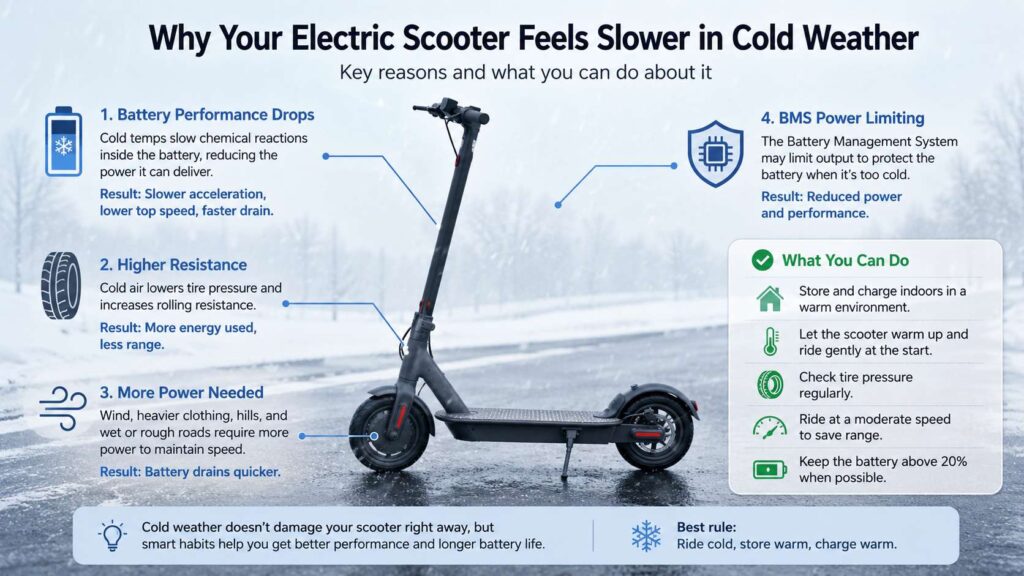
Your scooter feels slower in cold weather mainly due to the battery. Lithium-ion batteries rely on chemical reactions to release energy. Cold temperatures slow those reactions down. So, the battery has a harder time sending strong power to the motor.
That weaker power delivery shows up fast during real rides. You notice it most during:
- Starts from traffic lights
- Short uphill climbs
- Riding into wind
- Fast acceleration
- Sport mode riding
- Trips with a heavier backpack
- Longer winter commutes
The scooter may still reach a decent speed on flat ground. Still, it often takes longer to get there. The ride feels less sharp, and the motor feels like it has less punch.
This is why a scooter that feels normal in warm weather can feel tired on a cold morning.
The battery is not always damaged
A slower ride in winter does not always mean the battery is failing. In many cases, the battery only has less usable power during that cold ride.
After the scooter warms back up indoors, performance often improves. The battery did not repair itself. It simply returned to a better temperature range.
For example, a scooter parked indoors at room temperature will usually feel stronger than the same scooter parked overnight in a freezing garage. The difference can be obvious during the first few miles.
That said, poor winter habits can shorten battery life. Charging a very cold battery, storing the scooter in freezing conditions for long periods, or riding hard on a weak battery can add stress. So, cold-weather care still matters.
Why scooter range drops so much in winter
Speed is not the only thing that suffers. Range usually drops even more.
A scooter that gives strong real-world range in mild weather can lose a noticeable amount of distance in winter. The exact drop depends on the scooter, battery size, rider weight, tire pressure, hills, wind, and road surface.
Several things happen at the same time:
- The battery gives less usable energy.
- The scooter needs more power to hold speed.
- Tire pressure drops in cold air.
- Wet pavement adds rolling resistance.
- Cold wind increases drag.
- Heavy clothes and bags add load.
- Hills drain the battery faster.
So, the scooter is not fighting one problem. It is fighting a full winter setup.
This is why advertised range can feel even less realistic in cold weather. Lab range tests rarely match daily riding with cold air, stop-and-go traffic, hills, wind, and rider weight. For a deeper look at that gap, this guide on why electric scooter range claims sound better than real-world results explains why official numbers often look better than normal commuting results.
Cold weather causes voltage sag
Voltage sag sounds technical, but the idea is simple. The battery voltage drops under load. You feel it during hard acceleration, hill climbs, or riding against strong wind.
In warm weather, the battery recovers faster after each power demand. In cold weather, recovery takes longer. So, the scooter can feel weak even with 50% or 60% battery left.
That is why the battery percentage can look fine, yet the scooter still feels slow. The screen shows charge level, not how well the battery performs under pressure.
This is one reason winter riding feels unpredictable. The scooter may ride fine on flat roads, then slow down hard on a hill. The battery is not empty. It just cannot deliver power as strongly in the cold.
The battery system can reduce power
Most modern electric scooters have a battery management system. Riders often call it the BMS. This system watches voltage, current, temperature, and charging behavior.
In cold weather, the BMS can limit power to protect the battery. That protection is useful, but it can make the scooter feel weaker. Some scooters show a warning message or error icon. Others simply reduce performance with no clear alert.
The scooter is not trying to annoy you. It is protecting the battery pack from stress.
Still, check your manual. Each scooter has its own operating temperature range. Some models handle cold better than others. Budget scooters with small batteries often feel the drop faster than larger commuter scooters.
Tire pressure drops and slows the scooter down
Battery performance gets most of the blame, but tires matter too.
Cold air lowers tire pressure. A pneumatic tire that felt fine last week may feel soft after a cold night. Low pressure creates more rolling resistance, which makes the scooter slower and drains the battery faster.
Low pressure can also make steering feel heavy. On some scooters, it increases the risk of pinch flats. That is especially true on rough roads, potholes, and curb drops.
Check tire pressure more often during winter. Use a proper pressure gauge, not just a quick squeeze with your hand. Scooter tires are small, so even a small pressure change can affect the ride.
Wet roads make the scooter feel weaker
Winter roads are rarely perfect. Cold months bring wet pavement, road grit, leaves, mud, salt, and rougher surfaces. These conditions slow the scooter down and reduce grip.
Wet roads create more rolling resistance. They can also make riders use the throttle more gently. That softer riding style is smart, but it adds to the feeling that the scooter has lost power.
Painted lines, metal drain covers, tram tracks, and smooth paving stones can get slippery fast. So, the scooter may feel nervous under acceleration. Rear-wheel-drive scooters can spin more easily. Front-wheel-drive scooters can feel twitchy on slick surfaces.
The real issue is not only speed. It is control. A slightly slower ride is often safer on cold, damp streets.
Hills feel harder in cold weather
Hill climbing needs strong battery output. Cold batteries struggle with that.
This is why your scooter may feel fine on flat roads, then suddenly feel weak on a climb. Smaller motors suffer more. Heavier riders notice the drop sooner. A backpack, groceries, or winter clothing adds more load too.
A scooter that already slows down on hills in summer will feel worse in winter. That does not mean the scooter is useless. It means you need to plan the ride differently.
Build speed before the hill if the road is safe. Avoid stopping halfway up steep climbs. Use a steady throttle instead of hard bursts. These small habits reduce battery stress and make the ride smoother.
Charging a cold scooter is a bad habit
Charging habits matter a lot in winter.
Do not charge the scooter right after it has been sitting in freezing air. Bring it indoors first and let it warm up slowly. A room-temperature battery charges better and faces less stress.
Do not place the scooter beside a heater or radiator. Fast heat is not a smart fix. Let the battery return to normal indoor temperature on its own.
A simple winter rule works well: ride cold if the scooter allows it, store warm, charge warm.
This habit protects the battery and helps the scooter feel better on the next ride.
Store the scooter indoors if possible
A scooter stored indoors starts the ride with a warmer battery. That gives you better early performance and better range.
If the scooter sits overnight in a cold garage, balcony, shed, or car trunk, the battery starts the day already chilled. Then it has to power the motor from a weak starting point.
Indoor storage is one of the easiest winter upgrades. It costs nothing, but the difference can feel clear.
If your scooter has a removable battery, bring the battery indoors. Store it in a dry place, away from direct heat and water. Keep it away from clutter too, especially flammable items.
Start gently for the first few minutes
A cold battery does not like sudden hard acceleration. Start the ride gently. Use normal mode first, then switch to sport mode after a few minutes if the road is safe.
This gives the battery and tires time to settle into the ride. It also reduces wheel slip on damp surfaces.
At first, the scooter may still feel lazy. After a few minutes, it can feel a little better. Do not expect summer performance, but a softer start can make winter rides smoother.
Ride slower to save range
Speed drains electric scooter batteries quickly. Cold weather makes that drain worse.
If you ride at full speed during winter, range will fall fast. Drop your speed a little, and the battery usually lasts longer. The ride may take a few extra minutes, but you gain more control and better range.
For commuters, this matters. A small speed reduction can be the difference between arriving with battery left and limping home in low-power mode.
A slower ride can also help with safety. Cold tires, wet roads, and lower grip leave less room for mistakes.
Check local rules before winter commuting
Cold-weather riding is not only about the scooter. Local rules matter too, especially in places where e-scooter laws change often.
Helmet rules, speed limits, age limits, road access, and device rules can affect how and where you ride. Riders in Australia, for example, should pay attention to the Queensland e-bike and e-scooter laws from July 1, since rule changes can affect daily travel habits.
Winter already adds enough risk. Clear knowledge of local rules helps you avoid fines, unsafe roads, and bad riding choices.
Real opinion: winter scooter riding is useful, but not always fun
Here is the honest part. Winter scooter riding can be practical, but it is rarely as enjoyable as summer riding.
The scooter feels slower. Range feels less reliable. Wet roads make you more cautious. Cold wind hits harder than expected. You may start checking the battery more often than the road ahead, which is never ideal.
For short trips, winter riding still works well. A quick commute, a ride to the shop, or a short city route can make sense. For long rides, steep hills, icy roads, or heavy traffic, the scooter can become more stressful than useful.
A larger battery and stronger motor help. Still, no scooter fully escapes cold-weather battery loss.
Signs the cold is normal
The slowdown is probably normal if:
- The scooter feels better again indoors or in warmer weather.
- Range only drops on cold days.
- Charging works normally at room temperature.
- No warning code stays on the display.
- The battery case looks normal.
- The scooter makes no strange noise.
- Brakes and wheels move freely.
In this case, change your riding habits first. Store the scooter warm, check tire pressure, and plan shorter winter rides.
Signs your scooter needs service
Cold weather can reveal real faults. Pay attention to warning signs.
Stop riding and get the scooter checked if you notice:
- Sudden power loss under load
- Battery dropping from high charge to low charge very fast
- Charging failure at room temperature
- A swollen or cracked battery case
- Burning smell
- Smoke
- Unusual heat from the deck or battery area
- Error codes that stay after warming the scooter
- Weak performance in mild weather too
Battery problems deserve care. Use the original charger, avoid damaged cables, and contact the manufacturer or a qualified repair shop.
How to make your scooter feel better in cold weather
You cannot remove the effect of cold air, but you can reduce it.
Try these simple fixes:
- Store the scooter indoors before riding.
- Let a cold battery warm up before charging.
- Check tire pressure every few days in winter.
- Start the ride gently.
- Use normal mode at the start.
- Avoid full-throttle launches on cold mornings.
- Plan for shorter range.
- Keep more battery reserve than usual.
- Ride a bit slower on wet roads.
- Clean salt, grit, and dirt after wet rides.
- Check that brakes are not rubbing.
- Avoid ice, deep slush, and snow.
These habits will not turn a small commuter scooter into a high-power model. Still, they make winter rides safer, smoother, and more predictable.
Final verdict: cold weather makes scooters slower, but smart habits help
Your electric scooter feels slower in cold weather since the battery cannot deliver power as easily. Range drops, acceleration feels softer, and hills become harder. Low tire pressure, wet roads, wind, and extra rider load make the problem worse.
The good news is that winter slowdown is often normal. Store the scooter warm, charge it warm, check tire pressure, and ride gently at the start. Plan for less range than usual and keep extra battery margin for the trip home.
Cold weather does not mean you have to stop riding. It means you need to ride with more care. Treat the battery well, respect the road surface, and expect a softer ride until warm weather returns.