

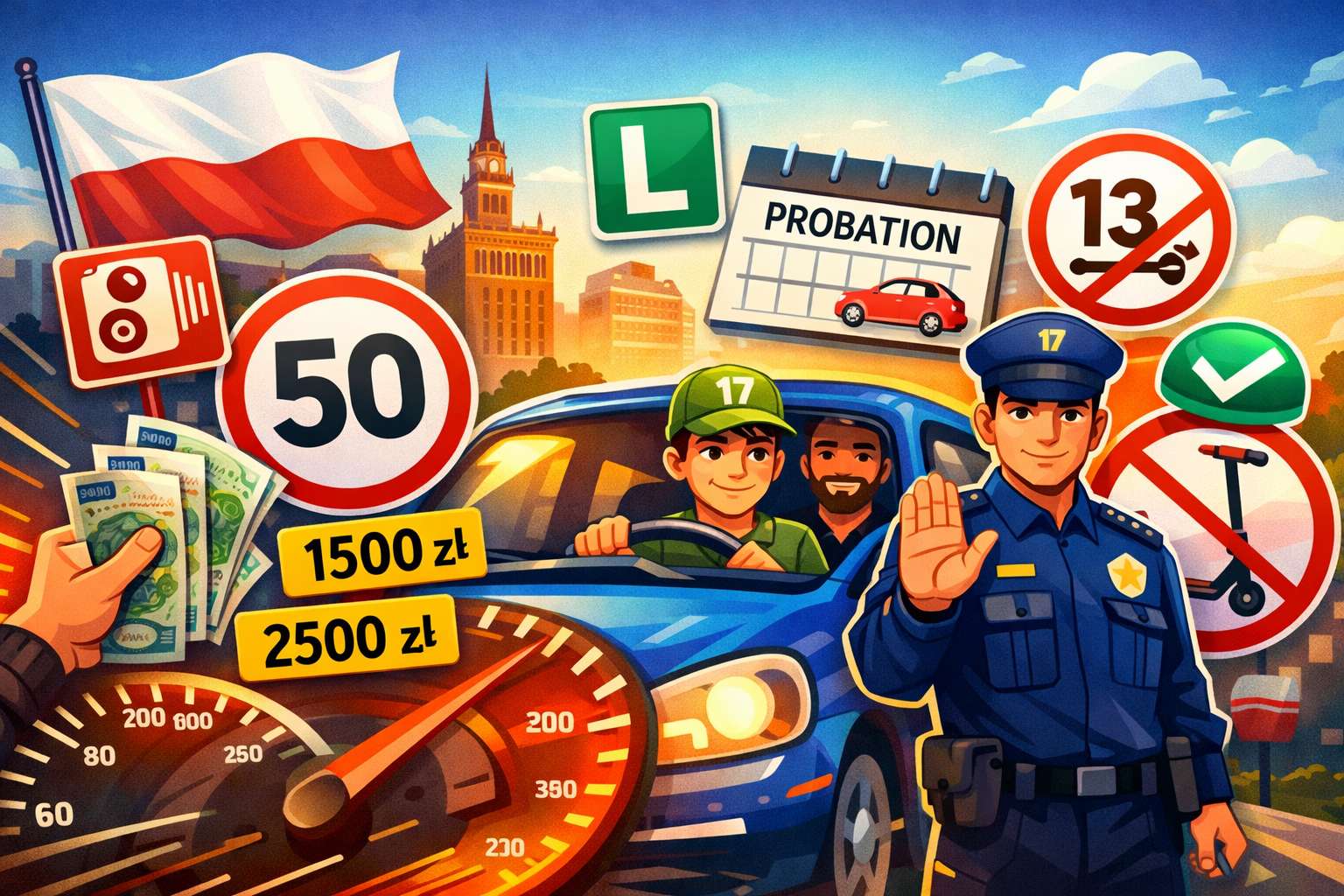
Poland has changed its road rules in 2026, and the update is much broader than many drivers first thought. The new law does not touch just one part of daily travel. It affects speeding, young drivers, illegal street activity, and electric scooter use. That means car drivers, parents, teenagers, and scooter riders all need to pay attention.
The rollout came in stages. The first set of rules started on January 29, 2026. Another group started on March 3, 2026. More changes will come on June 3 and September 3. So this is not one single legal switch. It is a full package that keeps expanding through the year.
The message is simple. Poland wants safer roads, and it wants stronger penalties for people who take clear risks. At the same time, it is giving 17 year olds a path to a category B licence under strict rules. That part will catch a lot of attention, but it does not mean teens now have full driving freedom.
The New Rules Started in Waves
The first wave began on January 29. That part focused on the most dangerous behavior on the road. Poland raised penalties linked to illegal street races, drifting, and other actions that put people at risk. The law took a much harder line on behavior that turns public roads into stunt zones.
Then came March 3. That date matters a lot for everyday drivers. From that point, police gained the power to take a driver’s licence for three months for driving more than 50 km/h over the limit on certain roads outside built up areas too. Before this change, many people linked that kind of licence loss mainly with urban areas. That is no longer the full picture.
March 3 matters for scooter riders too. Children under 13 can no longer use an electric scooter or another personal transport device on a public road, apart from one narrow case. They may ride only in a residential zone and only with adult supervision.
The next step arrives on June 3. From that date, riders under 16 must wear a helmet on a bicycle, electric scooter, or personal transport device. Then September 3 brings the probation system for first time category B drivers.
Speeding in Poland Can Cost Much More in 2026
Many people search for Poland speeding fines 2026, and for good reason. The fines are already heavy, and the wider licence suspension rule makes them sting even more. A driver who exceeds the speed limit by 51 to 60 km/h faces a fine of 1,500 zł. The next bracket, 61 to 70 km/h over the limit, brings 2,000 zł. Anything above 70 km/h over the limit brings 2,500 zł.
Repeat offences can cost even more. In some cases, the fine can rise to 5,000 zł. Penalty points rise too, and the highest speed bracket can bring 15 points. That is a serious hit for any driver.
The bigger story in 2026 is not only the money. It is the wider reach of the licence suspension rule. From March 3, a driver can lose a licence for three months for going more than 50 km/h over the limit on a two way single carriageway road outside a built up area. A lot of drivers used to treat those roads as less risky from a legal point of view. That old mindset can now get expensive very fast.
The law now hits stunt style driving harder too. Drifting can bring a fine of at least 1,500 zł. If that drifting creates danger in traffic, the minimum rises to 2,500 zł. Unreported motor gatherings with at least 10 vehicles can trigger fines from 2,000 zł. So the new rules do not target only classic speeding. They target the wider culture around reckless driving.
Yes, You Can Drive at 17 in Poland Now, But There Is a Catch
This is the change that will pull in a lot of clicks, and it is easy to see why. Poland now allows some 17 year olds to get a category B driving licence. A driving course can start at age 16 years and 9 months. A person under 18 still needs written consent from a parent or legal guardian.
That sounds like a big step, and it is, but the law puts tight limits around it. A category B licence gained before age 18 is valid only in Poland until the driver turns 18. So this is not the same as a full adult licence with broad freedom across borders.
The law adds another key rule. For the first six months after getting the licence, and no later than the 18th birthday, the young driver must travel with a supervising passenger in the front seat. That person must be at least 25 years old. That person must have held a category B licence for at least five straight years. That person must not be under a driving ban now, and must not have had one in the last five years. That person must be sober.
So yes, 17 year olds can drive in Poland now, but only inside a controlled framework. Parents who read only the headline may miss that part, and it matters a lot in real life.
New Drivers Will Face a Probation Period
Another major change starts on September 3, 2026. First time category B drivers will enter a probation period. That period lasts two years for drivers who got a licence at age 18 or older. For drivers who got the special under 18 category B licence, the period lasts three years, though it ends once the driver turns 20.
That rule adds a long learning phase after the driving test. It pushes new drivers into a stricter legal zone for a longer time. One of the sharpest rules in that phase is the zero alcohol requirement. For novice drivers, that is a clear line with no gray area.
This part of the reform may not get as many headlines as driving at 17, but it may shape daily behavior more than anything else in the package.
Poland’s E-Scooter Law Is Getting Much Tougher
Electric scooters have moved from a light regulation topic to a much stricter one. From March 3, 2026, the minimum age for riding an electric scooter on a public road rose from 10 to 13. That is a direct legal change, and many families may not know it yet.
A child under 13 may ride only in a residential zone, and only under adult supervision. That is a very narrow exception. Outside that case, riding on a public road is not allowed.
Young riders from 13 to 18 still need valid entitlement. That can be a bicycle card or a category AM, A1, B1, or T licence. Riders aged 18 and older do not need a separate scooter specific entitlement.
The riding rules remain strict too. A scooter rider must use a cycle path first. A road is allowed only where the speed limit is up to 30 km/h and no cycle path is available. The sidewalk is the last option, and it comes with tight limits. The rider must adjust speed to pedestrians and give way to them.
The maximum speed for an electric scooter stays at 20 km/h. Carrying a passenger is not allowed. Using a phone during riding is not allowed. Riding through a pedestrian crossing is not allowed either.
Then June 3 adds the helmet rule for riders under 16. That one may end up being the most visible change of all. Parents will feel it right away, and police will have a very clear rule to enforce.
If you want a useful example of how other places are tightening rules for riders, this guide on Cayman e-bike and scooter enforcement starting on 1 March 2026 gives a good look at what careful riders should check before stricter enforcement starts.
Why Poland Is Pushing Harder on Road Safety
The 2026 reforms did not appear out of nowhere. Poland has been working to reduce road deaths and serious injuries, and the government is trying to keep that trend going. The new package shows a clear pattern. It focuses on extreme speed, repeat offences, illegal races, stunt driving, novice driver risk, and unsafe scooter use.
That gives the whole reform a strong shape. It is not just about raising money through fines. It is about changing behavior on the road, and doing it with sharper penalties and clearer rules.
What Drivers and Riders Should Do Now
Drivers in Poland need to watch speed more carefully, especially outside built up areas on two way single carriageway roads. That road type now carries more legal risk than many people expect. A short burst of speed can turn into a lost licence.
Parents of young drivers need to understand the supervising passenger rule before handing over the keys. Parents of scooter riders should check age, documents, and helmet use now, not after a police stop.
The broad lesson is clear. Poland’s road rules in 2026 are stricter, more detailed, and less forgiving. Old habits that once brought a warning or a smaller fine can now bring much heavier consequences. For drivers and scooter riders alike, the safest move is simple. Learn the dates, learn the limits, and do not assume last year’s rules still apply.